IIf you have ever stared at a drinks menu and wondered about whisky vs whiskey, you are not alone. 🥃
The two spellings look almost the same, sound similar, and refer to the same broad type of distilled spirit.
Yet the spelling can tell you something important about where the drink comes from and how its maker chooses to label it.
The question of whisky vs whiskey is less about one spelling being “right” and the other being “wrong.” In most cases, both are correct.
The key is knowing which spelling fits the country, brand, or style you are talking about.
I teach writers to treat this as a usage choice rather than a simple spelling test.
Once you learn the basic pattern, the difference becomes much easier to remember.
This guide explains the rule, shows common examples, covers exceptions, and gives you quick ways to check your writing. 🍂 Desperate vs Desparate | Seamless vs Seemless | Shiny vs Shiney
🎯 Quick Answer: Whisky vs Whiskey
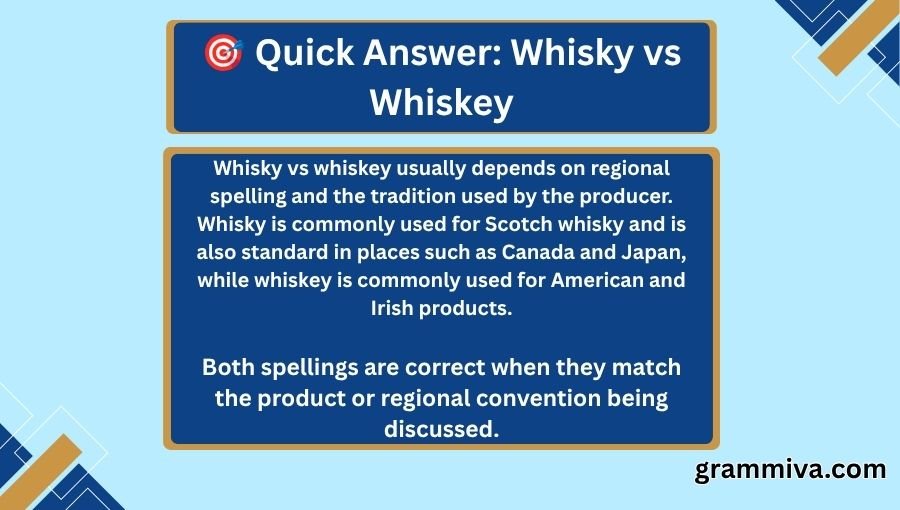
Whisky vs whiskey usually depends on regional spelling and the tradition used by the producer. Whisky is commonly used for Scotch whisky and is also standard in places such as Canada and Japan, while whiskey is commonly used for American and Irish products.
Both spellings are correct when they match the product or regional convention being discussed.
Related Word Forms and Close Variants
The two main forms have several related forms. Writers should also know that the plural and adjective forms generally keep the spelling used by the base word.
| Form | Type | Example |
|---|---|---|
| whisky | Singular noun | This whisky has a smoky flavor. |
| whiskies | Plural noun | The shop sells several Scottish whiskies. |
| whiskey | Singular noun | This whiskey is made in Kentucky. |
| whiskeys | Plural noun | The bar offers several American whiskeys. |
| whisky’s | Possessive form | The whisky’s flavor is bold. |
| whiskey’s | Possessive form | The whiskey’s label is easy to read. |
The plural forms are worth noticing. When whisky becomes plural, the usual form is whiskies. When whiskey becomes plural, whiskeys is common.
For example, you might write, “The store stocks several whiskies from Scotland.” You might also write, “The store stocks several American whiskeys.”
🥃 Whisky vs Whiskey: Understanding the Basics
The main difference between whisky vs whiskey is spelling convention. The choice often points to the place or tradition associated with the spirit.
| Form | Type | Meaning | Example | Correct/Incorrect |
|---|---|---|---|---|
| whisky | Noun | A distilled spirit using the spelling common in Scotland and several other regions | I bought a bottle of Scotch whisky. | ✅ Correct |
| whiskey | Noun | A distilled spirit using the spelling common in Ireland and the United States | He ordered an Irish whiskey. | ✅ Correct |
| Scotch whiskey | Noun phrase | A spelling that normally conflicts with standard Scotch usage | She bought Scotch whiskey. | ❌ Usually incorrect |
| Irish whisky | Noun phrase | A spelling that normally conflicts with standard Irish usage | He poured Irish whisky. | ❌ Usually incorrect |
| American whiskey | Noun phrase | Standard spelling for most American whiskey | We toured an American whiskey distillery. | ✅ Correct |
| Japanese whisky | Noun phrase | Common spelling used for Japanese products | Japanese whisky has gained global attention. | ✅ Correct |
The important point is that this is not normally a grammar rule like “affect vs effect.” It is mainly a spelling and usage convention.
If you are writing about a particular bottle, distillery, or brand, the safest approach is to follow the spelling used by the producer.
Is Whisky the Same as Whiskey?
Yes, whisky and whiskey are broad names for the same type of distilled spirit, but the spelling often reflects regional tradition or the producer’s chosen style.
That means the difference is usually not about two completely different kinds of drinks. Instead, it is often about where the spirit is made and how it is labeled.
For a general sentence, either spelling may be appropriate depending on your subject.
- “The article compares Scotch whisky and American whiskey.” ✅
- “The article compares Scotch whiskey and American whisky.” ❌ Usually not the standard regional spelling.
The first sentence follows common usage. The second reverses the usual conventions.
What Is the Difference Between Whisky and Whiskey?
The clearest difference is the spelling convention associated with the product’s country or tradition.
A useful pattern is:
- Scotland → whisky
- Ireland → whiskey
- United States → whiskey
- Canada → whisky
- Japan → whisky
This is a helpful guide, not a rule that overrides every brand or label.
| Region or tradition | Common spelling | Example |
|---|---|---|
| Scotland | whisky | Scotch whisky |
| Ireland | whiskey | Irish whiskey |
| United States | whiskey | Tennessee whiskey |
| Canada | whisky | Canadian whisky |
| Japan | whisky | Japanese whisky |
The pattern becomes especially useful when you are writing an article, menu, product description, school assignment, or travel guide.
Scotch Whisky
Scotch whisky is the standard phrase for whisky made in Scotland under the relevant rules for Scotch.
So this is the normal form:
She enjoys Scotch whisky. ✅
Not:
She enjoys Scotch whiskey. ❌
The same spelling appears in phrases such as single malt Scotch whisky and blended Scotch whisky.
American Whiskey
In the United States, whiskey is the standard spelling for many well-known styles.
Examples include:
- bourbon whiskey
- Tennessee whiskey
- American whiskey
- rye whiskey
So:
Kentucky whiskey is popular around the world. ✅
The spelling with the extra e is expected in these American contexts.
Irish Whiskey
Ireland also commonly uses whiskey.
For example:
Irish whiskey is known for its smooth character. ✅
If you are writing specifically about Ireland, whiskey is generally the safer choice.
Canadian and Japanese Whisky
Canada and Japan commonly use whisky without the extra e.
For example:
Canadian whisky has a long history. ✅
And:
Japanese whisky is popular with collectors. ✅
This gives you a simple memory trick: Scotland, Canada, and Japan generally use “whisky”; Ireland and the United States generally use “whiskey.”
💡 Test Tip: How Can You Choose the Right Spelling?
My simplest test is to ask one question:
“Where is this product or tradition from?”
If the answer is Scotland, Canada, or Japan, whisky will often be the correct choice.
If the answer is Ireland or the United States, whiskey will often be correct.
There is an even safer test for brand-specific writing: look at the producer’s own spelling and copy it consistently.
This matters because a brand name is not something an editor should casually “correct.”
| Question | Likely answer | Spelling |
|---|---|---|
| Is it Scotch? | Scotland | whisky |
| Is it Irish? | Ireland | whiskey |
| Is it bourbon? | United States | whiskey |
| Is it Canadian? | Canada | whisky |
| Is it Japanese? | Japan | whisky |
A quick memory phrase is:
“Ireland and America have the E.”
It is not a perfect rule for every bottle in every market, but it is a useful starting point.
📝 Case Study: A Restaurant Menu
I once edited a restaurant menu that listed several Scotch selections. The menu used “whiskey” for every item because the writer thought the spelling with the e was the standard American spelling.
The problem was that the menu was describing Scotch products.
I changed the relevant descriptions to whisky and kept whiskey for the American selections. The result was more accurate and much easier for knowledgeable customers to trust.
This is a good lesson for professional writers: context matters more than memorizing one spelling.
Imagine a menu that says:
Scotch whiskey — $18 ❌
A better version is:
Scotch whisky — $18 ✅
But if the menu says:
Kentucky whiskey — $18 ✅
The spelling with the e is appropriate.
Grammar Rules Explanation
The grammar rule is simple: whisky and whiskey are both nouns, and the spelling should match the regional or product convention you are describing.
This is primarily a matter of spelling and usage rather than a difference in grammatical category.
A sentence such as “I ordered Scotch whisky” is grammatically correct because whisky functions as a noun.
A sentence such as “I ordered Irish whiskey” is also grammatically correct because whiskey functions as a noun.
What makes “Scotch whiskey” unusual is not the sentence grammar. The issue is that the spelling does not match the usual convention for Scotch.
Most major English dictionaries recognize both spellings as established English forms. The practical writing rule is to match the spelling to the subject.
Correct vs Incorrect at a Glance
| Sentence | Correct/Incorrect | Why |
|---|---|---|
| I ordered Scotch whisky. | ✅ Correct | “Whisky” matches standard Scotch usage. |
| I ordered Irish whiskey. | ✅ Correct | “Whiskey” matches standard Irish usage. |
| Kentucky whiskey is widely known. | ✅ Correct | American usage commonly uses “whiskey.” |
| Japanese whiskey is the standard spelling. | ❌ Usually incorrect | Japanese products commonly use “whisky.” |
| The bar sells Canadian whisky. | ✅ Correct | Canadian usage commonly uses “whisky.” |
Notice that the sentences themselves are not grammatically broken when the “wrong” spelling appears. The problem is word choice and regional spelling.
Why Do People Confuse Whisky and Whiskey?
People confuse the two forms because the words have the same basic meaning and differ by only one letter. The spelling is also easy to mix up when writers move between American and international English.
Three common causes are:
- Fast typing — Writers often type the spelling they see most often.
- Autocorrect — Software may suggest the more familiar form.
- Lack of knowledge — Many people simply never learn the regional distinction.
I once caught myself typing “Scotch whiskey” in a draft after spending several pages writing about American whiskey. I had switched contexts without noticing. A quick read of the heading fixed the problem.
That experience shows why even careful writers can make this mistake.
| Confusion | Correct forms | Why people mix them up |
|---|---|---|
| it’s / its | it’s, its | Both sound alike. |
| your / you’re | your, you’re | Fast typing often causes errors. |
| there / their / they’re | three different forms | The words sound similar. |
| affect / effect | affect, effect | Their meanings overlap in some contexts. |
| whisky / whiskey | whisky, whiskey | Regional spelling differs. |
The lesson is simple: do not rely only on what “looks right.” Check the context.
⚠️ Common Mistakes With Whisky and Whiskey
The most common mistake is assuming that whiskey is always the American spelling and whisky is always the British spelling.
That shortcut is too broad.
Scotland is part of the United Kingdom, but the word used for Scotch is whisky. Meanwhile, Ireland, which is geographically close to Scotland, commonly uses whiskey.
Another mistake is switching spellings halfway through the same article.
For example:
This guide explores Scotch whisky. Scotch whiskey is often served with water. Japanese whisky is also discussed.
The second sentence creates inconsistency if it is still referring to Scotch.
A better version is:
This guide explores Scotch whisky. Scotch whisky is often served with water. Japanese whisky is also discussed.
Common Wrong Spellings and Uses
| Wrong Form | What’s Wrong | Correct Form |
|---|---|---|
| Scotch whiskey | Does not follow the usual Scotch spelling | Scotch whisky |
| Irish whisky | Does not follow the usual Irish spelling | Irish whiskey |
| American whisky | Usually not the standard American spelling | American whiskey |
| Japanese whiskey | Usually not the standard spelling for Japanese whisky | Japanese whisky |
| whiskeys in Scotland | Regional spelling is inconsistent with standard Scotch usage | whiskies in Scotland |
| whisky’s for sale | Apostrophe is incorrectly used to form a plural | whiskies for sale |
The last example is a grammar issue rather than a regional issue.
Remember:
- whiskies = plural
- whisky’s = possessive
- whiskeys = plural
- whiskey’s = possessive
For example:
The shop sells three whiskies. ✅
But:
The whisky’s label is damaged. ✅
The apostrophe in the second sentence shows possession.
🕰️ Word Origin and History
The two spellings developed through different English-language traditions. The modern forms are closely related and refer to the same broad family of distilled spirits, but spelling practices became established differently in different places.
A detailed history is not necessary to remember the modern rule. For everyday writing, regional usage is far more useful.
| Period | Form | Note |
|---|---|---|
| Earlier English usage | Related forms of the word | The spelling was not always fixed. |
| Later regional usage | Whisky / whiskey | Different spelling traditions became established. |
| Modern Scotland | whisky | Standard term for Scotch. |
| Modern Ireland | whiskey | Standard term in Irish usage. |
| Modern United States | whiskey | Standard spelling for most American styles. |
The key point is that today’s spelling is strongly tied to regional tradition.
You do not need to know the entire history to write the words correctly.
How Whisky vs Whiskey Works in Different Contexts
The best spelling can change depending on what you are writing about. The context should guide your choice.
| Context | Which Term to Use | Example |
|---|---|---|
| Everyday conversation | Match the product or region | I like Scotch whisky. |
| Professional writing | Follow regional and brand conventions | The company produces Canadian whisky. |
| Creative writing | Match the setting and subject | He poured a glass of Irish whiskey. |
| Social media/texting | Either may appear, but accuracy is still best | Japanese whisky is excellent. |
Everyday Conversation
In casual speech, people may use the two spellings loosely, especially when they are not talking about a specific country.
Even so, using the expected spelling shows that you understand the subject.
If someone says, “I bought a bottle of Scotch whisky,” the spelling fits the product.
Professional Writing
Professional writing deserves more care.
If you are creating:
- a product page
- a restaurant menu
- a magazine article
- a tourism guide
- a catalog
- a press release
you should use the spelling associated with the product.
Brand names deserve special care because changing a producer’s chosen spelling can make your copy look careless.
Creative Writing
Creative writers have more freedom, but accuracy still helps.
If your character is visiting Scotland, whisky will fit the setting when the character is talking about Scotch.
If your character is in Kentucky, whiskey is the natural choice for American whiskey.
Social Media and Texting
Social posts are informal, but the same basic rule applies.
A post saying:
“Trying a new Japanese whisky tonight!” ✅
looks natural and accurate.
A post saying:
“Trying a new Japanese whiskey tonight!” ❌
may still be understood, but it does not follow the usual spelling used for Japanese whisky.
🥃 Common Phrases With Whisky and Whiskey
There are several common phrases that help you see the spelling in context.
| Phrase | Meaning |
|---|---|
| Scotch whisky | Whisky made in Scotland under the rules for Scotch |
| single malt whisky | A style of whisky made at one distillery from malted barley |
| blended whisky | Whisky made by combining different whiskies |
| Irish whiskey | Whiskey associated with Ireland |
| bourbon whiskey | A style of American whiskey |
| rye whiskey | Whiskey made with a substantial amount of rye in the mash |
These phrases are useful because they show that the spelling is often part of a larger fixed term.
For example, Scotch whisky is much more natural than “Scotch whiskey.”
Likewise, Irish whiskey is the expected phrase rather than “Irish whisky.”
Alternative Words and Phrases
Sometimes you can avoid repeating the same word by using a broader or more specific term. However, alternatives do not always mean exactly the same thing.
| Alternative | Works When | Does Not Work When |
|---|---|---|
| distilled spirit | You want a broad category | You specifically mean whisky or whiskey |
| Scotch | You mean Scotch whisky | You mean American or Irish whiskey |
| bourbon | You mean a qualifying American style | You mean all whiskey |
| American whiskey | You mean whiskey from the United States | You mean Scotch or Irish whiskey |
| spirit | You are speaking broadly | You need precise product information |
Be careful with Scotch. It is not a universal replacement for whisky. It specifically points to Scotch whisky.
Likewise, bourbon is not another word for every kind of American whiskey.
Why Getting Whisky vs Whiskey Right Matters
Spelling accuracy matters because readers use small details to judge whether a piece of writing is reliable.
A spelling mistake in a casual text may not matter much. A spelling mistake on a product page or restaurant menu can be more noticeable.
I think of the rule this way:
“Good writing makes the right choice easy for the reader.”
That does not mean every reader will notice the spelling. It means knowledgeable readers will see that you have handled the subject with care.
| Situation | Why Getting It Right Matters |
|---|---|
| Resume | Shows attention to detail when the topic is relevant. |
| Client email | Creates a more polished impression. |
| Published content | Protects accuracy and reader trust. |
| Social post | Shows care without making the post feel formal. |
Accuracy also helps search engines and answer systems understand what you mean.
A page about Scotch should consistently use whisky. A page about American bourbon should consistently use whiskey.
Does American English Always Use Whiskey?
No. American English does not mean that whiskey must appear in every situation.
The spelling depends on the product or proper name being discussed.
For example, an American writer can correctly write:
Japanese whisky is popular in the United States.
The writer is using American English while preserving the standard spelling associated with the Japanese product.
This is a useful lesson for editors: American English does not require every foreign term to be changed into an American-looking spelling.
Proper names, product names, and regional terms often keep their established forms.
Is Whisky vs Whiskey a Grammar or Spelling Question?
It is mainly a spelling and usage question.
Both whisky and whiskey can function as singular nouns. Both can be made plural. Both can appear in normal English sentences.
The challenge is deciding which spelling fits the context.
| Question | Answer |
|---|---|
| Are both forms real English words? | Yes. |
| Can both be nouns? | Yes. |
| Is one always wrong? | No. |
| Does region matter? | Yes. |
| Does the producer’s spelling matter? | Yes. |
| Is the issue mainly grammar? | No. It is mainly spelling and usage. |
This distinction makes the topic much easier.
You are not learning a rule like “a noun must follow this verb.” You are learning a convention.
How To Remember The Difference
A simple memory trick can save you from most mistakes.
Think:
E = Ireland and the United States.
That gives you:
- Irish whiskey
- American whiskey
Then remember the other common group:
- Scotch whisky
- Canadian whisky
- Japanese whisky
Another trick is to remember famous style names.
Bourbon whiskey → United States → e
Scotch whisky → Scotland → no e
Irish whiskey → Ireland → e
Japanese whisky → Japan → no e
| Memory Cue | Spelling |
|---|---|
| Scotch | whisky |
| Bourbon | whiskey |
| Irish | whiskey |
| Canadian | whisky |
| Japanese | whisky |
If you forget, do not guess. Check the region or producer.
Can A Brand Use an Unusual Spelling?
Yes. A brand, product, or organization may use a particular spelling as part of its name or identity.
That is why professional writers should not blindly change every occurrence based on a general rule.
If a company’s official product name uses a particular form, preserve that name when referring to the product.
This is especially important in:
- product descriptions
- advertising
- packaging
- news coverage
- reviews
- catalogs
The general regional rule is a strong guide, but a specific proper name can take priority.
Quick Recap Checklist
Use this checklist whenever you are unsure.
| Question | If Yes → Use |
|---|---|
| Are you talking about Scotch? | whisky |
| Are you talking about Irish whiskey? | whiskey |
| Are you talking about American bourbon? | whiskey |
| Are you talking about Canadian whisky? | whisky |
| Are you talking about Japanese whisky? | whisky |
| Are you naming a specific product? | Follow the producer’s established spelling |
Practice Examples
- I enjoy Scotch whisky after dinner. ✅
- The distillery produces American whiskey. ✅
- She brought a bottle of Irish whiskey. ✅
Now try this:
The restaurant specializes in Scotch whiskey.
The better form is:
The restaurant specializes in Scotch whisky. ✅
And:
The shop sells Irish whisky.
The better form is:
The shop sells Irish whiskey. ✅
FAQs About Whisky vs Whiskey
What is the main difference between whisky and whiskey?
The main difference is usually spelling convention. Whisky is commonly associated with Scotland, Canada, and Japan, while whiskey is commonly associated with Ireland and the United States.
Is Scotch whisky or Scotch whiskey correct?
Scotch whisky is the standard form. When referring to whisky made in Scotland, use whisky.
Is Irish whisky or Irish whiskey correct?
Irish whiskey is the standard form. Ireland commonly uses the spelling with the e.
Is American whisky or American whiskey correct?
American whiskey is the usual spelling. This includes common American styles such as bourbon and rye whiskey.
Why does whisky sometimes have no e?
The spelling without the e is part of the regional tradition used in places such as Scotland, Canada, and Japan. It is not an abbreviation or a grammatical mistake.
Why does whiskey have an e?
The spelling whiskey is the established form commonly used in Ireland and the United States. The extra e is simply part of the standard spelling in those traditions.
Which spelling should I use in an American English article?
Use the spelling that matches the subject. American English writers can use whisky when discussing Scotch, Canadian whisky, or Japanese whisky. Use whiskey for American and Irish products.
Is whisky a British spelling and whiskey an American spelling?
Not exactly. That is a common oversimplification. Scotland uses whisky, while Ireland commonly uses whiskey. The United States also commonly uses whiskey. So the difference is better understood as regional and product-based rather than simply British versus American English.
Should I write whisky or whiskey when talking about the drink in general?
If you mean the drink in a broad, nonregional sense, either form can appear in English. For precise writing, choose the spelling that fits the product, country, or tradition you mean.
Which is correct: whiskies or whiskeys?
Both can be correct. Whiskies is the plural of whisky, while whiskeys is the plural of whiskey. Use the plural that matches the spelling of the singular form.
Final Takeaway
Whisky vs whiskey is mainly a question of regional spelling and product convention, not a battle between a correct word and an incorrect word. 🥃 If you are writing about Scotch, Canadian, or Japanese products, whisky is generally the right choice. If you are writing about Irish or American products, whiskey is generally the right choice.
The best habit is to identify the product or region before choosing the spelling. When a specific brand or product is involved, follow its established name.
Once you connect the spelling to the place, the rule becomes much easier to remember. And if you are ever unsure, check the label or the producer rather than relying on a guess.
The simplest rule to keep is this: match the spelling to the whisky or whiskey tradition you are describing. ✨ Get that one choice right, and most of the confusion disappears.

I am Ryan Mitchell, a writer focused on English grammar, vocabulary, and everyday language. I work at Grammiva, creating easy-to-understand articles that help readers improve their English with confidence.

[…] make this confusing pair easy. ✨ Whisky vs Whiskey | Desperate vs Desparate | Seamless vs […]
[…] grammar rule, and give you easy ways to remember the difference. 🔍 Disorganized vs Unorganized | Whisky vs Whiskey | Desperate vs […]