Have you ever typed a sentence and suddenly wondered whether you should write accept vs except? You are not alone. These two words look and sound similar, but they do very different jobs in a sentence. One is mainly about receiving, agreeing, or saying yes. The other is mainly about leaving something or someone out.
I teach English writing, and I often see this mix-up in emails, school papers, resumes, and online posts. The good news is that the difference is simple once you connect each word with its main idea. Think of one word as opening a door and the other as leaving something outside. 🚪
In this guide, I will show you how accept vs except works in real sentences. You will learn the meanings, grammar rules, common mistakes, memory tricks, and everyday uses. By the end, you should be able to choose the right word quickly and confidently. ✨ Principal vs Principle | Who vs Whom | Aluminum vs Aluminium
🎯 Quick Answer: Accept vs Except
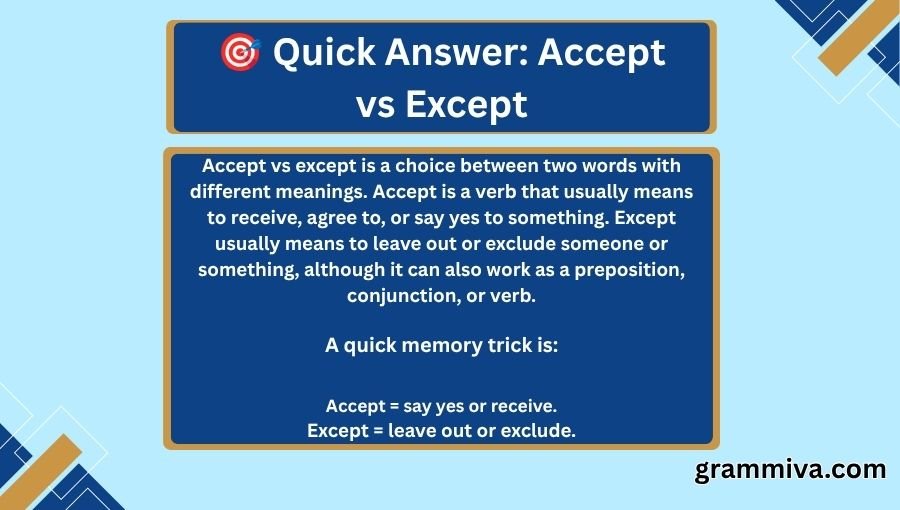
Accept vs except is a choice between two words with different meanings. Accept is a verb that usually means to receive, agree to, or say yes to something. Except usually means to leave out or exclude someone or something, although it can also work as a preposition, conjunction, or verb.
A quick memory trick is:
- Accept = say yes or receive.
- Except = leave out or exclude.
| Word | Basic Idea | Example |
|---|---|---|
| accept | receive or agree | I accept your offer. |
| except | leave out | Everyone came except Maria. |
🔤 Related Word Forms
The two words have useful related forms, especially when you need to recognize them in longer sentences. Accept has several common forms because it is a regular verb. Except also has related forms, but its use depends more on its role in the sentence.
| Form | Type | Example |
|---|---|---|
| accept | verb | I accept the invitation. |
| accepts | verb, third-person singular | She accepts the award. |
| accepted | past tense/past participle | He accepted the job. |
| accepting | present participle/gerund | They are accepting applications. |
| except | preposition/conjunction/verb | Everyone agreed except Tom. |
| excepted | past tense/past participle | No one was excepted from the rule. |
| excepting | present participle | Excepting one small error, the report was strong. |
The key point is that changing accept to accepted does not change its basic meaning. It still relates to receiving or agreeing. Likewise, forms of except still relate to exclusion.
🧭 Understanding the Basics of Accept vs Except
The easiest way to understand accept vs except is to focus on the direction of the action. Accept brings something in. Except leaves something out.
For example, if you accept an invitation, you say yes to it. If you say that everyone is invited except Jake, Jake is left out.
| Form | Type | Meaning | Example | Correct/Incorrect |
|---|---|---|---|---|
| accept | verb | receive or agree | I accept your apology. | ✅ Correct |
| except | preposition | excluding | Everyone came except Jake. | ✅ Correct |
| accept | verb | receive or agree | Everyone came accept Jake. | ❌ Incorrect |
| except | preposition | excluding | I except your apology. | ❌ Incorrect |
Accept Means Receive
One major meaning of accept is to receive something willingly.
You can accept:
- a gift
- an award
- an invitation
- an apology
- a payment
- a package
- a job offer
Consider this sentence:
I accepted the gift.
Here, accepted is the verb. The subject received the gift willingly.
Another example is:
She accepted the package from the delivery driver.
The action is receiving the package.
Accept Means Agree or Say Yes
Accept can also mean agreeing to something.
For example:
We accepted their proposal.
This means we agreed to the proposal.
You can also accept an invitation:
I accepted the invitation to the wedding.
In this sentence, the person said yes to the invitation.
Except Means Excluding
Except often tells us that one person or thing is not included in a group.
For example:
Everyone passed the test except Mark.
This means Mark did not belong to the group of people who passed.
Here is another example:
The store is open every day except Sunday.
The store is open on all the listed days, but Sunday is excluded.
Except Can Introduce an Exception
Except can also introduce something that does not follow the general statement.
For example:
I like all fruit except grapefruit.
The general idea is that I like fruit. Grapefruit is the exception.
A useful test is to replace except with excluding. If the sentence still makes sense, except is probably the correct word.
Test Tip 💡
When you are unsure, ask yourself one question:
Am I saying yes or receiving something?
If yes, use accept.
Am I leaving someone or something out?
If yes, use except.
| Meaning | Word Type | Example Sentence |
|---|---|---|
| receive something | verb | I accepted the package. |
| agree to something | verb | She accepted the offer. |
| say yes | verb | He accepted the invitation. |
| leave out | preposition | Everyone attended except Ben. |
| make an exception | conjunction/preposition | I would go, except I am busy. |
🤔 Is Accept the Same as Except?
No. Accept and except are not interchangeable. Accept normally describes an action of receiving, agreeing, or saying yes. Except normally marks an exclusion or exception.
Compare these two sentences:
I accept your explanation.
Everyone understood the explanation except Tom.
The first sentence says that someone agrees to or receives an explanation. The second sentence removes Tom from the group.
| Sentence | Meaning | Correct Word |
|---|---|---|
| I ___ your apology. | I receive it or agree to it. | accept |
| Everyone ___ Sarah attended. | Sarah is excluded. | except |
| We ___ the offer. | We said yes. | accept |
| The room was empty ___ for one chair. | One thing is an exception. | except |
The words may be close in spelling, but their jobs are very different.
🎯 Accept vs Except at a Glance
The fastest way to compare accept vs except is to remember yes/receive versus exclude/leave out.
| Feature | Accept | Except |
|---|---|---|
| Main role | Verb | Often preposition or conjunction |
| Main idea | Receive or agree | Exclude or make an exception |
| Common phrase | accept an offer | everyone except me |
| Can describe saying yes? | Yes | No |
| Can describe exclusion? | No | Yes |
| Example | She accepted the job. | She invited everyone except me. |
A simple mental picture can help:
Accept: something comes in.
Except: something stays out.
📝 Correct Meanings and Uses
Accept an Offer
When someone agrees to an offer, use accept.
I accepted the job offer.
The person said yes to the offer.
They accepted our proposal.
The group agreed to the proposal.
Accept an Apology
You can accept an apology when you decide to receive it or acknowledge it.
I accept your apology.
This does not necessarily mean that you have forgotten what happened. It means you are receiving or acknowledging the apology.
Accept a Gift
Use accept when someone willingly receives something.
She accepted the birthday gift.
The gift came to her, and she received it.
Accept a Fact or Situation
Accept can also mean recognizing something as true or dealing with a situation.
He finally accepted the fact that the plan had failed.
The person came to recognize the situation.
Except One Person
Use except when one person is excluded.
Everyone was ready except Daniel.
Daniel was the only person who was not ready.
Except One Thing
Use except to leave out a thing.
I like everything on the menu except the soup.
The soup is the exception.
Except for
The phrase except for is extremely common.
The report was excellent except for a few spelling errors.
This means the report was excellent overall, but the spelling errors were an exception.
Except for Monday, I am free all week.
Monday is the one day that does not fit the general statement.
📚 Why Do People Confuse Accept and Except?
People confuse these words because they look similar and begin with the same three letters. Their sounds are also close in many accents. That makes them easy to mix up when reading quickly or typing from memory.
I once edited a short business email that said, “We are happy to except your offer.” The writer clearly knew what they wanted to say. They simply picked the wrong word while typing. After replacing except with accept, the sentence became correct.
The mistake is especially common because both words appear frequently in everyday English. Your brain may notice the familiar letter pattern before it checks the meaning.
Here are the main reasons the mistake happens:
- Fast typing: You type the first similar-looking word that comes to mind.
- Autocorrect: Software may not know which meaning you intend.
- Similar spelling: The words differ by only one main letter.
- Lack of practice: You may know both words but not have a clear memory rule.
- Reading too quickly: You may focus on spelling instead of sentence meaning.
The best solution is not to memorize a complicated rule. Instead, connect each word with its main idea.
🧩 How To Remember the Difference
A strong memory trick is to connect accept with agree.
Both words begin with a similar A sound in your memory:
Accept = Agree
Then connect except with exclude:
Except = Exclude
You can also remember these two short phrases:
- Accept an offer.
- Everyone except me.
If you remember those two examples, you can build many other sentences from them.
| Memory Word | Meaning | Example |
|---|---|---|
| Accept = agree | say yes | I accept the offer. |
| Accept = receive | take something | She accepted the gift. |
| Except = exclude | leave out | Everyone came except Sam. |
| Except = exception | one thing is different | I like all colors except gray. |
Another useful trick is the door test.
Imagine a door.
If you accept, you let something in.
If you use except, you keep something out.
That mental image can make the difference much easier to remember.
💼 Case Study: A Workplace Email
Imagine that a manager sends this message:
“We are pleased to ___ your proposal.”
The intended meaning is that the company agrees to the proposal.
The correct sentence is:
“We are pleased to accept your proposal.”
Using except would completely change the meaning and make the sentence incorrect.
Now consider a different message:
“All team members attended the meeting ___ Alex.”
Here, Alex is being left out of the group.
The correct sentence is:
“All team members attended the meeting except Alex.”
I once caught a similar mistake while reviewing a meeting notice. The writer had typed “everyone accept new employees.” The intended meaning was that new employees were not included. Changing accept to except fixed the sentence immediately.
| Workplace Situation | Correct Word | Example |
|---|---|---|
| Agree to a proposal | accept | We accept your proposal. |
| Receive an application | accept | The office accepts applications online. |
| Exclude a person | except | Everyone attended except Mike. |
| Exclude a day | except | We work every day except Sunday. |
| Receive an apology | accept | I accept your apology. |
📏 Grammar Rules Explanation
Accept is primarily a verb. It describes an action such as receiving, agreeing to, approving, or recognizing something.
Examples include:
She accepted the award.
They accepted the invitation.
We accept credit cards.
Except is commonly used to show exclusion or an exception. It can function in several grammatical roles, including as a preposition and conjunction, depending on the sentence.
Examples include:
Everyone left except John.
I would help, except I am working.
The important grammar rule is based on meaning and sentence function. Do not choose between the words simply because they sound alike. Look at what the sentence is trying to say.
Most standard English reference works agree on this basic distinction: accept relates to receiving or agreeing, while except relates to exclusion or an exception.
Correct vs Incorrect at a Glance
| Sentence | Correct/Incorrect | Why |
|---|---|---|
| I accept your invitation. | ✅ Correct | The speaker is saying yes to the invitation. |
| I except your invitation. | ❌ Incorrect | The intended meaning is not exclusion. |
| Everyone came except Lisa. | ✅ Correct | Lisa is excluded from the group. |
| Everyone came accept Lisa. | ❌ Incorrect | Accept does not mean “excluding.” |
| We accepted the new plan. | ✅ Correct | The group agreed to the plan. |
⚠️ Common Mistakes With Accept and Except
The most common mistake is replacing accept with except, or vice versa, because the words look almost the same.
Here are some broader word pairs that cause similar problems.
| Confusing Pair | Correct Meaning 1 | Correct Meaning 2 |
|---|---|---|
| accept / except | receive or agree | exclude |
| it’s / its | it is | belonging to it |
| your / you’re | belonging to you | you are |
| they’re / their / there | they are / belonging to them / place | different functions |
| affect / effect | influence, usually a verb | result, usually a noun |
| then / than | time or sequence | comparison |
These mistakes often come from three simple causes:
Fast Typing
When you are rushing, your fingers may produce a familiar word before your brain checks the meaning.
Autocorrect
Autocorrect can help with spelling, but it cannot always understand your intended meaning. A correctly spelled wrong word may remain unchanged.
Lack of Knowledge
Some writers have learned both words separately but have never clearly learned the difference between them.
Specific Wrong Forms and Uses
| Wrong Form | What’s Wrong | Correct Form |
|---|---|---|
| accept everyone except me | This may be correct depending on meaning; check the intended action. | accept / except as needed |
| everyone accept John | Accept does not mean excluding John. | everyone except John |
| I except your apology | The verb should mean receiving or agreeing. | I accept your apology. |
| I accept Monday | This is wrong if Monday is being excluded. | except Monday |
| we except the offer | The intended meaning is agreement. | we accept the offer |
| all students accept Mia | The intended meaning is exclusion. | all students except Mia |
One warning matters here: accept is not always wrong before a person or thing. The sentence must be judged by its meaning. For example, “I accept Mia as a team leader” is perfectly correct because it means I recognize or approve Mia in that role.
🌎 Usage in Different Contexts
The choice between accept and except stays the same across different types of writing. What changes is the kind of sentence around the word.
| Context | Which Term to Use | Example |
|---|---|---|
| Everyday conversation | accept or except | I accept your apology. |
| Professional writing | accept or except | We accept the revised contract. |
| Creative writing | accept or except | Everyone trusted him except his brother. |
| Social media/texting | accept or except | I like every song except that one. |
Everyday Conversation
You might say:
“I accept your offer.”
Or:
“Everyone is coming except Josh.”
Both are natural and common.
Professional Writing
In business writing, the difference can affect the meaning of an important message.
“We are pleased to accept your application.”
This means the application has been received or approved.
“All employees must attend except those on leave.”
This means employees on leave are excluded.
Creative Writing
Writers use except to create contrast.
Everyone trusted the old map except Nora.
The word helps identify the unusual person in the group.
Accept can show an emotional or personal decision:
After years of worry, Daniel accepted the truth.
Social Media and Texting
Informal writing still needs the correct word.
I would accept that deal.
Everyone liked the post except me.
Short messages may be casual, but the meanings remain different.
💬 Common Phrases With Accept and Except
Both words appear in common phrases. Learning these phrases can make the difference easier to remember.
| Phrase | Meaning |
|---|---|
| accept an offer | agree to an offer |
| accept an apology | receive or acknowledge an apology |
| accept responsibility | admit or take responsibility |
| accept a gift | willingly receive a gift |
| everyone except | everyone excluding a person or thing |
| except for | excluding one detail or condition |
Examples:
She decided to accept responsibility for the mistake.
Everyone except Carlos knew about the change.
The trip was great except for the rain.
These phrases are useful because they give you familiar patterns to recognize.
🔄 Synonyms and Alternatives
Sometimes you can replace accept or except with another word or phrase. However, the replacement must fit the meaning.
| Alternative | Works When | Does Not Work When |
|---|---|---|
| receive | You mean getting something | You mean excluding something |
| agree to | You mean saying yes | You mean leaving something out |
| approve | You mean giving approval | You mean simply receiving an item |
| exclude | You mean leaving someone or something out | You mean accepting an offer |
| leave out | You mean not including something | You mean receiving or agreeing |
For example:
I accepted the offer.
can often become:
I agreed to the offer.
But:
Everyone came except Mark.
cannot become:
Everyone came accepted Mark.
The sentence needs an exclusion word such as excluding or except.
❓ Can Accept and Except Ever Appear in the Same Sentence?
Yes. They can appear together when a sentence needs both meanings. Accept can describe receiving or agreeing, while except can identify something that is excluded.
For example:
I accept every suggestion except the last one.
Here, accept tells us what the speaker does with the suggestions. Except identifies the one suggestion that is not included.
Another example is:
We accept all forms of payment except personal checks.
The business accepts most forms of payment but excludes personal checks.
This is a useful way to see the difference clearly. The two words are not rivals that cannot appear together. They simply perform different jobs.
🧠 Accept vs Except in Questions
Questions can make the difference slightly harder because you must understand the intended meaning before choosing the word.
Compare:
Will you accept the invitation?
This asks whether you will say yes.
Who came except Sarah?
This asks about a group while leaving Sarah outside it.
Try asking yourself whether the blank needs a verb of agreement or receiving or an exclusion word.
| Question | Correct Word | Reason |
|---|---|---|
| Will you ___ the offer? | accept | You are being asked whether you will say yes. |
| Who attended ___ Mark? | except | Mark is excluded. |
| Did she ___ the gift? | accept | She received it. |
| Did everyone come ___ Anna? | except | Anna is the exception. |
✍️ Accept vs Except in Writing
Good writers do not choose between these words by appearance. They look at the role each word plays in the sentence.
When editing your work, stop for a second whenever you see accept or except. Ask:
- Does this sentence involve receiving?
- Does it involve agreement?
- Does it involve saying yes?
- Is someone or something being left out?
- Could I replace the word with exclude or excluding?
If the answer to the first three questions is yes, accept is likely correct.
If the last two are true, except is likely correct.
This small editing habit can prevent a surprisingly noticeable error.
📌 Why Getting the Difference Right Matters
Knowing accept vs except matters because a one-letter difference can change the meaning of a sentence completely. The words may look similar, but they communicate opposite ideas in many situations.
Clarity in Communication
A reader should not have to guess what you mean.
Compare:
We accept all applications except late submissions.
This clearly says the company receives applications but excludes late ones.
Professionalism
A wrong word in a client email can make a message look careless.
For example:
We are pleased to except your offer.
The reader may understand your meaning, but the mistake can reduce confidence in the message.
Digital Communication
Emails, posts, resumes, and messages are often read quickly. Clear word choice makes your meaning easier to understand.
A simple rule is worth remembering:
Clear words make clear messages.
| Situation | Why Getting It Right Matters |
|---|---|
| Resume | Shows careful writing |
| Client email | Protects professional credibility |
| Published content | Improves accuracy |
| Social post | Prevents confusing readers |
🛠️ How To Check Your Sentence
If you are unsure about a sentence, use this three-step check.
Step 1: Find the Main Idea
Ask what is happening.
Is someone receiving something? Is someone agreeing? Or is someone being left out?
Step 2: Replace the Word
Try a simple replacement.
For accept, try:
- receive
- agree
- say yes
For except, try:
- exclude
- leave out
- apart from
Step 3: Read the Sentence Again
If the replacement keeps the same meaning, you probably chose the right word.
| Original Idea | Replacement Test | Likely Answer |
|---|---|---|
| receive | receive | accept |
| agree | agree | accept |
| say yes | say yes | accept |
| exclude | exclude | except |
| leave out | leave out | except |
| apart from | apart from | except |
📝 Practice Examples
Try choosing the correct word before looking at the answers.
Example 1
I will ___ the invitation.
Answer: accept.
The person is saying yes to the invitation.
Example 2
Everyone enjoyed the meal ___ David.
Answer: except.
David is the exception.
Example 3
The company decided to ___ the proposal.
Answer: accept.
The company agreed to the proposal.
Example 4
The office is closed every day ___ Friday.
Answer: except.
Friday is excluded from the general statement.
| Sentence | Answer | Reason |
|---|---|---|
| I ___ your apology. | accept | receive/acknowledge |
| Everyone came ___ Lily. | except | exclude |
| They ___ the terms. | accept | agree |
| I eat all vegetables ___ peas. | except | leave out |
| She ___ the award. | accept | receive |
✅ Quick Recap Checklist
Use this checklist whenever you hesitate.
| Question | If Yes → Use |
|---|---|
| Does the word mean receive? | accept |
| Does it mean agree? | accept |
| Does it mean say yes? | accept |
| Does it mean exclude? | except |
| Does it mean leave out? | except |
| Does it introduce an exception? | except |
Practice
- I ___ the job offer.
→ accept - Everyone was invited ___ Tom.
→ except - She accepted the gift except for the damaged box.
→ Both words can correctly appear because they perform different jobs.
The core rule is simple:
Accept brings something in. Except leaves something out.
❓ FAQs About Accept vs Except
What is the difference between accept and except?
Accept means to receive, agree to, approve, or say yes to something. Except means to exclude someone or something or to identify an exception.
Is accept a verb?
Yes. Accept is primarily a verb. For example, “I accept your offer” means “I agree to your offer.”
Is except a verb?
Except can be a verb, although it is commonly used as a preposition or conjunction. As a verb, it can mean to leave someone or something out.
How do I remember accept vs except?
Use this simple memory rule: accept = agree or receive, while except = exclude or leave out.
Another easy pair to memorize is:
I accept the offer.
Everyone came except Sam.
Should I say accept or except an apology?
Say accept an apology. For example: “I accept your apology.” The verb describes receiving or acknowledging the apology.
Should I say accept or except an invitation?
Say accept an invitation when you mean that you are saying yes to it.
I accepted the invitation.
Is it “everyone accept me” or “everyone except me”?
If you mean that everyone is included but you, the correct sentence is:
Everyone except me.
Except shows that you are excluded.
Is it “accept for” or “except for”?
The usual phrase meaning “excluding” is except for.
The room was clean except for one corner.
Accept for is not the standard expression for this meaning.
Can accept and except be used together?
Yes. They can appear in the same sentence when they express different ideas.
We accept all returns except damaged items.
Here, accept means receive, while except marks the items that are excluded.
What is the easiest test for accept vs except?
Ask whether the word means receive or agree. If it does, choose accept. If it means exclude, leave out, or apart from, choose except.
🏁 Conclusion
Accept vs except becomes much easier once you stop focusing on their similar spelling and focus on their meaning. Accept is mainly about receiving, agreeing, approving, or saying yes. Except is mainly about excluding someone or something or showing an exception.
When you see accept, think “bring it in.” When you see except, think “leave it out.” That small mental picture can help you make the right choice in emails, schoolwork, business writing, social posts, and everyday conversation.
I recommend memorizing two model sentences: “I accept the offer” and “Everyone came except Sam.” Once those patterns feel natural, you can apply the same rule to dozens of other sentences.
A one-letter difference should never have to cause a big writing problem. Remember the simple rule, check the meaning, and choose with confidence. ✨
Accept means yes. Except means leave out. Remember that, and you will rarely mix them up again.

I am Alex Morgan, an English grammar and vocabulary writer passionate about making language learning simple and useful. I work at Grammiva, where I create clear educational content and practical English examples for learners.



[…] shows common examples, covers mistakes, and gives you practical ways to remember the rule. Accept vs Except | Principal vs Principle | Who vs […]