Have you ever typed a sentence, reread it, and wondered whether you need than vs then? You are not alone. These two small words look and sound similar, but they do very different jobs. One is mainly used to compare things. The other usually tells us when something happens or what happens next.
The good news is that you do not need to memorize a long list of grammar rules. Once you learn the basic job of each word, the difference becomes much easier to spot. 😊
I teach and edit English with one goal in mind: make grammar rules easy to use in real writing. In this guide, I will show you how to tell these words apart, avoid common mistakes, and check your sentence in seconds. We will look at everyday speech, work emails, school writing, social media, and more.
By the end, you should be able to choose the right word without stopping to second-guess yourself. ✍️ Your vs youre | Accept vs Except | Principal vs Principle
🎯 Quick Answer: Than vs Then
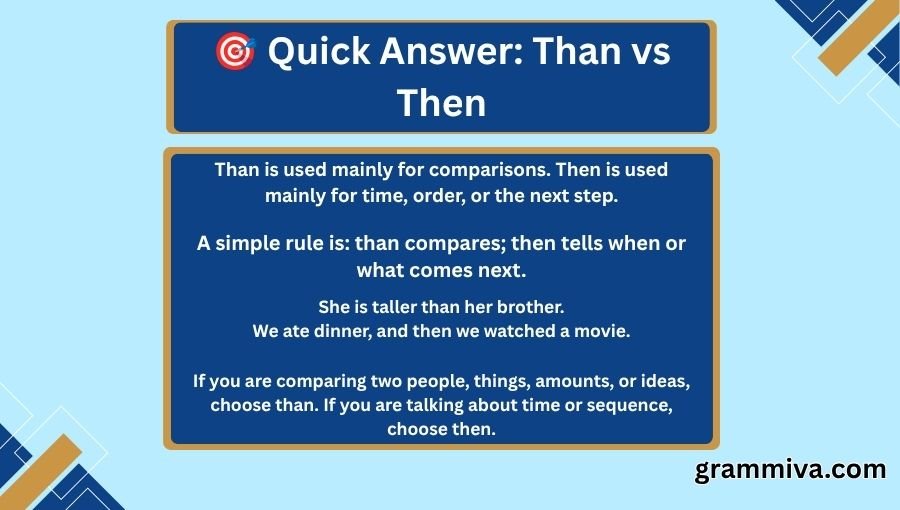
Than is used mainly for comparisons. Then is used mainly for time, order, or the next step.
A simple rule is: than compares; then tells when or what comes next.
- She is taller than her brother.
- We ate dinner, and then we watched a movie.
If you are comparing two people, things, amounts, or ideas, choose than. If you are talking about time or sequence, choose then.
Related Word Forms
Neither word has a common plural or possessive form that changes its basic spelling. However, both can appear in different sentence patterns, so it helps to understand how they function.
| Form | Type | Example |
|---|---|---|
| than | conjunction/preposition | This car is faster than mine. |
| then | adverb | We went home then. |
| rather than | fixed phrase | I would walk rather than drive. |
| even then | phrase | Even then, I did not agree. |
| if…then | paired expression | If you study, then you may pass. |
The key point is that than and then are separate words with separate jobs. They are not interchangeable spellings of the same word.
🎯 Understanding Than vs Then
The easiest way to understand the difference is to ask what your sentence is doing. Than introduces or connects a comparison. Then usually describes time, order, or a result that follows a condition.
| Form | Type | Meaning | Example | Correct/Incorrect |
|---|---|---|---|---|
| than | comparison word | Shows a difference between things | Maya is older than Leo. | ✅ Correct |
| then | adverb | Shows time or order | First call Maya, then call Leo. | ✅ Correct |
| than | comparison word | Shows time or sequence | We ate than left. | ❌ Incorrect |
| then | adverb | Shows comparison | Maya is older then Leo. | ❌ Incorrect |
Think of than as the word that builds a bridge between two sides of a comparison.
A is bigger than B.
Think of then as a word that moves the action forward.
First A happens. Then B happens.
That one idea solves most cases.
Is Than Used for Comparisons?
Yes. Than is the standard word used when comparing two or more things.
Consider these examples:
- My new phone is cheaper than my old one.
- Sarah runs faster than I do.
- This test was harder than the last one.
- We received more orders than expected.
In each sentence, the writer is measuring one thing against another.
Here is a useful sentence breakdown:
The blue car is faster than the red car.
- The blue car = the first thing being compared.
- faster = the quality being compared.
- than = the word that introduces the second side.
- the red car = the second thing being compared.
If you can point to two sides of a comparison, than is usually the right choice.
Is Then Used for Time and Order?
Yes. Then commonly tells readers when something happens or shows the order of events.
For example:
- Finish your homework, then play outside.
- I lived in Chicago then.
- We went to the store and then came home.
- First, mix the flour. Then add the eggs.
Here, there is no comparison. Instead, then moves the reader from one moment or action to another.
Can Then Show a Result?
Yes. Then can also introduce or point to a result.
For example:
If you leave now, then you can catch the bus.
The word then connects the condition with what follows from it.
In everyday English, the word may sometimes be left out:
If you leave now, you can catch the bus.
Both versions can work. Then simply makes the sequence or result more explicit.
A Quick Meaning Table
| Meaning | Word Type | Example Sentence |
|---|---|---|
| Comparison | than | Jack is younger than Maria. |
| Time | then | I lived there then. |
| Sequence | then | Wash your hands, then eat. |
| Result | then | If that is true, then we need a new plan. |
| Preference | than | I would rather stay than leave. |
💡 How To Remember the Difference
I use a very simple memory trick with students:
Than = comparison.
Then = time or next.
You can also connect the e in then with the idea of events. This is not a grammar rule. It is just a memory aid.
Try these quick checks:
- Bigger than → comparison.
- Better than → comparison.
- More than → comparison.
- First, then → sequence.
- Now and then → time.
- If this happens, then that happens → result.
💡 Test Tip
When you are unsure, replace the word mentally.
Ask:
“Am I comparing something?”
If yes, try than.
Then ask:
“Am I talking about when something happens or what happens next?”
If yes, try then.
For example:
My sister is taller ___ me.
You are comparing height. The answer is than.
We finished lunch and ___ went home.
You are showing what happened next. The answer is then.
This test works especially well when you are proofreading quickly.
Why Do People Confuse Than and Then?
People confuse these words because they look and sound very similar. They also appear often in everyday sentences, so a small typing error can easily slip through.
I once had a student write, “I would rather walk then take the bus” in an otherwise excellent paragraph. When I asked why, the student knew that then related to time but had typed it automatically. The comparison pattern had not become a habit yet.
That is common. Knowing a rule and applying it automatically are two different skills.
Here are the main reasons mistakes happen:
- Fast typing — Your fingers may choose the familiar spelling before your brain checks the meaning.
- Autocorrect — Software can sometimes preserve a wrong word because both forms are valid English words.
- Lack of knowledge — A writer may not know that the words have different jobs.
- Sound similarity — In normal speech, the difference can be hard to notice.
- Habit — If you have used one form incorrectly for years, the error can feel natural.
Than vs Then at a Glance
The difference becomes much clearer when you place the two words side by side.
| Feature | Than | Then |
|---|---|---|
| Main job | Comparison | Time or sequence |
| Common question | “Compared with what?” | “When or what next?” |
| Example | She is older than me. | She left, then called me. |
| Common pattern | more than | first, then |
| Another use | rather than | if…then |
| Main warning | Do not use for sequence | Do not use for comparison |
A useful habit is to look at the words around the blank.
Words such as more, less, better, worse, older, younger, faster, slower, taller, shorter, bigger, smaller, rather often point toward than.
Words such as first, next, later, afterward, now, finally often point toward then.
These clues are not absolute rules, but they are helpful signals.
Correct Meanings and Uses of Than
Comparisons With Adjectives
Than often follows a comparative adjective.
Examples:
- This room is brighter than the other one.
- My dog is smaller than yours.
- The second chapter is longer than the first.
- Winter is colder than fall in many places.
The comparative word tells us what is being measured. Than connects that comparison to the second item.
Comparisons With Amounts
Than also works with amounts.
- We need more time than we expected.
- She has fewer books than I do.
- The project costs less than the original estimate.
- He earns more than his brother.
Here, the comparison may involve quantity rather than a physical quality.
Preferences With “Rather Than”
One common phrase is rather than.
Examples:
- I would rather read than watch TV.
- She chose tea rather than coffee.
- We decided to walk rather than drive.
This construction is about choosing between alternatives. It does not describe a time sequence.
Correct and Incorrect Pairs
| Sentence Pair | Correct | Incorrect |
|---|---|---|
| My car is older than yours. | ✅ My car is older than yours. | ❌ My car is older then yours. |
| I would rather stay than leave. | ✅ I would rather stay than leave. | ❌ I would rather stay then leave. |
| She is faster than me. | ✅ She is faster than me. | ❌ She is faster then me. |
| This costs more than that. | ✅ This costs more than that. | ❌ This costs more then that. |
Correct Meanings and Uses of Then
Then for Sequence
The most common use of then is to show what happens next.
- First, open the box. Then remove the cover.
- I took a shower and then went to bed.
- We finished the meeting and then had lunch.
In these examples, then acts like a signpost. It tells the reader what comes next.
Then for a Past or Known Time
Then can refer to a particular time.
- I was living in Boston then.
- She was much younger then.
- Back then, we did not have smartphones.
The meaning depends on context. Then can point to a time that has already been mentioned or is understood.
Then for a Result
Then can also show what follows from a condition.
- If you agree, then we can begin.
- If the store is closed, then we will come back tomorrow.
- If you know the answer, then explain it.
In formal writing, the sentence may be clearer without then in some cases. Still, the word is grammatically possible when it helps show the connection.
Correct and Incorrect Pairs
| Sentence Pair | Correct | Incorrect |
|---|---|---|
| First we ate, then we left. | ✅ First we ate, then we left. | ❌ First we ate, than we left. |
| I lived there then. | ✅ I lived there then. | ❌ I lived there than. |
| Finish this, then start that. | ✅ Finish this, then start that. | ❌ Finish this, than start that. |
| If that happens, then we will wait. | ✅ If that happens, then we will wait. | ❌ If that happens, than we will wait. |
📝 Case Study: A Workplace Email
Imagine that an employee is writing an email to a manager:
“The new report is more detailed then the old report.”
The intended meaning is a comparison. The writer is saying that one report has a greater level of detail.
The corrected sentence is:
“The new report is more detailed than the old report.”
Now consider a different sentence:
“We reviewed the report and than sent it to the client.”
Here, the writer is describing two actions in order. The corrected version is:
“We reviewed the report and then sent it to the client.”
I once edited a short business report that had three then/than mistakes in two pages. The writer had strong ideas and clear organization. The errors simply came from typing quickly. Once we marked every comparison and every sequence, the mistakes became easy to fix.
This shows why context matters more than spelling alone.
Grammar Rules Explanation
The core grammar rule is simple: than is used to connect a comparison, while then normally works as an adverb related to time, sequence, or result.
In a sentence such as “The house is larger than the apartment,” than connects the comparative adjective “larger” with the second item in the comparison.
In “We visited the museum, then went home,” then describes the order of events.
These words cannot normally be exchanged without changing the meaning or making the sentence incorrect.
Standard English references, including well-known dictionaries and grammar guides, treat than and then as distinct words with different functions.
The spelling difference is small, but the grammar difference is real.
Correct vs Incorrect at a Glance
| Sentence | Correct/Incorrect | Why |
|---|---|---|
| This book is better than that one. | ✅ Correct | The sentence compares two books. |
| We finished the book, then watched the movie. | ✅ Correct | The sentence shows sequence. |
| She is taller then her sister. | ❌ Incorrect | The sentence needs a comparison word. |
| First wash the vegetables, than cut them. | ❌ Incorrect | The sentence describes order. |
| I would rather stay than go. | ✅ Correct | “Rather than” shows a preference. |
⚠️ Common Mistakes With Than and Then
Most mistakes are not caused by complex grammar. They happen because the two words are easy to mix up.
Similar Grammar Confusions
| Confusing Pair | Correct Meaning | Typical Mistake |
|---|---|---|
| than / then | comparison / sequence | Switching the two |
| your / you’re | possession / you are | Writing your for you’re |
| its / it’s | possession / it is | Adding an apostrophe to possessive its |
| their / there / they’re | possession / place / they are | Choosing by sound |
| affect / effect | influence / result | Mixing the two in formal writing |
These pairs share one feature: the wrong word may still look perfectly normal to a reader at first glance.
Specific Wrong Forms and Uses
| Wrong Form | What’s Wrong | Correct Form |
|---|---|---|
| better then | Uses a sequence word after a comparison | better than |
| more then | Uses the wrong word for quantity comparison | more than |
| first than | Uses a comparison word for sequence | first, then |
| rather then | Incorrect spelling in the fixed phrase | rather than |
| less then | Wrong word after a comparison of amount | less than |
| older then | Wrong word after a comparative adjective | older than |
Why Fast Typing Causes Trouble
When you type quickly, your brain often focuses on meaning rather than individual letters. Because than and then are both familiar, the wrong one can pass unnoticed.
Autocorrect can make this harder. A spell checker may not flag then when you intended than because then is a correctly spelled English word.
That is why a grammar check must sometimes be a meaning check, not just a spelling check.
How To Remember Than vs Then
Here are several easy memory methods.
Use “Compare” as Your First Question
When you see a blank, ask:
“Am I comparing?”
If yes, choose than.
My laptop is lighter ___ yours.
You are comparing two laptops.
Answer: than.
Use “Next” for Then
If the sentence means “next,” then is usually right.
We had breakfast and then left.
You could mentally say:
We had breakfast and next left.
The sentence may sound less natural, but the meaning is clear.
Watch for Comparative Words
These words often signal than:
- better
- worse
- older
- younger
- faster
- slower
- taller
- shorter
- bigger
- smaller
- more
- less
- fewer
For example:
This option is better than the other one.
Watch for Sequence Words
These often work naturally with then:
- first
- next
- later
- afterward
- finally
For example:
First, read the question. Then, write your answer.
Usage in Different Contexts
The correct choice does not change based on whether you are texting a friend or writing a report. The basic rule remains the same.
| Context | Which Term to Use | Example |
|---|---|---|
| Everyday conversation | Than for comparisons; then for time/order | This one is cheaper than that one. Then we can go home. |
| Professional writing | Than for comparisons; then for sequence | Sales are higher than last year. We then reviewed the results. |
| Creative writing | Either, depending on meaning | She was stronger than before. Then the lights went out. |
| Social media/texting | Either, depending on meaning | Better than I expected! Then I went home. |
In informal messages, people may make mistakes without noticing. That does not change the standard rule.
If you are writing something public, professional, or academic, it is worth checking the word carefully.
Common Phrases With Than and Then
Both words appear in common phrases.
| Phrase | Meaning |
|---|---|
| rather than | Instead of one choice, choose another |
| more than | A greater amount or degree |
| less than | A smaller amount or degree |
| better than | A comparison showing higher quality |
| now and then | Occasionally |
| every now and then | Sometimes |
| back then | At an earlier time |
| then and there | At that exact time and place |
These phrases can help reinforce the difference.
Notice how than phrases usually involve comparison or choice, while then phrases often involve time.
Synonyms and Alternatives
Sometimes you can replace the word or rewrite the sentence. This can be useful if you are editing for clarity.
| Alternative | Works When | Does Not Work When |
|---|---|---|
| compared with | You are making a direct comparison | The sentence describes sequence |
| instead of | You are showing an alternative | You need a normal comparative structure |
| next | You are showing the next action | You are comparing two things |
| afterward | You are describing what happens later | You are making a comparison |
| later | You are referring to a future or later time | You need to compare amounts |
For example:
The new model is cheaper than the old model.
You could rewrite this as:
The new model costs less compared with the old model.
But you cannot replace than with next, because the meaning would change completely.
Likewise:
We ate dinner, then left.
Could become:
We ate dinner, and afterward we left.
Why It Matters: Than vs Then
Getting these two words right may seem like a tiny detail. In clear writing, however, small details matter.
Clarity in Communication
A wrong word can make a sentence pause-worthy.
Compare:
This plan is better than the first one.
with:
This plan is better then the first one.
The second version may still be understood, but it is grammatically wrong.
Professionalism
In a client email, report, resume, or application, repeated basic errors can distract from your ideas.
Good grammar does not make an idea smarter. It helps the reader focus on the idea.
Digital Communication
Text messages move quickly. Social posts move even faster. That makes small errors easy to overlook.
A quick final read can catch them.
“More than expected” = comparison.
“Then we left” = sequence.
A useful principle is:
Clear words make clear ideas easier to see.
| Situation | Why Getting It Right Matters |
|---|---|
| Resume | Shows care and attention to detail |
| Client email | Makes your message look polished |
| Published content | Builds reader trust |
| Social post | Keeps short messages clear |
Is There a Special Exception?
There is no major spelling exception that turns than into then or vice versa. The important edge case is that then can do more than simply describe time.
For example:
If you finish early, then you can leave.
Here, then expresses a result rather than a simple sequence of events.
Another useful pattern is:
I would rather read than watch TV.
This may not look like a normal adjective comparison, but than is still correct because the structure compares two choices.
So remember the broader idea:
- than connects comparison or alternatives.
- then connects time, order, or a result.
Is Than the Same as Then?
No. Than and then have different grammatical jobs.
Than is mainly used for comparisons, while then is mainly used for time, sequence, and related results.
For example:
- The blue shirt is cheaper than the red shirt.
- Buy the shirt, then go home.
Can Then Be Used for a Comparison?
No, not in standard English when the sentence requires than.
The correct sentence is:
This is better than that.
Not:
This is better then that.
The word then should not replace than simply because the two words sound similar.
Can Than Be Used for Time?
No, not when the sentence requires then.
For example:
We finished work and then went home.
Using than would be incorrect because the sentence describes the order of events.
Which Is Correct: More Than or More Then?
More than is correct when you are comparing an amount, number, or degree.
Examples:
- I have more than enough.
- The movie lasted more than two hours.
- She earned more than expected.
More then is normally an error when the intended meaning is comparison.
Which Is Correct: Rather Than or Rather Then?
Rather than is correct.
Examples:
- I would walk rather than drive.
- She chose to wait rather than rush.
- We stayed home rather than go out.
The phrase expresses a choice between alternatives.
Which Is Correct: First Then or First Than?
First, then is correct when describing order.
For example:
First, check the address. Then send the email.
The two words work together because they describe what happens first and what happens next.
How Can I Check Than vs Then Quickly?
Ask one question:
Is the sentence comparing things?
- Yes → than
- No, it is showing time, order, or a result → then
For example:
My bag is heavier ___ yours.
Comparison → than.
Pack your bag, ___ leave.
Sequence → then.
Does Then Always Mean “Next”?
No. Then has several related uses.
It can refer to:
- a time in the past or future,
- the next action,
- an outcome,
- a result from a condition.
For example:
I lived there then.
Here, then refers to a past time.
Finish your work, then call me.
Here, it shows sequence.
If you agree, then we can start.
Here, it introduces a result.
Does Than Always Follow a Comparative Adjective?
No. Than can also appear in comparisons involving amounts, pronouns, nouns, and fixed phrases.
Examples include:
- more than enough
- less than expected
- rather than wait
- other than Monday
The shared idea is still comparison, difference, or an alternative.
Why Does Autocorrect Miss Than and Then Errors?
Autocorrect often checks whether a word is spelled correctly. Both than and then are correctly spelled words.
Therefore, software may not know that you chose the wrong one for the meaning of your sentence.
For example:
She is older then me.
There is no spelling error in then itself. The problem is its role in the sentence.
That is why human proofreading still matters.
Quick Recap Checklist
Use this checklist whenever you are unsure.
| Question | If Yes → Use |
|---|---|
| Am I comparing two things? | than |
| Am I comparing amounts? | than |
| Am I choosing one option over another? | than |
| Am I showing what happens next? | then |
| Am I talking about a particular time? | then |
| Am I showing a result after a condition? | then |
Practice Examples
- My new desk is larger ___ my old desk.
Answer: than — it compares two desks. - We finished the meeting and ___ went to lunch.
Answer: then — it shows sequence. - I would rather call ___ send a text.
Answer: than — it compares two choices. - First, read the instructions. ___ begin the test.
Answer: Then — it shows what happens next.
FAQs About Than vs Then
What is the easiest way to remember than vs then?
Remember: than compares; then tells when or what comes next. If you are comparing two things, use than. If you are showing time, order, or a result, use then.
Is it “better than” or “better then”?
The correct phrase is better than because “better” creates a comparison.
Correct: “This plan is better than the first one.”
Incorrect: “This plan is better then the first one.”
Is it “first then” or “first than”?
Use first, then when describing a sequence.
Correct: “First, wash the vegetables. Then, cut them.”
Than is not used to show what happens next.
Is it “more than” or “more then”?
Use more than when comparing an amount or degree.
Correct: “The repair cost more than expected.”
More then is incorrect when the intended meaning is comparison.
Is “rather than” correct?
Yes. Rather than is the standard phrase for showing a preference or alternative.
For example:
“I would rather walk than drive.”
Can “then” mean a result?
Yes. Then can show a result after a condition.
For example:
“If you finish your work, then you can leave.”
In some sentences, then can be removed without changing the basic meaning.
Can “than” be used without a comparison word?
Yes. Than can appear in phrases such as rather than, other than, and more than. Its use is broader than simply following words such as “better” or “faster.”
Why are than and then so easy to mix up?
They look and sound very similar, and both are common English words. Fast typing, autocorrect, and habit can also cause errors.
Which word is used for time: than or then?
Use then for time.
For example:
“I was living in New York then.”
Use than when making a comparison.
How do I proofread than and then in my writing?
Read each sentence and ask whether the word shows comparison or time/order. If it compares, choose than. If it shows what happens next, when something happened, or a result, choose then.
Conclusion
Than vs then becomes easy once you focus on meaning instead of spelling. 😊 Use than when you compare people, things, amounts, or choices. Use then when you talk about time, show the next step, or point to a result.
My favorite shortcut is still the simplest one:
Than compares. Then moves things along.
When you see words such as better, faster, older, more, less, or rather, check whether a comparison is being made. If so, than is likely the right choice. When the sentence describes what happens next or refers to a time, then is usually the answer.
Do not depend only on spell check. Both words are spelled correctly, so the real test is meaning. Take one extra second to ask what the sentence is doing.
Once this distinction becomes a habit, you will catch these errors quickly in emails, schoolwork, articles, messages, and everyday writing. ✨
Remember it once, use it forever: than compares, then tells what comes next.

I am Ryan Mitchell, a writer focused on English grammar, vocabulary, and everyday language. I work at Grammiva, creating easy-to-understand articles that help readers improve their English with confidence.
[…] By the end, you should be able to choose the right word without stopping to think twice. 😊 Than vs Then | Your vs youre | Accept vs […]
[…] tricks, real-life uses, and practical tests you can use whenever you are unsure. Advice vs Advise | Than vs Then | Your vs […]