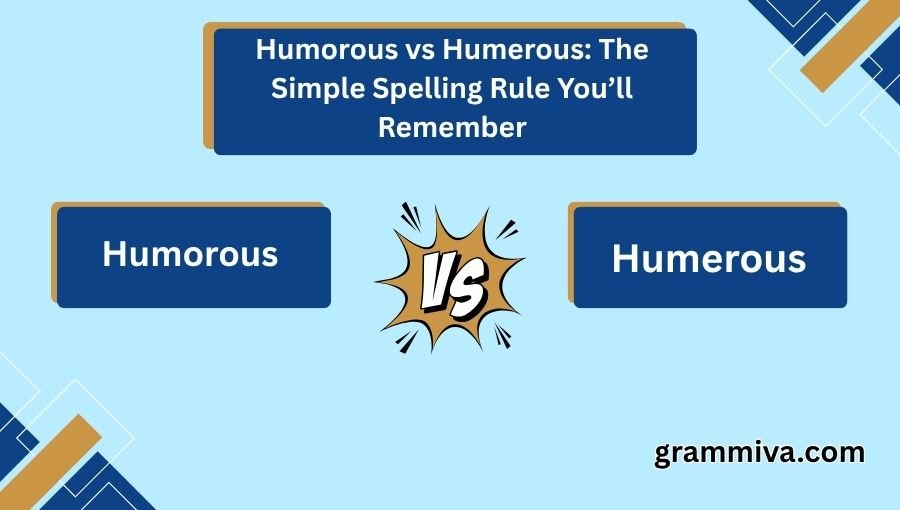
Have you ever typed a word, stared at it for a second, and thought, “That looks right… but does it?” 😅 humorous vs humerous is one of those spelling problems that can make even confident writers pause. The two forms look almost the same, and they sound close enough in everyday speech to cause trouble.
The good news is that the rule is simple. When you mean funny, amusing, or related to humor, the standard US English spelling is humorous. The spelling humerous is generally a misspelling of that word.
This small spelling difference matters because the wrong form can stand out in a school paper, work email, website, resume, or published article. You may have a great idea, but a spelling mistake can distract your reader.
In this guide, I’ll explain the difference in plain English. I’ll also show you examples, common mistakes, memory tricks, grammar rules, and practical uses so you can choose the right spelling without stopping to think twice. ✍️ Affect vs Effect | Advice vs Advise | Than vs Then
🎯 Quick Answer: Humorous vs Humerous
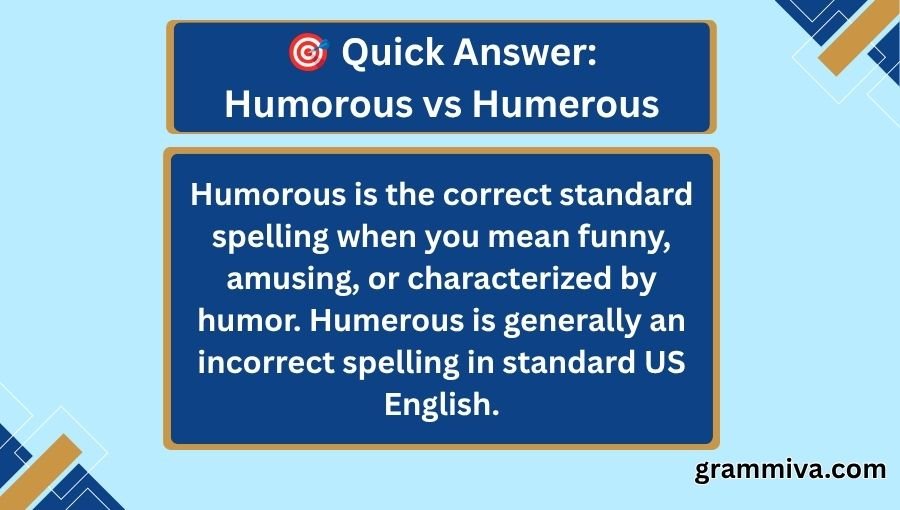
Humorous is the correct standard spelling when you mean funny, amusing, or characterized by humor. Humerous is generally an incorrect spelling in standard US English.
| Word | Correct? | Meaning | Example |
|---|---|---|---|
| humorous | ✅ Yes | Funny or amusing | She wrote a humorous story. |
| humerous | ❌ No | Usually a misspelling of humorous | She wrote a humerous story. |
| humerus | ✅ Yes | The upper-arm bone | The doctor examined his humerus. |
| humor | ✅ Yes | Amusement or a sense of what is funny | His humor is easy to understand. |
The easiest rule is:
If you mean “funny,” write humorous.
Related Word Forms You Should Know
The word humorous has several related forms. Knowing them can make the spelling easier because you can connect the adjective to its base word, humor.
| Form | Type | Example |
|---|---|---|
| humor | Noun | Her humor made the meeting easier. |
| humorous | Adjective | She gave a humorous answer. |
| humorously | Adverb | He humorously described the problem. |
| humorless | Adjective | His response sounded humorless. |
| humorist | Noun | The humorist wrote several comic essays. |
| humerous | Nonstandard/misspelled form | Avoid this spelling when you mean funny. |
Notice the connection:
humor → humorous → humorously
That connection is one of the best ways to remember the spelling.
🎯 What Is the Difference Between Humorous and Humerous?
The main difference is simple: humorous is the standard adjective meaning funny or amusing, while humerous is generally a spelling error when used with that meaning.
| Form | Type | Meaning | Example | Status |
|---|---|---|---|---|
| humorous | Adjective | Funny or amusing | The movie was humorous. | ✅ Correct |
| humerous | Intended adjective | Usually intended to mean funny | The movie was humerous. | ❌ Incorrect |
| humerus | Noun | Upper-arm bone | She injured her humerus. | ✅ Correct |
| humor | Noun | Funny quality or amusement | His humor is clever. | ✅ Correct |
Correct vs. Incorrect Examples
- ✅ Correct: The teacher gave a humorous example.
- ❌ Incorrect: The teacher gave a humerous example.
- ✅ Correct: We watched a humorous movie.
- ❌ Incorrect: We watched a humerous movie.
- ✅ Correct: Her humorous comment made everyone smile.
- ❌ Incorrect: Her humerous comment made everyone smile.
The key point is that these are not two standard adjectives with different meanings. In ordinary US English, humerous should not replace humorous.
Why Do People Confuse Humorous and Humerous?
People confuse these spellings because they look nearly identical, sound similar, and are easy to mistype. The word humerus, which refers to the upper-arm bone, adds another layer of confusion because its spelling is visually close to both forms.
There is also a simple spelling trap. When people hear humorous, they may remember the general sound rather than the exact letters. The middle part of the word is not strongly pronounced in normal speech, so spelling it from sound alone can be difficult. The humorous vs humerous confusion usually comes from the similar appearance of the two spellings.
I once edited a short school article where a student had written humerous several times. The student knew exactly what the word meant and had used it correctly in every sentence. The only problem was one missing letter. Once I pointed out the connection between humor and humorous, the student corrected every instance in less than a minute.
That is why I recommend remembering the base word rather than trying to spell the adjective by sound.
The visual problem
Look at these two forms:
humorous
humerous
They differ by only one letter. That makes the mistake easy to overlook during fast proofreading.
The anatomy problem
There is a real word called humerus. It is the long bone in the upper arm.
That creates a useful three-way distinction:
- humor = amusement or a funny quality
- humorous = funny or amusing
- humerus = upper-arm bone
The spelling humerous often appears because writers blend the visual patterns of humorous and humerus.
💡 How Do You Spell Humorous Correctly?
Spell it:
H-U-M-O-R-O-U-S
A useful memory formula is:
humor + ous = humorous
Do not change the o in humor to an e.
| Memory Step | Correct Form |
|---|---|
| Start with the noun | humor |
| Add the adjective ending | -ous |
| Put them together | humorous |
| Avoid changing the vowel | no “e” after “hum” |
A quick spelling test
If you are unsure, cover the ending and ask yourself:
What is the base word?
If the answer is humor, keep that spelling visible in your mind:
humor → humorous
That is much safer than trying to spell the word from pronunciation.
Humorous Meaning and Correct Use
Humorous is an adjective used to describe something that is funny, amusing, playful, or connected with humor. Understanding humorous vs humerous is easier when you connect humorous to the base word humor.
It can describe many things, including:
- a person
- a story
- a joke
- a comment
- a movie
- an article
- a speech
- a conversation
- a tone
- a writing style
- an observation
- a situation
Describing a person
You can say:
She is a humorous person.
This means she often says or does things that are funny or amusing.
You can also say:
He has a great sense of humor.
Here, humor is the noun, while humorous is the adjective.
Describing writing
You might write:
The author uses a humorous tone.
This means the writing contains humor or presents its subject in a funny or playful way.
Describing a story
My grandfather told us a humorous story.
The story was funny or amusing.
Describing a situation
The mistake created a humorous moment.
The situation became funny, perhaps because of something unexpected.
Meaning Summary
| Meaning | Word Type | Example Sentence |
|---|---|---|
| Funny | Adjective | The play was humorous. |
| Amusing | Adjective | She shared a humorous story. |
| Full of humor | Adjective | His writing is humorous. |
| Playful in tone | Adjective | The article takes a humorous approach. |
💡 Test Tip
Ask:
“Am I describing something as funny or amusing?”
If the answer is yes, humorous is probably the word you need.
Is Humerous Ever the Correct Spelling for “Funny”?
No, not in standard US English when you mean funny or amusing. Humerous is generally treated as a misspelling of humorous, so writers should use humorous instead.
This is especially important in formal writing.
| Sentence | Correct? | Better Version |
|---|---|---|
| The article has a humerous tone. | ❌ | The article has a humorous tone. |
| She wrote a humerous story. | ❌ | She wrote a humorous story. |
| His answer was humorous. | ✅ | No change needed. |
| The presentation was humorous. | ✅ | No change needed. |
If you see humerous in your own writing, do not assume it is an alternative spelling. In normal English, replace it with humorous.
📝 Case Study: A Humorous Email at Work
Imagine that a manager sends this message after a long team meeting:
“Thank you for surviving another meeting. Your patience deserves its own award.”
The manager might later describe the message as humorous.
For example:
The manager used a humorous closing line to make the email feel more relaxed.
Now imagine writing:
The manager used a humerous closing line.
The meaning is still clear, but the spelling is wrong.
I once caught a similar mistake in a workplace document. The writer had prepared a friendly message for a customer and had used humerous twice. Nothing about the tone was wrong. The message was warm and professional. A quick spelling check fixed the problem before it went out.
This shows an important lesson: correct word choice and correct spelling are separate skills. You can choose the perfect word and still spell it incorrectly.
Grammar Rules Explanation
Humorous is an adjective. It modifies a noun or describes a person, thing, action, style, or situation as funny or characterized by humor.
The standard spelling preserves the base word humor:
humor + -ous → humorous
The spelling humerous does not follow the standard form used for this meaning.
Most standard English reference sources and spelling references agree that humorous is the form to use when describing something funny or amusing.
There is another useful grammar distinction:
- humor is generally a noun.
- humorous is an adjective.
- humorously is an adverb.
- humorless is an adjective.
For example:
Her humor is clever.
Her writing is humorous.
She humorously described the situation.
His response was humorless.
The spelling problem becomes easier when you identify the grammatical role first.
Correct vs. Incorrect at a Glance
| Sentence | Correct/Incorrect | Why |
|---|---|---|
| The article has a humorous tone. | ✅ Correct | Humorous is the adjective meaning funny or amusing. |
| The article has a humerous tone. | ❌ Incorrect | Humerous is not the standard spelling. |
| She gave a humorous answer. | ✅ Correct | The adjective correctly describes the answer. |
| She gave a humerous answer. | ❌ Incorrect | The spelling should be humorous. |
| His humor made the class laugh. | ✅ Correct | Humor is the noun. |
⚠️ Common Mistakes With Humorous
Most mistakes with this word are spelling mistakes rather than difficult grammar errors. Writers often know the meaning but remember the letter pattern incorrectly.
Mistake 1: Dropping the second “o”
❌ The story was humerous.
✅ The story was humorous.
Mistake 2: Confusing humorous with humerus
❌ The doctor examined his humorous.
✅ The doctor examined his humerus.
The second sentence is about anatomy, not comedy.
Mistake 3: Using humor instead of humorous
❌ She has a humor personality.
✅ She has a humorous personality.
Humor is generally a noun. Humorous is the adjective.
Mistake 4: Using humorous instead of humor
❌ His humorous is excellent.
✅ His humor is excellent.
Why These Mistakes Happen
Three common causes are:
- Fast typing: Your fingers may produce the familiar-looking form before you notice it.
- Autocorrect: Spell-check tools do not always catch every unusual error, especially when a misspelled word resembles another word.
- Lack of knowledge: If you have never connected humorous with humor, the spelling may feel random.
I once caught myself typing humerous in a draft while writing quickly. I stopped because the word looked familiar but slightly wrong. Thinking of humor immediately gave me the correct spelling.
Similar Grammar Confusions
| Confusion | Correct Form | Basic Difference |
|---|---|---|
| it’s / its | Both can be correct | It’s = it is; its shows possession. |
| your / you’re | Both can be correct | Your shows possession; you’re = you are. |
| their / there / they’re | All can be correct | They have different jobs and meanings. |
| affect / effect | Both can be correct | Their meanings and grammatical roles differ. |
| then / than | Both can be correct | Then relates to time or sequence; than is used for comparison. |
| humorous / humerous | humorous | Humerous is generally a misspelling. |
Common Wrong Spellings and Uses
| Wrong Form | What’s Wrong | Correct Form |
|---|---|---|
| humerous | Missing the correct “o” pattern | humorous |
| humerouse | Incorrect ending | humorous |
| humourous | Not the standard US form | humorous |
| humorus | Incorrect vowel pattern | humorous |
| humorious | Extra letters | humorous |
| humurous | Letters are rearranged | humorous |
🇺🇸 Is Humorous Different in American and British English?
The spelling humorous is standard in both American and British English, although the related noun may differ by region.
American English commonly uses humor, while British English commonly uses humour. That difference does not mean American English changes humorous to humerous.
| Meaning | American English | British English |
|---|---|---|
| Noun | humor | humour |
| Adjective | humorous | humorous |
| Adverb | humorously | humorously |
| Person who creates humor | humorist | humourist |
| Lacking humor | humorless | humourless |
So, for US English, remember:
humor → humorous
Do not write humerous.
Humorous vs Humerous in Different Contexts
The correct spelling stays the same across normal writing contexts. What changes is how formal or playful your use of humorous should be.
| Context | Which Term to Use | Example |
|---|---|---|
| Everyday conversation | humorous | That was a humorous story. |
| Professional writing | humorous | The presentation had a humorous tone. |
| Creative writing | humorous | The author created a humorous character. |
| Social media/texting | humorous | Her caption was humorous and clever. |
In casual texting, people sometimes make spelling errors without worrying about them. That does not turn humerous into a standard spelling.
If you are writing something that others will read carefully, use humorous.
🎯 Humorous vs Humerous in Professional Writing
Professional writing should use humorous when the word is appropriate. A spelling error can make a polished email, report, proposal, or presentation look less carefully edited. In professional writing, knowing humorous vs humerous can help you avoid a simple but noticeable spelling error.
For example:
The speaker used a humorous example to explain the new process.
This sentence is correct.
The wrong form is:
The speaker used a humerous example to explain the new process.
The difference is only one letter, but readers notice spelling errors more easily when they occur in formal documents.
Where the Correct Spelling Matters Most
| Situation | Why It Matters |
|---|---|
| Resume | Shows attention to detail. |
| Client email | Supports a professional impression. |
| School paper | Demonstrates spelling accuracy. |
| Published article | Protects the quality of the final copy. |
Why Does Getting This Spelling Right Matter?
Getting the spelling right matters because clear writing depends on small details. A reader should focus on your message, not stop to wonder whether a word has been spelled correctly.
Correct spelling helps with:
- Clarity: The reader immediately recognizes the intended word.
- Professionalism: Clean writing looks more polished.
- Digital communication: Emails, posts, and messages are often read quickly.
- Trust: Careful writing can make your information feel more reliable.
A simple rule I use when editing is:
The easier your writing is to read, the less your reader has to work.
That principle applies even to a tiny spelling difference.
How Can You Remember Humorous Easily?
The easiest memory trick is to remember the base word humor.
Think:
HUMOR + OUS = HUMOROUS
Another useful trick is to separate the two confusing ideas:
humorous = funny
humerus = bone
That gives you a quick mental picture.
If someone tells a joke, think humorous.
If a doctor talks about the long bone in the upper arm, think humerus.
| Word | Memory Clue | Meaning |
|---|---|---|
| humor | Think laughter | Funny quality |
| humorous | Think “humor + ous” | Funny or amusing |
| humerus | Think arm bone | Upper-arm bone |
| humerous | Think “wrong spelling” | Avoid for standard writing |
💡 When Should You Use Humorous Instead of Another Word?
Humorous is useful, but it is not always the most precise word. Choose another adjective when it gives your reader a clearer idea of the type of humor involved.
| Alternative | Works When | Does Not Work When |
|---|---|---|
| funny | You want a simple, everyday word. | You need a more formal tone. |
| amusing | Something is mildly entertaining. | You mean extremely funny. |
| witty | Humor depends on clever ideas or words. | The humor is not especially clever. |
| hilarious | Something is extremely funny. | You only mean mildly amusing. |
| comical | A person, action, look, or situation seems funny. | You need to describe a subtle style of humor. |
For example, these sentences are all possible:
The story was humorous.
The story was funny.
The story was amusing.
The story was hilarious.
But they are not identical. Hilarious is much stronger than humorous, while amusing can be softer.
Common Phrases With Humorous
There are many natural combinations that use humorous. These phrases can help you learn how the adjective normally appears in a sentence.
| Phrase | Meaning |
|---|---|
| humorous story | A story that is funny or amusing |
| humorous comment | A funny or playful remark |
| humorous tone | A style that includes humor |
| humorous writing | Writing that uses humor |
| humorous character | A character presented as funny |
| humorous approach | A playful or funny way of presenting a subject |
For example:
The writer uses a humorous tone to discuss a serious subject.
My uncle told a humorous story at dinner.
The article takes a humorous approach to everyday problems.
Is Humorous the Same as Funny?
Humorous and funny often overlap, but they are not always identical. Funny is more common in everyday speech, while humorous can sound slightly more formal or descriptive.
| Word | General Feel | Example |
|---|---|---|
| funny | Everyday | That was a funny story. |
| humorous | Slightly more formal | That was a humorous story. |
| amusing | Mild | The story was amusing. |
| hilarious | Very strong | The story was hilarious. |
| witty | Clever | Her response was witty. |
If you are writing an article, report, essay, or review, humorous can be a useful choice.
How Is Humorous Used in Creative Writing?
In creative writing, humorous can describe a character, scene, narrator, dialogue, or overall style.
For example:
The novel has a humorous narrator who sees ordinary problems in unusual ways.
You can also use the word to describe tone:
The writer balances a serious subject with a humorous tone.
This is useful because humor does not always mean jokes. A writer can create humor through character behavior, unexpected situations, clever observations, or playful language.
Creative Writing Examples
- ✅ The story has a humorous ending.
- ❌ The story has a humerous ending.
- ✅ The narrator uses humorous observations.
- ❌ The narrator uses humerous observations.
- ✅ The character has a humorous personality.
- ❌ The character has a humerous personality.
Can You Use Humorous in a Serious Sentence?
Yes. Humorous can describe the tone of writing about a serious subject. The subject does not have to be silly.
For example:
The documentary takes a humorous look at workplace culture.
The topic may be serious, but the writer or filmmaker may use humor to make it easier to discuss.
This is common in essays, opinion writing, documentaries, speeches, advertising, and creative nonfiction.
The important thing is tone. Humor can make a serious idea easier to approach, but it should still fit the audience.
How Does Humorous Work in Social Media and Texting?
Humorous is perfectly acceptable in social media posts, captions, comments, and messages. In casual writing, though, people often choose simpler words such as funny or hilarious.
| Situation | Natural Choice |
|---|---|
| Professional LinkedIn post | humorous |
| Personal text | funny |
| Casual social caption | funny or hilarious |
| Blog article | humorous |
| Formal review | humorous |
| Creative post | humorous, funny, or witty |
For example:
Here is a humorous look at the problems every new homeowner faces.
That sounds natural in a blog or social post.
How Can You Tell Whether Humerous Is Wrong?
Use a simple substitution test. Once you understand humorous vs humerous, you can quickly choose the correct form in emails, essays, articles, and everyday writing.
Replace the word with funny.
If the sentence still makes sense, you probably want humorous.
For example:
The article has a humorous tone.
Replace humorous with funny:
The article has a funny tone.
The meaning works.
Now check the spelling:
humorous
not:
humerous
This test does not replace proofreading, but it can help you remember the correct word.
Humorous vs Humerous at a Glance
| Feature | Humorous | Humerous |
|---|---|---|
| Standard US spelling | ✅ Yes | ❌ No |
| Means funny | ✅ Yes | ❌ Not as a standard word |
| Adjective | ✅ Yes | Not standard |
| Suitable for school | ✅ Yes | ❌ No |
| Suitable for business | ✅ Yes | ❌ No |
| Suitable for published writing | ✅ Yes | ❌ No |
| Related base word | humor | — |
| Main memory clue | humor + ous | Avoid |
The choice is straightforward: use humorous.
🎯 Quick Recap Checklist
Before you finish writing, ask yourself these questions.
| Question | If Yes → Use |
|---|---|
| Am I describing something as funny? | humorous |
| Am I describing something as amusing? | humorous |
| Am I talking about a funny writing style? | humorous |
| Am I talking about the upper-arm bone? | humerus |
| Did I write “humerous” to mean funny? | Change it to humorous |
Practice Examples
1. The author uses a ______ tone throughout the article.
Answer: humorous
2. The doctor examined the patient’s ______.
Answer: humerus
3. She told a ______ story during dinner.
Answer: humorous
If you can answer those three, you understand the basic rule.
Why Do People Write Humerous by Accident?
The error is believable because English contains many words with similar sounds and letter patterns. Writers may also rely too heavily on pronunciation when spelling an unfamiliar word.
The presence of humerus makes the problem even easier to understand. Since humerus is a real word, the spelling pattern feels familiar.
Another issue is speed. When we type quickly, we often write based on memory rather than checking every letter.
That is why a useful proofreading habit is to slow down when a word “looks almost right.”
If you see humerous, pause.
Ask:
“Do I mean funny?”
If yes, change it to:
humorous
FAQs About Humorous vs Humerous
Is it humorous or humerous?
The correct standard spelling is humorous when you mean funny or amusing. Humerous is generally a misspelling and should be avoided in standard US English.
What is the difference between humorous and humerous?
There is no normal meaning difference between the two in standard US English. Humorous is the correct adjective for something funny or amusing, while humerous is generally an incorrect spelling.
Is humerous a word?
It can appear in informal or user-created material, but it should not be treated as the standard spelling of the adjective meaning funny. For normal writing, use humorous.
How do you spell humorous correctly?
Spell it H-U-M-O-R-O-U-S. A helpful memory trick is humor + ous = humorous.
Is humorous an adjective?
Yes. Humorous is an adjective. It describes a person, thing, story, comment, style, or situation as funny or characterized by humor.
Is humorous the same as funny?
They are close in meaning, but funny is more common in everyday speech. Humorous can sound slightly more formal and is useful when describing a style, tone, story, or piece of writing.
What is the difference between humorous and hilarious?
Both describe something funny, but hilarious is much stronger. Humorous can describe something mildly or moderately funny, while hilarious suggests that it causes a great deal of laughter.
Is humorous the same as humerus?
No. Humorous means funny or amusing. Humerus is the name of the long bone in the upper arm. They are different words with different meanings.
Is humourous correct in American English?
No. American English normally uses humor for the noun and humorous for the adjective. Humour is the common British spelling of the noun, but that does not make humerous the correct US adjective.
Can humorous describe a person?
Yes. You can say someone is humorous when that person often expresses or creates humor. For example: “Our teacher has a humorous personality.”
Conclusion
Humorous vs humerous becomes easy once you remember one simple rule: when you mean funny or amusing, use humorous. The incorrect-looking form humerous is usually the result of a spelling mix-up, often caused by the similar appearance of humor, humorous, and humerus.
The best memory trick is short:
humor + ous = humorous
If you are talking about laughter, jokes, funny stories, playful writing, or an amusing personality, choose humorous.
If you are talking about the bone in the upper arm, choose humerus.
And if you find yourself writing humerous, stop for a second and check the base word. That tiny pause can prevent an easy spelling error. 😊
Good writing is often built from small choices. Remember the O in humor, keep it in humorous, and you will have one less spelling mistake to worry about. ✨

I am Ethan Brooks, an English grammar and vocabulary writer. I work at Grammiva, where I create simple and helpful content to make English learning easier for students and everyday learners.

[…] By the end, you should be able to spot the error quickly and write the word with confidence. ✍️ Humorous vs Humerous | Affect vs Effect | Advice vs […]
[…] should be able to choose the right spelling without stopping to think. ✍️ Concede vs Conceed | Humorous vs Humerous | Affect vs […]