Have you ever typed a sentence and stopped because you could not remember whether you needed advice vs advise? You are not alone. These two words look almost the same, but they do different jobs in a sentence. One is a noun, while the other is a verb. That small grammar difference can cause big mistakes in emails, schoolwork, resumes, and everyday writing.
The good news is that the rule is simple once you see the pattern. I teach this difference by focusing on one basic question: Are you naming a helpful suggestion, or are you describing the act of giving that suggestion? 🎯
In this guide, I will explain the difference in plain US English. You will see easy examples, common mistakes, memory tricks, workplace examples, and practice questions. By the end, you should be able to choose the right word without stopping to think twice. 😊 Than vs Then | Your vs youre | Accept vs Except
🎯 Quick Answer: Advice vs Advise
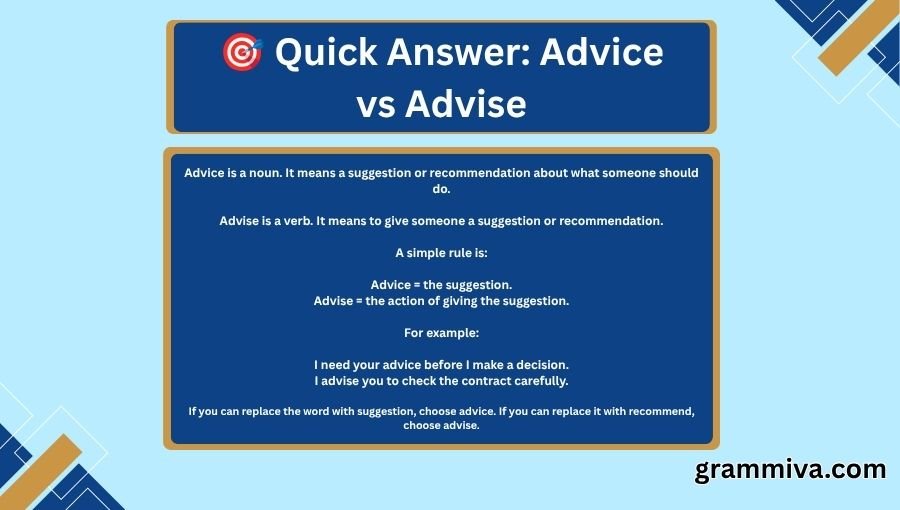
Advice is a noun. It means a suggestion or recommendation about what someone should do.
Advise is a verb. It means to give someone a suggestion or recommendation.
A simple rule is:
Advice = the suggestion.
Advise = the action of giving the suggestion.
For example:
- I need your advice before I make a decision.
- I advise you to check the contract carefully.
If you can replace the word with suggestion, choose advice. If you can replace it with recommend, choose advise.
Advice vs Advise: Related Word Forms
These words do not have a normal plural-versus-possessive relationship, but they do have related forms that are easy to mix up.
| Form | Type | Example |
|---|---|---|
| advice | Noun | She gave me useful advice. |
| advise | Verb | I advise you to wait. |
| advised | Past-tense verb/adjective | The doctor advised him to rest. |
| advising | Present participle/gerund | She is advising the team. |
| advises | Third-person singular verb | He advises new employees. |
The key pair is still advice and advise. The other forms come from the verb advise.
🎯 Understanding Advice vs Advise
The main difference between advice vs advise is grammatical. Advice names information or a recommendation. Advise describes the action of giving that recommendation.
Think of it this way:
Advice is a thing. Advise is an action.
| Form | Type | Meaning | Example | Correct/Incorrect |
|---|---|---|---|---|
| advice | Noun | A suggestion or recommendation | Your advice helped me. | ✅ Correct |
| advise | Verb | To give a suggestion | I advise you to wait. | ✅ Correct |
| advice | Verb | To give a suggestion | I advice you to wait. | ❌ Incorrect |
| advise | Noun | A suggestion | Thanks for your advise. | ❌ Incorrect |
| advice | Noun | A suggestion | She asked for my advice. | ✅ Correct |
Advice Is a Noun
Advice is a noun because it names a suggestion, recommendation, or helpful opinion.
You can often put words such as some, good, helpful, useful, or valuable before it.
Examples:
- I need some advice.
- She gave me good advice.
- His advice was helpful.
- We followed your advice.
- Can I ask for your advice?
Notice that advice does not describe an action. It names the information being given.
Advise Is a Verb
Advise is a verb because it describes an action.
Examples:
- I advise you to save a copy.
- The lawyer advised us to read the agreement.
- My teacher advised me to practice every day.
- We advise customers to arrive early.
- She advised him not to sign the form.
A useful sentence pattern is:
advise + person + to + verb
For example:
The manager advised the employee to speak with HR.
Another common pattern is:
advise + against + noun or -ing form
For example:
I advise against driving in heavy snow.
How the Two Words Work Together
You can use both words in the same sentence.
My advice is to leave early, and I advise you to avoid rush hour.
Here, advice names the recommendation. Advise describes the act of making that recommendation.
Meaning Summary
| Meaning | Word Type | Example Sentence |
|---|---|---|
| A helpful suggestion | Noun | Her advice was practical. |
| A recommendation | Noun | I asked for his advice. |
| The act of giving a recommendation | Verb | I advise you to wait. |
| Giving a warning or recommendation | Verb | Doctors advise patients to exercise. |
💡 How To Remember the Difference
The easiest memory trick is to focus on the final sound.
Advice has an S sound at the end.
Advise has a Z sound at the end.
You do not need to memorize complicated grammar terms. Just remember:
Advice = a piece of guidance.
Advise = to give guidance.
Another useful trick is the ice/action test.
If you are talking about the thing someone gives you, use advice.
If you are talking about what someone does, use advise.
| Question | Answer | Word |
|---|---|---|
| What did she give me? | A recommendation | advice |
| What did she do? | She recommended something | advise |
| What do I need? | A suggestion | advice |
| What should I do? | I should recommend or guide | advise |
🧠 Is Advice or Advise Correct in a Sentence?
The correct choice depends on the job the word performs.
Use advice when the word acts as a noun. Use advise when the word acts as a verb.
Compare these sentences:
- I need your advice. ✅
- I advise you to wait. ✅
- She gave me helpful advice. ✅
- She advised me to wait. ✅
Now compare the incorrect versions:
- I need your advise. ❌
- I advice you to wait. ❌
- She gave me helpful advise. ❌
- She adviced me to wait. ❌
Test Tip 💡
Try replacing the word with suggestion.
If the sentence still works, use advice.
I need your advice.
I need your suggestion.
That works.
Now try the verb test:
I advise you to leave.
I recommend that you leave.
That also works.
If you are describing the act of recommending something, you need advise.
📝 Case Study: Advice vs Advise at Work
Imagine that a manager is writing an email to a new employee.
The manager wants to say that the employee should save important documents before making changes.
Here is the wrong sentence:
I advice you to save a backup before editing the file. ❌
The correct version is:
I advise you to save a backup before editing the file. ✅
The manager could also write:
My advice is to save a backup before editing the file. ✅
The difference is easy to see. In the first sentence, advise is the action the manager wants the employee to take. In the second sentence, advice is the recommendation itself.
I once edited a short workplace memo where the writer had used advise every time they meant advice. The message was still understandable, but the repeated mistake made the memo look rushed. A two-word grammar check fixed the whole problem: “Is this a thing or an action?”
That is a useful editing habit.
Advice vs Advise: Grammar Rules Explanation
The grammar rule is based on word type.
Advice is a noun. It refers to a recommendation, suggestion, or guidance.
Advise is a verb. It means to recommend, suggest, or give guidance.
Standard English reference sources agree on this basic distinction.
Because advice is a noun, it can appear after verbs such as give, get, ask for, need, seek, and follow.
Examples:
- give advice
- get advice
- ask for advice
- need advice
- seek advice
- follow advice
Because advise is a verb, it can appear after subjects such as I, we, they, she, and he.
Examples:
- I advise you to wait.
- We advise customers to arrive early.
- She advises students to plan ahead.
- They advised us to check the details.
The past form of advise is advised, not adviced.
Correct vs Incorrect at a Glance
| Sentence | Correct/Incorrect | Why |
|---|---|---|
| I need your advice. | ✅ Correct | Advice is a noun. |
| I need your advise. | ❌ Incorrect | Advise is a verb. |
| I advise you to wait. | ✅ Correct | Advise is a verb. |
| I advice you to wait. | ❌ Incorrect | Advice cannot function as this verb. |
| She advised me to call later. | ✅ Correct | Advised is the past form of advise. |
⚠️ Why Do People Confuse Advice and Advise?
People confuse these words because they look nearly identical and have closely related meanings. Both words are connected with giving recommendations, so it is easy to type one when you mean the other.
The spelling difference is only one letter:
- advice
- advise
Their sounds also differ at the end, but that difference may not be clear to every speaker.
There are several common reasons for the mistake:
- Fast typing: You know the rule but type too quickly.
- Autocorrect: Your device may not catch the grammar problem because both words are correctly spelled.
- Lack of knowledge: You may never have learned that the words have different grammatical roles.
- Similar meaning: Both words relate to recommendations.
- Workplace pressure: You may write quickly when sending an email or message.
A student once wrote, “Thank you for your advise,” on an assignment. She knew exactly what she meant. She simply treated the word as a verb because it sounded like one. Once we changed it to “Thank you for your advice,” the rule made sense to her.
Similar Grammar Confusions
| Confusing Pair | Correct Difference |
|---|---|
| advice / advise | noun / verb |
| it’s / its | contraction / possessive |
| your / you’re | possessive / contraction |
| their / they’re | possessive / contraction |
| affect / effect | usually verb / usually noun |
| then / than | time or sequence / comparison |
Common Wrong Forms
| Wrong Form | What’s Wrong | Correct Form |
|---|---|---|
| Thanks for your advise. | A noun is needed. | Thanks for your advice. |
| I advice you to wait. | A verb is needed. | I advise you to wait. |
| She adviced me. | The past form is not “adviced.” | She advised me. |
| Helpful advise | A noun is needed. | Helpful advice |
| Please advice me. | The verb is misspelled. | Please advise me. |
| He gave me an advise. | “Advice” is normally uncountable. | He gave me some advice. |
📚 Word History and Spelling
The modern forms advice and advise developed from closely related words in English and French. Their spellings became separated over time to reflect their different grammatical roles.
The important point for modern writers is not the full history. It is the spelling pattern we use today.
| Period | Form | Note |
|---|---|---|
| Earlier English use | Related forms | Words for guidance and recommendation developed from related roots. |
| Middle English | Related spellings | Different forms appeared in English writing. |
| Later English | advice / advise | The noun and verb became more clearly distinguished in spelling. |
| Modern English | advice / advise | The noun-versus-verb distinction remains standard. |
You do not need to memorize this history to use the words correctly. The modern grammar rule is what matters most.
🌎 Advice vs Advise in Different Contexts
The same basic rule applies whether you are speaking with a friend, writing a business email, creating a story, or posting online.
| Context | Which Term to Use | Example |
|---|---|---|
| Everyday conversation | advice for a suggestion | Can I ask for your advice? |
| Professional writing | advice for a recommendation | Thank you for your advice. |
| Professional writing | advise for an action | We advise customers to arrive early. |
| Creative writing | Either, based on grammar | Her advice changed his mind. |
| Social media/texting | Either, based on grammar | Any advice for a first-time buyer? |
Everyday Conversation
People often ask friends and family for advice.
Examples:
Do you have any advice?
Can I get your advice?
What advice would you give me?
When describing what someone tells another person to do, use advise.
I would advise you to wait.
Professional Writing
Both words are common in business English.
You might write:
We appreciate your advice.
Or:
We advise all customers to keep their receipts.
The verb advise is especially common in formal notices.
Creative Writing
Writers can use both words naturally.
Her father gave her one piece of advice.
Her father advised her to stay calm.
The first sentence focuses on the recommendation. The second focuses on the action of giving it.
Social Media and Texting
Informal writing still follows the same grammar rule.
Need some advice! Which laptop should I buy? ✅
I advise you to compare the prices first. ✅
A casual setting does not change the word’s grammatical role.
💬 Common Phrases With Advice
Advice appears in several everyday phrases. These phrases are useful because they help you recognize the noun quickly.
| Phrase | Meaning |
|---|---|
| ask for advice | request a recommendation |
| give advice | offer a recommendation |
| get advice | receive guidance |
| take someone’s advice | follow someone’s recommendation |
| seek advice | actively look for guidance |
| a piece of advice | one recommendation |
One useful detail is the phrase a piece of advice.
We normally do not say:
an advice ❌
Instead, we say:
a piece of advice ✅
For example:
Let me give you a piece of advice.
This works because advice is generally treated as an uncountable noun in standard English.
🔄 Synonyms and Alternatives
Sometimes you can replace advice or advise with another word. The best choice depends on the sentence.
| Alternative | Works When | Does Not Work When |
|---|---|---|
| suggestion | You mean an idea about what someone could do. | You need a verb describing the act of recommending. |
| recommendation | You mean a specific or useful choice. | The sentence needs a simple action verb. |
| guidance | You mean general help or direction. | You mean one specific suggestion. |
| recommend | You need a verb. | You need a noun after “your” or “some.” |
| counsel | You need a formal word for guidance. | You want a casual everyday tone. |
For example:
I recommend this restaurant.
Here, recommend can replace advise in some contexts.
But:
I appreciate your advice.
You cannot simply replace advice with recommend. The grammar is different.
🎯 Advice vs Advise in Formal and Informal English
The basic rule does not change with the level of formality. Advice remains the noun, and advise remains the verb.
However, different settings may favor different sentence patterns.
| Style | Example |
|---|---|
| Casual | Can I get your advice? |
| Neutral | I need your advice about this decision. |
| Professional | We appreciate your advice on this matter. |
| Formal | We advise all applicants to review the requirements. |
A formal setting does not make advise a more correct version of advice. The choice is still based on grammar.
🧩 How To Check Advice vs Advise While Editing
When I proofread, I use a fast three-step check.
Step 1: Find the word.
Look for advice or advise.
Step 2: Ask what the word is doing.
Is it naming a suggestion?
If yes, use advice.
Is it describing the action of recommending?
If yes, use advise.
Step 3: Try a replacement.
Replace advice with suggestion.
Replace advise with recommend.
For example:
She gave me advice.
Try:
She gave me a suggestion.
It works, so advice is correct.
Now:
She advised me to wait.
Try:
She recommended that I wait.
It works, so advised is correct.
| Original | Replacement Test | Result |
|---|---|---|
| I need your advice. | I need your suggestion. | advice |
| She advised me to wait. | She recommended that I wait. | advised |
| He gave good advice. | He gave a good suggestion. | advice |
| We advise customers to call first. | We recommend that customers call first. | advise |
⚠️ Special Grammar Point: “Please Advise”
You may see Please advise in business emails.
This is correct.
Please advise me of any changes. ✅
Here, advise is a verb. The writer is asking someone to provide information or guidance.
Do not write:
Please advice me of any changes. ❌
The word after please is often a verb when the sentence is giving a direct request.
Compare:
Please advise. ✅
Please advice. ❌
This phrase is common in workplace writing, although a more specific request can sometimes sound clearer.
For example:
Please let me know if the schedule changes.
That sentence may be more direct than “Please advise.”
❤️ Why Getting Advice vs Advise Right Matters
A one-letter spelling difference can affect how polished your writing looks. The reader will usually understand your meaning, but repeated errors can make a message seem less careful.
Accuracy matters in:
- resumes
- cover letters
- client emails
- school assignments
- reports
- published articles
- business notices
- social media posts
A simple rule can help:
“Use the noun for the thing. Use the verb for the action.”
Why Accuracy Matters
| Situation | Why Getting It Right Matters |
|---|---|
| Resume | Shows care with written communication. |
| Client email | Creates a more professional impression. |
| Published content | Builds reader trust. |
| Social post | Makes the message easier to read and share. |
Good grammar does not mean using complicated words. It means choosing the right word for the job.
📝 A Short Real-Life Example
I once caught myself typing “please advice” in a quick message. I was moving fast and knew what I wanted to say, so my brain did not notice the spelling problem. I stopped, changed it to “please advise,” and sent it.
That small moment shows why these errors survive proofreading. Both words look real. Spell-check may not flag either one. You need to check the grammar, not just the spelling.
🧠 How To Remember the Difference Long Term
Here are three simple memory tricks.
Trick 1: Think “thing” versus “action”
Advice = thing.
Advise = action.
Trick 2: Use “suggestion”
If suggestion fits, use advice.
Thanks for your advice.
Thanks for your suggestion.
Trick 3: Use “recommend”
If recommend fits, use advise.
I advise you to check the file.
I recommend that you check the file.
These tests are quick enough to use while writing an email.
Advice vs Advise Practice Examples
Try choosing the correct word before looking at the answers.
- I need some ___ about my new job.
- I ___ you to read the instructions first.
- Thank you for your helpful ___.
- The doctor ___ him to get more rest.
- Can I ask for your ___?
Answers:
| Number | Correct Answer | Why |
|---|---|---|
| 1 | advice | It names guidance. |
| 2 | advise | It describes an action. |
| 3 | advice | It is a noun. |
| 4 | advised | It is the past form of the verb. |
| 5 | advice | It follows “ask for.” |
❓ Is Advice the Same as Advise?
No. Advice is a noun, while advise is a verb. Both relate to suggestions and recommendations, but they perform different jobs in a sentence.
❓ Is “Please Advice” Correct?
No. The standard phrase is “Please advise.” Here, advise is a verb meaning to provide information or guidance.
❓ How Do You Use Advice in a Sentence?
Use advice when you are naming a suggestion or recommendation.
For example:
I appreciate your advice.
She gave me useful advice.
❓ How Do You Use Advise in a Sentence?
Use advise when you are describing the action of giving a recommendation.
For example:
I advise you to wait.
We advise customers to check their orders.
❓ What Is the Difference Between Advice and Advise?
The main difference is grammar. Advice is a noun for a suggestion or recommendation. Advise is a verb meaning to recommend or give guidance.
❓ Is “Adviced” a Correct Word?
No. Adviced is not the standard past-tense form. The correct past tense of advise is advised.
She advised me to leave early. ✅
❓ Can You Say “A Piece of Advice”?
Yes. A piece of advice is a standard expression used for one recommendation.
Let me give you a piece of advice.
Avoid saying “an advice” in standard US English.
❓ Is Advice Countable or Uncountable?
Advice is normally an uncountable noun in standard English. That is why we usually say some advice, good advice, or a piece of advice, rather than an advice.
❓ What Is an Easy Trick for Remembering Advice and Advise?
Think advice = suggestion and advise = recommend.
If you mean the thing someone gives, choose advice. If you mean the action of giving guidance, choose advise.
❓ Which One Should I Use in a Professional Email?
Use advice when you are referring to guidance you received or want to receive. Use advise when you are asking someone to provide information or telling someone what you recommend.
For example:
Thank you for your advice.
Please advise if you need anything else.
❓ Why Does Autocorrect Not Always Catch the Mistake?
Both advice and advise are correctly spelled English words. Spell-check tools may not know which one fits your sentence because the problem is grammatical, not simply a spelling error.
🔍 Quick Recap Checklist
Use this checklist whenever you are unsure.
| Question | If Yes → Use |
|---|---|
| Am I naming a suggestion? | advice |
| Am I asking for guidance? | advice |
| Can I replace the word with “suggestion”? | advice |
| Am I describing the action of recommending? | advise |
| Can I replace the word with “recommend”? | advise |
| Am I writing “Please ___”? | advise |
| Am I talking about past guidance? | advised |
Final Practice
- My teacher gave me some good advice. ✅
The word names a suggestion. - My teacher advised me to practice more. ✅
The word describes the action of recommending. - My teacher gave me some good advise. ❌
The noun should be advice.
FAQs About Advice vs Advise
What is the simple difference between advice and advise?
Advice is a noun meaning a suggestion or recommendation. Advise is a verb meaning to give a suggestion or recommendation.
Which is correct: “Thanks for your advice” or “Thanks for your advise”?
“Thanks for your advice” is correct because the sentence needs a noun after “your.”
Which is correct: “I advice you” or “I advise you”?
“I advise you” is correct because the sentence needs a verb.
Is “Please advise” grammatically correct?
Yes. Please advise is grammatically correct because advise is functioning as a verb.
Can I say “a good advice”?
In standard US English, it is better to say good advice or a good piece of advice. The noun advice is normally uncountable.
What is the past tense of advise?
The past tense is advised.
The doctor advised me to rest.
Is advice a noun or a verb?
Advice is a noun. It names a suggestion, recommendation, or guidance.
Is advise a noun or a verb?
Advise is a verb. It describes the action of giving a recommendation or guidance.
How can I remember advice vs advise?
Remember:
Advice = a thing.
Advise = an action.
You can also use the replacement test: suggestion → advice and recommend → advise.
Why do advice and advise look so similar?
They are closely related words with similar meanings, so their spellings can easily be confused. Their grammatical roles are different, though, which is why English uses different forms.
Advice vs Advise: Final Takeaway
Advice vs advise becomes easy once you remember one rule: advice is the noun, and advise is the verb. If you are talking about a suggestion, recommendation, or guidance itself, choose advice. If you are describing the act of giving that guidance, choose advise.
When I edit a sentence, I ask one quick question: “Am I naming the suggestion, or am I describing the action?” That question solves most cases immediately.
Remember these two examples:
I need your advice.
I advise you to wait.
The first sentence names the guidance. The second describes the action of giving it.
Once this pattern becomes familiar, you will spot the difference almost automatically. Keep the rule simple, check the word’s job in the sentence, and do not rely only on spell-check. A tiny spelling difference can make your writing much cleaner and more professional. ✨
Advice is the suggestion. Advise is the action. Remember that, and you will never have to guess again.

I am Adam Wilson, an English language content writer with an interest in grammar and vocabulary. I work at Grammiva and focus on creating clear explanations and practical examples for English learners.
[…] mistakes, memory tricks, real-life uses, and practical tests you can use whenever you are unsure. Advice vs Advise | Than vs Then | Your vs […]
[…] so you can choose the right spelling without stopping to think twice. ✍️ Affect vs Effect | Advice vs Advise | Than vs […]