Have you ever typed a sentence, looked at principal vs principle, and suddenly wondered which word belongs there? You are not alone. These two words sound almost the same, and both are common in school, work, news, and everyday writing. Yet they have very different meanings.
The good news is that you do not need to memorize a long grammar rule. Once you connect each word with its main meaning, the difference becomes much easier to spot.
I have taught and edited enough English to know that a simple memory trick often works better than a page of rules. 😊 In this guide, I will explain principal vs principle in plain US English.
You will learn what each word means, how to use it, how to remember the difference, and how to avoid common mistakes. By the end, choosing between these two words should feel almost automatic. ✨ Who vs Whom | Aluminum vs Aluminium | Aerofoil vs Airfoil
🎯 Quick Answer: Principal vs Principle
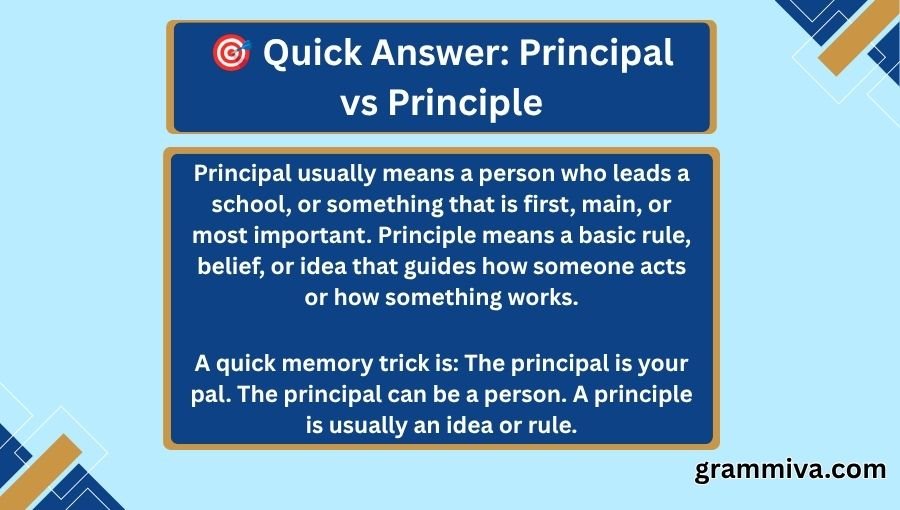
Principal usually means a person who leads a school, or something that is first, main, or most important. Principle means a basic rule, belief, or idea that guides how someone acts or how something works.
A quick memory trick is: The principal is your pal. The principal can be a person. A principle is usually an idea or rule.
| Word | Main Meaning | Example |
|---|---|---|
| principal | School leader | The principal spoke at the assembly. |
| principal | Main or most important | Safety is our principal concern. |
| principal | Original amount of money borrowed or invested | She paid down the principal on her loan. |
| principle | Basic rule or belief | Honesty is one of his core principles. |
| principle | Basic idea behind something | The machine works on a simple principle. |
Is Principal the Same as Principle?
No. Principal and principle are different words with different meanings. The easiest way to separate them is to remember that principal often points to a person, a main thing, or money, while principle points to a rule, belief, or basic idea.
Here is the difference at a glance:
| Form | Type | Meaning | Example | Correct/Incorrect |
|---|---|---|---|---|
| principal | noun | School leader | The principal called a meeting. | ✅ Correct |
| principal | adjective | Main or most important | This is the principal reason. | ✅ Correct |
| principal | noun | Main amount of a loan or investment | He paid $500 toward the principal. | ✅ Correct |
| principle | noun | Rule or belief | She follows a strong moral principle. | ✅ Correct |
| principle | noun | Basic idea or law | The device works by a simple principle. | ✅ Correct |
| principle | noun | School leader | The principle called a meeting. | ❌ Incorrect |
The spelling difference is small, but the meaning difference is large.
📚 Principal vs Principle: Meaning and Correct Use
The core rule is simple: principal can describe a leader, a main thing, or the main amount of money. Principle refers to a rule, belief, or basic idea.
I recommend learning the words by meaning rather than by spelling alone. When you know what the sentence is trying to say, the correct spelling becomes much easier to choose.
Principal as a School Leader
Principal is a noun when it means the person who leads a school.
Examples:
- The principal welcomed the new students.
- I spoke with the principal after class.
- Our principal announced the new school policy.
Break the first sentence down:
The principal = the school leader.
welcomed = the action.
the new students = the people receiving the action.
So, if you are talking about a school leader, use principal.
Principal as “Main” or “Most Important”
Principal can also be an adjective. In this use, it means main, chief, or most important.
Examples:
- The principal reason for the change was cost.
- Her principal goal is to help new writers.
- The company’s principal office is in Chicago.
Here, principal does not name a person. It tells us that something is the main or most important one.
Principal in Money and Finance
In financial writing, principal means the original amount of money borrowed or invested, apart from interest.
For example:
- I made a payment toward the principal of my mortgage.
- The bank charges interest on the loan principal.
- She invested $10,000 and earned interest on the principal.
If you borrow $20,000 and later pay $3,000 toward the amount you actually borrowed, that payment reduces the principal. Interest is a separate cost.
Principle as a Rule or Belief
Principle is a noun. It usually refers to a basic rule, value, or belief.
Examples:
- Honesty is an important principle in our family.
- He refused the offer on principle.
- The company operates according to clear ethical principles.
A principle can guide someone’s choices. It does not have to be a written rule.
For example, a person might have the principle that people should always be treated fairly. That belief can influence many decisions.
Principle as a Basic Idea
Principle can also describe a basic idea that explains how something works.
Examples:
- The engine works on a simple principle.
- Scientists use basic principles to explain the process.
- The teacher explained the principle behind the experiment.
Here, principle is not about personal morality. It means a basic idea or rule behind something.
Quick Meaning Table
| Meaning | Word Type | Example Sentence |
|---|---|---|
| School leader | Noun | The principal met with the parents. |
| Main or most important | Adjective | Her principal concern was safety. |
| Main amount of a loan | Noun | He paid extra toward the principal. |
| Personal rule or belief | Noun | She has strong principles. |
| Basic idea or rule | Noun | The machine follows a simple principle. |
💡 How Can You Remember Principal vs Principle?
You can remember the difference with two simple mental links: principal = person/main, while principle = rule/belief.
The most popular school-related memory trick is:
The principal is your pal.
Both principal and pal contain the letter a. The trick is not a complete grammar rule, but it is useful when you need to remember the spelling of the school leader.
For principle, think of a personal rule or belief.
Try this:
- Principal → person, main, money
- Principle → rule, belief, basic idea
I once watched a student prepare for a spelling test by writing “principal = pal” on a sticky note beside her desk. A week later, she used the word correctly in every school example. The trick worked because she connected the spelling to meaning rather than trying to memorize two isolated spellings.
A Fast Test
Ask yourself:
Am I talking about a school leader?
→ Use principal.
Am I talking about something main or most important?
→ Use principal.
Am I talking about money borrowed or invested?
→ Use principal.
Am I talking about a rule, belief, or basic idea?
→ Use principle.
That four-part test handles most everyday cases.
📝 Principal vs Principle in Real-Life Writing
A workplace email shows how easily these words can change meaning.
Imagine a manager writes:
“Our principal concern is customer safety.”
Here, principal means the main concern.
Now imagine the manager writes:
“Customer safety is one of our guiding principles.”
Here, principles means the company’s basic values or rules.
Both sentences can be correct. The writer’s intended meaning decides which word belongs.
Case Study: A Workplace Email
Imagine an employee writing this message:
“I believe honesty is an important principal of our team.”
The sentence has one wrong word. The intended meaning is a guiding belief or rule. Therefore, principle is correct:
“I believe honesty is an important principle of our team.”
Now compare it with:
“Customer safety is our principal concern.”
This is correct because principal means the main concern.
| Original Idea | Correct Word | Correct Sentence |
|---|---|---|
| School leader | principal | The principal approved the event. |
| Main concern | principal | Safety is our principal concern. |
| Guiding belief | principle | Fairness is an important principle. |
| Basic scientific idea | principle | The experiment demonstrates a basic principle. |
| Loan amount | principal | She made a payment toward the principal. |
A useful habit is to pause before typing. Ask what the word means in that sentence. That one-second check can prevent a surprisingly common error.
Grammar Rules Explanation: Why Are They Different?
Principal and principle are both nouns, but principal can also work as an adjective. Their meanings are not interchangeable.
Use principal when the sentence refers to:
- A school leader.
- Something main or most important.
- The main amount of money borrowed or invested.
Use principle when the sentence refers to:
- A rule.
- A belief or value.
- A basic idea or law.
Standard English reference works agree on this basic distinction. The key is not the sound of the word. The key is the meaning.
Correct vs Incorrect at a Glance
| Sentence | Correct/Incorrect | Why |
|---|---|---|
| The principal spoke to the students. | ✅ Correct | A school leader is a principal. |
| Honesty is a core principle. | ✅ Correct | A principle can be a guiding belief. |
| Safety is our principal concern. | ✅ Correct | Principal means main or most important. |
| The principle spoke at graduation. | ❌ Incorrect | A school leader is a principal. |
| She follows strong principals. | ❌ Incorrect | For guiding beliefs, the plural is principles. |
The most important lesson is this: similar sound does not mean similar meaning.
⚠️ Common Mistakes With Principal and Principle
People often confuse these words because they sound alike. In speech, you may not notice the difference at all. The problem appears when you write them.
Three common causes are:
- Fast typing: You type the first spelling that comes to mind.
- Autocorrect: Your device may not know which meaning you intended.
- Lack of knowledge: You may have learned the words by sound without learning their separate meanings.
I once caught myself typing “principal” in a sentence about a company’s guiding values. I reread the sentence before sending it and changed it to “principle.” The error was tiny, but the reread caught it.
Similar Grammar Confusions
| Confused Forms | Correct Use | Quick Reminder |
|---|---|---|
| its / it’s | its = belonging to it; it’s = it is | Try “it is.” |
| your / you’re | your = belonging to you; you’re = you are | Try “you are.” |
| their / they’re | their = belonging to them; they’re = they are | Try “they are.” |
| affect / effect | Usually affect = influence; effect = result | Check the sentence role. |
| then / than | then = time/order; than = comparison | Look for a comparison. |
| principal / principle | principal = leader/main/money; principle = rule/belief/idea | Check the meaning. |
Wrong Forms to Watch For
| Wrong Form | What’s Wrong | Correct Form |
|---|---|---|
| school principle | A school leader is a principal. | school principal |
| moral principal | A moral rule is a principle. | moral principle |
| guiding principal | A guiding belief is a principle. | guiding principle |
| principal of fairness | Fairness is a value or rule. | principle of fairness |
| school principle’s office | The leader’s title is principal. | principal’s office |
| company principals | If you mean company values, this is the wrong word. | company principles |
Notice that principal’s can be correct when it is possessive:
The principal’s office is on the second floor.
Here, the apostrophe does not change the base word. The school leader is still the principal.
🕰️ The History Behind Principal and Principle
The two words have a shared historical background connected with the idea of something being first or basic, but modern English gives them different uses. Their similar spelling and sound help explain why learners often mix them up.
Over time, principal developed common uses involving a leading person, a main thing, and the main amount of money. Principle became associated with a basic rule, belief, or idea.
| Period | Form | General Note |
|---|---|---|
| Earlier English use | principal | Connected with the idea of being first or chief. |
| Later English use | principal | Expanded into uses for leaders and main things. |
| Later English use | principle | Became established for basic rules, beliefs, and ideas. |
| Modern English | principal | Common for school leaders, main concerns, and loan amounts. |
| Modern English | principle | Common for values, rules, and basic ideas. |
You do not need to remember this history to use the words correctly. The modern meaning test is much more useful.
🌎 Principal vs Principle in Different Contexts
The context can make the choice especially clear.
| Context | Which Term to Use | Example |
|---|---|---|
| Everyday conversation | Either, depending on meaning | The principal called me. |
| Professional writing | Either, depending on meaning | Safety is our principal concern. |
| Creative writing | Either, depending on meaning | She would not break her principles. |
| Social media/texting | Either, depending on meaning | Our principal gave us the day off. |
Everyday Conversation
You might say:
“I need to talk to the principal.”
That means the school leader.
You might also say:
“He refused on principle.”
That means he refused because doing otherwise would go against his beliefs or values.
Professional Writing
Both words are common in business writing.
Examples:
“Our principal goal is to reduce waste.”
“The company follows strict safety principles.”
The first means main goal. The second refers to guiding rules or values.
Creative Writing
Writers may use principle when describing a character’s values:
“She would rather lose the job than abandon her principles.”
They may use principal when describing the main feature of something:
“The principal character entered the room.”
Social Media and Texting
Short messages do not change the grammar rule.
You might write:
“The principal just announced a snow day!”
Or:
“I won’t do it. It’s against my principles.”
Informal writing can be brief, but the meaning of each word stays the same.
Common Phrases With Principal and Principle
Some phrases make the difference easier to remember because they appear often in standard English.
| Phrase | Meaning |
|---|---|
| school principal | The leader of a school |
| principal concern | The main concern |
| principal reason | The main reason |
| principal amount | The original amount of money borrowed or invested |
| guiding principle | A rule or belief that guides action |
| on principle | Because of a belief or value |
Here are the phrases in sentences:
- The school principal sent a letter to parents.
- Cost is the principal concern.
- That was the principal reason for the change.
- She made a payment on the principal amount.
- Trust is a guiding principle of the team.
- He declined on principle.
These phrases are worth learning as complete units. They can help you recognize the correct word quickly.
🎯 Principal vs Principle: A Simple Decision Guide
When I edit a sentence containing one of these words, I use a meaning-first approach. I do not start by looking at the spelling. I first ask what the writer means.
Use this decision guide:
Does the word mean a school leader?
→ principal
Does it mean main or most important?
→ principal
Does it mean the main amount of a loan or investment?
→ principal
Does it mean a rule, belief, value, or basic idea?
→ principle
For example:
The ______ reason for the delay was bad weather.
“Main reason” makes sense. Therefore:
The principal reason for the delay was bad weather.
Now:
Honesty is a basic ______ of good leadership.
“Rule” or “belief” makes sense. Therefore:
Honesty is a basic principle of good leadership.
The substitution test is powerful because it focuses on meaning.
Are There Synonyms for Principal and Principle?
Yes, but the best alternative depends on the meaning. A synonym can sometimes help you decide which word you need.
| Alternative | Works When | Does Not Work When |
|---|---|---|
| main | principal means most important | You mean a school leader. |
| chief | principal means most important | You mean a loan amount. |
| leader | principal means school leader | You mean “main.” |
| rule | principle means a guiding rule | You mean a school leader. |
| belief | principle means a personal value | You mean a basic scientific idea. |
For example, if you can replace principal with main, you probably have the correct word:
Our principal concern is safety.
Our main concern is safety.
If you can replace principle with rule, you probably have the correct word:
Fairness is an important principle.
Fairness is an important rule.
This test is not perfect in every sentence, but it works very well in common cases.
💼 Why Getting Principal and Principle Right Matters
Correct word choice makes writing clearer. It also shows that you understand the meaning of the words you use.
A spelling mistake between these two words may not make a sentence impossible to understand, but it can make the writer look careless. That matters more in formal settings.
Clear words create clear messages.
That short rule is worth remembering.
| Situation | Why Getting It Right Matters |
|---|---|
| Resume | Shows careful writing and attention to detail. |
| Client email | Helps create a professional impression. |
| Published content | Prevents readers from being distracted by errors. |
| Social post | Makes your message easier to understand and share. |
Imagine writing:
“The principal of honesty is important to our company.”
A reader may understand your meaning, but principle of honesty is the correct form. In a business document, that small mistake can weaken an otherwise polished message.
Accuracy does not mean using complicated words. It means using simple words correctly.
🔍 When Should You Use Principal?
Use principal when you mean a school leader, something main, or the main amount of money.
Here are three quick patterns:
Person:
The principal met with the teacher.
Main:
That is the principal reason.
Money:
The payment reduced the loan principal.
| Pattern | Meaning | Example |
|---|---|---|
| principal + person | School leader | The principal called home. |
| principal + noun | Main or most important | Her principal goal is accuracy. |
| loan/investment + principal | Main money amount | Interest was calculated on the principal. |
If one of these three meanings fits, principal is likely your answer.
📖 When Should You Use Principle?
Use principle when you mean a basic rule, belief, value, or idea.
For example:
Respect is a basic principle of good teamwork.
Here, respect is a guiding value.
Another example:
The machine operates according to a simple principle.
Here, the word refers to a basic idea behind how something works.
| Pattern | Meaning | Example |
|---|---|---|
| moral principle | Personal or ethical value | Honesty is a moral principle. |
| guiding principle | Rule that guides action | Safety is our guiding principle. |
| basic principle | Fundamental idea | The lesson teaches a basic principle. |
| on principle | Because of a belief | She refused on principle. |
A useful clue is that principle is almost always about an idea rather than a person.
❓ Why Do People Confuse Principal and Principle?
People confuse these words because they sound very similar and often appear in related kinds of sentences. Spelling alone does not give you a strong clue, so meaning must do the work.
School settings create a particularly common trap. Someone may hear “principal” many times but later remember only the sound. When they write the word, principle may seem equally plausible.
Another issue is that principal has several meanings. It can refer to a person, a main concern, or money. That makes it harder to attach the word to one simple definition.
The good news is that you only need a few mental labels:
- Principal = person
- Principal = main
- Principal = money
- Principle = rule
- Principle = belief
- Principle = basic idea
Those labels cover most everyday uses.
❓ Can Principal Be an Adjective?
Yes. Principal can be an adjective when it means main or most important.
For example:
The principal cause of the problem was poor planning.
Here, principal describes the noun cause.
Compare:
The principal spoke to us.
In this sentence, principal is a noun because it names a person.
| Sentence | Part of Speech | Meaning |
|---|---|---|
| The principal called. | Noun | School leader |
| The principal reason was cost. | Adjective | Main |
| The principal amount was reduced. | Noun | Main amount of money |
| Her principles are strong. | Noun | Beliefs or values |
This is one reason the word can feel confusing. Its grammatical role can change while the spelling stays the same.
❓ Can Principle Be Plural?
Yes. The plural form of principle is principles.
Use principles when you mean more than one rule, belief, value, or basic idea.
Examples:
- The organization follows several ethical principles.
- He taught his children important life principles.
- These scientific principles apply in many situations.
Do not use principals when you mean rules or beliefs.
❌ The company has strong ethical principals.
✅ The company has strong ethical principles.
The word principals can be correct when it is the plural of principal, such as:
The district met with all the school principals.
❓ What Is the Difference Between Principal and Principle in a Sentence?
The difference depends on the meaning of the word in that sentence.
Consider these two examples:
The principal concern is safety.
Here, principal means main.
Safety is a core principle.
Here, principle means a guiding value or rule.
The words can appear in sentences about the same topic while still having different meanings.
| Sentence | Meaning of the Word |
|---|---|
| The principal called a meeting. | School leader |
| Safety is the principal concern. | Main concern |
| Safety is a core principle. | Guiding value |
| He paid the loan principal. | Main amount borrowed |
| The experiment shows a scientific principle. | Basic idea |
❓ Is “Principal” Always Related to Schools?
No. Principal is not limited to schools. It can mean the main or most important person or thing, and it has a financial meaning as well.
Examples:
The principal reason was cost.
The principal amount of the loan was $50,000.
So, the school meaning is only one use. This is why memorizing “principal = school leader” is not enough.
A better memory rule is:
Principal = leader, main, or money.
❓ Is “Principle” Always a Moral Rule?
No. Principle can refer to moral values, but it can also mean a basic idea or rule behind something.
For example:
She refuses to lie on principle.
This is about a value.
But:
The device works according to a simple principle.
This is about a basic idea.
So, think of principle as a rule, belief, value, or basic idea. It is not limited to morality.
❓ What Does “On Principle” Mean?
On principle means doing or refusing something because of a belief or value.
For example:
He would not accept the unfair offer on principle.
The sentence means that accepting the offer would conflict with his beliefs.
Other examples include:
- She refused to cheat on principle.
- I do not support the plan on principle.
- He would not take credit for someone else’s work on principle.
This phrase always uses principle, not principal.
❓ What Does “Principal Amount” Mean?
The principal amount is the main amount of money borrowed or invested, separate from interest.
For a loan, the principal is the amount you owe before adding interest and other charges.
For example, if you borrow $10,000, the $10,000 is the initial principal. Payments can reduce that amount over time.
I made an extra payment toward the loan principal.
Here, principal is correct because the sentence concerns money.
❓ Which Is Correct: “School Principal” or “School Principle”?
The correct phrase is school principal.
A school leader is a principal.
✅ The school principal announced the new schedule.
❌ The school principle announced the new schedule.
The word principle means a rule, belief, or basic idea. It does not mean the person who leads a school.
❓ Which Is Correct: “Guiding Principal” or “Guiding Principle”?
The correct phrase is guiding principle.
A guiding principle is a belief or rule that helps direct behavior or decisions.
✅ Honesty is our guiding principle.
❌ Honesty is our guiding principal.
A school leader can be a principal, but a guiding rule is a principle.
❓ How Do I Know Which Word to Use Quickly?
Replace the word with a simpler word.
If main works, choose principal.
The principal reason = the main reason.
If rule or belief works, choose principle.
A principle of fairness = a rule or belief about fairness.
If you mean a school leader, choose principal.
If you mean loan money, choose principal.
This gives you a fast four-question check:
- Is it a school leader?
- Does it mean main?
- Does it mean loan or investment money?
- Is it a rule, belief, or basic idea?
The first three point to principal. The last points to principle.
🧠 Quick Recap Checklist
Use this checklist whenever you are unsure.
| Question | If Yes → Use |
|---|---|
| Does it mean a school leader? | principal |
| Does it mean main or most important? | principal |
| Does it mean the main amount of a loan or investment? | principal |
| Does it mean a rule or belief? | principle |
| Does it mean a basic idea or law? | principle |
Practice Examples
1. The ______ spoke during graduation.
Answer: principal
2. Respect is an important ______ in our family.
Answer: principle
3. The ______ reason for the delay was weather.
Answer: principal
Try creating your own sentence with each word. If you can explain why you chose it, you understand the difference.
✍️ Principal vs Principle: Practice Sentences
Here are several examples to reinforce the rule.
| Sentence | Correct/Incorrect | Explanation |
|---|---|---|
| The principal greeted the parents. | ✅ Correct | School leader |
| Kindness is a good principle. | ✅ Correct | Guiding value |
| Cost was the principal concern. | ✅ Correct | Main concern |
| The bank reduced the principal. | ✅ Correct | Main loan amount |
| She follows strong principles. | ✅ Correct | Beliefs or rules |
| The principle greeted the parents. | ❌ Incorrect | School leader = principal |
| Cost was the principle concern. | ❌ Incorrect | Main concern = principal |
| He follows strong principals. | ❌ Incorrect | Beliefs = principles |
These examples show why context matters more than sound.
🚫 Principal vs Principle: Mistakes to Avoid
Here are some especially common mistakes:
Mistake 1: Using Principle for a School Leader
Wrong:
The principle sent a letter home.
Right:
The principal sent a letter home.
Mistake 2: Using Principal for a Belief
Wrong:
Honesty is an important principal.
Right:
Honesty is an important principle.
Mistake 3: Using Principle for “Main”
Wrong:
This is the principle reason.
Right:
This is the principal reason.
Mistake 4: Using Principals for Beliefs
Wrong:
The team’s principals include fairness and respect.
Right:
The team’s principles include fairness and respect.
Mistake 5: Assuming Every Use of Principal Is About Schools
Wrong idea:
“Principal” only means a school leader.
Better idea:
Principal can mean a school leader, something main, or a main financial amount.
📌 A One-Line Rule to Remember
If you remember only one thing, remember this:
Principal is the person, the main thing, or the money; principle is the rule, belief, or basic idea.
That single sentence covers the most important difference.
FAQs About Principal vs Principle
What is the easiest way to remember principal vs principle?
Remember “The principal is your pal.” Use principal for a school leader, something main, or a loan’s main amount. Use principle for a rule, belief, value, or basic idea.
Is the school principal spelled principal or principle?
It is spelled principal. A school principal is the person who leads a school.
Is it “principal reason” or “principle reason”?
The correct phrase is principal reason when you mean the main reason.
The principal reason for leaving was the cost.
Is it “guiding principle” or “guiding principal”?
The correct phrase is guiding principle because it means a rule or belief that guides someone.
Is it “moral principal” or “moral principle”?
The correct phrase is moral principle. A moral principle is a belief or rule about right and wrong.
Is “principal” a noun or adjective?
It can be either. As a noun, it can mean a school leader or the main amount of money. As an adjective, it means main or most important.
Can “principle” refer to science?
Yes. Principle can mean a basic idea or rule that explains how something works.
For example:
The device works according to a basic scientific principle.
What is the plural of principal?
The plural is principals.
For example:
The district held a meeting for all school principals.
What is the plural of principle?
The plural is principles.
For example:
The organization follows several ethical principles.
What does “on principle” mean?
On principle means acting according to a belief or value.
For example:
She refused the offer on principle.
It means she refused because accepting it would go against her beliefs.
Conclusion: Principal vs Principle Made Simple
Principal vs principle becomes much easier when you focus on meaning instead of sound. Use principal for a school leader, something main or most important, or the main amount of money in a loan or investment. Use principle for a rule, belief, value, or basic idea.
When you are unsure, ask yourself what the word means. If you could replace it with main, school leader, or loan amount, choose principal. If you could replace it with rule, belief, or basic idea, choose principle.
You do not need to memorize dozens of examples. A few strong connections are enough. Principal = person, main, money. Principle = rule, belief, idea.
The next time these two words sound alike on the page, pause for one second and check the meaning. That tiny habit can turn a confusing spelling choice into an easy one. 🌟
When the meaning is clear, the spelling usually follows.

I am Alex Morgan, an English grammar and vocabulary writer passionate about making language learning simple and useful. I work at Grammiva, where I create clear educational content and practical English examples for learners.

[…] everyday uses. By the end, you should be able to choose the right word quickly and confidently. ✨ Principal vs Principle | Who vs Whom | Aluminum vs […]