Have you ever written a sentence like “I sneaked into the room” and then wondered whether it should be “I snuck into the room”? 🤔 You are not alone. Sneaked vs snuck is a common point of confusion because both forms are used by native US English speakers, but they can feel different depending on the setting.
I teach and edit English, and I often see writers hesitate over this pair.
The good news is simple: both “sneaked” and “snuck” are accepted past-tense forms of “sneak.”
However, “snuck” is much more common in everyday American English, while “sneaked” can sound more formal, careful, or deliberate.
So which one should you choose? The answer depends mainly on your audience, tone, and writing style.
In this guide, I will explain the difference, show you clear examples, cover common mistakes, and give you easy tests you can use whenever you are unsure. ✨ Gases vs Gasses | Disorganized vs Unorganized | Whisky vs Whiskey
🎯 Quick Answer: Sneaked vs Snuck
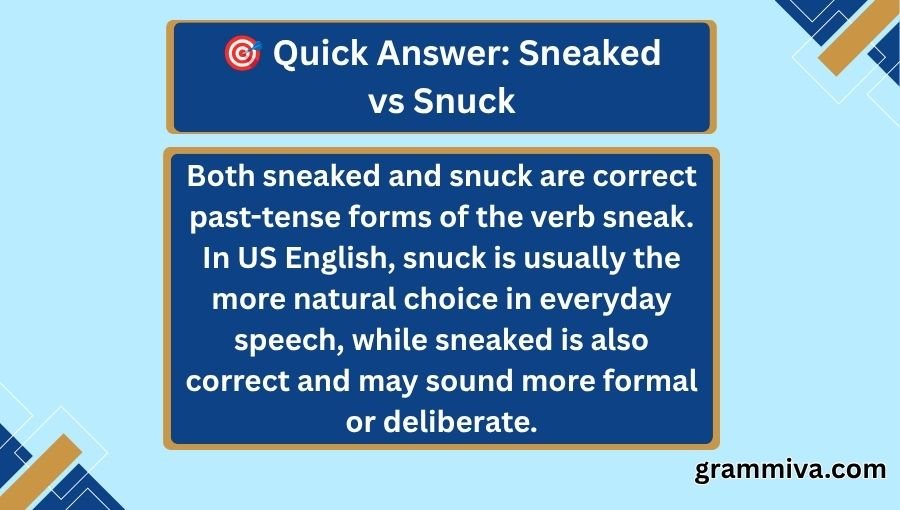
Both sneaked and snuck are correct past-tense forms of the verb sneak. In US English, snuck is usually the more natural choice in everyday speech, while sneaked is also correct and may sound more formal or deliberate.
For example:
- “She snuck out of the house after midnight.”
- “She sneaked out of the house after midnight.”
Both sentences are grammatically correct. The first sounds more natural to many American English speakers.
Related Forms of Sneak
The verb sneak has several useful forms. Knowing them makes the past-tense choice much easier.
| Form | Type | Example |
|---|---|---|
| sneak | Base verb | I want to sneak inside. |
| sneaks | Present tense | He sneaks away quietly. |
| sneaked | Past tense / past participle | She sneaked into the room. |
| snuck | Past tense / past participle | She snuck into the room. |
| sneaking | Present participle | They are sneaking past us. |
The key point is that sneaked and snuck can both fill the past-tense role.
🎯 Is Sneaked the Same as Snuck?
Yes. Sneaked and snuck can both be past-tense forms of sneak, and both can describe moving, acting, or doing something quietly so that other people do not notice.
The main difference is not basic meaning. It is usage and tone.
Compare these sentences:
| Form | Type | Meaning | Example | Correct/Incorrect |
|---|---|---|---|---|
| sneak | Base verb | Move or act quietly | I will sneak out later. | ✅ Correct |
| sneaked | Past tense | Moved or acted secretly | I sneaked out earlier. | ✅ Correct |
| snuck | Past tense | Moved or acted secretly | I snuck out earlier. | ✅ Correct |
| sneaking | -ing form | Moving or acting secretly | They are sneaking away. | ✅ Correct |
| sneakded | Incorrect past form | Not a standard form | She sneakded away. | ❌ Incorrect |
If you are writing for an American audience, snuck will often sound more natural in casual conversation.
Sneaked
“ Sneaked” is a regular past-tense form. It follows the familiar pattern of adding -ed to a verb.
Examples:
- “The child sneaked into the kitchen.”
- “I sneaked a look at the answer.”
- “They sneaked past the guards.”
These sentences are correct.
Snuck
“Snuck” is an irregular past-tense form. It does not use the normal -ed ending.
Examples:
- “The child snuck into the kitchen.”
- “I snuck a look at the answer.”
- “They snuck past the guards.”
These sentences are also correct.
🔍 Why Do People Confuse Sneaked and Snuck?
People confuse these forms because English has two accepted past-tense patterns for this verb. One follows a regular pattern, while the other uses a shorter irregular form.
I once had a student circle snuck in a draft because she thought every past-tense verb had to end in -ed. She knew that “walked” and “jumped” were correct, so “snuck” looked wrong to her. Once we compared it with other irregular verbs such as “went” and “ran,” the problem became much clearer.
English simply does not make every past-tense verb in the same way.
| Reason for Confusion | What Happens | Example |
|---|---|---|
| Fast typing | Writers choose the form that comes to mind first. | “He snuck out.” |
| Autocorrect | Software may favor a familiar form. | “She sneaked away.” |
| Lack of knowledge | A writer may think one form is always wrong. | “Snuck is incorrect.” |
| Regional habits | Speakers hear one form more often. | US speakers often hear “snuck.” |
| Formal writing habits | Writers may prefer regular forms. | “The cat sneaked inside.” |
The safest lesson is this: do not treat “snuck” as a grammar error simply because it does not end in -ed.
🧭 Sneaked vs Snuck at a Glance
The simplest way to understand the pair is to think about style rather than basic grammar.
| Feature | Sneaked | Snuck |
|---|---|---|
| Past tense of sneak | Yes | Yes |
| Grammatically correct | Yes | Yes |
| Common in US casual speech | Yes, but less common | Very common |
| Works in professional writing | Yes | Yes, depending on tone |
| Sounds conversational | Sometimes | Often |
| Sounds more formal | Often | Less often |
| Can describe secret movement | Yes | Yes |
| Can describe secretly doing something | Yes | Yes |
Neither form changes the basic action.
For instance, “She snuck a cookie” and “She sneaked a cookie” both mean that she took a cookie quietly or secretly.
💡 When Should You Use Sneaked?
Use sneaked when you want the regular -ed form or when it fits the tone of your sentence better. It is especially reasonable in careful prose, edited writing, or situations where the regular form sounds more natural to you.
Consider these examples:
- “The reporter sneaked into the back of the meeting.”
- “He sneaked a quick look at his phone.”
- “The dog sneaked into the bedroom.”
- “She sneaked past the sleeping guard.”
Why “Sneaked” Can Sound More Formal
Because sneaked follows the regular past-tense pattern, it can feel more measured or formal. That does not make it more grammatically correct than snuck.
Think of it as a style choice.
A sentence in a formal report might read:
“The employee sneaked into the restricted area before the alarm sounded.”
That sentence is perfectly acceptable.
Meaning Summary
| Meaning | Word Type | Example Sentence |
|---|---|---|
| Move quietly | Verb | The cat sneaked into the room. |
| Avoid being noticed | Verb | He sneaked away before anyone saw him. |
| Secretly look | Verb | She sneaked a glance at the clock. |
| Secretly take or add something | Verb | He sneaked an extra cookie from the plate. |
💡 When Should You Use Snuck?
Use snuck when you want the form that is especially natural in everyday American English. It works well in conversation, informal writing, stories, dialogue, and many ordinary professional sentences.
Examples:
- “He snuck out before dinner.”
- “She snuck a look at the clock.”
- “The dog snuck into the kitchen.”
- “I snuck downstairs after everyone went to bed.”
For many US readers, snuck sounds direct and natural.
A Simple Test Tip
💡 Test Tip: Replace the sentence with a simple everyday version in your head. If you are talking to a friend, “snuck” will often feel natural.
For example:
“I ___ into the room.”
If “I snuck into the room” sounds normal to you, it is a good choice.
Do not reject it simply because it lacks -ed.
📝 A Real-Life Case Study: The Office Email
Imagine an employee notices that a colleague entered a meeting room before the meeting officially started.
An informal message might say:
“Mike snuck into the conference room early.”
That sounds natural and conversational.
A more formal report might say:
“Mike sneaked into the conference room before the scheduled meeting.”
Both sentences communicate the same basic idea.
| Situation | Natural Choice | Example |
|---|---|---|
| Text to a friend | Snuck | Jake snuck out early. |
| Casual workplace chat | Snuck | She snuck into the meeting. |
| Formal report | Sneaked | He sneaked into the restricted area. |
| Story dialogue | Snuck | “I snuck in through the back door.” |
| Edited narrative | Either | The boy sneaked/snuck away. |
The choice should match the voice of the writing.
Grammar Rules Explanation
The grammar rule is straightforward: sneaked and snuck are both established past-tense forms of the verb sneak.
“Sneaked” is formed with the regular -ed ending. “Snuck” is an irregular past-tense form. In standard American English, both forms can be used when the sentence calls for the past tense of “sneak.”
The difference is therefore not the same as a true correct-versus-incorrect pair such as “goed” versus “went.” “Snuck” is not a mistake created by dropping letters from “sneaked.” It is an accepted form in its own right.
Standard English reference works recognize the use of both forms. The practical difference is mainly one of frequency, region, style, and tone.
Correct vs Incorrect at a Glance
| Sentence | Correct/Incorrect | Why |
|---|---|---|
| She sneaked into the room. | ✅ Correct | “Sneaked” is a valid past-tense form. |
| She snuck into the room. | ✅ Correct | “Snuck” is also a valid past-tense form. |
| She sneak into the room yesterday. | ❌ Incorrect | The past-time marker requires past tense. |
| She sneakded into the room. | ❌ Incorrect | “Sneakded” is not a standard form. |
| They were sneaking outside. | ✅ Correct | “Sneaking” is the correct -ing form. |
The important distinction is between sneaked, snuck, and invented forms such as sneakded.
⚠️ Common Mistakes With Sneaked and Snuck
Most mistakes happen because writers assume there must be only one correct past-tense form.
Another common problem is speed. When people type quickly, they often choose the first form that feels familiar.
I once caught myself typing “sneaked” in a casual message because I had just been editing formal prose. I changed it to “snuck” after rereading the sentence. The original was not grammatically wrong. It simply did not match the relaxed tone I wanted.
Here are some common sources of confusion:
| Common Confusion | Correct Choice | Reason |
|---|---|---|
| It’s / its | Depends on meaning | One is a contraction; one is possessive. |
| Your / you’re | Depends on meaning | They have different grammatical jobs. |
| Their / there / they’re | Depends on meaning | The words have different functions. |
| Sneaked / snuck | Both can be correct | They are both past-tense forms of sneak. |
| Affect / effect | Depends on sentence | The words usually have different roles. |
Specific Wrong Forms
| Wrong Form | What’s Wrong | Correct Form |
|---|---|---|
| sneakded | Adds an incorrect ending | sneaked or snuck |
| snucked | Adds -ed-like letters to snuck | snuck |
| sneeked | Misspells the base verb | sneaked |
| sneek | Misspells sneak | sneak |
| snuckked | Incorrectly adds extra letters | snuck |
| sneak yesterday | Wrong tense for the context | sneaked or snuck |
Why These Errors Happen
Three causes appear again and again:
- Fast typing: You type the word before thinking about the sentence.
- Autocorrect: Your software may suggest a form that you did not intend.
- Lack of knowledge: You may have learned one form but never encountered the other.
The best solution is not to memorize a complicated rule. Remember that both “sneaked” and “snuck” are valid past-tense choices.
📚 The History Behind Sneaked and Snuck
The two forms reflect the way English can develop more than one accepted past-tense pattern for the same verb.
“Sneaked” follows the regular pattern of adding -ed. “Snuck” developed as an irregular past form and became established in English use. Over time, both forms continued to appear, with “snuck” becoming especially common in American English.
The important lesson for modern writers is not the exact historical timeline. It is that the existence of both forms is a normal part of English usage.
| Period | Form | General Note |
|---|---|---|
| Earlier English use | sneak | Base verb |
| Regular development | sneaked | Uses the regular past-tense pattern |
| Later established usage | snuck | Irregular past form |
| Modern English | sneaked / snuck | Both are used |
| Modern US English | snuck is especially common | Strong everyday use |
You do not need to know the history to use the words correctly. Still, it explains why the pair does not follow the simple rule that every past-tense verb must end in -ed.
🌎 Usage in Different Contexts
The best choice can depend on where the sentence appears.
Everyday Conversation
Snuck is usually a very natural choice.
“I snuck into the kitchen for a snack.”
It sounds relaxed and ordinary.
Professional Writing
Both forms can work. Choose based on the tone of the document.
“The employee sneaked into the storage area.”
If the document is formal, “sneaked” may feel slightly more restrained.
Creative Writing
Either form can work. Writers often choose the word that best matches the character or narrator.
“She snuck down the stairs without making a sound.”
That sentence has a lively, conversational feel.
Social Media and Texting
Snuck is often a natural choice because social writing tends to favor conversational language.
“I snuck away for five minutes and got coffee. ☕”
| Context | Which Term to Use | Example |
|---|---|---|
| Everyday conversation | Usually snuck | I snuck outside. |
| Professional writing | Either | He sneaked into the area. |
| Creative writing | Either | She snuck through the door. |
| Social media/texting | Usually snuck | We snuck out early! |
💬 Common Phrases With Sneak
The word sneak appears in several common phrases. In these expressions, the meaning usually involves doing something quietly, secretly, or without being noticed.
| Phrase | Meaning |
|---|---|
| sneak out | Leave quietly or secretly |
| sneak in | Enter quietly or secretly |
| sneak away | Leave without being noticed |
| sneak a look | Look quickly or secretly |
| sneak a peek | Take a quick hidden look |
| sneak up on someone | Approach someone without being noticed |
These phrases can appear with either past-tense form when the sentence requires the past:
- “He snuck out early.”
- “He sneaked out early.”
- “She snuck a peek.”
- “She sneaked a peek.”
The meaning remains clear in both versions.
🔄 Synonyms and Alternatives
Sometimes you can avoid the choice entirely by using another verb. This can be useful if you want a different tone.
| Alternative | Works When | Does Not Work When |
|---|---|---|
| slipped | Someone moves quietly or smoothly | You need the idea of secrecy specifically |
| crept | Someone moves slowly and quietly | The action is not slow |
| tiptoed | Someone walks quietly | The person is not literally walking on tiptoe |
| quietly entered | You want a neutral, formal phrase | You want a lively or casual tone |
| secretly went | Secrecy matters most | You want a vivid description |
For example:
“She slipped into the room.”
This can replace “She snuck into the room,” but the exact feeling changes. “Snuck” suggests secrecy. “Slipped” can focus more on smooth or unnoticed movement.
🎯 How Can You Remember the Difference?
You do not need a complicated memory trick. Just remember these three points:
- Sneaked is correct.
- Snuck is also correct.
- Snuck is especially common in everyday US English.
A useful mental shortcut is:
Casual American English → snuck often feels most natural.
Regular or more formal style → sneaked may fit well.
Neither form automatically makes your sentence better.
✍️ Sneaked vs Snuck in Formal and Informal Writing
The choice becomes easier when you think about the voice of your sentence.
Consider this pair:
✅ “The reporter sneaked into the building before the event.”
✅ “The reporter snuck into the building before the event.”
Both are correct.
The first can sound a little more formal or carefully edited. The second sounds more conversational.
Now consider dialogue:
“I snuck in through the back door,” Maya whispered.
“Snuck” works naturally because dialogue often reflects ordinary speech.
A formal report might instead say:
“The individual sneaked into the building shortly before midnight.”
Again, this is a style preference, not a basic grammar rule.
❓ Is Snuck More Correct Than Sneaked?
No. Snuck is not more grammatically correct than sneaked. Both are accepted past-tense forms of “sneak.”
However, “snuck” is often the more common choice in American everyday English. If you are writing casual dialogue, a text message, or a conversational article, “snuck” may sound more natural.
❓ Is Sneaked Wrong in American English?
No. Sneaked is not wrong in American English. It is a valid past-tense form and can be used in both speech and writing.
If someone tells you that “snuck” is the only correct form, that rule is too strict.
Likewise, saying that “sneaked” is always wrong is also incorrect.
❓ Should I Use Sneaked or Snuck in an Essay?
Either can be correct in an essay. Choose the form that matches the style of your writing.
For a conversational essay, “snuck” may sound natural:
“The child snuck into the kitchen.”
For a more formal essay, “sneaked” may fit better:
“The child sneaked into the kitchen.”
If your teacher, editor, or style guide gives you a specific preference, follow that preference.
❓ Which Is More Common in American English, Sneaked or Snuck?
Snuck is generally more common in everyday American English. It is widely used in conversation and informal writing.
“Sneaked” remains correct and useful. Its regular -ed form can sometimes sound more formal or deliberate.
❓ Can I Say “I Sneaked Out”?
Yes. “I sneaked out” is grammatically correct.
You can also say:
“I snuck out.”
Both mean that you left quietly or secretly.
The second version will often sound more natural in casual American conversation.
❓ Can I Say “I Snuck a Peek”?
Yes. “I snuck a peek” is correct.
You can also say:
“I sneaked a peek.”
Both forms work because “sneak” can describe secretly or quietly taking a quick look.
❓ Is “Snucked” a Word?
“Snucked” is not the standard past-tense form you should use. The accepted choices are sneaked and snuck.
Therefore:
- “She sneaked away.” ✅
- “She snuck away.” ✅
- “She snucked away.” ❌
Do not add -ed to “snuck.”
❓ Which Form Should I Use in Dialogue?
For natural American dialogue, snuck is often the easiest choice.
For example:
“I snuck out before Mom noticed.”
It sounds like ordinary conversation.
However, characters can speak in different ways. If “sneaked” better fits the voice of a character, it is grammatically acceptable.
❓ Does Sneaked Mean Something Different From Snuck?
Usually, no. Sneaked and snuck generally express the same basic meaning when they are used as past-tense forms of sneak.
The difference is mostly about style, frequency, and personal or regional preference.
❓ Is “Sneaked” More Formal Than “Snuck”?
It can sound more formal or careful, but this is not an absolute rule.
A writer may choose “sneaked” because it fits the rhythm of the sentence or the style of the document. Another writer may use “snuck” in the same formal setting.
The words do not have separate core meanings.
❓ What Is the Past Tense of Sneak?
Both sneaked and snuck can be used as the past tense of “sneak.”
Examples:
- Present: “I sneak outside.”
- Past: “I sneaked outside.”
- Past: “I snuck outside.”
- -ing form: “I am sneaking outside.”
This is one of those English verbs that has more than one accepted past-tense form.
⚠️ Special Note About Style Guides and House Preferences
Some teachers, editors, publishers, or organizations may prefer one form. A particular publication might favor sneaked for its house style, while another may freely use snuck.
If you are writing for someone else, follow the requested style.
If no special rule exists, choose the form that sounds natural for your audience.
🚦 Quick Recap Checklist
Use this checklist whenever you are unsure.
| Question | If Yes → Use |
|---|---|
| Am I writing casual American dialogue? | Usually snuck |
| Am I writing a relaxed text or post? | Usually snuck |
| Do I prefer the regular -ed form? | sneaked |
| Does a formal sentence sound better with -ed? | sneaked |
| Am I describing a past action with either accepted form? | sneaked or snuck |
| Am I tempted to write “snucked”? | Stop — use snuck |
| Am I tempted to write “sneakded”? | Stop — use sneaked or snuck |
Practice Examples
Try choosing the best form before looking at the answers.
1. “Tom ___ out of the house before sunrise.”
Best answer: snuck or sneaked. Both are correct.
2. “The dog ___ into the bedroom.”
Best answer: snuck or sneaked. Both are correct.
3. “She ___ a quick look at the answer.”
Best answer: snuck or sneaked. Both are correct.
The key is not finding one magical answer. The key is understanding that both forms are valid.
📌 Why Getting Sneaked vs Snuck Right Matters
Knowing the difference helps you make better choices about tone and clarity. It also prevents you from “correcting” a sentence that is already grammatically acceptable.
Clear writing is not only about avoiding errors. It is also about choosing words that fit the audience.
“Good grammar should make your meaning easier to see, not harder to express.”
| Situation | Why Getting It Right Matters |
|---|---|
| Resume or job document | Shows careful control of written English. |
| Client email | Helps your message sound polished and natural. |
| Published content | Keeps word choice consistent. |
| Social post | Helps the writing sound natural to readers. |
There is no need to replace every “snuck” with “sneaked.” Doing so could make casual writing sound less natural.
Likewise, there is no reason to change every “sneaked” to “snuck.”
The better question is: Which form fits this sentence and audience?
🎯 Sneaked vs Snuck: The Easiest Rule to Remember
If you remember only one thing, remember this:
Both “sneaked” and “snuck” are correct past-tense forms of “sneak.”
In American English, snuck is often the more natural choice in everyday conversation. Sneaked is also correct and can work well when a regular -ed form or a more formal tone fits the sentence.
So you can write:
✅ “She snuck out of the room.”
You can also write:
✅ “She sneaked out of the room.”
But do not write:
❌ “She snucked out of the room.”
And do not invent:
❌ “She sneakded out of the room.”
The difference is about accepted forms and style, not about one word being universally right and the other universally wrong.
Conclusion
Sneaked vs snuck is not a battle between a correct word and an incorrect one. Both are accepted past-tense forms of sneak, and both can describe moving or acting quietly so that others do not notice. 🎯
When I am writing casual American English, I usually expect snuck to feel more natural. It works especially well in conversation, dialogue, texting, and relaxed online writing. Sneaked remains a perfectly valid choice, especially when the regular -ed form fits the tone or rhythm of the sentence.
The most important rule is simple: do not “correct” snuck just because it does not end in -ed. It is not a mistake. At the same time, do not assume that sneaked is outdated or wrong. It has a legitimate place in standard English.
Once you understand that both forms are correct, the choice becomes much easier. Stop asking, “Which one is grammatically right?” and start asking, “Which one sounds right for my audience and tone?”
That small change in thinking will help you use both forms with confidence. ✨
Remember: both are correct; choose the one that fits the voice.

I am Ethan Brooks, an English grammar and vocabulary writer. I work at Grammiva, where I create simple and helpful content to make English learning easier for students and everyday learners.

[…] you will know exactly when to write never mind and why nevermind is usually best avoided. ✍️ Sneaked vs Snuck | Gases vs Gasses | Disorganized vs […]