Have you ever typed a science sentence, stopped, and wondered whether the right word is gases vs gasses? You are not alone.
These two words look almost identical, and both can appear in writing about air, chemistry, pressure, and physical matter.
The problem is that they do not mean the same thing, and one is far more common than the other. ✍️
As an editor and grammar teacher, I see this confusion most often when writers move quickly.
A student may know that the plural of gas is related to gas, yet still hesitate when adding the final letters. The extra s creates a spelling trap.
The good news is that the rule is simple.
Once you understand what each word means, you can usually choose the correct form in seconds.
In this guide, I will explain gases vs gasses, show you real examples, cover the grammar rule, and give you easy ways to remember the difference. 🔍 Disorganized vs Unorganized | Whisky vs Whiskey | Desperate vs Desparate
🎯 Quick Answer: Gases vs Gasses
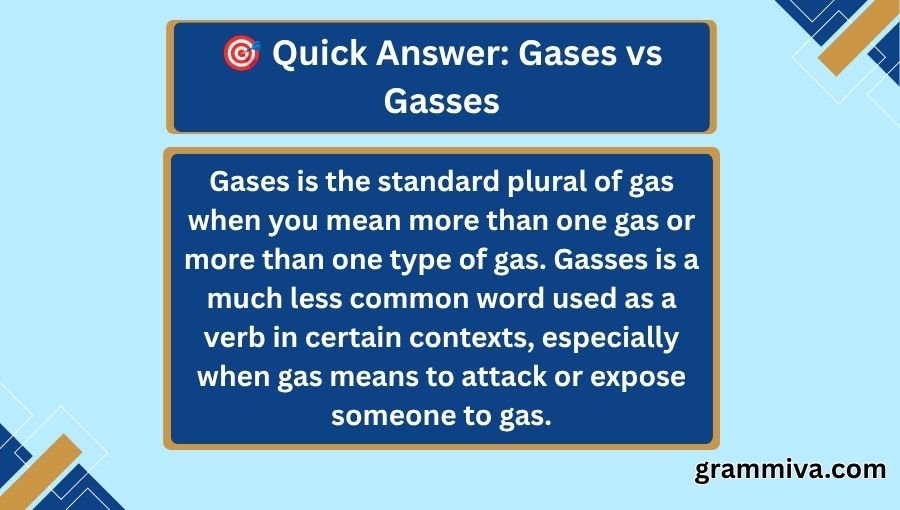
Gases is the standard plural of gas when you mean more than one gas or more than one type of gas. Gasses is a much less common word used as a verb in certain contexts, especially when gas means to attack or expose someone to gas.
| Word | Main Use | Example |
|---|---|---|
| gases | Plural noun | Scientists study several gases. |
| gasses | Verb form | The machine gasses the material. |
For ordinary science and everyday writing, gases is almost always the word you need.
What Is the Difference Between Gases and Gasses?
The basic difference between gases vs gasses is grammatical. Gases is normally a plural noun, while gasses is a verb form.
When gas means a substance in a gaseous state, its plural is gases. For example, oxygen and nitrogen are gases.
When gas is used as a verb, gasses can be the third-person singular present form. It can describe putting gas into something or, in some contexts, exposing something or someone to gas.
| Form | Type | Meaning | Example | Correct/Incorrect |
|---|---|---|---|---|
| gas | Noun | A substance in a gaseous state | Oxygen is a gas. | ✅ Correct |
| gases | Plural noun | More than one gas or gas type | Several gases were tested. | ✅ Correct |
| gas | Verb | To fill, treat, or expose with gas | The process can gas the chamber. | ✅ Correct |
| gasses | Verb | Third-person singular form of gas | The machine gasses the chamber. | ✅ Correct |
| gasses | Plural noun for gas | Intended as the normal plural of gas | Three gasses were detected. | ❌ Incorrect |
The key is not simply the number of letters. Look at the job the word is doing in the sentence.
Why Is Gases Usually Correct?
Gases is correct when you are talking about two or more gases. This is the standard plural form used in science, medicine, engineering, environmental writing, and everyday speech.
For example:
- Oxygen and hydrogen are gases.
- The lab measured several gases.
- Greenhouse gases can affect Earth’s climate.
- The container holds different gases.
The word gases is especially common in technical writing. You will see it when people discuss oxygen, carbon dioxide, helium, methane, nitrogen, water vapor, and other substances.
Gases as a Scientific Plural
In science, gas describes a state of matter. A gas does not have a fixed shape or fixed volume in the way a solid normally does. When we talk about more than one kind or sample of gas, gases is the normal plural.
Consider this sentence:
The researchers tested three gases.
Here, three tells us that the noun must be plural. The correct plural is gases.
Gases in Everyday Writing
You do not need to be a scientist to use gases correctly. The word also appears in ordinary discussions about cooking, cars, weather, health, and the environment.
For example:
Some gases have no color or smell.
The sentence refers to more than one gas, so gases is the natural choice.
Gases in Environmental Writing
Environmental writing frequently uses the phrase greenhouse gases. This is a standard plural phrase because it refers to a group of gases that can contribute to the greenhouse effect.
Other examples include:
- harmful gases
- toxic gases
- exhaust gases
- noble gases
- volcanic gases
- industrial gases
| Meaning | Word Type | Example Sentence |
|---|---|---|
| More than one gas | Plural noun | The lab detected several gases. |
| Different types of gas | Plural noun | Noble gases have special properties. |
| Gas released from a source | Plural noun | The plant monitors exhaust gases. |
💡 Test Tip
Try replacing the word with “more than one gas.”
If the sentence still makes sense, you probably need gases.
The experiment involved three ___.
“Three more than one gas” clearly points to a plural noun. Therefore, gases is correct.
Is Gasses Ever Correct?
Yes. Gasses can be correct, but it is much less common because it is generally a verb form rather than the ordinary plural of gas.
For example:
The equipment gasses the chamber before the test.
Here, gasses describes an action performed by the equipment. It is not naming several gases.
This distinction matters because writers sometimes see the spelling gasses and assume it is simply another plural form. In standard modern writing, that is not the form you should normally choose for the plural noun.
| Sentence | What the Word Does | Correct? |
|---|---|---|
| The lab tested five gases. | Names multiple gases | ✅ Yes |
| The device gasses the chamber. | Describes an action | ✅ Yes |
| The lab tested five gasses. | Attempts to form plural noun | ❌ No |
| The device gases the chamber. | Attempts to form a verb | ❌ Usually no |
How Do You Use Gases in a Sentence?
Use gases when the word functions as a plural noun. It can be the subject, object, or complement of a sentence.
Here are several patterns:
As the subject:
Gases expand when heated.
As the object:
The sensor detects gases.
After a number:
The scientist studied four gases.
After words such as “several” or “many”:
Several gases were found in the sample.
The word does not need a number to be plural. Words such as many, several, different, and various can also signal that gases is needed.
Correct and Incorrect Examples
| ❌ Incorrect | ✅ Correct | Reason |
|---|---|---|
| The scientist studied three gasses. | The scientist studied three gases. | Gases is the plural noun. |
| Several gasses were found. | Several gases were found. | The sentence needs a plural noun. |
| These gasses are harmless. | These gases are harmless. | These points to plural gases. |
| Two gasses filled the tank. | Two gases filled the tank. | A number requires the plural noun. |
| Toxic gasses escaped. | Toxic gases escaped. | The sentence describes multiple gases. |
How Do You Use Gasses in a Sentence?
Use gasses when it functions as a verb. The exact meaning depends on how gas is being used as an action word.
For instance:
The system gasses the chamber before production.
Here, the system is doing something. The verb is gasses.
This use is far less likely to appear in ordinary writing than the noun gases. That is why most people who are unsure between the two should choose gases when talking about multiple gas substances.
A simple question can help:
Is the word naming things, or describing an action?
If it names multiple gas substances, use gases.
If it describes an action performed by a singular subject, gasses may be correct.
📝 Case Study: A Workplace Email
I once edited a technical report in which a writer repeatedly used gasses for the plural noun. The report said that “three gasses were released during testing.” The writer clearly understood the science. The problem was only the spelling.
I changed the sentence to:
Three gases were released during testing.
I also checked every other occurrence. The correction took less than a minute, but it made the report look much more polished.
Now imagine the same issue in an email:
We detected two gasses near the storage area.
A reader will probably understand the meaning. Still, the spelling can distract a professional reader. A cleaner version is:
We detected two gases near the storage area.
The lesson is simple: when gas is a plural noun, use gases.
Grammar Rules Explanation
The standard grammar rule is straightforward. Gases is the normal plural form of the noun gas. Gasses is used as a verb form in contexts where gas functions as an action word.
The difference comes from the grammatical role of the word, not from a different way of spelling the same plural noun.
English has many words whose spelling changes when a suffix is added. With gas, the plural noun is normally written gases. This keeps the plural form distinct from the verb form gasses.
Most standard English dictionaries and style references recognize gases as the normal plural noun. They also record uses of gasses connected with the verb gas.
Correct vs Incorrect at a Glance
| Sentence | Correct/Incorrect | Why |
|---|---|---|
| The scientist studied several gases. | ✅ Correct | Gases is a plural noun. |
| The factory released harmful gases. | ✅ Correct | Multiple gases are being discussed. |
| The laboratory tested four gasses. | ❌ Incorrect | The plural noun should be gases. |
| The machine gasses the chamber. | ✅ Correct | Gasses is functioning as a verb. |
| Three gasses were measured. | ❌ Incorrect | The sentence needs the plural noun gases. |
A useful rule is:
Multiple substances = gases. Action performed by a singular subject = gasses, when that verb meaning applies.
Why Do People Confuse Gases and Gasses?
People confuse these words because they look and sound closely related. The spelling difference is small, but the grammar difference is important.
The problem becomes worse when people type quickly. A writer may think, “The singular is gas, so I will just add another s.” That creates gasses, even though the standard plural is gases.
Autocorrect can also contribute. Spell-check tools may accept a word because it exists somewhere in the dictionary. They do not always understand the meaning you intended.
I once caught myself typing gasses in a note about air samples. I had written the sentence quickly and was thinking about the topic rather than the spelling. I reread it before sending the note and fixed it to gases. That small check saved an embarrassing correction later.
Common Grammar Confusions
| Confusion | Correct Choice | Main Difference |
|---|---|---|
| it’s / its | Depends on meaning | Contraction vs. possessive |
| your / you’re | Depends on meaning | Possessive vs. “you are” |
| there / their / they’re | Depends on meaning | Place vs. possession vs. “they are” |
| affect / effect | Depends on meaning | Usually verb vs. noun |
| gases / gasses | Depends on grammar | Plural noun vs. verb |
Why These Mistakes Happen
Fast typing: Your fingers may add an extra letter before your brain catches the error.
Autocorrect: A spelling tool may recognize both forms as real words.
Lack of knowledge: If you have never learned the difference, the two forms can seem interchangeable.
Sound-based spelling: Some writers spell words according to how they sound. That does not always work in English.
Visual habit: Seeing a double consonant in another word can make gasses look more familiar.
⚠️ Common Mistakes With Gases vs Gasses
| Wrong Form or Use | What’s Wrong | Correct Form |
|---|---|---|
| two gasses | Incorrect plural noun | two gases |
| harmful gasses | Incorrect plural noun | harmful gases |
| several gasses | Incorrect plural noun | several gases |
| three different gasses | Incorrect plural noun | three different gases |
| gases the chamber | Wrong verb form for the intended action | gasses the chamber |
| the gasses were measured | Incorrect plural noun | the gases were measured |
Gases vs Gasses in Different Contexts
The best choice becomes easier when you look at the context. In most settings, gases will be the correct choice because writers usually mean more than one gas.
| Context | Which Term to Use | Example |
|---|---|---|
| Everyday conversation | Usually gases | Some gases can be dangerous. |
| Professional writing | Usually gases | The report lists the detected gases. |
| Creative writing | Usually gases for the plural noun | Strange gases filled the room. |
| Social media or texting | Gases for the plural noun | Which gases are in the mixture? |
Everyday Conversation
In casual speech, you may talk about gases without thinking about the grammar.
Different gases behave differently.
That is a simple plural noun, so gases is correct.
Professional Writing
Professional writing needs extra care because spelling errors can affect how trustworthy a document looks.
Use gases in reports, instructions, emails, research summaries, and workplace documents when you mean multiple gases.
Creative Writing
Creative writers may use words such as gasses if the word is being used as a verb in a particular sentence. However, when describing several gases in a fictional scene, use gases.
Blue gases drifted across the floor.
Social Media and Texting
Casual writing often contains shortcuts and spelling mistakes. Still, gases is short enough to write correctly.
If you are posting about science, climate, chemistry, or air quality, writing gases helps your message look clear and informed.
Common Phrases With Gases
There are several common phrases in which gases naturally appears. These phrases are useful because they show how the plural noun works in real writing.
| Phrase | Meaning |
|---|---|
| greenhouse gases | Gases involved in the greenhouse effect |
| toxic gases | Gases that can cause harm |
| noble gases | A group of chemical elements with distinctive properties |
| exhaust gases | Gases released from engines or other processes |
| harmful gases | Gases that may cause harm |
| industrial gases | Gases used or produced in industry |
These phrases can help you remember the standard plural spelling. If you have seen greenhouse gases many times, that familiar phrase can act as a memory anchor.
How Can You Remember the Difference?
The easiest memory trick is to connect gases with more than one gas.
Think:
One gas → several gases
Then remember that gasses has a different job. It can function as a verb.
Another useful test is to look at the word before it.
Words such as these often signal a plural noun:
- two
- three
- several
- many
- different
- various
- these
- those
For example:
several ___
The natural completion is gases.
| Memory Clue | Choose | Example |
|---|---|---|
| One substance | gas | The gas escaped. |
| More than one substance | gases | The gases escaped. |
| Several types | gases | Different gases were tested. |
| Singular subject performing an action | gasses, when appropriate | The system gasses the chamber. |
💡 A One-Second Test
Ask:
“Can I replace this word with ‘gas substances’?”
If yes, you probably need gases.
For example:
The researchers identified several gases.
You could think of this as:
The researchers identified several gas substances.
That confirms that gases is acting as a plural noun.
Synonyms and Alternatives
Sometimes you can avoid the spelling issue by choosing a different phrase. However, the replacement must preserve the meaning.
| Alternative | Works When | Does Not Work When |
|---|---|---|
| gas types | You mean different kinds of gas | You mean specific individual samples |
| gas samples | You mean collected samples | You mean gases in general |
| vapors | You specifically mean vapor | The substance is not vapor |
| emissions | You mean released material | You mean all gases, including contained ones |
| substances | A broad scientific term is suitable | You specifically need to identify gases |
For example, gas types can replace different gases in some sentences. But it cannot always replace gases without changing the meaning.
Scientists studied several gases.
You could write:
Scientists studied several gas types.
The second sentence emphasizes kinds rather than simply multiple samples.
Why Does Correct Usage Matter?
Correct spelling helps readers understand your meaning without stopping to decode your sentence. It also shows care in professional, academic, and public writing.
The difference between gases and gasses is small, but small errors can make a larger document look less polished.
A useful writing principle is:
Clear words make clear ideas easier to trust.
Clarity in Communication
If you write gasses when you mean the plural noun, readers may pause. A science reader may notice the error immediately.
Professionalism
Reports, emails, resumes, presentations, and published articles benefit from accurate spelling. A single error does not define your writing, but repeated errors can distract from your message.
Digital Communication
Online writing moves quickly. Posts, comments, and messages are often written without a second review. That makes simple memory rules especially useful.
| Situation | Why Getting It Right Matters |
|---|---|
| Resume | Shows attention to detail |
| Client email | Keeps professional writing polished |
| Published content | Builds reader trust |
| Social post | Makes the message easier to understand |
Is Gasses Always Wrong?
No. Gasses is not simply a misspelling in every situation. It can be a legitimate verb form when gas is being used as an action word.
For example:
The system gasses the chamber before the test.
Here, the word answers the question “What does the system do?” It does not answer “How many gases are there?”
That is the crucial distinction.
If you write:
The system contains three gasses.
you are using gasses as a plural noun. In standard usage, that should be:
The system contains three gases.
If you write:
The system gasses the chamber.
the word is a verb and can be correct.
Word History and Spelling Pattern
The spelling difference is best understood through modern English grammar rather than through a complicated history lesson. The noun gas forms its standard plural as gases, while the verb can form gasses in contexts where the doubled consonant helps show the verb ending.
The important point for writers is not the historical path of the word. It is the spelling pattern you use today.
| Form | Modern Role | Practical Note |
|---|---|---|
| gas | Singular noun | One gas |
| gases | Plural noun | More than one gas |
| gas | Verb | To perform an action involving gas |
| gasses | Verb | Third-person singular present form in relevant uses |
You do not need to memorize a long history to write the word correctly. Learn the modern distinction and apply it consistently.
How Does Gases vs Gasses Work in Scientific Writing?
Scientific writing almost always requires gases when the writer means multiple gases. This includes chemistry, environmental science, physics, engineering, laboratory reports, and many health-related topics.
Examples include:
The instrument measures gases in the air.
Several gases were present in the sample.
The study examined greenhouse gases.
Different gases react in different ways.
Notice the pattern. Each word names multiple gases. None of these sentences describes an action performed by a singular subject. Therefore, gases is the right form.
| Scientific Example | Correct Form | Why |
|---|---|---|
| The sensor detects ___ in the air. | gases | Multiple substances |
| Three ___ were identified. | gases | Number + plural noun |
| The sample contained harmful ___. | gases | Plural noun |
| The machine ___ the chamber. | gasses | Verb describing an action |
How Does Gases vs Gasses Work in Formal Writing?
Formal writing follows the same basic rule as casual writing. The difference is that errors may be more noticeable in formal settings.
Suppose you are writing a report:
The test detected two gasses.
A polished version is:
The test detected two gases.
Now consider:
The device gasses the chamber before each test.
Here, the spelling is different because the word is functioning as a verb.
The lesson is not “always use gases.” The better lesson is:
Use the form that matches the grammatical job of the word.
Practice: Can You Choose the Right Word?
Try these sentences before looking at the answers.
- The scientist studied four ___.
- Several ___ escaped from the pipe.
- The machine ___ the container before testing.
- Different ___ can have different properties.
- The report lists three ___ found in the sample.
Answers
| Practice Sentence | Answer | Reason |
|---|---|---|
| The scientist studied four ___. | gases | Plural noun |
| Several ___ escaped from the pipe. | gases | Plural noun |
| The machine ___ the container. | gasses | Verb |
| Different ___ can have different properties. | gases | Plural noun |
| The report lists three ___ found in the sample. | gases | Number + plural noun |
If you got all five, you have the central rule down.
FAQs About Gases vs Gasses
Is “gases” the plural of “gas”?
Yes. Gases is the standard plural form of the noun gas when you mean more than one gas or more than one type of gas.
Is “gasses” a correct word?
Yes, gasses can be correct when it functions as a verb in an appropriate context. It is not normally the standard plural noun for gas.
Which is correct: gases or gasses?
For the plural noun, gases is correct. Use gasses only when the grammatical context calls for that verb form.
How do you spell the plural of gas?
Spell the plural as gases. For example: “The scientist measured three gases.”
Why do people write “gasses”?
People often write gasses because the word looks like a natural plural with a doubled consonant. Fast typing, autocorrect, and uncertainty about the spelling can also cause the mistake.
Is “greenhouse gasses” correct?
No, when referring to multiple gases that contribute to the greenhouse effect, the standard phrase is greenhouse gases.
Is “toxic gasses” correct?
When toxic describes multiple gas substances, the standard phrase is toxic gases.
When should I use “gasses”?
Use gasses when it is functioning as a verb in a sentence where gas means to perform an action involving gas. For example: “The system gasses the chamber.”
Are “gases” and “gasses” pronounced differently?
They can be pronounced differently depending on the grammatical use and the meaning. If pronunciation is not clear from context, focus first on the word’s grammatical role.
What is the easiest way to remember gases vs gasses?
Remember this simple pair: one gas, two gases. If you are naming more than one gas, use gases. Think of gasses as a possible verb form rather than the normal plural noun.
✅ Quick Recap Checklist
Use this checklist whenever you hesitate between the two spellings.
| Question | If Yes → Use |
|---|---|
| Am I talking about more than one gas? | gases |
| Am I naming several types of gas? | gases |
| Does a number come before the word? | Usually gases |
| Do I mean greenhouse, toxic, or exhaust ___? | gases |
| Is the word describing an action performed by a singular subject? | gasses, when that verb meaning fits |
Three Final Practice Examples
1. The lab detected several ___ in the sample.
Answer: gases ✅
2. The machine ___ the chamber before testing.
Answer: gasses ✅
3. Three different ___ were identified.
Answer: gases ✅
The fastest rule is still the best one: multiple gas substances = gases.
Conclusion: Gases vs Gasses Made Simple
Gases vs gasses becomes easy once you focus on grammar instead of appearance. Gases is the standard plural noun for gas, so use it when you mean two or more gases, different types of gas, or phrases such as greenhouse gases, toxic gases, and exhaust gases.
Gasses has a different role. It can function as a verb when gas describes an action. That is why the two spellings should not be treated as interchangeable.
When I teach this rule, I recommend keeping one sentence in your head: “One gas, several gases.” That short pattern handles most cases you will meet in school, work, science, and everyday writing.
If you are unsure, look at the sentence and ask whether the word names several substances or describes an action. That one question usually gives you the answer.
Get the plural right, keep the grammar clear, and gases will no longer be a spelling trap. ✨

I am Alex Morgan, an English grammar and vocabulary writer passionate about making language learning simple and useful. I work at Grammiva, where I create clear educational content and practical English examples for learners.



[…] examples, cover common mistakes, and give you easy tests you can use whenever you are unsure. ✨ Gases vs Gasses | Disorganized vs Unorganized | Whisky vs […]