Have you ever looked at a messy desk and wondered about disorganized vs unorganized? You are not alone. These two words look almost the same, and in many everyday sentences, they can seem interchangeable.
But there is a small difference in meaning and tone that can help you choose the better word.
When I explain disorganized vs unorganized to writers, I usually start with one simple idea: disorganized often describes something that lacks order, structure, or a clear system, while unorganized usually focuses more directly on something that has not been organized.
That difference is small, but it matters in polished writing.
The good news is that you do not need to memorize a long list of rules.
Once you understand the main idea, choosing between the two becomes much easier. 😊
In this guide, I will show you the difference, give you clear examples, explain common mistakes, and share simple tests you can use when you are unsure.
Let’s make this confusing pair easy. ✨ Whisky vs Whiskey | Desperate vs Desparate | Seamless vs Seemless
🎯 Quick Answer: Disorganized vs Unorganized
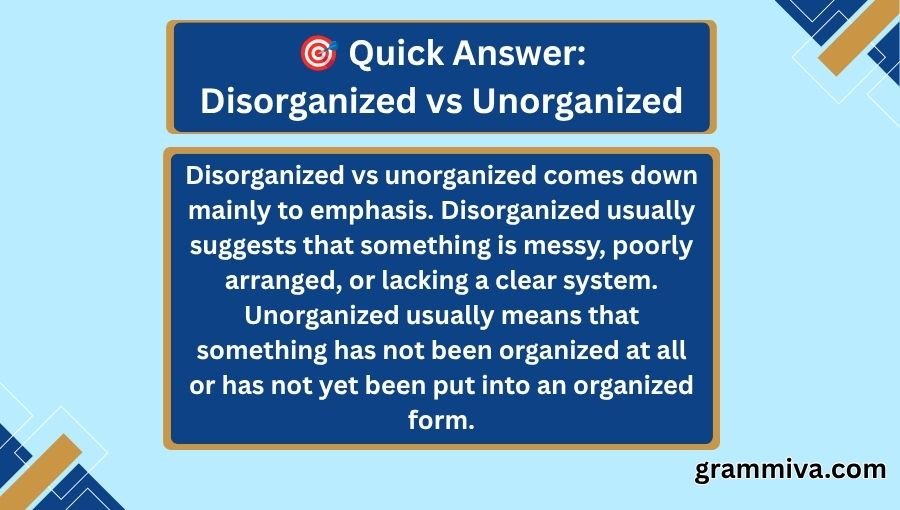
Disorganized vs unorganized comes down mainly to emphasis. Disorganized usually suggests that something is messy, poorly arranged, or lacking a clear system. Unorganized usually means that something has not been organized at all or has not yet been put into an organized form.
For example, “Her notes are disorganized” suggests that the notes exist but are hard to follow. “Her notes are unorganized” can simply mean that nobody has arranged them yet.
In normal US English, disorganized is often the more natural choice when you are describing a lack of order.
📚 Related Word Forms
The words disorganized and unorganized are both adjectives. Their base forms are organize, disorganize, and organized, but they do not all express the same idea.
| Form | Type | Example |
|---|---|---|
| organize | Verb | I need to organize these files. |
| organized | Adjective | Her files are organized. |
| disorganize | Verb | The sudden change may disorganize the team. |
| disorganized | Adjective | His schedule is disorganized. |
| unorganized | Adjective | The records remain unorganized. |
The form organized describes something arranged in a useful or orderly way. Adding dis- often creates the idea of a lack of order or a loss of order. Adding un- often gives the simpler idea of something not being organized.
That pattern is helpful, but prefixes do not always work like perfect mathematical formulas. English has many words whose meaning depends on common usage and context.
🔎 Is Disorganized the Same as Unorganized?
No. Disorganized and unorganized overlap, but they are not always identical. The safest difference is that disorganized often describes poor order or poor structure, while unorganized often describes something that has not been organized.
Consider these examples:
- The office is disorganized.
The office has things in confusing places or lacks a useful system. - The office is unorganized.
The office has not been organized.
The first sentence can suggest an active problem with the way things are arranged. The second can sound more neutral.
| Form | Type | Meaning | Example | Correct/Incorrect |
|---|---|---|---|---|
| disorganized | Adjective | Lacking order or structure | The filing system is disorganized. | ✅ Correct |
| unorganized | Adjective | Not organized or not yet arranged | The files are still unorganized. | ✅ Correct |
| organized | Adjective | Arranged in an orderly way | The files are organized. | ✅ Correct |
| disorganize | Verb | To disturb or destroy order | The change could disorganize the team. | ✅ Correct |
Both adjectives can be grammatically correct. The real question is which meaning you want to communicate.
🎯 Disorganized vs Unorganized at a Glance
The easiest way to remember the difference is to ask whether you are describing bad order or simply a lack of organization.
| Point | Disorganized | Unorganized |
|---|---|---|
| Main idea | Poorly arranged or lacking order | Not organized |
| Tone | Often more negative | Often more neutral |
| Suggests a system problem | Usually | Sometimes |
| Can describe a messy situation | Yes | Yes |
| Common in everyday US English | Very common | Less common in some settings |
| Best for describing poor structure | Yes | Sometimes |
Here is a useful shortcut:
Disorganized = the order is poor.
Unorganized = the organization is missing.
That is not an absolute rule for every sentence. English speakers may use the words in overlapping ways. Still, it is a strong practical guide.
💡 Why Do People Confuse Disorganized and Unorganized?
People confuse these words because both contain organized, and both can describe something that lacks order. Their meanings overlap enough that a sentence can sometimes sound acceptable with either word.
I once reviewed a student’s essay about a school project. She used unorganized several times to describe a messy research plan. I changed most of those uses to disorganized because she was describing a plan that existed but had poor structure. Once I explained the difference, she immediately saw why the new wording was stronger.
Another reason for the confusion is that English uses both un- and dis- in many words. Learners may expect each prefix to have one fixed meaning. They do not.
The following examples show the basic contrast:
- “The meeting was disorganized.”
The meeting happened, but it lacked a clear structure. - “The meeting was unorganized.”
The meeting was not organized, which may focus more on the absence of planning.
Neither sentence is automatically wrong. Context decides which word communicates the intended idea more clearly.
🧠 Key Differences Between Disorganized and Unorganized
There are three useful differences to keep in mind: order, process, and tone. Understanding disorganized vs unorganized becomes easier when you compare their meaning, tone, and common usage.
1. Order
Disorganized is a strong choice when something has parts that are arranged badly.
The report is disorganized.
This suggests that the report may contain useful information, but the ideas are not presented in a clear order.
2. Process
Unorganized can focus on the fact that the organizing process has not happened.
The documents are unorganized.
This may simply mean that the documents have not been sorted, labeled, or placed into a system.
3. Tone
Disorganized can sound more critical.
If you tell a coworker, “Your files are disorganized,” you are pointing out a problem with their arrangement.
If you say, “Your files are unorganized,” the comment may sound more like a description of their current state.
| Difference | Disorganized | Unorganized |
|---|---|---|
| Focus | Poor order | Lack of organization |
| Common feeling | Critical or negative | Neutral or descriptive |
| Typical question | “Why is this so hard to follow?” | “Has anyone organized this yet?” |
| Strongest use | Messy or poorly structured systems | Materials awaiting organization |
✍️ When Should You Use Disorganized?
Use disorganized when you want to describe something that is confusing, messy, poorly planned, or lacking a clear structure.
Common examples include:
- a disorganized office
- a disorganized schedule
- a disorganized argument
- a disorganized report
- a disorganized meeting
- a disorganized classroom
- a disorganized process
For example:
The presentation was disorganized, so the audience had trouble following the main point.
The presentation had content, but its structure was weak.
You can also use the word to describe a person:
He is disorganized and often forgets where he put important papers.
Here, the word describes a repeated habit or trait. It suggests that the person has trouble keeping things in order.
A Simple Meaning Table
| Meaning | Word Type | Example Sentence |
|---|---|---|
| Poorly arranged | Adjective | Her desk is disorganized. |
| Lacking a clear plan | Adjective | The event felt disorganized. |
| Hard to follow | Adjective | His explanation was disorganized. |
| Poor at keeping things in order | Adjective | I can be disorganized when I am busy. |
💡 Test Tip
Ask yourself:
“Does this thing have a system, but is the system messy or confusing?”
If the answer is yes, disorganized is usually the better choice.
📦 When Should You Use Unorganized?
Use unorganized when you want to stress that something has not been organized or arranged.
For example:
The old photographs are still unorganized.
This sentence does not necessarily say that the photographs are badly arranged. It may simply mean that nobody has sorted them yet.
Another example is:
We have a box of unorganized receipts.
The receipts have not been placed into categories or sorted into a useful system.
| Situation | Better Choice | Why |
|---|---|---|
| Files have been arranged badly | disorganized | The existing order is poor. |
| Files have never been sorted | unorganized | Organization has not happened. |
| A confusing speech | disorganized | The ideas lack structure. |
| Papers waiting to be sorted | unorganized | They have not been arranged yet. |
| A person often loses things | disorganized | It describes a habit or trait. |
In many everyday sentences, a native speaker may choose disorganized even where unorganized is possible. That is one reason disorganized is often the safer choice when describing confusion or mess.
📝 Case Study: A Disorganized Work Project
Imagine that a manager asks an employee to prepare a client report.
The employee has gathered sales numbers, customer notes, charts, and meeting records. However, the information appears in random sections. Some headings are missing. The same point appears three times. Important details are difficult to find.
The manager might say:
“The report is disorganized. Please put the information into a clearer order.”
That wording works because the report already has information, but the structure is poor.
Now imagine a different situation. The manager gives the employee a folder containing hundreds of receipts that have never been sorted.
The manager could say:
“These receipts are unorganized. Please sort them by month.”
Here, unorganized clearly focuses on the lack of sorting.
| Workplace Situation | Natural Description | Reason |
|---|---|---|
| Report has confusing sections | disorganized | Poor structure |
| Receipts have never been sorted | unorganized | Organization has not happened |
| Meeting has no clear flow | disorganized | Poor planning and structure |
| Blank folders await filing | unorganized | They have not been arranged |
| Employee regularly loses documents | disorganized | Describes a habit |
📖 Grammar Rules Explanation
The main grammar rule is simple: both disorganized and unorganized can function as adjectives, so both can grammatically modify a noun.
The difference is mainly one of meaning and normal usage.
Disorganized commonly describes a condition in which order, structure, or planning is poor. It can describe physical objects, writing, events, systems, and people.
Unorganized commonly describes something that has not been organized. It can describe materials, information, groups, or other things that lack organization.
The prefixes help provide a useful clue. Dis- often gives a sense of separation, disturbance, reversal, or lack of the expected quality. Un- often gives a direct negative meaning. However, English prefixes are not strict formulas. You should judge the complete word and the context.
Most standard English reference works recognize disorganized as an established adjective. Unorganized is also a valid word in appropriate contexts.
The important point is that unorganized is not simply the “wrong” version of disorganized. Calling it wrong would be too broad. Instead, the two words often carry different shades of meaning.
Correct vs Incorrect at a Glance
| Sentence | Correct/Incorrect | Why |
|---|---|---|
| The report was disorganized and hard to follow. | ✅ Correct | The report lacked clear structure. |
| The report was unorganized and hard to follow. | ✅ Correct | Possible, though less direct for poor structure. |
| The papers are still unorganized. | ✅ Correct | They have not been sorted. |
| The manager is disorganized with deadlines. | ✅ Correct | It describes a repeated habit. |
| The manager is disorganised with deadlines in standard US spelling. | ❌ Incorrect | US English normally spells the word with -ized. |
The last example highlights another issue. In US English, disorganized is the standard spelling. British English may use disorganised, but that is a spelling difference between varieties of English, not a difference between the meanings of the two words.
⚠️ Common Mistakes With These Words
The biggest mistake is assuming that one word is always correct and the other is always wrong. That is not true.
People also make errors because the words sound similar and share the same base word.
Common Grammar Confusions
| Confusion | Common Problem | Correct Use |
|---|---|---|
| its / it’s | Mixing possession and contraction | Its color is bright. / It’s bright. |
| your / you’re | Mixing possession and contraction | Your book is here. / You’re early. |
| their / there / they’re | Mixing possession, place, and contraction | Their car is there. They’re inside. |
| affect / effect | Mixing verb and noun uses | The change affected us. The effect was clear. |
| disorganized / unorganized | Treating the words as exact matches | Choose based on the intended meaning. |
Why do these errors happen?
Fast typing is one reason. When people type quickly, they often choose the first familiar-looking word.
Autocorrect can also make things worse. Software may change a word based on spelling patterns without understanding the writer’s exact meaning.
Lack of knowledge is another cause. If someone has never learned the small difference between two related words, guessing is natural.
I once caught myself typing unorganized in an editing note when I meant that a paragraph had a poor structure. I reread the sentence, noticed the meaning had shifted, and changed it to disorganized. Even experienced writers can make these choices too quickly.
Specific Wrong Forms and Uses
| Wrong Form | What’s Wrong | Correct Form |
|---|---|---|
| disorganised | Usually not the preferred US spelling | disorganized |
| unorganised | Usually not the preferred US spelling | unorganized |
| dis-organized | Unnecessary hyphen in normal use | disorganized |
| un-organized | Unnecessary hyphen in normal use | unorganized |
| dis organize | Incorrect separation of the word | disorganize |
| un organize | Incorrect separation of the word | unorganize |
The last form deserves care. Unorganize can occur in specialized or less common contexts, but it is not the normal everyday verb most writers need. If you mean “make something less organized,” disorganize is the natural standard choice.
🧩 How Does Context Change the Best Choice?
The disorganized vs unorganized difference can become clearer when you look at the context in which each word is used. Context can make the difference much clearer. A word that sounds natural in one sentence may sound less natural in another.
Everyday Conversation
In casual speech, disorganized is often the natural choice for a person, room, schedule, or event.
“My room is so disorganized.”
This sounds very natural because the speaker is describing a messy condition.
Professional Writing
In work writing, the distinction can be useful.
“The current filing system is disorganized.”
This tells the reader that the system exists but does not work well.
“The documents remain unorganized.”
This tells the reader that the documents still need to be sorted.
Creative Writing
Writers may choose either word based on tone.
“Her thoughts were disorganized after the shock.”
This suggests confusion and a lack of mental structure.
“The papers were unorganized on the desk.”
This simply describes the state of the papers.
Social Media and Texting
Casual posts usually favor the more familiar disorganized.
“My weekend plans are completely disorganized 😂.”
In informal writing, people may use the words loosely. That is fine as long as the meaning is clear.
| Context | Which Term to Use | Example |
|---|---|---|
| Everyday conversation | Usually disorganized | My schedule is disorganized. |
| Professional writing | Depends on meaning | The records remain unorganized. |
| Creative writing | Either, depending on tone | His thoughts were disorganized. |
| Social media/texting | Usually disorganized | My room is disorganized! |
🗣️ Common Phrases With Disorganized
There are no special idioms that you must memorize for this pair. However, disorganized commonly appears with words related to work, planning, information, and physical spaces.
| Phrase | Meaning |
|---|---|
| disorganized schedule | A schedule that is difficult to manage or follow |
| disorganized office | An office with poor order or arrangement |
| disorganized thoughts | Ideas that are difficult to arrange clearly |
| disorganized meeting | A meeting without clear structure or planning |
| disorganized system | A system that lacks useful order |
| disorganized person | A person who often struggles with organization |
These combinations are useful because they show how the adjective works in real sentences.
For example:
“The team has a disorganized workflow.”
This means the workflow lacks a clear or effective structure.
🔄 Synonyms and Alternatives
Sometimes you do not need either word. A more exact word can make your sentence clearer.
For example, instead of saying “The report is disorganized,” you could say “The report is confusing,” “The report lacks structure,” or “The report is poorly arranged.”
| Alternative | Works When | Does Not Work When |
|---|---|---|
| messy | You mean physically untidy | The problem is only with ideas or structure |
| chaotic | There is extreme confusion or disorder | The situation is only mildly untidy |
| scattered | Things or ideas are spread around | You mean a complete lack of planning |
| poorly arranged | You want a precise formal description | You want a short casual phrase |
| lacking structure | Writing or ideas have weak organization | You are simply describing a messy room |
Choosing a synonym can sometimes be better than debating the two original words. Good writing is not about using the most difficult word. It is about using the clearest one.
🎯 When Is Disorganized Better Than Unorganized?
Disorganized is usually better when the reader needs to understand that something has poor order, weak structure, or confusing planning.
For example:
“The presentation was disorganized.”
This immediately tells the reader that the presentation did not flow well.
Compare it with:
“The presentation was unorganized.”
This can be understood, but it is less precise if your main point is that the presentation had a poor structure.
The same idea works for people:
“She is disorganized.”
This can describe a person who regularly struggles with schedules, planning, paperwork, or belongings.
By contrast:
“She is unorganized.”
This may simply suggest that she is not organized. It does not always carry the same strong sense of a recurring problem.
| Intended Meaning | Recommended Word |
|---|---|
| Poor structure | disorganized |
| Confusing arrangement | disorganized |
| Messy planning | disorganized |
| Not yet sorted | unorganized |
| Not yet arranged | unorganized |
| General lack of organization | Either, depending on context |
🏢 Professional Writing Tips
Professional writing needs clear meaning. Small word choices can change how a sentence sounds. In professional writing, knowing the difference between disorganized vs unorganized can help you choose a more precise word.
Calling a department “disorganized” can sound like direct criticism. It may suggest that the department has poor systems or poor management.
Calling a group “unorganized” may sound less forceful. It can describe a group that has not yet formed a clear structure.
Consider these versions:
“The project team is disorganized.”
This sounds like a criticism of the team’s working habits.
“The project team is unorganized.”
This can suggest that the team lacks an organized structure.
If you are writing a workplace email, it may be even better to avoid both labels and describe the specific issue:
“The project files are not yet sorted by client.”
That sentence is more useful because it tells the reader exactly what needs to change.
| Situation | Less Precise | More Precise |
|---|---|---|
| Messy files | The files are disorganized. | The files are not sorted by date. |
| Confusing report | The report is disorganized. | The report needs clearer sections. |
| Poor meeting | The meeting was disorganized. | The meeting had no clear agenda. |
| Unsorted receipts | The receipts are unorganized. | The receipts have not been sorted by month. |
📱 Why Does This Difference Matter?
The disorganized vs unorganized distinction matters because the two words can create slightly different meanings and tones. Word choice matters because readers build meaning from small clues. A sentence can be grammatically correct but still less precise than it could be.
Clarity in Communication
If you say something is disorganized, the reader can reasonably understand that the existing arrangement is poor.
If you say something is unorganized, the reader may understand that organization has not happened yet.
Professionalism
In a resume, report, or client email, precise language makes your writing sound more careful.
Digital Communication
Short messages often leave out context. A precise adjective can prevent confusion.
A useful rule is:
“Good word choice helps the reader understand your exact point without guessing.”
| Situation | Why Getting It Right Matters |
|---|---|
| Resume | Shows careful language and clear thinking |
| Client email | Reduces the chance of misunderstanding |
| Published content | Improves accuracy and readability |
| Social post | Helps readers understand your intended tone |
You do not need fancy vocabulary to sound professional. You need accurate vocabulary.
🧪 How To Remember the Difference
Try this two-question test.
Question 1: Is the thing already arranged, but arranged badly?
If yes, choose disorganized.
Question 2: Has the thing simply not been organized yet?
If yes, unorganized may be the better choice.
Here are quick practice examples:
- The files are in five different folders with no clear system.
Answer: disorganized. - The new receipts are sitting in a box because nobody has sorted them.
Answer: unorganized. - The speaker jumped from one topic to another.
Answer: disorganized. - The team has not yet created a filing system.
Answer: unorganized.
| Question | If Yes → Use |
|---|---|
| Is the existing order confusing? | disorganized |
| Is the structure poor? | disorganized |
| Has the material not been sorted yet? | unorganized |
| Has no clear system been created? | unorganized |
| Are you describing a person who often struggles with order? | disorganized |
⚠️ Special US English Spelling Note
There is one spelling issue worth remembering for US readers.
American English normally uses disorganized and unorganized, with -ized rather than -ised.
So, for standard US English:
- disorganized ✅
- unorganized ✅
- disorganised ❌ in standard US spelling
- unorganised ❌ in standard US spelling
The forms ending in -ised are associated with other varieties of English. This is a spelling difference, not evidence that one meaning is automatically right or wrong.
📝 Three Real-Life Examples
Example 1: A Student’s Notes
A student has taken notes during several classes. The notes contain good information, but the headings are mixed together and the ideas jump around.
A teacher might write:
“Your notes are disorganized. Try grouping each topic under a clear heading.”
That is better than simply saying the notes are unorganized because the main problem is their structure.
Example 2: A New Box of Records
A company receives a box of old records. Nobody has opened the box before.
The office manager says:
“These records are unorganized. We need to sort them by year.”
Here, the records have not yet been arranged.
Example 3: A Busy Schedule
A person has appointments written on different pieces of paper. Some overlap. Others have no time listed.
A friend might say:
“Your schedule is disorganized.”
The problem is not merely that nobody organized it. The actual schedule is difficult to use.
These examples show why context is more important than trying to memorize a single “right” word.
📋 Quick Recap Checklist
Use this checklist whenever you are unsure.
| Question | If Yes → Use |
|---|---|
| Does the thing have a poor or confusing structure? | disorganized |
| Is the thing messy because parts are badly arranged? | disorganized |
| Are someone’s habits poor when it comes to planning? | disorganized |
| Has something simply not been arranged yet? | unorganized |
| Are materials waiting to be sorted? | unorganized |
Practice Examples
1. The marketing report jumps between unrelated topics.
Answer: disorganized.
2. The invoices have arrived, but nobody has sorted them.
Answer: unorganized.
3. My brother keeps missing appointments because he cannot manage his schedule.
Answer: disorganized.
The fastest memory trick is:
Bad organization → disorganized.
No organization yet → unorganized.
❓ FAQs About Disorganized vs Unorganized
Is disorganized or unorganized more common in American English?
Disorganized is generally the more natural everyday choice when describing something that is messy, confusing, or poorly structured. Unorganized is also valid and can be useful when you mean that something has not been organized.
Is unorganized grammatically correct?
Yes. Unorganized is a grammatically correct adjective. It should not automatically be treated as a mistake. The context determines whether it is the best word.
What is the difference between disorganized and unorganized?
Disorganized usually emphasizes poor order, weak structure, or confusion. Unorganized often emphasizes that organization has not happened or is incomplete.
Which word should I use for a messy room?
Disorganized is usually the more natural choice if the room has things in confusing or poor places.
“My room is disorganized.”
You could also use messy if physical untidiness is the main point.
Which word should I use for unsorted files?
Unorganized can work well if the files have not been sorted or arranged yet.
“The files are still unorganized.”
If the files have a system but the system is confusing, disorganized may be better.
Is a disorganized person different from an unorganized person?
There can be a small difference. A disorganized person often suggests someone who regularly has trouble with planning, order, schedules, or belongings. An unorganized person can simply describe someone who is not organized, without strongly emphasizing a repeated pattern.
Is disorganized the opposite of organized?
Yes, in common usage, disorganized is a direct contrast to organized when describing a lack of order or structure.
For example:
organized system → disorganized system
Can I use disorganized for writing?
Yes. It is very common to describe writing, reports, essays, arguments, or explanations as disorganized when their ideas are difficult to follow.
“The essay contains good ideas, but its structure is disorganized.”
Can I use unorganized for a group?
Yes, although the meaning can be slightly different. An unorganized group may be a group that has not formed a structure or system. A disorganized group more strongly suggests that the group is functioning poorly or without clear order.
How can I quickly remember disorganized vs unorganized?
Think of disorganized as poor organization and unorganized as missing organization. This is not a perfect rule for every sentence, but it is an excellent practical guide.
🌟 Conclusion
Disorganized vs unorganized becomes much easier when you focus on the meaning you want to express. Disorganized usually describes something that has poor order, weak structure, or confusing arrangement. Unorganized usually points to something that has not been organized or arranged yet.
When you are describing a messy report, confusing meeting, poorly planned schedule, or person who often struggles with order, disorganized is usually the stronger choice. When you are describing papers, records, receipts, or other materials that are simply waiting to be sorted, unorganized may be more precise.
Do not think of unorganized as automatically wrong. It has a legitimate place in English. The key is to match the word to the situation.
If you remember only one rule, remember this: poor organization usually suggests “disorganized,” while organization that has not happened yet can suggest “unorganized.” 🎯
Clear writing is not about choosing the fanciest word. It is about choosing the word that lets your reader understand you the first time. Keep that goal in mind, and this once-confusing pair becomes much easier. 😊

I am Adam Wilson, an English language content writer with an interest in grammar and vocabulary. I work at Grammiva and focus on creating clear explanations and practical examples for English learners.

[…] you real examples, cover the grammar rule, and give you easy ways to remember the difference. 🔍 Disorganized vs Unorganized | Whisky vs Whiskey | Desperate vs […]
[…] common mistakes, and give you easy tests you can use whenever you are unsure. ✨ Gases vs Gasses | Disorganized vs Unorganized | Whisky vs […]
[…] By the end, you will know exactly when to write never mind and why nevermind is usually best avoided. ✍️ Sneaked vs Snuck | Gases vs Gasses | Disorganized vs Unorganized […]