Have you ever stopped while writing because you were unsure about versus vs verses? 🤔 You are not alone.
These two words look and sound similar, but they have completely different meanings and uses.
Versus is used when two people, teams, choices, or ideas are compared or placed against each other.
Verses, on the other hand, is the plural form of verse and refers to multiple sections of a song, poem, or religious text.
When I explain versus vs verses to students and writers, I use one simple rule: think about whether you are talking about a comparison or a set of written sections.
If you mean “against,” choose versus. If you mean more than one verse, choose verses.
This small spelling difference can change the meaning of a sentence completely.
It can cause confusion in schoolwork, emails, articles, social media posts, and everyday messages.
The good news is that once you understand the meaning of each word, choosing the correct one becomes simple. 📚 Informal vs Unformal | Optimize vs Optimise | Practices vs Practises
🎯 Quick Answer: Versus vs Verses
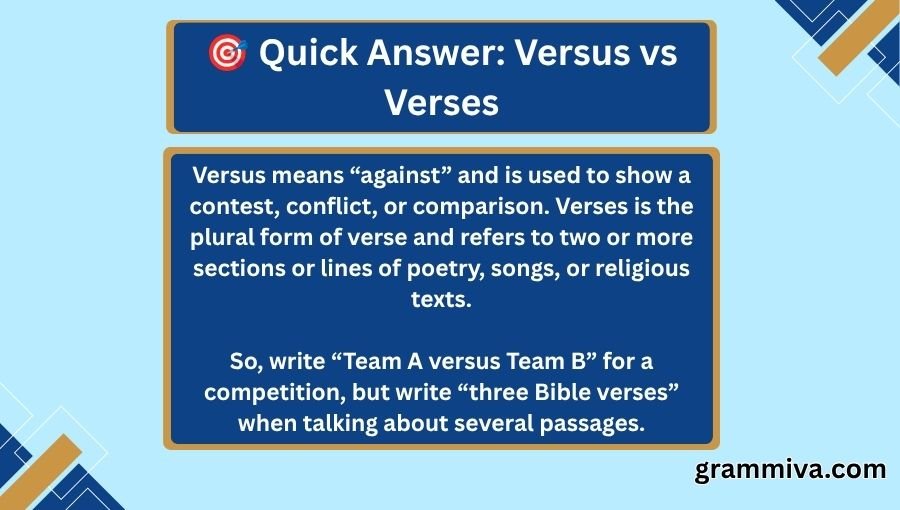
Versus means “against” and is used to show a contest, conflict, or comparison. Verses is the plural form of verse and refers to two or more sections or lines of poetry, songs, or religious texts.
So, write “Team A versus Team B” for a competition, but write “three Bible verses” when talking about several passages.
| Word | Basic Meaning | Example |
|---|---|---|
| Versus | Against or compared with | The Eagles played versus the Tigers. |
| Verses | More than one verse | She read three verses from the poem. |
Is Versus the Same as Verses?
No. Versus and verses are different words with different jobs in a sentence.
Versus is mainly a preposition. It shows that two sides are being compared or placed against each other. It is common in sports, legal cases, debates, and comparisons.
Verses is a plural noun. It means more than one verse. A verse can be a section of a song, a part of a poem, or a numbered section of a religious text.
Think of the difference this way:
- Versus = against
- Verses = more than one verse
Quick Examples
- ✅ Correct: The Lasers played versus the Celtics.
- ❌ Incorrect: The Lasers played verses the Celtics.
- ✅ Correct: I memorized five verses of the song.
- ❌ Incorrect: I memorized five versus of the song.
The first pair is about a competition. The second pair is about parts of a song.
🔎 Versus vs Verses at a Glance
The easiest way to understand versus vs verses is to compare their word types and meanings.
| Form | Type | Meaning | Example | Correct/Incorrect |
|---|---|---|---|---|
| Versus | Preposition | Against or compared with | It is cats versus dogs. | Correct |
| Verses | Plural noun | More than one verse | The poem has four verses. | Correct |
| Versus | Noun for song sections | Several parts of a song | The song has three versus. | Incorrect |
| Verses | Comparison word | Against | Team A verses Team B | Incorrect |
The key difference is not just spelling. The words perform different grammatical roles.
What Does Versus Mean?
Versus means “against” or “in comparison with.” It is used when two sides are being compared, opposed, or placed in a contest.
You may see it in several common settings.
Sports
Sports writing often uses versus to show two teams or players competing.
- ✅ Correct: The Bears will play versus the Lions.
- ❌ Incorrect: The Bears will play verses the Lions.
A shorter form, vs., is also very common.
- Bears vs. Lions
- Red Sox vs. Yankees
Legal Writing
Legal cases often place two parties against each other. This is another common use of versus.
For example:
- Smith versus Jones
Here, versus tells the reader that one party is opposing another party in a legal case.
Comparisons
You can also use versus when discussing two choices.
- Price versus quality
- Online learning versus classroom learning
- Coffee versus tea
In each case, the writer is comparing two things.
Meaning Summary
| Meaning | Word Type | Example Sentence |
|---|---|---|
| Against | Preposition | The team played versus its rival. |
| In comparison with | Preposition | We discussed quality versus price. |
| Opposing another party | Preposition | The case was Jones versus Smith. |
💡 Test Tip
Replace versus with against. If the sentence still makes sense, versus is probably the right choice.
For example:
The Tigers played versus the Bears.
Change it to:
The Tigers played against the Bears.
The meaning remains clear. That is your clue.
What Does Verses Mean?
Verses is the plural form of verse. It means two or more verses.
A verse can be a section of a poem, song, or religious text. Therefore, when you have multiple verses, you use verses.
For example:
- The song has three verses.
- She memorized several Bible verses.
- The poem contains six short verses.
Here, verses does not mean “against.”
Verses in Songs
Songs often contain verses along with other parts, such as a chorus.
- ✅ Correct: The singer wrote four verses.
- ❌ Incorrect: The singer wrote four versus.
Verses in Poetry
A poem may have several sections. Those sections can be called verses.
- ✅ Correct: Each verse has a different rhythm.
- ❌ Incorrect: Each versus has a different rhythm.
Religious Verses
The word verses is also common when discussing numbered passages in religious texts.
For example:
- She read several Bible verses.
- The teacher asked us to study two verses.
- He quoted three verses during the discussion.
| Type of Verse | Example |
|---|---|
| Song verse | The song has two verses. |
| Poetry verse | The poem contains five verses. |
| Religious verse | She read several Bible verses. |
Why Do People Confuse Versus and Verses?
People confuse these words because their spelling is very similar. They also sound similar in casual speech.
Another reason is fast typing. When people type quickly, they may choose the first word that looks familiar.
I once reviewed a student’s short essay about music. The student wrote “the first versus of the song” several times. The student knew exactly what they meant but had confused the plural spelling of verse with versus. Once I showed them that “verses” means multiple parts of a song, the error made sense immediately.
Autocorrect can make the problem worse. A typing tool may not understand the meaning of your sentence. It can sometimes suggest a word that looks correct but does not fit the context.
Common causes include:
- Fast typing
- Autocorrect
- Similar spelling
- Similar pronunciation
- Lack of grammar knowledge
- Confusion about the meaning of verse
The best solution is to check the meaning before checking the spelling.
🧠 How Can You Remember the Difference?
Use the against test.
If you can replace the word with against, use versus.
If you can replace it with multiple sections, use verses.
| Question to Ask | Answer | Word |
|---|---|---|
| Does it mean “against”? | Yes | Versus |
| Does it mean “compared with”? | Yes | Versus |
| Does it mean several parts of a song? | Yes | Verses |
| Does it mean several parts of a poem? | Yes | Verses |
| Does it mean several religious passages? | Yes | Verses |
Here is another memory trick:
Versus = V. S. = sides facing each other
Verses = verse + s = more than one verse
This is not a formal grammar rule. It is simply a useful memory aid.
📝 Case Study: A Simple Workplace Example
Imagine that you are writing a work email about two software plans.
You write:
“We need to compare Plan A verses Plan B.”
That sentence contains the wrong word.
The correct version is:
“We need to compare Plan A versus Plan B.”
Why? Because the email is comparing two choices. It is not talking about parts of a song, poem, or religious text.
Now imagine a different email:
“Please review the first three verses of the training song.”
Here, verses is correct because the writer means three sections of a song.
The context tells you which word belongs.
| Situation | Correct Word | Example |
|---|---|---|
| Comparing two products | Versus | Product A versus Product B |
| Comparing two plans | Versus | Basic versus Premium |
| Talking about song sections | Verses | The song has three verses. |
| Discussing Bible passages | Verses | Read these two verses. |
I once caught myself typing versus when I meant several sections of a song in a draft newsletter. I stopped because the sentence was about lyrics, not a comparison. That quick context check fixed the error before the newsletter went out.
Grammar Rules Explanation
The grammar difference becomes clear when you look at the role each word plays.
Versus connects two opposing or compared sides. It commonly means “against” or “in comparison with.”
Verses is a plural noun. It refers to more than one verse.
This means you cannot normally switch them without changing the meaning or making the sentence grammatically wrong.
Standard English references and dictionaries consistently distinguish verse from versus. The spelling must match the intended meaning.
Correct vs Incorrect at a Glance
| Sentence | Correct/Incorrect | Why |
|---|---|---|
| The final is Tigers versus Bears. | Correct | Two teams are being compared or opposed. |
| The poem has four verses. | Correct | “Verses” means multiple sections of a poem. |
| We discussed quality verses price. | Incorrect | The sentence compares two things, so “versus” is needed. |
| She memorized three versus. | Incorrect | She means three sections, so “verses” is needed. |
| The case was Brown versus Miller. | Correct | “Versus” shows opposing legal parties. |
Why the Error Changes Meaning
Compare these two sentences:
The teams played versus each other.
The song contains five verses.
The first sentence describes opposition. The second describes multiple sections.
The words may look close, but their meanings are completely different.
⚠️ Common Mistakes With Versus and Verses
The most common mistake is choosing the word based on appearance rather than meaning.
Writers sometimes see the letters vers- and assume the words are interchangeable. They are not.
Other common problems include:
- Typing too quickly
- Trusting autocorrect
- Forgetting the plural form of verse
- Confusing a comparison with a song or poem section
- Writing what sounds right without checking the context
Similar Grammar Confusions
This problem is similar to other pairs of words that look or sound alike.
| Confusing Pair | Correct Difference |
|---|---|
| It’s / Its | “It’s” means “it is”; “its” shows possession. |
| Your / You’re | “Your” shows possession; “you’re” means “you are.” |
| Their / They’re | “Their” shows possession; “they’re” means “they are.” |
| Then / Than | “Then” relates to time; “than” is used for comparison. |
| There / Their | “There” refers to a place or idea; “their” shows possession. |
| Versus / Verses | “Versus” means against; “verses” means multiple verses. |
Common Wrong Forms for This Topic
| Wrong Form | What’s Wrong | Correct Form |
|---|---|---|
| verses in a competition | Wrong word for comparison | versus |
| versus of the song | Wrong word for multiple song sections | verses |
| price verses quality | Wrong word for comparison | price versus quality |
| three versus | Wrong plural form | three verses |
| team verses team | Wrong spelling for opposition | team versus team |
| Bible versus | Wrong word for multiple passages | Bible verses |
📖 Word Origin and History
The two words have different histories and developed as separate English words.
Verse is connected with the idea of a line or section of writing, poetry, or song. Over time, its plural form became verses.
Versus is used to show opposition or comparison. It is especially familiar in phrases involving competing parties, legal cases, and side-by-side comparisons.
The important point for modern writers is simple: their similar spelling does not make them interchangeable.
| Stage | Form | General Note |
|---|---|---|
| Earlier English use | Verse | Used for lines or sections of writing. |
| Plural development | Verses | Used for more than one verse. |
| Comparison use | Versus | Used to show opposition or comparison. |
| Modern writing | Versus / vs. | Common in comparisons, sports, and legal contexts. |
You do not need to memorize the history to use the words correctly. Knowing the modern meaning is enough.
🌎 Usage in Different Contexts
The correct word depends heavily on the situation.
In everyday conversation, versus can describe a choice or comparison. In creative writing, verses is common when discussing poetry and songs.
| Context | Which Term to Use | Example |
|---|---|---|
| Everyday conversation | Versus | It is coffee versus tea. |
| Professional writing | Versus | The report compares cost versus value. |
| Creative writing | Verses | The poem contains five verses. |
| Social media/texting | Versus or vs. | Lakers vs. Celtics tonight! |
In casual digital writing, vs. is often shorter and more natural.
For example:
Android vs. iPhone
But when you are writing formal prose, spelling out versus may be clearer.
Is “Vs.” the Same as “Versus”?
Yes. Vs. is a common abbreviation for versus.
It is often used in headings, sports schedules, charts, and informal comparisons.
Examples include:
- Dogs vs. cats
- Team A vs. Team B
- Online school vs. traditional school
- Price vs. performance
However, vs. does not mean verses.
So this is correct:
Poetry vs. prose
But this is correct for a song:
The song has three verses.
| Form | Meaning | Example |
|---|---|---|
| Versus | Against/comparison | Quality versus price |
| Vs. | Abbreviation of versus | Quality vs. price |
| Verse | One section or line group | One verse |
| Verses | More than one verse | Three verses |
Common Phrases With Versus
Versus appears in many common comparison phrases.
| Phrase | Meaning |
|---|---|
| X versus Y | X compared with Y |
| Quality versus price | Comparing quality and price |
| Nature versus nurture | Comparing two influences |
| Good versus bad | Two opposing ideas |
| Team A versus Team B | Two teams competing |
| Pros versus cons | Comparing advantages and disadvantages |
These phrases are useful because they show that versus is about comparison or opposition.
Can Verses Mean Lines in a Song or Poem?
Yes. Verses can refer to multiple sections of a song or poem.
For example:
The singer performed all four verses.
Here, the word refers to several sections of the song.
The singular form is verse:
The singer performed one verse.
The plural form is verses:
The singer performed four verses.
This is a simple singular-versus-plural pattern:
one verse → two or more verses
How Does Versus Work in Comparisons?
Versus works when you place two things on opposite sides of a comparison.
For example:
Experience versus education
The writer is asking or discussing how experience compares with education.
More examples:
- Speed versus accuracy
- Saving versus spending
- Summer versus winter
- Books versus movies
- Quality versus quantity
In each case, the reader understands that two ideas are being compared.
How Does Verses Work in Religious Writing?
Verses is common when referring to multiple numbered or separate passages in religious texts.
For example:
Please read verses 4 through 7.
Here, the word is plural because the writer means more than one verse.
Another example:
These verses discuss forgiveness.
Again, the word refers to several passages.
Do not write:
Please read versus 4 through 7.
That would suggest “against,” which does not make sense in this context.
💡 A Simple Three-Second Test
When you are unsure, stop and ask one question:
Am I talking about a comparison or multiple sections?
If it is a comparison, use versus.
If it is multiple sections of a poem, song, or text, use verses.
| If You Mean… | Use… |
|---|---|
| Against | Versus |
| Compared with | Versus |
| A competition | Versus |
| More than one song section | Verses |
| More than one poem section | Verses |
| More than one religious passage | Verses |
This test takes only a few seconds and works in most everyday situations.
🔄 Synonyms and Alternatives
Sometimes you can replace versus with another phrase. The best choice depends on the sentence.
| Alternative | Works When | Does Not Work When |
|---|---|---|
| Against | Showing opposition | Talking about poem sections |
| Compared with | Making a comparison | Describing song verses |
| In comparison with | Formal comparisons | Referring to multiple verses |
| Versus | Direct comparison | Meaning several written sections |
For example:
Price versus quality
can become:
Price compared with quality
But you cannot replace:
three verses
with:
three against
because the meaning is different.
Why It Matters for Clear Writing
Using the correct word helps readers understand your meaning immediately. This matters in school assignments, business writing, published content, emails, and online posts.
A tiny spelling error can create a sentence that looks strange or communicates the wrong idea.
| Situation | Why Getting It Right Matters |
|---|---|
| Resume | Shows careful writing |
| Client email | Prevents confusion |
| Published content | Improves accuracy and trust |
| Social post | Makes the message easier to understand |
A useful writing principle is:
Clear words make clear ideas.
You do not need complicated vocabulary to write well. You need the right word in the right place.
Does Context Always Tell You Which Word to Use?
In most cases, yes. Context is the strongest clue.
Look at these examples:
The two companies are competing versus each other.
The sentence is about competition.
Now compare:
The student studied five verses.
The sentence is about multiple sections.
If you are still unsure, identify the noun or idea that follows the word. If you see a team, opponent, choice, or comparison, versus is likely. If you see a poem, song, Bible passage, or multiple sections, verses is likely.
Can You Use Versus and Verses in the Same Sentence?
Yes, when each word has its own meaning.
For example:
The discussion compared the song’s verses versus its chorus.
Here, verses refers to multiple song sections, while versus introduces the comparison.
Another example is:
We compared the first two verses versus the final verse.
The wording can be made smoother in many contexts, but the individual words are correctly distinguished.
This shows why context matters so much.
Quick Recap Checklist
Use this checklist whenever you hesitate between the two words.
| Question | If Yes → Use |
|---|---|
| Does the word mean “against”? | Versus |
| Are two things being compared? | Versus |
| Are two teams competing? | Versus |
| Do you mean several parts of a song? | Verses |
| Do you mean several sections of a poem? | Verses |
| Do you mean several religious passages? | Verses |
Practice Examples
- The Wildcats played ___ the Tigers.
Answer: versus - She memorized three ___ of the poem.
Answer: verses - We need to compare cost ___ quality.
Answer: versus
A quick meaning check will usually give you the answer.
FAQs About Versus vs Verses
What is the difference between versus and verses?
Versus means “against” or “compared with.” Verses is the plural form of verse and means more than one section of a poem, song, or religious text.
Is versus the same as vs.?
Yes. Vs. is a common abbreviation for versus. Both can show a comparison or opposition.
Is “verses” the plural of “verse”?
Yes. The singular is verse, while the plural is verses.
Should I write “team versus team” or “team verses team”?
Use versus when describing a competition or opposition. For example, “Team A versus Team B.”
Should I write “Bible verses” or “Bible versus”?
Use Bible verses when referring to multiple passages. Versus means “against” and does not have that meaning.
Is “price versus quality” correct?
Yes. Price versus quality is correct because the phrase compares two ideas.
Is “three verses of a song” correct?
Yes. Three verses of a song is correct because you are referring to multiple sections of the song.
How can I remember versus vs verses?
Remember versus = against and verses = more than one verse. The “against” test is one of the easiest ways to choose correctly.
Can “versus” be used in legal cases?
Yes. Versus is commonly used to identify opposing parties in legal case names and descriptions.
Which is correct: “verses” or “versus” in a comparison?
Use versus. For example, “Online learning versus classroom learning.” The word verses is used when you mean multiple verses.
Conclusion
Versus vs verses becomes easy once you focus on meaning instead of spelling. Versus means “against” or “compared with,” so use it for competitions, opposing sides, and comparisons. Verses is the plural of verse, so use it when you mean two or more sections of a song, poem, or religious text.
When I edit sentences with this confusion, I always use the same quick test: replace the word with against. If the sentence still makes sense, versus is probably correct. If you are talking about multiple sections, choose verses.
Remember the simple rule: versus compares, while verses multiply. ✍️ Once that distinction becomes familiar, you can spot this spelling mistake almost instantly. Keep your meaning clear, choose the word that matches your context, and your writing will stay accurate and easy to understand. 📚

I am Alex Morgan, an English grammar and vocabulary writer passionate about making language learning simple and useful. I work at Grammiva, where I create clear educational content and practical English examples for learners.

[…] cover common mistakes, and give you simple tests you can use whenever you are unsure. ✍️ Versus vs Verses | Informal vs Unformal | Optimize vs […]