Have you ever typed a sentence, looked at wracking vs racking, and wondered which word actually belongs there? 🤔 You are not alone.
These two words look almost identical, sound very similar in many phrases, and can both appear in writing about stress, damage, or effort.
The good news is that the difference becomes much easier once you connect each spelling to its main job.
Rack is the word you will usually need when you mean strain, torment, collect, arrange, or place something on a rack.
Wrack is most often linked with ruin, destruction, or serious damage.
I teach grammar by looking at what a word is doing in the sentence, rather than asking students to memorize long lists. That method works especially well here.
Once you understand the basic meanings, phrases such as “rack your brain,” “rack up points,” “nerve-racking,” and “wrack and ruin” become much easier to handle. ✍️
Let’s break the difference down step by step. Babies vs Babys | Suing vs Sueing | Versus vs Verses
🎯 Quick Answer: Wracking vs Racking
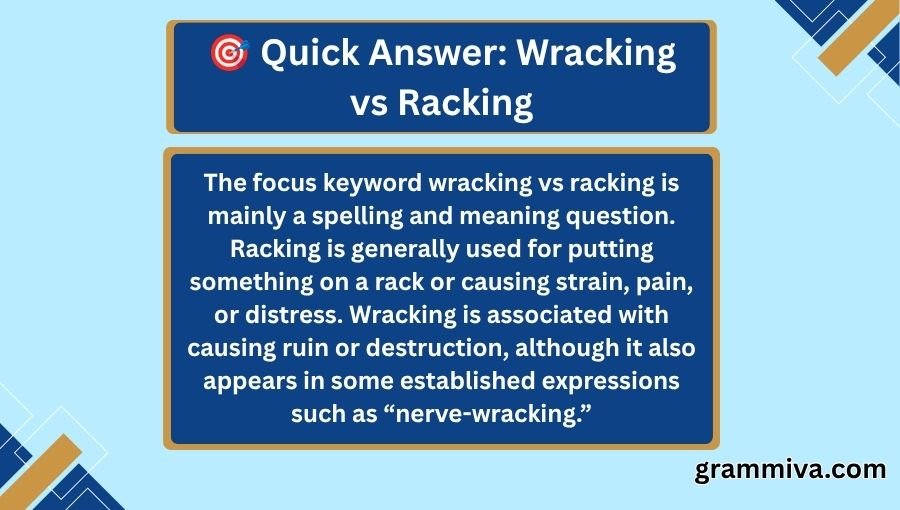
The focus keyword wracking vs racking is mainly a spelling and meaning question. Racking is generally used for putting something on a rack or causing strain, pain, or distress. Wracking is associated with causing ruin or destruction, although it also appears in some established expressions such as “nerve-wracking.”
A simple rule is:
- Rack = strain, torment, arrange, or put on a rack.
- Wrack = ruin or destroy.
If you mean mental or physical strain, racking is usually the safer choice: “rack your brain” and “rack your nerves.” If you mean destruction, wrack may be the right word: “wrack and ruin.”
Related Word Forms You Should Know
These words have several useful forms. Learning them together can prevent spelling mistakes.
| Form | Type | Example |
|---|---|---|
| rack | noun/verb | The books are on the rack. |
| racked | past tense/past participle | The storm racked the coast. |
| racking | present participle/adjective | The noise was racking my nerves. |
| wrack | noun/verb | The fire left the building in wrack. |
| wracked | past tense/past participle | The accident wracked his body with pain. |
| wracking | present participle/adjective | It was a nerve-wracking wait. |
One useful detail is that wracked and wracking can appear in phrases about severe pain or distress. English has some overlap here, especially in older or fixed expressions. That is why simply memorizing “wrack always means destruction” is too rigid.
🔎 Understanding Wracking vs Racking
The main difference between these words is their usual meaning.
Rack is much more common in modern everyday writing. It can mean to place something on a rack, but it can also mean to cause pain, strain, or distress. It appears in many familiar expressions.
Wrack is much less common. It is strongly connected with destruction, ruin, or wreckage. It is especially familiar in the fixed phrase “wrack and ruin.”
Here is the basic contrast:
| Form | Type | Meaning | Example | Correct/Incorrect |
|---|---|---|---|---|
| rack | noun/verb | support, arrange, strain, or torment | Please rack the pool balls. | ✅ Correct |
| racking | verb/adjective | causing strain or distress | The decision was racking my nerves. | ✅ Correct |
| wrack | noun/verb | ruin or destruction | The building was left in wrack. | ✅ Correct |
| wracking | adjective/verb form | causing severe distress or damage in certain uses | It was a nerve-wracking exam. | ✅ Correct |
| wracking | general replacement for every use of “racking” | Used automatically just because it sounds right | I need to wrack my brain. | ❌ Usually not the preferred form |
The key is context. Do not choose a spelling only because the word sounds familiar.
Is Rack the More Common Choice?
Yes. Rack is the broader and more common word in ordinary English. It has many meanings that have nothing to do with destruction.
You can rack billiard balls. You can rack up points. You can rack your brain. Something can rack your nerves. A storm can rack a ship or coast with powerful force.
That wide range is one reason racking shows up more often than wracking.
Rack as a Physical Support
A rack can be a frame used to hold or organize things.
For example:
- Put the dishes on the drying rack.
- Hang your coat on the rack.
- The bike is attached to the roof rack.
Here, rack has a clear physical meaning.
Rack as Strain or Torment
The verb rack can also describe severe mental or physical strain.
Examples:
- The pain racked her body.
- Doubt racked his mind.
- The decision racked me with worry.
The idea is that something is placing intense pressure on a person.
Rack in Common Expressions
Some phrases are so common that they are worth learning as complete units.
| Expression | Meaning | Example |
|---|---|---|
| rack your brain | think very hard | I racked my brain for an answer. |
| rack your nerves | cause stress or irritation | The constant noise is racking my nerves. |
| rack up | collect or accumulate | She racked up several awards. |
| rack your mind | think deeply | I racked my mind trying to remember his name. |
| rack rent | a full or high rent in older/legal usage | The property was subject to rack rent. |
What Does Wrack Mean?
Wrack is mainly connected with ruin, destruction, or severe damage. It is much less common than rack in everyday writing.
One familiar phrase is “wrack and ruin.” It means complete or serious destruction.
For example:
Years of neglect left the old house to wrack and ruin.
The word can also appear in expressions involving destruction or devastation. In modern English, however, many writers encounter wrack mainly through a small group of established phrases.
A useful way to remember it is:
Wrack → ruin.
That is not a rule for every historical or idiomatic use, but it is a strong practical guide.
🧠 Why Do People Confuse Wracking and Racking?
People confuse these words because they are visually and phonetically close. They also overlap in some expressions involving pain, stress, and distress.
Another problem is that English has several phrases where both forms have appeared over time. That can make a learner wonder whether there is one perfect spelling for every sentence.
I once edited a short business article in which the writer used “wrack” four times. Each use was meant to describe stress. Once we replaced the word with the appropriate form of rack, the meaning became much clearer.
Here are the main reasons the mistake happens:
- The words look almost the same.
- They can both occur near words such as pain, nerves, and distress.
- Some fixed expressions preserve older or variant forms.
- People often remember the sound rather than the spelling.
- Autocorrect may reinforce the wrong choice.
A Fast Memory Trick
Think:
Rack = pressure. Wrack = ruin.
If something is putting pressure on your body, mind, or nerves, rack will often be the form you want.
If something is being reduced to ruin, wrack may be appropriate.
🎯 Test Tip: Ask What the Word Is Doing
When you are unsure, stop and ask one question:
Am I talking about strain, or am I talking about destruction?
If the answer is strain, try rack first.
If the answer is destruction or ruin, consider wrack.
This test is especially useful when writing quickly.
For example:
- “The long wait was ___ my nerves.”
- The idea is stress.
- Racking is the natural choice.
- “The abandoned building fell into ___ and ruin.”
- The idea is destruction.
- Wrack belongs in the fixed phrase.
The test will not solve every idiom in English, but it will solve many ordinary spelling choices.
📝 Correct Meanings and Uses
The two words become easier when their main uses are separated.
1. Rack Means to Strain or Torment
When rack is a verb, it can describe severe physical or emotional strain.
Example:
The injury racked his body with pain.
Sentence breakdown:
- The injury = subject
- racked = verb
- his body = object
- with pain = phrase explaining the result
The verb tells us that the injury caused intense suffering.
2. Rack Means to Put Something in Order
Rack also has a very practical meaning.
We racked the billiard balls before the game.
Here, racked means arranged the balls in the proper formation.
Another example:
She racked the dishes after washing them.
This use has nothing to do with emotional distress.
3. Rack Up Means Accumulate
The phrase rack up means to collect or build up something.
The team racked up three wins.
You can also say:
He racked up a large credit-card balance.
The meaning comes from accumulation, not physical strain.
4. Wrack Means Ruin or Destruction
Wrack is used much less often, but its connection with ruin is important.
The abandoned factory was left to wrack and ruin.
This is a fixed expression. It describes a place or thing falling into serious decay or destruction.
Meaning Summary
| Meaning | Word Type | Example Sentence |
|---|---|---|
| Put something on or in a rack | Verb | She racked the equipment. |
| Arrange objects | Verb | He racked the balls. |
| Cause severe strain | Verb | The pain racked his body. |
| Accumulate | Verb with “up” | She racked up points. |
| Ruin or destroy | Verb | The storm wracked the coastline. |
| Ruin or destruction | Noun | The building fell into wrack and ruin. |
Notice that the line between the words is not absolute in every historical or idiomatic use. Context still matters.
Case Study: A Workplace Email
Imagine you are writing an email after a stressful project.
You might write:
“The last-minute changes were racking my nerves, but we finished the report on time.”
That is a natural use because the changes caused stress.
Now imagine a different message:
“Years of neglect left the old office building to wrack and ruin.”
Here, wrack fits because the sentence focuses on destruction and decay.
I once caught myself typing “wrack up” in a draft about sales numbers. I stopped because I remembered that the phrase is rack up, not “wrack up.” The quick mental test worked: sales numbers are being accumulated, not destroyed.
Grammar Rules Explanation
The safest grammar rule is to connect the spelling to the meaning and expression.
Rack is the standard choice for many meanings involving physical support, arrangement, accumulation, strain, and torment. This is why we write “rack up points,” “rack your brain,” and “rack your nerves.”
Wrack is tied more closely to ruin, destruction, and severe damage. The clearest familiar expression is “wrack and ruin.”
There are also established phrases in which wrack appears with meanings related to severe distress or damage. Because English contains these older and overlapping patterns, it is better to learn common expressions as whole phrases instead of treating one spelling as universally correct.
Standard dictionaries and major English reference works generally reflect this distinction, while also recording established variations.
The practical rule is simple: choose the spelling that matches the expression and meaning you intend.
Correct vs Incorrect at a Glance
| Sentence | Correct/Incorrect | Why |
|---|---|---|
| I racked my brain for the answer. | ✅ Correct | “Rack your brain” is the standard common expression. |
| I wracked my brain for the answer. | ⚠️ Variant/less preferred | “Wrack” occurs in some usage, but “rack your brain” is the safer standard choice. |
| The team racked up ten points. | ✅ Correct | “Rack up” means accumulate. |
| The team wracked up ten points. | ❌ Incorrect in standard usage | The established phrase is “rack up.” |
| The old house fell into wrack and ruin. | ✅ Correct | “Wrack and ruin” is an established expression. |
⚠️ Common Mistakes With These Words
The biggest mistake is assuming that the two spellings are interchangeable. They are not.
Another common error is remembering a phrase only by sound. When people hear “rack your brain,” they may later write “wrack your brain” because the words sound similar.
Fast typing also causes mistakes. Your brain knows what you mean, but your fingers may produce the spelling that looks familiar.
Autocorrect can make this worse. If the software accepts a word, that does not mean it is the best word for your sentence.
A lack of knowledge is another reason. English contains many pairs of words that differ by only one letter, so memorizing the main expressions is useful.
Similar Grammar Confusions
| Confusion | Correct Use | Example |
|---|---|---|
| its / it’s | its = belonging to it; it’s = it is | The dog wagged its tail. |
| your / you’re | your = belonging to you; you’re = you are | You’re holding your book. |
| their / there / they’re | possession / place / they are | They’re waiting over there. |
| affect / effect | usually verb / usually noun | The change affected the result. |
| then / than | time or sequence / comparison | She arrived later than I did. |
| rack / wrack | strain or accumulation / ruin and certain fixed uses | I racked up points. |
Common Wrong Spellings and Uses
| Wrong Form | What’s Wrong | Correct Form |
|---|---|---|
| wrack up points | The established expression means accumulate. | rack up points |
| wrack your brain | Usually not the preferred form for the common expression. | rack your brain |
| wrack your nerves | Usually use the established “rack” form for this meaning. | rack your nerves |
| rack and ruin | The familiar fixed expression uses “wrack.” | wrack and ruin |
| wrack the balls | Physical arrangement uses “rack.” | rack the balls |
| wracking up points | The phrase is “racking up” when used as a continuous form. | racking up points |
One caution: some of these “wrong” forms can be found in real-world writing. That does not automatically make them the clearest or most standard choice. Usage changes over time, and dictionaries may record variants.
How To Remember the Difference
A short memory trick can save you from repeated mistakes.
Remember Rack With “Stress”
Think:
Rack = pressure or strain.
- rack your brain
- rack your nerves
- rack up points
- rack the balls
- drying rack
Remember Wrack With “Ruin”
Think:
Wrack = ruin.
The strongest example is:
wrack and ruin
You can also remember the visual connection:
Wrack → Wreckage.
That is not a formal grammar rule. It is simply a memory aid.
Usage in Different Contexts
The right form can depend on the expression you are using, but the basic distinction stays the same.
| Context | Which Term to Use | Example |
|---|---|---|
| Everyday conversation | Usually rack | That noise is racking my nerves. |
| Professional writing | Use the established expression | The team racked up strong results. |
| Creative writing | Rack or wrack, depending on meaning | Fear racked his mind. |
| Social media/texting | Usually rack | I’m racking my brain trying to remember! |
In professional writing, clarity matters more than trying to sound unusual. If rack is the normal form, use it.
In creative writing, you may encounter wrack when describing destruction or devastation. Even there, context should guide the choice.
Common Phrases With Rack and Wrack
Several phrases are worth memorizing because they occur often.
| Phrase | Meaning |
|---|---|
| rack your brain | think very hard |
| rack your nerves | cause stress or irritation |
| rack up | accumulate |
| rack and ruin | not the standard form; avoid this spelling |
| wrack and ruin | complete ruin or destruction |
| nerve-racking | causing nervousness or stress |
One phrase deserves special attention: nerve-racking is a common standard spelling. You may also encounter nerve-wracking in edited and unedited writing. Because usage varies, follow the style guide or house style you are expected to use. If you simply want a clear alternative, “stressful” is often easier.
Are “Nerve-Racking” and “Nerve-Wracking” the Same?
They are closely related expressions, and both spellings can be found in actual English usage. Nerve-racking follows the basic “rack = strain” pattern, while nerve-wracking connects the phrase to the idea of causing severe distress.
For everyday writing, either may appear depending on the publication or style preference. If you want to avoid the spelling issue altogether, you can write:
The interview was extremely stressful.
That sentence is clear and natural.
Synonyms and Alternatives
Sometimes the best solution is not choosing between the two spellings. You can simply use another word.
| Alternative | Works When | Does Not Work When |
|---|---|---|
| stressful | You mean something causes worry or tension | You mean physically arranging something |
| exhausting | You mean something drains energy | You mean collecting points |
| tormenting | You mean something causes severe distress | You mean putting objects on a rack |
| destroying | You mean causing ruin | You mean thinking hard |
| accumulating | You mean building up a total | You mean causing emotional strain |
For example, instead of:
The waiting period was nerve-racking.
You could write:
The waiting period was stressful.
The meaning remains clear.
💡 Why the Difference Matters
Correct word choice helps readers understand you without stopping to decode your sentence.
A spelling mistake between rack and wrack may not always change the meaning dramatically. However, repeated word-choice errors can make professional writing look less polished.
I once reviewed a résumé that used several nearly correct word choices. None was disastrous by itself. Together, however, they distracted the reader from the person’s actual skills. Small details can affect how easy a document is to read.
Think of accurate word choice as removing speed bumps from your writing.
Clear writing lets the reader focus on your message instead of your mistakes.
| Situation | Why Getting It Right Matters |
|---|---|
| Resume | Shows care with written communication |
| Client email | Prevents confusion and builds trust |
| Published content | Makes the writing easier to edit and understand |
| Social post | Helps readers understand the intended meaning quickly |
Is “Wrack” Ever Correct for Stress or Pain?
Yes, but this is where the topic gets tricky.
You may see wracked used with words such as pain, guilt, or emotion. For example, “wracked with guilt” is a familiar expression. The form wracking also appears in expressions connected with severe distress.
That does not mean you should replace every use of racked with wracked.
Instead, learn the expression you are using.
Compare:
- I racked my brain. — standard common expression.
- He was wracked with guilt. — established expression.
- The movie was nerve-racking. — common spelling.
- The city was left in wrack and ruin. — established destruction phrase.
The important lesson is that English word choice depends on both meaning and fixed usage.
🔍 How Can You Check Which Spelling Is Correct?
Use this three-step method.
Step 1: Identify the meaning.
Are you talking about strain, accumulation, arrangement, or ruin?
Step 2: Check whether it is a fixed phrase.
Expressions such as “rack up,” “rack your brain,” and “wrack and ruin” should be learned as complete phrases.
Step 3: Read the sentence aloud.
If the sentence still feels uncertain, replace the word temporarily with a simpler synonym. This can reveal the intended meaning.
For example:
“I need to ___ my brain.”
Replace the missing word with “think hard.”
That points you toward rack, giving you “rack my brain.”
🔄 Wracking vs Racking in Past and Present Forms
The endings can make the spelling even more confusing.
| Base Form | -ed Form | -ing Form | Example |
|---|---|---|---|
| rack | racked | racking | The pain was racking his body. |
| rack | racked | racking | She racked up points. |
| wrack | wracked | wracking | The disaster wracked the region. |
| wrack | wracked | wracking | The experience was nerve-wracking. |
The key is to choose the correct base word first. Once you know whether the sentence needs rack or wrack, the related forms become easier to spell.
🚫 When Should You Avoid Guessing?
Avoid guessing when you are dealing with a fixed expression.
For example, “rack up” is not something you should rebuild from the basic meaning of the word. It is a set phrase.
The same is true for “wrack and ruin.”
When an expression is common, treat it like a vocabulary unit. This approach works for many tricky English pairs.
📚 A Simple Editing Method for Writers
When I proofread, I do not stop at spelling. I ask whether the chosen word matches the meaning.
Try this quick editing process:
- Circle the questionable word.
- Replace it with a plain word such as “stress,” “collect,” or “destroy.”
- Identify the meaning.
- Check whether the sentence contains a fixed expression.
- Choose rack or wrack based on that meaning.
- Read the final sentence once more.
This method takes only a few seconds.
It is also useful for students, bloggers, editors, and anyone who writes professional emails.
🧩 Key Differences Between Wracking and Racking
Here is the entire lesson in one table.
| Feature | Rack/Racking | Wrack/Wracking |
|---|---|---|
| Main idea | Strain, arrange, support, accumulate | Ruin, destruction, severe damage in certain uses |
| Everyday frequency | Very common | Less common |
| Common phrase | rack your brain | wrack and ruin |
| Accumulation | rack up | Not wrack up |
| Physical support | rack | Not wrack |
| Stress-related usage | very common | appears in established variants |
| Best memory word | pressure | ruin |
FAQs About Wracking vs Racking
What is the difference between wracking and racking?
Racking usually relates to strain, torment, arrangement, or accumulation. Wracking is more closely associated with ruin or severe damage, although it appears in some established expressions involving distress.
Is it “rack your brain” or “wrack your brain”?
The standard common expression is “rack your brain.” It means to think very hard.
Example:
“I racked my brain trying to remember her name.”
Is it “rack up” or “wrack up”?
The correct standard expression is “rack up.” It means to accumulate or collect something.
Example:
“The player racked up 20 points.”
Is “nerve-wracking” correct?
Yes, nerve-wracking is a recognized spelling used in English. Nerve-racking is also common. If you want to avoid the variation, you can simply use stressful.
What does “wrack and ruin” mean?
Wrack and ruin means serious or complete destruction or decay. It is an established expression.
Example:
“The empty building fell into wrack and ruin.”
Should I write “racking with pain” or “wracking with pain”?
Both patterns can occur in real English, depending on the exact expression. Racking follows the common verb pattern of causing severe strain or pain. Wracked with pain is also an established construction. Check the complete phrase rather than applying a single rule to every sentence.
Is “wrack” a real English word?
Yes. Wrack is a real English word, although it is less common than rack. It is strongly associated with ruin, destruction, and certain established expressions.
Can “racking” mean collecting something?
Yes. When paired with up, racking can mean accumulating something.
Example:
“She is racking up frequent-flyer miles.”
Why do people spell “rack” as “wrack”?
The words look and sound similar, and English has overlapping expressions involving stress and damage. Fast typing, autocorrect, and uncertainty about fixed phrases can also cause the mistake.
Which spelling should I use in formal writing?
Use the form that matches the established expression and intended meaning. For common phrases such as rack your brain and rack up, use rack. For wrack and ruin, use wrack. When an expression has documented spelling variation, follow the style guide used by your school, workplace, or publication.
✅ Quick Recap Checklist
Use this checklist whenever you are unsure.
| Question | If Yes → Use |
|---|---|
| Do you mean think very hard? | rack |
| Do you mean accumulate something? | rack |
| Do you mean arrange something on a rack? | rack |
| Do you mean cause strain or torment? | Usually rack |
| Do you mean ruin or destruction? | wrack |
| Are you using the phrase “___ and ruin”? | wrack |
| Are you writing “___ up points”? | rack |
Practice Examples
- I had to rack my brain to solve the puzzle. ✅
- The company racked up several new orders. ✅
- The abandoned house fell into wrack and ruin. ✅
Try making your own sentence with each form. If you can connect rack with pressure or accumulation and wrack with ruin, you have the core rule.
Final Takeaway: Wracking vs Racking Made Simple
Wracking vs racking becomes much easier when you focus on meaning instead of spelling alone. Rack is the word you will usually need for strain, torment, arrangement, support, and accumulation. Think of phrases such as rack your brain, rack your nerves, and rack up points.
Wrack is less common and is closely tied to ruin, destruction, and established expressions such as wrack and ruin.
You may also encounter wracked or wracking in expressions involving intense pain or distress, so do not treat the two spellings as completely separate worlds.
My best advice is to learn the common phrases as complete units.
When you see “rack up,” remember the phrase.
When you see “wrack and ruin,” remember the phrase.
When you mean severe strain, check whether the familiar rack pattern fits.
Once you connect each spelling with its main meaning, this tiny spelling difference stops being a guessing game. 🧠
Keep rack connected with pressure and accumulation, and wrack connected with ruin.
That simple habit will make your writing clearer, faster, and more confident. ✨

I am Adam Wilson, an English language content writer with an interest in grammar and vocabulary. I work at Grammiva and focus on creating clear explanations and practical examples for English learners.