Have you ever stopped while writing a sentence because you could not decide between a unique vs an unique? You are not alone.
This tiny grammar choice causes a surprising amount of confusion, especially because the word unique begins with the letter u. 😊
At first glance, an unique may look correct.
After all, we normally use an before words that begin with a vowel letter, such as an apple or an idea.
But English does not choose a or an based only on spelling.
The sound at the start of the next word matters.
When I teach this rule, I tell students to listen before they look.
The word unique begins with a sound like “yoo”, not a plain vowel sound.
That sound acts like the beginning of you.
Because of that, the correct phrase in standard US English is a unique, not an unique.
The good news is that this rule is easy to remember once you understand the sound behind it.
In this guide, I will explain the rule, show clear examples, cover common mistakes, and give you simple tests you can use whenever you are unsure. Sang vs Sung | Began vs Begun | Absence vs Abscence
🎯 Quick Answer: A Unique vs An Unique
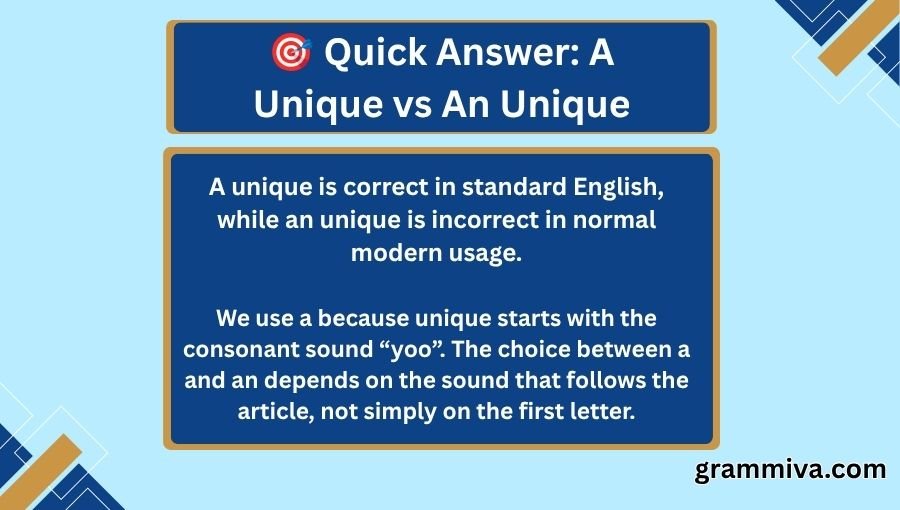
A unique is correct in standard English, while an unique is incorrect in normal modern usage.
We use a because unique starts with the consonant sound “yoo”. The choice between a and an depends on the sound that follows the article, not simply on the first letter.
| Phrase | Correct? | Reason |
|---|---|---|
| a unique idea | ✅ Correct | Unique begins with a “yoo” sound |
| an unique idea | ❌ Incorrect | The opening sound is not a plain vowel sound |
| a unique opportunity | ✅ Correct | The article matches the initial sound |
| an unusual idea | ✅ Correct | Unusual begins with a vowel sound |
🔤 Related Word Forms and Useful Variations
The word unique does not have a special plural or possessive form that changes the article rule. However, writers often confuse unique with related forms such as uniquely and uniqueness.
| Form | Type | Example |
|---|---|---|
| unique | Adjective | She found a unique solution. |
| uniquely | Adverb | The building is uniquely designed. |
| uniqueness | Noun | The product’s uniqueness is clear. |
| unique’s | Possessive form | Rarely needed and usually avoided in normal writing |
The important point is simple: when unique directly follows an indefinite article, use a unique.
🎯 Is A Unique the Correct Form?
Yes. A unique is the standard correct form because unique begins with a consonant sound.
The word starts with the sound “yoo”, as in you. That opening sound is treated as a consonant sound in English grammar.
Consider these sentences:
- ✅ She has a unique style.
- ❌ She has an unique style.
The spelling begins with u, but the sound begins with y.
This is the same basic idea behind words such as university, uniform, and user. We normally say:
- a university
- a uniform
- a user
We do not normally say an university, an uniform, or an user.
❌ Why Is An Unique Usually Incorrect?
An unique is usually incorrect because unique does not begin with the vowel sound required after an.
The article an is used before a vowel sound. For example:
- an apple
- an orange
- an honest person
- an idea
The article a is used before a consonant sound:
- a book
- a house
- a university
- a unique idea
So the key is not the letter u. The key is the sound.
A simple sound test
Say the phrase aloud:
a unique idea
It sounds natural because the words flow as:
a + yoo-nique
Now try:
an unique idea
The transition sounds unnatural in standard English because an is designed to come before a vowel sound.
| Beginning | Sound Type | Article | Example |
|---|---|---|---|
| apple | Vowel sound | an | an apple |
| idea | Vowel sound | an | an idea |
| honest | Vowel sound | an | an honest answer |
| unique | Consonant sound | a | a unique answer |
| university | Consonant sound | a | a university |
| user | Consonant sound | a | a user |
🧠 How Do A Unique and An Unique Differ?
The difference is grammatical rather than a difference in meaning. A unique is the standard form, while an unique should normally be avoided.
Both expressions appear to describe the same thing. The issue is which indefinite article fits the pronunciation of unique.
| Form | Meaning | Standard Usage | Example |
|---|---|---|---|
| a unique | One special or unusual thing | Correct | It is a unique design. |
| an unique | Intended to mean the same thing | Not standard | It is an unique design. |
The mistake often happens because people learn a shortcut: “Use an before a word that starts with a vowel.”
That shortcut is incomplete.
The better rule is:
Use a before a consonant sound and an before a vowel sound.
That rule works much more reliably.
💡 What Is the Fastest Test for A Unique?
The fastest test is to say the word aloud and listen to its first sound.
If the word begins with a sound like “yoo,” use a.
Try these:
- a unique plan
- a unique chance
- a unique feature
- a unique person
- a unique experience
The same sound rule explains why we say:
- a university
- a union
- a uniform
- a useful tool
- a user account
💡 Test Tip
When you are unsure about a or an, ignore the first written letter for a moment.
Ask:
“What sound do I hear first?”
If you hear a consonant sound, choose a. If you hear a vowel sound, choose an.
This test is especially useful with words beginning with u, h, and abbreviations.
📝 Correct Meanings and Uses of Unique
Unique is an adjective. It is used to describe something that is special, different, or unlike other things.
In everyday writing, people often use unique to mean “very unusual” or “different from the usual.”
A unique idea
Use a unique idea when describing one idea that stands out from others.
She suggested a unique idea for the school project.
Here, a introduces one idea, and unique describes it.
A unique experience
Use a unique experience when one event feels unusually different or special.
Traveling alone gave him a unique experience.
A unique opportunity
Use a unique opportunity when referring to a special chance.
The internship gave me a unique opportunity to learn from experts.
A unique design
Use a unique design when describing something with a distinctive appearance or approach.
The artist created a unique design for the poster.
| Meaning | Word Type | Example Sentence |
|---|---|---|
| Different from others | Adjective | She has a unique style. |
| Special or unusual | Adjective | We had a unique experience. |
| Distinctive | Adjective | The house has a unique design. |
| One of its kind in a given context | Adjective | The museum owns a unique object. |
📝 Case Study: A Unique Sentence at Work
Imagine that you are writing an email to a client about a new product.
You type:
“We believe this is an unique solution for your business.”
The sentence may look acceptable if you are thinking about the spelling of unique. But once you say it aloud, the problem becomes easier to hear.
I once edited a short business proposal where this exact type of article mistake appeared several times. The writer had excellent ideas and strong vocabulary. The problem came from relying on the first letter rather than the first sound.
I changed the sentences to:
“We believe this is a unique solution for your business.”
That small correction made the document sound more polished.
| Original Idea | Better Version | Reason |
|---|---|---|
| an unique solution | a unique solution | Unique begins with “yoo” |
| an unique feature | a unique feature | Consonant sound |
| an unique approach | a unique approach | Consonant sound |
| an unique product | a unique product | Consonant sound |
📚 Grammar Rules Explanation
The choice between a and an is based on pronunciation, not simply spelling.
Use a before a consonant sound. Use an before a vowel sound.
The word unique begins with a sound commonly represented in ordinary spelling as “yoo.” Because that opening sound is consonant-like, a is the correct indefinite article.
Therefore:
- a unique idea is correct.
- an unique idea is incorrect in standard usage.
This same rule explains why we say a university even though university begins with the letter u. The pronunciation starts with the same general “yoo” sound.
By contrast, words such as umbrella begin with a true vowel sound, so we say an umbrella.
Standard English grammar references agree on this sound-based article rule.
Correct vs Incorrect at a Glance
| Sentence | Correct/Incorrect | Why |
|---|---|---|
| She found a unique solution. | ✅ Correct | Unique begins with a consonant sound |
| She found an unique solution. | ❌ Incorrect | An does not fit the opening sound |
| He designed a unique logo. | ✅ Correct | The phrase starts with “a + yoo” |
| He designed an unique logo. | ❌ Incorrect | The article is mismatched |
| It was a unique experience. | ✅ Correct | Unique begins with a consonant sound |
⚠️ Why Do People Confuse A Unique and An Unique?
People confuse these forms because English spelling and pronunciation do not always match neatly. When people search for a unique vs an unique, they are usually unsure whether the letter “u” requires an. The answer depends on the sound, not the spelling.
The letter u is especially tricky. Sometimes it begins with a vowel sound, as in umbrella. At other times, it begins with a “yoo” sound, as in unique.
Three common causes are:
- Fast typing — People type based on memory and move on.
- Autocorrect — Software may not always teach the reason behind a correction.
- Lack of knowledge — Many learners were taught the simplified rule about vowel letters rather than vowel sounds.
A student once wrote an unique opportunity in an essay. When I asked her why, she pointed to the letter u and said, “Because u is a vowel.” That answer made sense from a spelling point of view. It simply did not account for pronunciation.
Once she learned to listen to the first sound, she stopped making the mistake.
Similar Grammar Confusions
| Confusion | Correct Form | Common Reason for Error |
|---|---|---|
| it’s / its | depends on meaning | Apostrophe confusion |
| your / you’re | depends on meaning | Similar sound |
| their / there / they’re | depends on meaning | Same or similar sounds |
| a / an | depends on first sound | Spelling-based shortcut |
| affect / effect | depends on sentence role | Similar appearance and meaning |
Common Wrong Forms for This Topic
| Wrong Form | What’s Wrong | Correct Form |
|---|---|---|
| an unique | Wrong article | a unique |
| an unique idea | Article does not match sound | a unique idea |
| an unique opportunity | Same article error | a unique opportunity |
| an unique solution | Same article error | a unique solution |
| an unique experience | Same article error | a unique experience |
🕰️ Does the History of Unique Explain the Article Choice?
No. You do not need the history of the word unique to choose the correct article.
The practical grammar rule comes from modern English pronunciation. Whether a word begins with a particular letter does not automatically determine whether it takes a or an.
For article choice, listening to the opening sound is far more useful than memorizing word history.
🌎 How Is A Unique Used in Different Contexts?
A unique works the same way in everyday speech, professional writing, creative writing, and digital communication. The context may change, but the article rule does not. The rule for a unique vs an unique stays the same in everyday speech, professional writing, creative writing, and online communication.
| Context | Which Term to Use | Example |
|---|---|---|
| Everyday conversation | a unique | That’s a unique idea. |
| Professional writing | a unique | We offer a unique service. |
| Creative writing | a unique | She lived in a unique house. |
| Social media/texting | a unique | What a unique look! |
Everyday conversation
You might say:
“That’s a unique way to solve the problem.”
This sounds natural and clear.
Professional writing
Professional writing benefits from accurate grammar:
“Our company provides a unique approach to customer support.”
Creative writing
Writers can use the phrase naturally:
“Beyond the hill stood a unique little house.”
Social media and texting
Informal writing can be shorter, but the same grammar still applies:
“Just found a unique gift idea! 🎁”
🔎 How Can You Remember the Difference?
Remember the sound, not the letter. A simple way to remember a unique vs an unique is to say unique aloud. The “yoo” sound tells you to choose a, not an.
A useful mental trick is to replace unique with you-nique for one second.
You would naturally say:
a you-nique idea
You would not normally say:
an you-nique idea
That mental trick can help you remember the correct article.
| Word | First Sound | Correct Article | Example |
|---|---|---|---|
| unique | “yoo” | a | a unique plan |
| university | “yoo” | a | a university |
| useful | “yoo” | a | a useful tool |
| umbrella | vowel sound | an | an umbrella |
| unusual | vowel sound | an | an unusual event |
🧩 A Unique vs An Unique: The Core Rule
The core rule is simple: choose the article based on sound.
A unique is correct because unique begins with the consonant sound represented by its “yoo” opening.
An unique is not the standard choice because an normally comes before a vowel sound.
This rule also helps with other words that begin with letters that can create different sounds.
| Word | First Sound | Article | Full Phrase |
|---|---|---|---|
| unique | “yoo” | a | a unique idea |
| user | “yoo” | a | a user account |
| useful | “yoo” | a | a useful guide |
| hour | vowel sound | an | an hour |
| honest | vowel sound | an | an honest answer |
💬 When Does An Work Before U Words?
An can work before a word beginning with u when the u has a true vowel sound.
For example:
an umbrella
The word umbrella begins with a vowel sound.
Another example is:
an unusual event
The opening sound in unusual is a vowel sound, so an is correct.
This is why “u is a vowel” is not enough information to choose the article.
| U Word | First Sound | Correct Phrase |
|---|---|---|
| unique | “yoo” | a unique idea |
| university | “yoo” | a university |
| user | “yoo” | a user |
| umbrella | vowel sound | an umbrella |
| unusual | vowel sound | an unusual event |
✍️ Common Phrases With A Unique
There are many natural phrases using a unique. These phrases are useful in school, business, conversation, and online writing.
| Phrase | Meaning |
|---|---|
| a unique idea | an idea that stands out |
| a unique opportunity | a special chance |
| a unique experience | an unusually different experience |
| a unique approach | a distinctive way of doing something |
| a unique design | a design that differs from others |
| a unique perspective | a distinctive way of seeing something |
Examples include:
- She offered a unique perspective. 💡
- The team created a unique approach to the problem.
- We found a unique opportunity to work together.
- He described it as a unique experience.
🔄 What Can Replace A Unique?
Sometimes you can replace unique with another adjective. The best choice depends on what you actually mean.
Do not replace it just to avoid learning the article rule. Choose another word only when it gives your sentence the meaning you want.
| Alternative | Works When | Does Not Work When |
|---|---|---|
| a special | Something has personal importance | You specifically mean distinctiveness |
| a rare | Something is uncommon | The thing is simply different |
| an unusual | Something is not usual | You need the exact sense of unique |
| a distinctive | Something has a clear identifying quality | The meaning is simply “special” |
| an original | Something is new or independently created | You only mean uncommon |
Notice an interesting example:
an unusual idea
Here an is correct because unusual begins with a vowel sound.
But:
a unique idea
Here a is correct because unique begins with the “yoo” sound.
That contrast is an excellent way to learn the rule.
🎯 Why Does Getting A Unique Right Matter?
Getting the article right improves clarity and makes your writing sound more natural.
One small grammar choice can affect how polished a sentence feels. This matters most when the sentence appears in a resume, client email, article, school paper, or other formal setting.
A reader may understand an unique, but standard grammar still favors a unique.
“Good grammar should make your meaning easier to trust.”
That principle is useful beyond this one phrase.
| Situation | Why Getting It Right Matters |
|---|---|
| Resume | Shows careful writing |
| Client email | Creates a professional impression |
| Published content | Improves language quality |
| Social post | Makes the message cleaner |
I once caught myself typing an unique feature in a product description after writing quickly for several minutes. I reread the sentence before publishing it and immediately noticed the sound problem. It was a good reminder that even experienced writers need to proofread small grammar choices.
🚫 Can You Ever Use An Unique?
In standard modern US English, a unique is the form you should use before unique.
You may occasionally see an unique in older, nonstandard, learner, or poorly edited writing. Seeing it does not make it the preferred form.
For school, business, websites, applications, and other polished writing, choose a unique.
| Situation | Recommended Form |
|---|---|
| Academic writing | a unique |
| Business writing | a unique |
| Formal email | a unique |
| Website content | a unique |
| Everyday speech | a unique |
| Standard US English | a unique |
🧠 How Does A Unique Fit the General A-or-An Rule?
The phrase follows the same broad rule used throughout English.
Use a before a consonant sound:
a car
a teacher
a university
a unique idea
Use an before a vowel sound:
an apple
an answer
an umbrella
an unusual idea
The important word is sound.
| Rule | Example | Correct? |
|---|---|---|
| a + consonant sound | a unique idea | ✅ |
| an + vowel sound | an unusual idea | ✅ |
| an + “yoo” sound | an unique idea | ❌ |
| a + vowel sound | a umbrella | ❌ |
📖 Why Spelling Can Mislead You
English spelling can make grammar rules look harder than they are.
If you see unique, your eyes immediately notice the letter u. Since u is a vowel, you may feel that an should follow.
But articles are not chosen by letter alone.
Consider hour. It begins with h, which is a consonant letter. Yet we say:
an hour
Why? The h is not pronounced, so the word begins with a vowel sound.
Now compare unique:
a unique idea
The written u is a vowel letter, but the word begins with the consonant-like “yoo” sound.
This shows why pronunciation matters.
📋 Quick Recap Checklist
Use this checklist whenever you see the phrase. If you forget the rule for a unique vs an unique, do not look only at the first letter. Listen to the first sound of unique and choose the article that matches it.
| Question | If Yes → Use |
|---|---|
| Does the next word begin with a consonant sound? | a |
| Does unique sound like it begins with “yoo”? | a unique |
| Does the word begin with a true vowel sound? | an |
| Are you looking only at the first written letter? | Stop and check the sound |
Practice Examples
- She designed a unique logo. ✅
- We found a unique solution. ✅
- They had an unique solution. ❌
Try reading each sentence aloud. Your ear will often catch the problem before your eyes do.
❓ FAQs About A Unique vs An Unique
Is a unique grammatically correct?
Yes. A unique is the standard correct form in US English because unique begins with a “yoo” sound, which is treated as a consonant sound for article choice.
Is an unique ever correct?
In standard modern English, an unique should normally be avoided. Use a unique instead.
Why do we say a unique instead of an unique?
We say a unique because articles depend on sound rather than spelling. Unique begins with a “yoo” sound, so it takes a.
Is unique a vowel sound?
No. Although unique starts with the vowel letter u, its opening sound is the consonant-like “yoo” sound. That is why we say a unique.
Is it a unique idea or an unique idea?
The correct phrase is a unique idea.
Example:
“She came up with a unique idea.”
Is it a unique opportunity or an unique opportunity?
The correct phrase is a unique opportunity.
Example:
“This is a unique opportunity to learn.”
Why is an unusual correct but an unique incorrect?
The two words begin with different sounds. Unusual begins with a vowel sound, so an unusual is correct. Unique begins with a “yoo” sound, so a unique is correct.
Should I use a unique in formal writing?
Yes. A unique is the standard choice in formal and professional writing.
Does the rule apply to university?
Yes. We normally say a university, not an university, because university also begins with a “yoo” sound.
What is the easiest way to remember a unique vs an unique?
Listen to the first sound. If unique sounds like “yoo-nique,” remember that it begins with a consonant sound. Therefore, use a unique.
✅ Final Takeaway
A unique vs an unique is not really a battle between two meanings. It is a question of sound and article choice. The correct standard form is a unique because unique begins with a “yoo” sound.
The most useful rule to remember is this: choose a or an based on the sound that comes next, not simply the first letter you see. That rule explains a unique, a university, a user, an umbrella, and an unusual event.
When I proofread writing, I find that small article mistakes are often easy to fix once the writer stops thinking about spelling and starts listening to the sentence. 👂
So the next time you pause over this phrase, say it aloud. If you hear “yoo” at the start, your choice is clear: a unique.
Remember the sound, choose the article, and let your writing speak with confidence. ✨

I am Ryan Mitchell, a writer focused on English grammar, vocabulary, and everyday language. I work at Grammiva, creating easy-to-understand articles that help readers improve their English with confidence.

[…] the end, you should be able to choose confidently without stopping to second-guess yourself. ✍️ A Unique vs An Unique | Sang vs Sung | Began vs […]
[…] what each document is designed to do, choosing between them becomes much easier. Eyeing vs Eying | A Unique vs An Unique | Sang vs […]