Have you ever wondered about began vs begun when writing a sentence like “I have began working” and wondered whether it sounds right? 😅 You are not alone.
Many writers confuse these two words because both come from the same verb: begin.
However, each form has a different grammatical role.
The good news is that the rule is simple once you understand how each word works.
Began is the simple past form of begin.
Begun is the past participle, so it normally needs a helping verb such as has, have, or had.
I explain grammar by focusing on the job a word does in a sentence rather than asking readers to memorize long rules.
This approach works especially well here.
Once you connect began with a past action and begun with a helping verb, choosing the correct form becomes much easier. 🌟
This guide explains the difference between began and begun, provides clear examples, explores common mistakes, and shares simple tests you can use whenever you are unsure which form is correct. Absence vs Abscence | Attorneys vs Attornies | Ingrained vs Engrained
🎯 Quick Answer: Began vs Begun
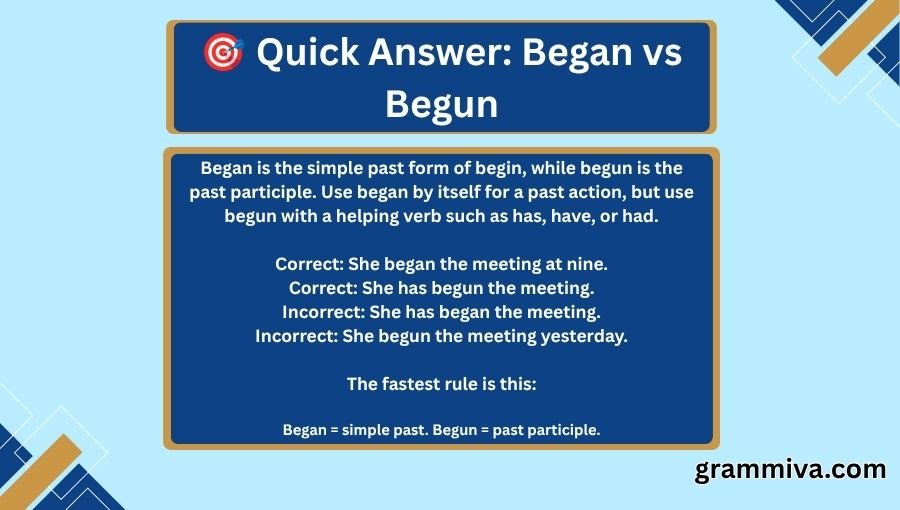
Began is the simple past form of begin, while begun is the past participle. Use began by itself for a past action, but use begun with a helping verb such as has, have, or had.
- Correct: She began the meeting at nine.
- Correct: She has begun the meeting.
- Incorrect: She has began the meeting.
- Incorrect: She begun the meeting yesterday.
The fastest rule is this:
Began = simple past. Begun = past participle.
Is Began the Simple Past Form?
Yes. Began is the simple past form of begin. Use it when you are talking about an action that happened in the past.
The basic pattern is:
Subject + began + object or complement
Examples:
- I began my homework after dinner.
- They began the project last Monday.
- She began to laugh.
- We began walking before sunrise.
Notice that began does not need has, have, or had before it.
Began for a Finished Past Action
The simple past often tells us that something happened at a particular point or period in the past.
Consider:
Maria began her new job in June.
The action started in the past. The sentence simply reports when it started.
Compare that with:
Maria has begun her new job.
Here, has changes the grammar. Because the sentence uses the present perfect, the correct participle is begun.
Examples With Began
| Sentence | What It Shows | Correct? |
|---|---|---|
| I began reading at eight. | A past starting point | ✅ Yes |
| He began the lesson yesterday. | A completed past reference | ✅ Yes |
| We began our trip on Friday. | A past event | ✅ Yes |
| She has began the lesson. | Wrong participle after has | ❌ No |
| They begun work at noon. | Missing helping verb | ❌ No |
When Should You Use Begun?
Use begun when the sentence calls for the past participle of begin. In standard English, that usually means a helping verb comes before it.
Common helping verbs include:
- has
- have
- had
- is
- are
- was
- were
- been
The most common perfect-tense patterns are:
- has begun
- have begun
- had begun
For example:
The movie has begun.
The students have begun their work.
The rain had begun before we left.
Begun in Perfect Tenses
The perfect tenses use a form of have plus a past participle.
| Tense | Pattern | Example |
|---|---|---|
| Present perfect | has/have + begun | She has begun writing. |
| Past perfect | had + begun | She had begun writing before lunch. |
| Future perfect | will have + begun | She will have begun by noon. |
The important point is not the tense name. The useful question is: Do I already have a helping verb such as has, have, or had?
If yes, begun is often the form you need.
🔍 Began vs Begun at a Glance
The core difference is grammatical, not one of meaning. Both forms relate to starting something, but they perform different jobs.
| Form | Type | Meaning | Example | Correct/Incorrect |
|---|---|---|---|---|
| begin | Base verb | Start something | I begin work at nine. | ✅ Correct |
| began | Simple past | Started in the past | I began work at nine. | ✅ Correct |
| begun | Past participle | Started, used with a helping verb | I have begun work. | ✅ Correct |
| has began | Incorrect verb combination | — | She has began work. | ❌ Incorrect |
| begun alone | Incorrect in ordinary standard use | — | She begun work yesterday. | ❌ Incorrect |
A useful way to remember the forms is:
begin → began → begun
Think of these as three different forms of the same verb.
Why Do People Confuse Began and Begun?
People confuse the two forms because they describe the same basic action: starting. The difference is in how the verb fits into the sentence.
I once worked with a student who wrote, “The game has began.” He knew that began meant “started,” so the sentence seemed reasonable to him. We changed it to “The game has begun” and then looked at another example: “The game began at seven.” Once he saw the two patterns side by side, the problem disappeared.
Another reason is that irregular verbs do not follow the easy -ed pattern. We say:
- walk → walked → walked
- jump → jumped → jumped
- begin → began → begun
That changing vowel can make the forms harder to remember.
A Simple Three-Form Pattern
| Base Form | Past Form | Past Participle |
|---|---|---|
| begin | began | begun |
| write | wrote | written |
| go | went | gone |
| see | saw | seen |
| take | took | taken |
This pattern is worth studying because begin behaves like many other irregular verbs. The past and past participle are not always identical.
How Can You Tell Which Form Is Correct?
Ask yourself one short question:
Is there a helping verb before the form?
If there is no helping verb and you are describing a past event, began is usually correct.
The concert began at eight.
If you have has, have, or had, use begun.
The concert has begun.
This quick test will solve most everyday cases.
💡 Test Tip
Cover the verb and look at the words immediately before it.
- “She ___ the lesson yesterday.” → began
- “She has ___ the lesson.” → begun
- “She had ___ the lesson.” → begun
If has, have, or had is already there, do not use began.
What Are the Correct Meanings and Uses?
The basic meaning of begin is “to start.” The three forms differ because of grammar, not because they describe completely different actions.
| Meaning or Use | Word Type | Example Sentence |
|---|---|---|
| Start in the present or as a general action | Base verb | We begin class at nine. |
| Started in the past | Simple past | We began class at nine. |
| Started, with a helping verb | Past participle | We have begun class. |
| Started before another past event | Past perfect | We had begun class before he arrived. |
Using Began With a Past Time
Use began when the sentence gives a clear past reference.
Examples include:
- The show began at 7:30.
- She began her speech yesterday.
- The company began operations in 2019.
- I began studying last night.
Words such as yesterday, last week, in 2020, and two hours ago often appear naturally with the simple past.
Using Begun With Has or Have
Use begun after has or have when using the present perfect.
The meeting has begun.
The workers have begun repairs.
The present perfect can connect a past action to the present situation.
Using Begun With Had
Use begun after had for the past perfect.
The movie had begun before we entered the theater.
There are two past events here. The movie started first. We entered later.
How Does Began Work in Everyday Sentences?
Began works well when the sentence simply reports a past start. It can be followed by a noun, to plus a verb, or an -ing form.
Examples:
She began the report on Monday.
She began to write the report.
She began writing the report.
All three can be grammatical. The key issue is the form of begin itself.
Sentence Breakdown
Take this sentence:
The child began to cry.
- The child = subject
- began = simple past verb
- to cry = action that started
Now compare:
The child has begun to cry.
- The child = subject
- has = helping verb
- begun = past participle
- to cry = action that started
The addition of has changes the verb form.
How Does Begun Work in Perfect Constructions?
Begun normally appears as part of a larger verb phrase.
For example:
The class has begun.
The word has carries the tense. Begun supplies the past participle form.
You can also see it after had:
The class had begun before I arrived.
And after will have:
The class will have begun by the time you arrive.
The same principle stays in place. Begun does not replace began simply because the action happened in the past. Its form depends on the grammatical structure.
📝 Case Study: A Workplace Email
Imagine a manager writing to a team:
“The training began at 9:00 a.m. Please join the call if you have not attended yet.”
That is correct because began reports a past starting time.
Now imagine the manager sends an update during the session:
“The training has begun, so please join the call as soon as possible.”
That is also correct. Here, has begun connects the start of the training with the current situation.
I once caught myself typing “The review has began” in a work note after a long editing session. I spotted the word has, changed began to begun, and moved on. That tiny check saved me from sending a grammar error to a large group.
Workplace Comparison
| Situation | Best Form | Example |
|---|---|---|
| Reporting a past start time | began | The meeting began at 10. |
| Reporting something that has started | has begun | The meeting has begun. |
| Reporting something that started before another past event | had begun | The meeting had begun before I arrived. |
| Reporting a future deadline | will begin | The meeting will begin at 10. |
Grammar Rules Explanation
The difference comes from the forms of an irregular verb.
The verb begin has three main forms:
begin → began → begun
Began is the simple past form. Begun is the past participle. A past participle usually works with a helping verb in constructions such as the perfect tenses.
Standard grammar references agree on this basic distinction.
The rule can be stated simply:
Use began as the simple past form. Use begun as the past participle.
This is why these sentences work differently:
The lesson began at nine.
The lesson has begun.
The first sentence uses the simple past. The second uses the present perfect.
A common mistake is to think that begun simply means “a more formal version of began.” It does not. The two words are different grammatical forms.
Correct vs Incorrect at a Glance
| Sentence | Correct/Incorrect | Why |
|---|---|---|
| The meeting began at noon. | ✅ Correct | Began is simple past. |
| The meeting has begun. | ✅ Correct | Begun follows has. |
| The meeting had begun before lunch. | ✅ Correct | Begun follows had. |
| The meeting has began. | ❌ Incorrect | Has requires the past participle begun. |
| The meeting begun at noon. | ❌ Incorrect | Begun cannot normally stand alone as simple past. |
⚠️ Common Mistakes With Began and Begun
Most mistakes happen because people focus on meaning instead of sentence structure. Both forms relate to starting, so the ear may not always catch the error.
Three common causes are:
- Fast typing — You know the rule but type the wrong form.
- Autocorrect or predictive text — Your device may favor a familiar word.
- Lack of knowledge — You may never have learned that the two forms have different grammatical jobs.
I once edited a short report in which the same writer used “has began” three times. The writer clearly understood the meaning. The problem was simply that the past participle form had not become automatic yet.
Similar Grammar Confusions
| Confusion | Correct Choice | Basic Rule |
|---|---|---|
| it’s / its | depends on meaning | It’s = it is; its = possessive |
| your / you’re | depends on meaning | Your = belonging to you; you’re = you are |
| they’re / their / there | depends on meaning | Different meanings and jobs |
| then / than | depends on meaning | Then relates to time; than compares |
| began / begun | depends on structure | Began = simple past; begun = past participle |
Common Wrong Forms
| Wrong Form | What’s Wrong | Correct Form |
|---|---|---|
| has began | Has needs the past participle | has begun |
| have began | Have needs the past participle | have begun |
| had began | Had needs the past participle | had begun |
| begun yesterday | Begun is being used alone as simple past | began yesterday |
| begun at 8:00 | Missing helping verb | began at 8:00 |
| has begin | Base form used after has | has begun |
Do Began and Begun Have Different Meanings?
Not in the basic sense of starting. Both are forms of the verb begin. The main difference is grammatical.
Think of it this way:
Began tells you that something started in the past.
Begun tells you that the verb is being used as a past participle.
That distinction is more useful than trying to memorize separate definitions.
A Quick Structure Test
Look at these examples:
The race began at noon.
The race has begun.
The race had begun before we arrived.
The action is similar in all three sentences. The verb form changes because the grammar changes.
How To Remember the Difference
The easiest memory trick is to connect each form to a pattern.
Pattern 1: Began Stands Alone
I began.
She began.
They began.
Here, began is the main past-tense verb.
Pattern 2: Begun Needs Help
I have begun.
She has begun.
They had begun.
Here, a helping verb supports begun.
The “Have Test”
When you are unsure, quietly add have to the sentence.
If the structure naturally calls for:
have begun
then begun is the past participle you need.
For example:
The work has ___.
The answer is begun.
But:
The work ___ yesterday.
The answer is began.
This simple test is especially useful when proofreading.
Usage in Different Contexts
The basic rule stays the same in every setting. What changes is the kind of sentence you are likely to write.
| Context | Which Term to Use | Example |
|---|---|---|
| Everyday conversation | began or begun, based on structure | The game began early. |
| Professional writing | began or begun, based on structure | The review has begun. |
| Creative writing | began or begun, based on structure | The storm began at midnight. |
| Social media/texting | began or begun, based on structure | The concert has begun! |
Everyday Conversation
People often use the simple past when telling a story.
The movie began late.
They may use the present perfect when talking about something happening now.
The movie has begun, so hurry!
Professional Writing
Accuracy matters in emails, reports, resumes, and business documents.
The project began in January.
The testing phase has begun.
Both are clear and professional.
Creative Writing
Writers often use began when describing events in a story.
The wind began to rise.
They may use had begun when showing that one past event happened before another.
The rain had begun before the travelers reached the village.
Social Media and Texting
Informal writing may be less careful, but standard grammar still helps.
The sale has begun!
This is short, natural, and correct.
Common Phrases With Begin and Its Forms
There are several common expressions involving begin. The exact form depends on the grammar of the sentence.
| Phrase | Meaning |
|---|---|
| begin with | Start with something |
| begin again | Start another time |
| begin to understand | Start understanding |
| begin to change | Start changing |
| begin by doing something | Start with a particular action |
| from the beginning | From the start |
Examples:
Let’s begin with the first question.
She began to understand the problem.
The team began by reviewing the notes.
These expressions can appear with different forms of the verb depending on the sentence.
Alternatives You Can Use
Sometimes you can replace begin or one of its forms with another word. The best choice depends on the sentence.
| Alternative | Works When | Does Not Work When |
|---|---|---|
| start | You want a simple, common synonym | A fixed phrase specifically requires begin |
| launch | Something such as a product or project officially starts | You are describing an ordinary personal action |
| commence | Formal writing calls for a formal word | You want a casual, natural tone |
| open | An event, meeting, or discussion starts | The action is not about opening something |
| kick off | Informal speech describes the start of an event | Formal writing requires a neutral tone |
For example:
The meeting began at nine.
can become:
The meeting started at nine.
But replacing every use of begin with another word is unnecessary. Begin is already clear and natural.
Why Correct Verb Forms Matter
Correct verb forms improve clarity. They also make your writing look polished.
A reader may understand “The project has began,” but the sentence still contains a grammar error. In a formal email, school assignment, resume, or published article, small errors can distract from your message.
Clear grammar lets the reader focus on your idea instead of your mistake.
Why Accuracy Matters
| Situation | Why Getting It Right Matters |
|---|---|
| Resume | Shows care with written communication |
| Client email | Builds a professional impression |
| Published content | Improves trust and readability |
| Social post | Makes your message easier to read |
Grammar does not need to be complicated. In this case, one small rule handles most situations.
Is There a Special Exception?
There is no common standard-English exception that allows begun to replace began as the ordinary simple past form.
You may encounter unusual uses in older, dialectal, poetic, or intentionally nonstandard writing. Those cases do not change the standard rule taught in modern US English.
For normal writing, remember:
- I began
- I have begun
- I had begun
That is the safe standard pattern.
Which Form Should You Use in a Past Story?
Use began when you are simply telling what happened.
For example:
The children began playing after lunch.
If you need to show that the action had already started before another past event, use had begun.
The children had begun playing before their parents arrived.
This distinction helps readers understand the order of events.
Timeline Example
| Event | Sentence | Verb Form |
|---|---|---|
| Start happened in the past | The class began at nine. | began |
| Start connects to now | The class has begun. | begun |
| Start happened before another past event | The class had begun before I arrived. | begun |
| Start will happen later | The class will begin at nine. | begin |
Quick Recap Checklist
Use these questions whenever you are proofreading.
| Question | If Yes → Use |
|---|---|
| Am I simply describing a past action? | began |
| Does the sentence contain has before the verb? | begun |
| Does it contain have before the verb? | begun |
| Does it contain had before the verb? | begun |
| Am I talking about a future start? | begin |
Practice Examples
- The lecture ___ at 10:00 yesterday.
Answer: began - The lecture has ___.
Answer: begun - The lecture had ___ before we arrived.
Answer: begun
A final memory line can help:
Yesterday, it began. By now, it has begun.
FAQs About Began vs Begun
Is began the past tense of begin?
Yes. Began is the simple past form of begin. For example: “She began the lesson at nine.”
Is begun the past tense of begin?
No. Begun is the past participle of begin. It normally appears with a helping verb, such as has, have, or had.
Is it correct to say “has began”?
No. In standard US English, the correct form is “has begun.” The word has is followed by the past participle.
Is it correct to say “had began”?
No. The standard form is “had begun.” For example: “The show had begun before we arrived.”
Can I say “the meeting begun”?
Not as a normal simple past sentence. Say “the meeting began.” If you want to use begun, add the needed helping verb: “the meeting has begun.”
Which is correct: “the class began” or “the class begun”?
“The class began” is correct when you are using the simple past. “The class has begun” is correct when you are using the present perfect.
What is the easiest way to remember began and begun?
Remember this three-part pattern:
begin → began → begun
Then connect began with simple past and begun with helping verbs such as has, have, and had.
Can begun be used with “has”?
Yes. Has begun is a standard and very common construction.
Example:
The meeting has begun.
Can begun be used with “have”?
Yes. Use have begun when the subject calls for have.
Example:
The students have begun their work.
Is “began” more formal than “begun”?
No. Neither form is simply more formal. They have different grammatical functions. Began is the simple past, while begun is the past participle.
How Can You Master Began and Begun?
The best way to master these forms is to stop treating them as interchangeable vocabulary words. Think of them as different pieces of the same verb.
When you see a sentence about the past, ask whether you are using the simple past:
She began writing.
If you see has, have, or had, check for the past participle:
She has begun writing.
If you are talking about a future event, remember that the base form may be needed:
She will begin writing tomorrow.
This gives you the full pattern:
| Time or Structure | Correct Form | Example |
|---|---|---|
| Base form | begin | I begin work at nine. |
| Simple past | began | I began work at nine yesterday. |
| Present perfect | has/have begun | I have begun work. |
| Past perfect | had begun | I had begun work before noon. |
| Future | will begin | I will begin work tomorrow. |
The more examples you read and write, the more natural the pattern becomes.
Conclusion
Began vs begun becomes easy once you remember one rule: began is the simple past form, while begun is the past participle.
Use began when you are simply telling the reader that something started in the past:
The meeting began at nine.
Use begun when it follows a helping verb such as has, have, or had:
The meeting has begun.
The key is not to ask which word “sounds better.” Instead, look at the grammar around the verb. That small habit will help you choose the right form quickly. ✨
If you remember only one sentence, make it this:
It began yesterday, but it has begun today.
Once that pattern sticks, you will be far less likely to write “has began” or use “begun” by itself. Good grammar is often just a matter of seeing the pattern clearly and this one is easier than it first appears. 👍

I am Alex Morgan, an English grammar and vocabulary writer passionate about making language learning simple and useful. I work at Grammiva, where I create clear educational content and practical English examples for learners.
[…] the end, you should be able to choose the right form quickly and confidently. 👍 Began vs Begun | Absence vs Abscence | Attorneys vs […]
[…] common mistakes, and give you simple tests you can use whenever you are unsure. Sang vs Sung | Began vs Begun | Absence vs […]