Have you ever typed a sentence like “That habit is deeply engrained” and then stopped because “ingrained” suddenly looked more familiar? You are not alone. ingrained vs engrained is a common spelling and usage question because both forms appear in English, and both can refer to something that is deeply fixed or difficult to remove.
The good news is that the choice does not have to be confusing.
In most US English writing, ingrained is the form you should reach for.
Engrained is also a recognized form, but it is less common and is often treated as a variant of ingrained.
Major reference sources recognize this relationship.
I have found that the easiest way to remember the difference is not to memorize a long rule.
Instead, learn which spelling is the normal choice in modern writing, then recognize that the other form exists.
Once you see the pattern, this tiny spelling problem becomes much easier. ✨ Labeling vs Labelling | Everyone vs Every One | Harass vs Haras
🎯 Quick Answer: Ingrained vs Engrained
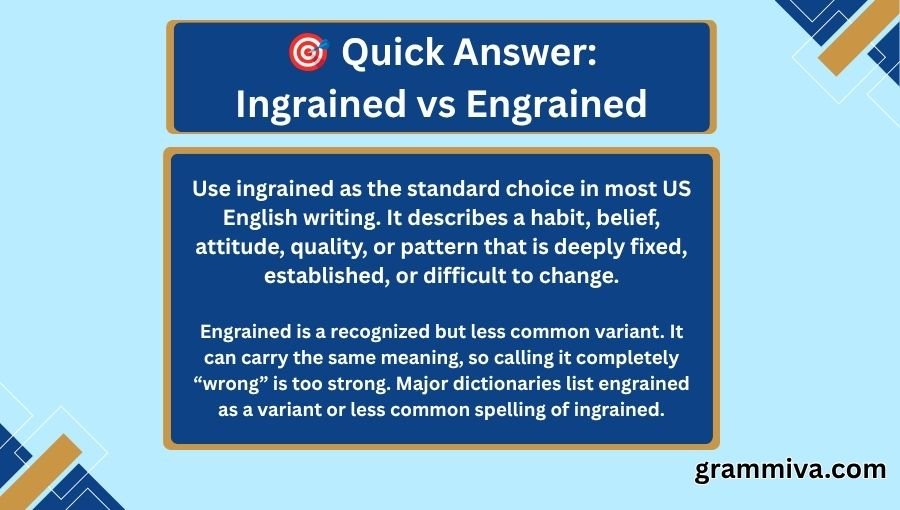
Use ingrained as the standard choice in most US English writing. It describes a habit, belief, attitude, quality, or pattern that is deeply fixed, established, or difficult to change.
Engrained is a recognized but less common variant. It can carry the same meaning, so calling it completely “wrong” is too strong. Major dictionaries list engrained as a variant or less common spelling of ingrained.
| Form | Status | Example |
|---|---|---|
| ingrained | Standard and preferred in most writing | Her habit is deeply ingrained. |
| engrained | Recognized, but less common | Her habit is deeply engrained. |
| ingrain | Base verb | Parents can ingrain good habits. |
| engrainedly | Rare adverb form | The belief was engrainedly held. |
For everyday, academic, business, and professional writing, my advice is simple: choose ingrained unless you have a specific reason to use the variant.
Is Ingrained the Same as Engrained?
Yes, in modern usage the two forms can have the same basic meaning. Ingrained is the more common and generally preferred spelling, while engrained is recognized as a less common variant.
Both forms can describe something that has become firmly fixed in a person, group, system, or material.
For example:
- “The habit was deeply ingrained.”
- “The habit was deeply engrained.”
The first sentence is the better default for most American readers.
This is why the issue is mainly about preferred spelling and usage, not two completely different meanings.
Ingrained
Ingrained commonly means deeply fixed or firmly established. It can describe habits, beliefs, attitudes, reactions, customs, values, and other things that are hard to change.
It can also describe something physically worked into a material, such as dirt worked into fabric or a surface.
Engrained
Engrained can carry the same meanings, but it is less common. Reference sources such as Merriam-Webster and Oxford recognize it as a variant of ingrained.
| Word | Main idea | Typical use | Best choice? |
|---|---|---|---|
| ingrained | Deeply fixed or embedded | Habits, beliefs, attitudes, dirt | Yes |
| engrained | Same basic idea | Habits, beliefs, attitudes, dirt | Acceptable but less common |
| ingrain | To make something deeply fixed | Teaching or establishing habits | Yes |
| engrain | Variant of ingrain | Same basic action | Less common |
🔎 Ingrained vs Engrained at a Glance
The key difference is not meaning. It is frequency and preferred spelling.
If you are writing a resume, school paper, article, report, email, or business document, ingrained is usually the safest choice.
| Form | Type | Meaning | Example | Correct/Incorrect |
|---|---|---|---|---|
| ingrained | Adjective | Deeply fixed or established | Good manners were ingrained in her. | ✅ Correct |
| engrained | Adjective | Same basic meaning | Good manners were engrained in her. | ✅ Acceptable, less common |
| ingrain | Verb | To establish deeply | Teachers can ingrain good study habits. | ✅ Correct |
| engrain | Verb | Variant of ingrain | Teachers can engrain good study habits. | ✅ Acceptable, less common |
| ingraind | — | Nonstandard spelling | The habit was ingraind early. | ❌ Incorrect |
| engraned | — | Misspelling | The idea became engraned. | ❌ Incorrect |
Why Is Ingrained Usually Better?
The word ingrained is the form readers are more likely to expect. That matters because familiar spelling reduces distractions.
A reader should focus on your idea, not wonder whether you made a spelling mistake.
This is especially useful in formal writing. If I were editing a company report, I would normally change engrained to ingrained unless the writer had a clear reason to preserve the variant.
Why Do People Confuse Ingrained and Engrained?
People confuse these words because they look and sound extremely similar, and both forms are found in real English. The confusion becomes even stronger because engrained is not simply a random misspelling; it is a recognized variant.
There is another reason. English has many pairs where a small letter changes the spelling without changing the basic sound or meaning. That makes your eyes less reliable than you might think.
I once edited a short workplace guide where the same writer used ingrained in one paragraph and engrained three paragraphs later. Nothing was wrong with the sentence meaning. The inconsistency simply made the document look less polished.
A Simple Memory Trick
Think:
Ingrained = in deeply.
Something that is ingrained has become deeply fixed in a person, habit, system, or material.
This is only a memory trick, not a complete explanation of the word’s history. But it is useful when you are typing quickly.
| Memory cue | What it reminds you | Example |
|---|---|---|
| IN | Something is deeply fixed in something else | An ingrained habit |
| GRAIN | The word can suggest something worked into material | Ingrained dirt |
| -ED | Often describes the resulting state | A deeply ingrained belief |
What Does Ingrained Mean?
Ingrained means deeply fixed, firmly established, or difficult to change. It is especially common with habits, beliefs, attitudes, customs, fears, reactions, and ways of thinking.
Here are common uses.
Ingrained Habits
An ingrained habit is one that has become automatic or very difficult to change.
Example:
“Checking his phone before breakfast had become an ingrained habit.”
The important idea is not simply that he checks his phone often. The word suggests that the behavior is deeply established.
Ingrained Beliefs
An ingrained belief is a belief that has become deeply fixed.
Example:
“Her belief that hard work matters was ingrained from childhood.”
The belief is not temporary. It has become a strong part of how she thinks.
Ingrained Attitudes
An attitude can also be ingrained when it has been firmly established over time.
Example:
“The team had an ingrained habit of solving problems together.”
The word works well because the behavior is deeply rooted in the group’s normal way of working.
Ingrained Physical Material
The word can also describe dirt or another substance that has become difficult to remove because it has worked into a surface or material.
Example:
“The cleaner removed years of ingrained dirt from the floor.”
Here, ingrained is physical rather than psychological.
| Meaning | Word Type | Example Sentence |
|---|---|---|
| Deeply fixed habit | Adjective | His morning routine was ingrained. |
| Deeply fixed belief | Adjective | The belief was deeply ingrained. |
| Deeply fixed attitude | Adjective | Her calm attitude was ingrained. |
| Worked into material | Adjective | The fabric had ingrained dirt. |
💡 Test Tip
When you want to describe something that is deeply fixed, firmly established, or hard to change, try ingrained first.
Ask yourself:
“Would I naturally say ‘deeply fixed’ here?”
If yes, ingrained will often fit.
Is Engrained Wrong?
No. Engrained is not simply a made-up spelling error. It is recognized as a less common variant of ingrained.
However, there is an important difference between “recognized” and “preferred.”
A word can be legitimate while still being less common. That is the situation here.
For example:
- “She has an ingrained fear of public speaking.” ✅
- “She has an engrained fear of public speaking.” ✅
Both can be understood and both are supported as variants in reference sources. But the first is the stronger choice for most general American writing.
So, if someone asks, “Which spelling should I use?” my answer is:
Use ingrained.
✍️ Correct Meanings and Uses of Ingrained
The safest way to master the word is to see it in different settings.
Habits
“Waking up early was an ingrained part of his routine.”
This means the habit was firmly established.
Beliefs
“Trust in the company had become deeply ingrained among employees.”
This means the belief had become a strong part of their thinking.
Reactions
“Her first reaction was an ingrained response to years of practice.”
The response had become automatic through repeated experience.
Culture
“Sharing food is an ingrained part of the family tradition.”
The practice is deeply established in the group’s way of life.
Dirt
“The old carpet was covered with ingrained dirt.”
Here, ingrained refers to something physically embedded in a surface.
| Use | Example | What the word tells us |
|---|---|---|
| Habit | An ingrained habit of checking email | The behavior is firmly established |
| Belief | An ingrained belief in fairness | The belief is deeply fixed |
| Attitude | An ingrained distrust of strangers | The attitude is deeply rooted |
| Reaction | An ingrained response to stress | The reaction is automatic or established |
| Dirt | Ingrained dirt on the carpet | The dirt is worked into the material |
📝 Case Study: A Workplace Email
Imagine that a manager writes:
“Our commitment to quality is engrained in every part of the process.”
The sentence is understandable. However, I would normally edit it to:
“Our commitment to quality is ingrained in every part of the process.”
Why?
The intended meaning is that the commitment is deeply fixed throughout the system. Ingrained is the more familiar choice for that idea.
Now consider this sentence:
“Years of ingrained dust made the old machine difficult to clean.”
Here, the word refers to material that has worked into a surface.
In both examples, the central idea is the same: something has become deeply fixed or embedded.
| Workplace situation | Preferred sentence | Reason |
|---|---|---|
| Company values | Our values are deeply ingrained. | Standard modern choice |
| Employee habits | The habit is ingrained in the team. | Natural collocation |
| Company culture | Collaboration is ingrained in our culture. | Clear and familiar |
| Physical cleaning | The surface had ingrained dirt. | Physical meaning |
Grammar Rules Explanation
The basic grammar rule is simple: ingrained is commonly used as an adjective, while ingrain is the related verb.
For example:
- “The habit is ingrained.”
- “The teacher helped ingrain the habit.”
The adjective describes a state. The verb describes the action that creates or establishes that state.
The variant engrained follows the same basic pattern. Standard reference sources recognize engrained as a less common form related to ingrain.
Most major dictionaries therefore do not support the idea that engrained is always grammatically wrong. The more useful rule is one of preferred usage: choose ingrained when you want the most familiar and widely expected form.
Correct vs Incorrect at a Glance
Because engrained is recognized, “incorrect” here often means not the preferred form, rather than impossible English.
| Sentence | Correct/Incorrect | Why |
|---|---|---|
| Her fear was deeply ingrained. | ✅ Correct | Standard and natural |
| Her fear was deeply engrained. | ✅ Acceptable | Recognized variant |
| His habits are ingraind. | ❌ Incorrect | Misspelling |
| The belief became engrained over time. | ✅ Acceptable | Variant spelling |
| Their values are ingrained in the culture. | ✅ Correct | Standard usage |
A useful editing rule is this: If you are unsure, replace engrained with ingrained.
⚠️ Common Mistakes With Ingrained and Engrained
The ingrained vs engrained spelling question causes mistakes because the two forms look and sound almost identical.
Other causes include:
- Fast typing: Your fingers may produce the familiar-looking form before you think about it.
- Autocorrect: A writing tool may accept a variant without telling you which form is more common.
- Lack of knowledge: Many writers simply do not know that engrained is a recognized variant.
- Sound-based spelling: Because the two forms sound alike, writers may choose based on appearance rather than usage.
I once caught myself typing engrained in a draft and changed it immediately. The funny part was that I had already used ingrained correctly in the previous paragraph. That is exactly how easy it is to switch between the two without noticing.
Similar Grammar and Spelling Confusions
| Confusion | Correct Form | Common Error | Quick Reminder |
|---|---|---|---|
| it’s / its | it’s = it is | Using its for it is | Expand the contraction |
| your / you’re | your = belonging; you’re = you are | Mixing them | Try “you are” |
| their / they’re | their = belonging; they’re = they are | Mixing them | Check the meaning |
| affect / effect | Depends on sentence role | Treating them as identical | Check verb/noun use |
| then / than | then = time; than = comparison | Switching them | Think “comparison” for than |
Specific Wrong Spellings and Uses
| Wrong Form | What’s Wrong | Correct Form |
|---|---|---|
| ingraind | Missing letters | ingrained |
| engraned | Wrong vowel pattern | engrained or, preferably, ingrained |
| ingrainned | Extra “n” | ingrained |
| ingrane | Missing final letters | ingrain |
| ingrained in to | Unnecessary separation | ingrained into / ingrained in |
| ingraineded | Incorrect ending | ingrained |
📚 The History Behind the Two Spellings
The two forms are closely related. The standard form ingrained comes from the verb ingrain, while engrained developed as a variant spelling. Modern reference sources continue to recognize both forms.
The useful lesson is not to build a complicated history lesson around the spelling. For modern writers, the practical point is much simpler: ingrained is the normal form, while engrained is a less common variant.
| Stage | Form | General Note |
|---|---|---|
| Earlier English use | ingrain | Used as a verb for deeply fixing something |
| Later adjective use | ingrained | Describes something deeply fixed or worked into material |
| Variant form | engrain | Developed as an alternative spelling |
| Modern English | ingrained / engrained | Both recognized, with ingrained generally preferred |
How To Use Ingrained in Different Contexts
The best spelling does not change just because the setting changes. Ingrained remains the safest choice in conversation, professional writing, creative work, and digital communication. Knowing ingrained vs engrained is useful whether you are writing a casual message, business email, or formal article.
Everyday Conversation
Use ingrained for habits and personal patterns.
“That habit is so ingrained that I do it without thinking.”
Professional Writing
Use ingrained when discussing culture, values, systems, habits, or attitudes.
“Safety is ingrained in our workplace culture.”
Creative Writing
The word can add depth to a character or setting.
“Years of hardship had left an ingrained distrust of strangers.”
Social Media and Texting
Casual writing gives you more freedom, but ingrained is still the cleanest choice.
“That old habit is seriously ingrained 😂”
| Context | Which Term to Use | Example |
|---|---|---|
| Everyday conversation | ingrained | That habit is ingrained in me. |
| Professional writing | ingrained | Quality is ingrained in our process. |
| Creative writing | ingrained | Fear was deeply ingrained in him. |
| Social media/texting | ingrained | My coffee habit is ingrained at this point. |
What Phrases Commonly Use Ingrained?
Ingrained appears naturally with words that describe habits, ideas, feelings, and patterns that have become deeply established.
Common combinations include:
- deeply ingrained
- firmly ingrained
- ingrained habit
- ingrained belief
- ingrained attitude
- ingrained culture
- ingrained behavior
- ingrained prejudice
- ingrained distrust
- ingrained fear
| Phrase | Meaning |
|---|---|
| deeply ingrained | Very strongly established |
| ingrained habit | A habit that is difficult to change |
| ingrained belief | A belief that is deeply fixed |
| ingrained attitude | A firmly established way of thinking |
| ingrained culture | A deeply established group practice |
| ingrained behavior | Behavior that has become a strong pattern |
One of the most useful combinations is deeply ingrained. It is common because ingrained already suggests something deep or firmly fixed, and deeply strengthens that idea.
🔄 Synonyms and Alternatives for Ingrained
You do not always need ingrained. Several alternatives can work, but each has a slightly different feel.
Rooted
Rooted works well for beliefs, traditions, and values.
“The tradition is deeply rooted in the community.”
Deep-Seated
Deep-seated is especially useful for strong feelings, beliefs, and attitudes.
“He had a deep-seated fear of failure.”
Established
Established works when something is accepted or firmly set, but it may not suggest the same deep personal quality.
Embedded
Embedded works well for systems, ideas, features, or things placed inside something else.
“The safety feature is embedded in the design.”
| Alternative | Works When | Does Not Work When |
|---|---|---|
| rooted | Talking about deep beliefs or traditions | You need to stress automatic habit |
| deep-seated | Talking about strong feelings or beliefs | Referring to simple, recent habits |
| established | Talking about accepted systems or practices | You need the idea of deep personal conditioning |
| embedded | Talking about systems, objects, or ideas placed inside something | The idea is purely about a personal habit |
| fixed | Talking about something stable or hard to change | You need a strong sense of depth or long history |
Why Does Getting Ingrained Right Matter?
Getting the spelling right improves clarity, professionalism, and trust. A single spelling choice will rarely change the meaning here, but repeated inconsistencies can make polished writing look careless.
This matters most when your writing represents you or your organization.
Clear writing lets the reader focus on your message instead of your mistakes.
That is the standard I use when editing: the best wording is often the wording that disappears into the sentence.
| Situation | Why Getting It Right Matters |
|---|---|
| Resume | Shows attention to detail |
| Client email | Creates a polished impression |
| Published content | Builds reader confidence |
| Social post | Makes the message easier to read |
Can Engrained Ever Be the Better Choice?
There is no general rule that makes engrained forbidden. It is a genuine variant, and reputable reference sources recognize it.
However, there is rarely a practical reason for a general US English writer to prefer it over ingrained.
If you are quoting an existing source, preserving a person’s wording, or working in a context where the variant is already established, engrained may be appropriate.
Otherwise, I recommend the simpler path:
Write ingrained.
How To Remember the Difference
The easiest memory rule is:
When in doubt, go with “in.”
Think of something as being deeply fixed in a person, habit, culture, or material.
Examples:
- ingrained habit
- ingrained belief
- ingrained attitude
- ingrained behavior
- ingrained dirt
You do not need to remember a complicated spelling history every time you write the word.
| Question to Ask Yourself | If Yes | Use |
|---|---|---|
| Do I mean deeply fixed? | Yes | ingrained |
| Do I mean firmly established? | Yes | ingrained |
| Do I mean difficult to change? | Yes | ingrained |
| Am I writing formal US English? | Yes | ingrained |
| Am I preserving a known variant? | Yes | engrained may be acceptable |
Practice Examples
- “Her morning routine was deeply ingrained.”
- “The company has an ingrained culture of teamwork.”
- “Years of dirt had become ingrained in the fabric.”
Ingrained vs Engrained: A Practical Editing Rule
When I edit a sentence containing either spelling, I ask three questions:
- What does the writer mean?
- Is the spelling grammatically possible?
- Which form will feel most natural to the intended reader?
For this pair, the answer is usually easy.
If the meaning is “deeply fixed,” both forms can work. If the goal is polished, standard US English, ingrained is the better default.
This distinction is useful because it prevents an overly strict rule. Saying “engrained is always wrong” is inaccurate. Saying “both forms are equally common” is also misleading.
The best practical answer sits between those extremes.
| Statement | Verdict |
|---|---|
| Ingrained is a standard spelling. | ✅ Yes |
| Engrained exists in English. | ✅ Yes |
| Engrained can have the same meaning. | ✅ Yes |
| Engrained is usually the preferred spelling in US writing. | ❌ No |
| Ingrained is the safer general choice. | ✅ Yes |
| You must never use engrained under any circumstances. | ❌ Too strong |
FAQs About Ingrained vs Engrained
Is ingrained or engrained correct?
Ingrained is the preferred spelling in most modern US English writing. Engrained is also a recognized variant, but it is less common.
Is engrained a real word?
Yes. Engrained is a real English word and is recognized as a variant of ingrained by major reference sources. It is less common than ingrained.
What is the meaning of ingrained?
Ingrained means deeply fixed, firmly established, or difficult to change. It can describe habits, beliefs, attitudes, reactions, culture, and even dirt worked into a material.
Is “deeply ingrained” correct?
Yes. Deeply ingrained is a natural and common phrase. It is often used for beliefs, habits, attitudes, fears, and cultural patterns.
Is “deeply engrained” correct?
It can be considered acceptable because engrained is a recognized variant. However, deeply ingrained is the better choice for most professional and general US English writing.
What is the difference between ingrained and engrained?
The main difference is spelling and usage preference. They can share the same meaning, but ingrained is much more familiar and is generally the preferred form.
Should I use ingrained in a formal essay?
Yes. Ingrained is the safest choice for formal essays, reports, academic writing, business documents, and published content.
Can ingrained describe physical dirt?
Yes. Ingrained can describe dirt that has worked into a surface or material and is difficult to remove. For example: “The carpet was covered in ingrained dirt.”
What is the verb form of ingrained?
The related verb is ingrain. For example: “Teachers can ingrain good study habits through repeated practice.” Engrain is also recognized as a less common variant.
Is “ingrained in” or “ingrained into” correct?
Both can appear, but ingrained in is very common when describing something deeply fixed within a person, group, or system. For example: “The value is ingrained in the company culture.”
✅ Quick Recap Checklist
If you remember only a few things, remember these: This ingrained vs engrained checklist gives you a quick way to remember which spelling to choose.
| Question | If Yes → Use |
|---|---|
| Do you mean deeply fixed? | ingrained |
| Do you mean difficult to change? | ingrained |
| Are you writing a formal document? | ingrained |
| Are you describing a deeply established habit? | ingrained |
| Are you describing dirt worked into fabric or a surface? | ingrained |
| Did you find the spelling “engrained”? | It is a recognized variant |
| Are you unsure which form looks best? | ingrained |
Three Final Practice Sentences
- “Years of practice made the routine ingrained.” ✅
- “Her belief in fairness was deeply ingrained.” ✅
- “The carpet had ingrained dirt that required deep cleaning.” ✅
Conclusion
Ingrained vs engrained becomes much easier once you separate “acceptable” from “preferred.”
Ingrained is the standard choice I recommend for most US English writing.
It describes something deeply fixed, firmly established, or difficult to change.
Engrained can express the same basic idea, but it is a less common variant.
That means you do not need to panic if you see engrained in a book, article, or existing document. It is a real form.
But when you are choosing the spelling yourself, especially for a resume, essay, website, report, or professional email, ingrained is the cleaner choice.
My favorite rule is still the simplest: think “in deeply” → ingrained.
It is quick, easy, and useful when you are writing under pressure.
Once this spelling is ingrained in your memory, you will not have to stop and wonder again. ✨

I am Ethan Brooks, an English grammar and vocabulary writer. I work at Grammiva, where I create simple and helpful content to make English learning easier for students and everyday learners.


[…] the end, you should be able to choose the correct form without hesitation. 👍 Ingrained vs Engrained | Labeling vs Labelling | Everyone vs Every […]
[…] the end, you should be able to spot the wrong spelling in seconds. ✍️ Attorneys vs Attornies | Ingrained vs Engrained | Labeling vs […]