Have you ever typed a word, looked at the screen, and wondered whether one letter is wrong? The question of optimize vs optimise creates exactly that kind of doubt.
Both spellings are real English words, and both have the same basic meaning.
The difference is mainly linked to the variety of English being used.
If you write for an American audience, optimize is the standard spelling.
If you are writing in British English, optimise is also widely used.
The same pattern appears with several other words, such as “organize organise” and “realize/realise.” 🇺🇸🇬🇧
I often see this spelling question in business writing, websites, school assignments, and SEO content. The good news is that you do not need to memorize a complicated grammar rule.
You mainly need to know which English style your audience expects.
This guide explains the difference between optimize and optimise, when to use each spelling, common mistakes, examples, and simple ways to remember the rule.
By the end, you should be able to choose the right form without stopping to second-guess yourself. ✍️ Practices vs Practises | Hoarder vs Horder | Tying vs Tieing
🎯 Quick Answer: Optimize vs Optimise
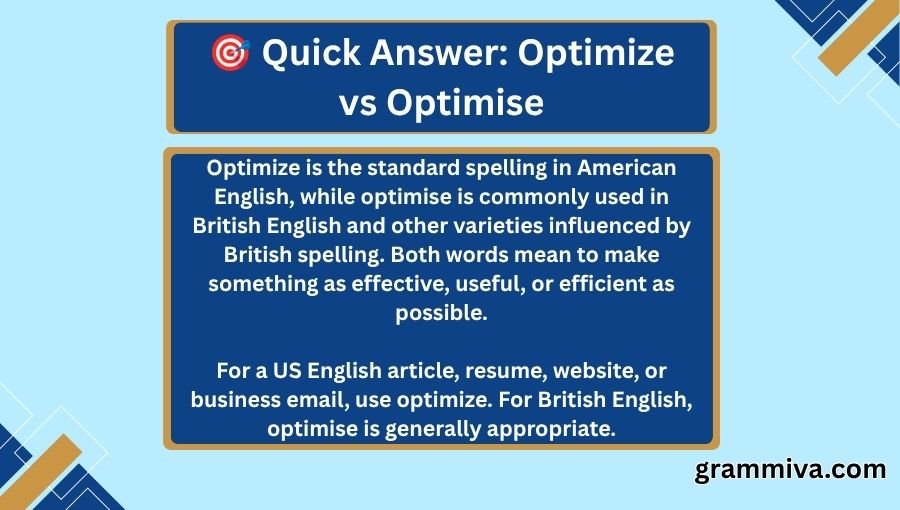
Optimize is the standard spelling in American English, while optimise is commonly used in British English and other varieties influenced by British spelling. Both words mean to make something as effective, useful, or efficient as possible.
For a US English article, resume, website, or business email, use optimize. For British English, optimise is generally appropriate.
Is Optimize the Same as Optimise?
Yes. Optimize and optimise have the same meaning and function as verbs. The main difference is spelling rather than meaning.
For example:
- “We need to optimize the website for mobile users.” 🇺🇸
- “We need to optimise the website for mobile users.” 🇬🇧
Both sentences say that the website should be improved so it works better for mobile users.
The choice depends on your target form of English.
| Spelling | Common English Style | Meaning | Example |
|---|---|---|---|
| Optimize | American English | Improve something for better results | We should optimize the page. |
| Optimise | British English | Improve something for better results | We should optimise the page. |
If your audience is mainly in the United States, consistency matters. Mixing American and British spellings can make your writing look less polished.
Optimize vs Optimise at a Glance
The core difference is simple: optimize is the preferred US spelling, while optimise is the preferred spelling in many British-style writing settings.
| Form | Type | Meaning | Example | Correct/Incorrect |
|---|---|---|---|---|
| Optimize | Verb | Improve for the best result | We need to optimize the process. | ✅ Correct in US English |
| Optimise | Verb | Improve for the best result | We need to optimise the process. | ✅ Correct in British English |
| Optimized | Past form | Improved for better results | The page was optimized. | ✅ US English |
| Optimised | Past form | Improved for better results | The page was optimised. | ✅ British English |
| Optimizing | -ing form | Improving for better results | We are optimizing the site. | ✅ US English |
Neither spelling is universally “wrong.” The correct choice depends on the English variety you are following.
Why Do People Confuse Optimize and Optimise?
People confuse these words because the two spellings look almost identical and sound the same in ordinary speech. The only visible difference is the final letter pattern: -ize versus -ise.
This pattern appears in many English words:
| American English | British English |
|---|---|
| Optimize | Optimise |
| Organize | Organise |
| Realize | Realise |
| Recognize | Recognise |
| Analyze | Analyse |
There is another reason for the confusion. Many people read content from several countries every day. A US reader may see “optimise” on a UK website, while a UK reader may see “optimize” in American software documentation.
I once edited a business article that used American spelling in every paragraph except for “optimise.” The writer had copied the word from a British source and did not notice the switch. Nothing about the sentence was grammatically wrong, but the mixed spelling made the article feel inconsistent.
A Simple Rule
Ask yourself one question:
Who will read this?
- US audience → optimize
- British-style audience → optimise
That one question solves most cases.
What Does Optimize Mean in American English?
In American English, optimize means to improve something so that it works as effectively, efficiently, or successfully as possible.
It can describe many things, including:
- websites
- software
- business processes
- schedules
- machines
- marketing campaigns
- search engine content
- computer systems
- plans
- performance
Consider this sentence:
“The company optimized its checkout process.”
The verb “optimized” tells us that the company changed the checkout process to improve its results or performance.
Common Uses of Optimize
| Use | Meaning | Example |
|---|---|---|
| Optimize a website | Improve website performance or visibility | We optimized the website for search. |
| Optimize a process | Make a process work better | The team optimized the workflow. |
| Optimize performance | Improve how something performs | Engineers optimized the software. |
| Optimize time | Use available time more effectively | She optimized her study schedule. |
Test Tip 💡
If you are writing for Americans, look at other spelling choices in your document. If you already use words such as “organize” and “realize,” optimize will usually fit your spelling style.
When Should You Use Optimise?
Use optimise when you are following British English spelling conventions or another writing style that uses the -ise form.
For example:
“The team will optimise the website before launch.”
The sentence is correct in British English.
The meaning does not change. The spelling simply follows a different regional convention.
| Situation | Preferred Form |
|---|---|
| US newspaper | Optimize |
| US business report | Optimize |
| US school paper | Optimize |
| UK business report | Optimise |
| UK school paper | Optimise |
| British-style publication | Optimise |
If you are writing for an international audience, choose a consistent style and use it throughout the document.
How Do Optimize and Optimise Work in Sentences?
Both forms work as verbs. They can appear in several verb structures, including the base form, past form, and -ing form.
Here are common examples:
Base form
- “We need to optimize the system.”
- “We need to optimise the system.”
Past form
- “The developer optimized the code.”
- “The developer optimised the code.”
-ing form
- “The company is optimizing its workflow.”
- “The company is optimising its workflow.”
The grammatical role stays the same.
| Verb Form | US English | British English |
|---|---|---|
| Base | Optimize | Optimise |
| Past | Optimized | Optimised |
| -ing | Optimizing | Optimising |
| Third-person singular | Optimizes | Optimises |
The main lesson is consistency. Do not switch between styles without a reason.
Is Optimize or Optimise Correct for SEO?
For US English SEO content, optimize is the standard spelling. This is especially relevant when writing phrases such as “optimize content,” “optimize a website,” or “optimize for search engines.”
For British English SEO content, optimise is commonly used.
SEO itself does not change the basic spelling rule. Your audience and chosen language style should guide your choice.
| SEO Situation | Recommended Spelling |
|---|---|
| US SEO article | Optimize |
| UK SEO article | Optimise |
| US landing page | Optimize |
| UK landing page | Optimise |
| US SEO guide | Optimize |
| UK SEO guide | Optimise |
For example:
- “How to optimize your website for search engines.” ✅
- “How to optimise your website for search engines.” ✅
Both are grammatically valid. The first fits US English.
Which Spelling Should You Use in Professional Writing?
In professional writing, use the spelling that matches your organization’s language style and target audience.
A US company normally uses optimize in its American English materials. A UK company may use optimise.
This applies to:
- emails
- reports
- presentations
- proposals
- resumes
- websites
- product documentation
- marketing material
A professional document should usually follow one spelling system from beginning to end.
| Professional Setting | Typical Choice |
|---|---|
| US company | Optimize |
| UK company | Optimise |
| US job application | Optimize |
| UK job application | Optimise |
| American technical documentation | Optimize |
The key is not to treat one spelling as a typo simply because it is unfamiliar to you.
Case Study: A Website Editing Example 📝
Imagine that a US marketing team is preparing a website guide called “How to Optimize Your Product Pages.”
The writer uses these sentences:
“We should optimize product descriptions.”
“The team will optimize image sizes.”
“Our goal is to optimize the checkout experience.”
All three sentences follow American spelling.
Now imagine that the same document suddenly says:
“We also need to optimise the product titles.”
The sentence still makes sense. However, the document now mixes spelling systems.
I once caught a similar issue while reviewing website copy. The writer had used “optimized” throughout the page but inserted “optimise” in one heading. The fix took only a few seconds, but it made the entire page more consistent.
The lesson is practical: choose a language style before you begin editing, then keep it consistent.
Grammar Rules Explanation
There is no grammar rule that makes one spelling universally correct and the other universally incorrect. The difference is mainly a regional spelling convention.
American English commonly uses -ize in words such as “optimize.” British English commonly uses -ise in words such as “optimise.”
Both forms act as verbs and carry the same basic meaning.
You can think of the difference this way:
American spelling: optimize → optimized → optimizing
British spelling: optimise → optimised → optimising
The same regional pattern can appear in related words. The important thing is to follow the style expected by your readers.
Standard English references and dictionaries recognize the regional spelling difference. A well-known dictionary can also help when you are checking an unfamiliar word or spelling style.
Correct vs Incorrect at a Glance
| Sentence | Correct/Incorrect | Why |
|---|---|---|
| We need to optimize the website. | ✅ Correct | Standard US spelling |
| We need to optimise the website. | ✅ Correct | Standard British-style spelling |
| We optimized the campaign. | ✅ Correct | US past-tense form |
| We optimised the campaign. | ✅ Correct | British-style past-tense form |
| We are optimizng the page. | ❌ Incorrect | The spelling is missing the “i” in “optimizing” |
Notice that optimise is not automatically incorrect. It becomes a style mismatch when you are specifically writing in US English.
What Are the Related Forms of Optimize and Optimise?
Both words have several related forms. The spelling pattern normally carries through these forms.
| Form | Type | Example |
|---|---|---|
| Optimize | Base verb | We optimize the process. |
| Optimise | Base verb | We optimise the process. |
| Optimized | Past form | We optimized the process. |
| Optimised | Past form | We optimised the process. |
| Optimizing | Present participle | We are optimizing the process. |
| Optimising | Present participle | We are optimising the process. |
| Optimization | Noun | Optimization improved the workflow. |
| Optimisation | Noun | Optimisation improved the workflow. |
There is no need to change the meaning when switching between the regional forms.
What Are the Most Common Mistakes With These Words? ⚠️
The most common mistake is not misunderstanding the meaning. It is mixing spelling systems.
For example, a writer may use:
- organize
- realize
- optimize
- optimise
in the same document.
That creates an inconsistent style.
Mistakes can happen for several reasons:
Fast Typing
When people type quickly, they often choose the spelling they have seen most recently.
Autocorrect
Autocorrect can sometimes favor the language setting installed on a device. A US writer using a UK English keyboard or browser setting may see different suggestions.
Lack of Knowledge
Some writers simply do not know that both spellings are used in different varieties of English.
| Similar Confusion | First Form | Second Form | Main Difference |
|---|---|---|---|
| It’s vs its | It’s | Its | Contraction vs possessive |
| You’re vs your | You’re | Your | Contraction vs possessive |
| They’re vs their | They’re | Their | Contraction vs possessive |
| Then vs than | Then | Than | Time/order vs comparison |
| Affect vs effect | Affect | Effect | Different grammatical uses |
These examples are different from optimize and optimise because they usually involve different meanings or grammatical functions. With optimize vs optimise, the meaning remains the same.
Specific Spelling Mistakes
| Wrong Form | What’s Wrong | Correct Form |
|---|---|---|
| Optmize | Missing “i” | Optimize |
| Optimze | Missing “i” | Optimize |
| Optmised | Misspelled form | Optimised |
| Optimazing | Incorrect vowel pattern | Optimizing |
| Optimiseing | Incorrect -ing formation | Optimising |
| Optimazation | Incorrect spelling | Optimization |
A spell checker can catch many of these errors, but you still need to know which regional spelling your document should follow.
How Can You Remember the Difference?
The easiest memory trick is to connect the spelling to the English style.
Think:
US → -ize → optimize
British → -ise → optimise
You can also remember the pattern by pairing related words.
| US English | British English |
|---|---|
| Optimize | Optimise |
| Organize | Organise |
| Realize | Realise |
| Recognize | Recognise |
| Modernize | Modernise |
If your document consistently uses the left column, choose optimize.
If it consistently uses the right column, choose optimise.
A useful editing trick is to search your document for both spellings. If you find both, decide which language style you want and replace the inconsistent form.
Where Is Optimize Commonly Used?
The word optimize is especially common in technical, business, marketing, and digital writing.
Here are some typical areas:
- SEO
- software development
- engineering
- business operations
- marketing
- website design
- data analysis
- performance testing
- project planning
- productivity
For example:
“The developer optimized the application to improve its performance.”
Here, “optimized” means the developer made changes intended to help the application perform better.
The word can also be used in everyday writing:
“I optimized my morning routine.”
That means the speaker changed the routine to make better use of time or effort.
Usage in Different Contexts
The correct choice depends on the English variety used in the context. The meaning stays the same.
| Context | Which Term to Use | Example |
|---|---|---|
| Everyday conversation | Match your regional English | I need to optimize my schedule. |
| Professional writing | Match company style | We optimized the workflow. |
| Creative writing | Match the chosen English style | She optimized every part of her plan. |
| Social media/texting | Either, depending on audience | I’m trying to optimize my routine. |
In informal texting, people may care less about regional spelling. In formal writing, consistency matters more.
What Are Common Phrases With Optimize?
There are several natural phrases built around optimize. The British versions simply change the spelling to optimise.
| Phrase | Meaning |
|---|---|
| Optimize performance | Improve how well something works |
| Optimize a website | Improve a website for better results |
| Optimize content | Improve content for a specific goal |
| Optimize the process | Make a process more effective |
| Optimize your workflow | Improve the way work is completed |
| Optimize for search | Adjust content to perform better in search |
These phrases are especially common in business and technology writing.
Optimize and Optimise in Digital Communication
Digital communication makes this spelling difference more visible because people interact with readers from many countries.
A US-based website may use:
“Optimize your content for readers.”
A UK-based website may use:
“Optimise your content for readers.”
Both are natural within their respective styles.
The important point is that the spelling does not change the basic instruction. It only signals the regional English style being followed.
| Digital Content | US Form | British Form |
|---|---|---|
| Blog heading | Optimize Your Website | Optimise Your Website |
| Optimize the process | Optimise the process | |
| Social post | Optimize your profile | Optimise your profile |
| Software guide | Optimize settings | Optimise settings |
Are There Any Special Exceptions?
There is no major meaning-based exception that changes the basic rule for optimize vs optimise. The main distinction is regional spelling.
However, proper names and brand names should not be changed simply to match your preferred English style.
For example, if a company officially spells its product or service name in a particular way, keep that official spelling.
This is a general writing rule: proper names should normally be written as their owners present them.
Synonyms and Alternatives
Sometimes you can replace optimize or optimise with another word. The best choice depends on what you actually mean.
| Alternative | Works When | Does Not Work When |
|---|---|---|
| Improve | You mean make something better | You need the idea of achieving the best possible result |
| Enhance | You mean add value or improve quality | You are discussing efficiency or performance specifically |
| Refine | You mean make small improvements | You mean a major performance change |
| Streamline | You mean simplify a process | You mean improve something that is not a process |
| Upgrade | You mean replace or improve to a newer level | You only mean making a small adjustment |
For example, “improve the website” is broad. “Optimize the website” can suggest making targeted changes for better performance or results.
Why Does Getting the Spelling Right Matter?
Correct spelling helps readers understand your intended language style. It also makes professional writing look more consistent.
The difference may seem tiny, but consistency matters when you are writing a long document.
A reader should not have to wonder whether different spellings are intentional.
“Clear writing makes the reader’s job easier.”
That simple idea applies to spelling choices as well.
| Situation | Why Getting It Right Matters |
|---|---|
| Resume | Shows attention to writing style |
| Client email | Creates a polished impression |
| Published content | Keeps the publication consistent |
| Social post | Matches the intended audience |
For US English content, using optimize consistently is a simple way to maintain the expected spelling style.
Does Optimize Mean the Same Thing as Optimization?
Yes, but they have different grammatical roles.
Optimize is a verb.
“We need to optimize the website.”
Optimization is a noun.
“Website optimization can improve the user experience.”
The spelling also changes according to regional style:
| US English | British English | Word Type |
|---|---|---|
| Optimize | Optimise | Verb |
| Optimized | Optimised | Past form |
| Optimizing | Optimising | -ing form |
| Optimization | Optimisation | Noun |
Do not confuse the verb with the noun when building a sentence.
Can You Use Optimize in Academic Writing?
Yes. Optimize is appropriate in academic writing when the subject calls for it and you are following American English conventions.
For example:
“The researchers optimized the model to reduce processing time.”
In British English, the same sentence may use “optimised.”
Academic writing often follows a specific style guide. If your school, university, journal, or instructor specifies a language variety, follow that instruction.
Is Optimize More Common in American English?
For US English writing, optimize is the standard form. British English commonly uses optimise.
The important point is not to treat frequency as a rule that applies to every country. Different English-speaking regions have different spelling conventions.
If you are writing for an American audience, choosing optimize keeps your spelling aligned with standard US usage.
How Does the Choice Affect SEO Content?
For SEO content, the choice should match the audience and the keyword you are targeting.
If a US audience searches for content using American spelling, US-style content should normally use optimize.
For a UK audience, optimise may better match the local spelling style.
However, SEO writing should never become a collection of forced spelling variations. Write naturally and keep the article consistent.
| Content Goal | Recommended Approach |
|---|---|
| US audience | Use optimize |
| UK audience | Use optimise |
| Global audience | Choose one consistent style |
| Brand content | Follow the brand’s style guide |
| Academic content | Follow the institution or publication style |
How Do You Choose Between Optimize and Optimise?
Use the following quick decision process.
Step 1: Identify Your Audience
Are you writing mainly for people in the United States? If yes, choose optimize.
Step 2: Check Your Style Guide
If your company, school, client, or publication has a style guide, follow it.
Step 3: Check Nearby Words
Look at words such as “organize,” “realize,” and “recognize.” They can reveal which spelling style the document is using.
Step 4: Stay Consistent
Once you choose one form, use the same regional style throughout the document.
| Question | If Yes → Use |
|---|---|
| Is the content written in US English? | Optimize |
| Is the content written in British English? | Optimise |
| Does your client require US spelling? | Optimize |
| Does your publication require British spelling? | Optimise |
| Does your style guide specify one form? | Follow the style guide |
Quick Recap Checklist ✅
Remember these simple points:
- Optimize is the standard US English spelling.
- Optimise is commonly used in British English.
- Both forms have the same basic meaning.
- Both are verbs.
- Related forms also follow the regional spelling pattern.
- Consistency matters in professional writing.
- Always follow a required house or style guide.
Practice Examples
Example 1
“We need to ___ the website.”
US English → optimize ✅
British English → optimise ✅
Example 2
“The team ___ the workflow last week.”
US English → optimized ✅
British English → optimised ✅
Example 3
“We are ___ the system.”
US English → optimizing ✅
British English → optimising ✅
The best answer depends on the English style you are using.
FAQs About Optimize vs Optimise
Is optimize correct in American English?
Yes. Optimize is the standard spelling used in American English. Use it in US-focused professional, academic, business, and digital writing unless a specific style guide says otherwise.
Is optimise correct in British English?
Yes. Optimise is commonly used in British English. It has the same basic meaning as “optimize.”
What is the main difference between optimize and optimise?
The main difference is regional spelling. Optimize is the US form, while optimise is commonly used in British English.
Is optimize or optimise better for a US audience?
For US English writing, optimize matches the standard American spelling convention.
Is optimize a verb?
Yes. Optimize is a verb meaning to improve something so it works as effectively or efficiently as possible.
What is the past tense of optimize?
The US English past form is optimized. The British form is optimised.
What is the noun form of optimize?
The noun is optimization in American English and optimisation in British English.
Is “optimise” a spelling mistake?
No. “Optimise” is a valid spelling used in British English and other writing styles based on British conventions. It is not automatically a spelling mistake.
Should I use optimize or optimise in SEO articles?
Use optimize for US English SEO content and optimise when following British English conventions. The key is to match the intended audience and remain consistent.
How can I remember optimize vs optimise?
Use this simple memory rule: US English → optimize with -ize; British English → optimise with -ise. Then check related words in your document to make sure the spelling style stays consistent.
Conclusion
Optimize vs optimise is mainly a difference between American and British spelling, not a difference in meaning. For US English, use optimize. For British English, use optimise. Both forms are verbs, and their related forms follow the same regional spelling pattern.
When I edit US English content, I look for consistency across the entire document. If the writing uses “organize,” “realize,” and “recognize,” then “optimize” is usually the natural match. 🇺🇸
The most useful rule is simple: identify your audience, follow the required style, and keep your spelling consistent. You do not need to worry that one form is universally wrong.
If you are writing for American readers, remember optimize. If you are following British English, optimise is the natural choice. ✨
Choose the spelling that matches your audience, then use it with confidence.

I am Ryan Mitchell, a writer focused on English grammar, vocabulary, and everyday language. I work at Grammiva, creating easy-to-understand articles that help readers improve their English with confidence.

[…] examples, covers common mistakes, and gives you a quick test you can use whenever you hesitate. Optimize vs Optimise | Practices vs Practises| Hoarder vs […]
[…] the meaning of each word, choosing the correct one becomes simple. 📚 Informal vs Unformal | Optimize vs Optimise | Practices vs […]