
Have you ever typed a sentence about tying vs tieing and stopped because one spelling looked wrong? You are not alone.
This is a common spelling question because the verb tie changes in a way that is easy to miss when you add -ing.
The good news is that the rule is simple once you see it.
In standard American English, tying is the correct spelling when you add ing to the verb tie. Tieing is generally considered incorrect.
I teach students and edit professional writing, and I have seen this mistake show up in schoolwork, emails, blog posts, and even polished documents.
The problem is not the meaning.
Both forms look as if they should be related to the verb tie. The problem is the spelling rule used when the final e meets ing.
Let’s break the rule down in plain English. By the end, you will know why tying is correct, why tieing looks tempting, and how to remember the difference. ✏️😊 Eighteen vs Eiteen | Business vs Bussiness | Ability vs Abillity
🎯 Quick Answer: Tying vs Tieing
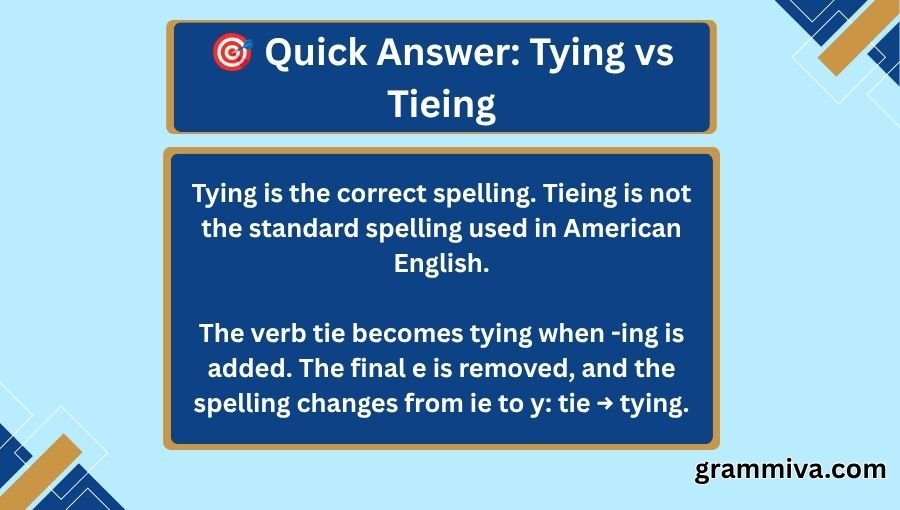
Tying is the correct spelling. Tieing is not the standard spelling used in American English.
The verb tie becomes tying when -ing is added. The final e is removed, and the spelling changes from ie to y: tie → tying.
Related Word Forms
The verb tie has several common forms. Knowing them can make the spelling rule easier to remember.
| Form | Type | Example |
|---|---|---|
| tie | Base verb | Please tie your shoes. |
| ties | Third-person singular | She ties her shoes quickly. |
| tied | Past tense/past participle | He tied the package. |
| tying | Present participle/gerund | She is tying the ribbon. |
| tie’s | Possessive form or contraction | The tie’s color is blue. |
The key form in this article is tying. When tie is followed by -ing, it does not become tieing.
Understanding the Basics of Tying vs Tieing
The basic difference is spelling: tying is standard, while tieing is generally incorrect.
The change happens because English spelling rules do not always allow us to simply attach -ing to the base word. When a verb ends in a silent e, that e is often dropped before -ing.
For example:
- make → making
- bake → baking
- smile → smiling
- write → writing
- tie → tying
But tie has an extra spelling change. After the final e is removed, the remaining letters are ti. English does not spell the new form tiing. Instead, the ie pattern changes to y, giving us tying.
Tying vs Tieing at a Glance
| Form | Type | Meaning | Example | Correct/Incorrect |
|---|---|---|---|---|
| tying | Present participle/gerund | Fastening or connecting something | She is tying her shoes. | ✅ Correct |
| tieing | Intended present participle | Intended to mean fastening or connecting | She is tieing her shoes. | ❌ Incorrect |
| tie | Base verb | Fasten or connect | Tie the rope. | ✅ Correct |
| tied | Past tense | Fastened or connected | He tied the rope. | ✅ Correct |
| ties | Present-tense form | Fastens or connects | She ties the rope. | ✅ Correct |
Why Is Tying Spelled This Way?
Tying is spelled with a y because the standard spelling of tie changes when -ing is added.
Think of the transformation like this:
tie + ing → tying
Not:
tie + ing → tieing
The spelling does not simply preserve every letter from the base word. English has many words where adding a suffix causes a spelling change.
What Does Tying Mean?
Tying means fastening, connecting, securing, or joining something by using a knot, string, rope, cord, or similar method.
It can also describe connecting things in a broader sense.
For example:
- She is tying her shoes.
- He is tying the package with string.
- They are tying the two ideas together.
- I am tying a ribbon around the box.
The word can describe a physical action or, in some contexts, a connection between ideas or events.
Tying as a Gerund
Tying can also act as a noun. This is called a gerund.
For example:
Tying your shoes is easy once you learn the steps.
Here, tying names an activity.
Another example is:
Tying the knot takes practice.
In this sentence, tying is part of a phrase that names an action.
Tying as a Present Participle
Tying can also help form a continuous verb phrase.
For example:
Maria is tying her shoes.
The word tying works with is to show that the action is happening now.
The same pattern appears in:
- He is tying the rope.
- We are tying the boxes together.
- They were tying the decorations to the fence.
💡 Test Tip: Use the Base-Word Test
When you are unsure whether to write tying or tieing, start with the base verb.
Ask yourself:
What is the base verb?
If the word is tie, the standard -ing form is tying.
A useful memory line is:
Tie changes to tying.
Do not try to build the word by simply adding the letters -ing. Instead, remember the complete spelling of the common form.
| Question | Answer |
|---|---|
| What is the base verb? | tie |
| What suffix is being added? | -ing |
| Is the final e kept? | No |
| Is the spelling changed further? | Yes |
| Correct form | tying |
Is Tieing Ever the Correct Spelling?
For standard modern American English, tieing should not be used as the ordinary present participle of tie. The standard spelling is tying.
This is worth remembering because tieing looks logical at first glance. A writer may think:
tie + ing = tieing
But English spelling does not always work by direct addition.
For everyday writing, school assignments, business documents, websites, and formal communication, choose tying.
Correct and Incorrect Examples
| Sentence | Status | Explanation |
|---|---|---|
| She is tying her shoes. | ✅ Correct | Tying is the standard form. |
| She is tieing her shoes. | ❌ Incorrect | Tieing is not the standard spelling. |
| He is tying the rope. | ✅ Correct | The verb tie becomes tying. |
| He is tieing the rope. | ❌ Incorrect | The spelling should be tying. |
| I am tying a ribbon around the box. | ✅ Correct | Tying is used correctly. |
Why Do People Confuse Tying and Tieing?
People confuse these spellings because tieing seems to follow a simple pattern. Writers often learn that you can add -ing to a verb, so they may naturally write tie + ing.
There is another reason. Many verbs ending in e follow a fairly clear rule:
- dance → dancing
- hope → hoping
- move → moving
- use → using
A writer may apply that rule mechanically and expect tie to become tiing. That looks strange, so tieing can seem like a reasonable solution.
I once marked a student’s homework in which the student had written tieing several times. When I asked why, the student pointed to the word tie and said, “I just added -ing.” That was actually a good clue to the problem: the student understood the verb but had not learned the spelling change.
The easiest fix is to memorize tie → tying as a pair.
Common Patterns That Cause Confusion
| Pattern | Base Verb | -ing Form |
|---|---|---|
| Silent e dropped | make | making |
| Silent e dropped | write | writing |
| Silent e dropped | smile | smiling |
| Special spelling change | lie | lying |
| Special spelling change | die | dying |
| Special spelling change | tie | tying |
Notice that tie, lie, and die are useful words to learn together.
Tying vs Tieing in Different Sentence Patterns
The correct form remains tying regardless of the sentence pattern.
With “Is,” “Am,” or “Are”
Use tying when describing an action that is happening now.
- I am tying my shoes.
- She is tying a bow.
- They are tying the boxes together.
With “Was” or “Were”
Use tying for an action that was happening at a past time.
- He was tying his shoes.
- We were tying the decorations to the wall.
- They were tying the branches together.
As a Noun
Use tying when the activity itself is the subject or object of a sentence.
- Tying knots takes practice.
- I enjoy tying ribbons.
- Tying the package was the final step.
With Other Verbs
Some verbs are followed naturally by an -ing form.
- She enjoys tying bows.
- He practiced tying knots.
- They finished tying the boxes.
| Sentence Pattern | Example |
|---|---|
| am/is/are + tying | She is tying her shoes. |
| was/were + tying | They were tying the rope. |
| noun use | Tying knots takes practice. |
| verb + tying | He practiced tying knots. |
📝 Case Study: A Workplace Email
Imagine that a warehouse worker needs to tell a manager that several packages are ready.
The worker writes:
“I finished tieing the labels to the boxes.”
The meaning is easy to understand. Still, the spelling is incorrect.
A cleaner version is:
“I finished tying the labels to the boxes.”
The change is small, but it makes the sentence look polished and professional.
I once edited a short work instruction where tieing appeared in a safety step. The writer had copied the form from an earlier document. We changed every instance to tying before the instructions were published. That small edit made the document more consistent and easier to trust.
This is a good lesson: spelling errors can spread when people copy old text. Always check a word that looks unusual before repeating it.
Grammar Rules Explanation
The standard spelling rule gives us tying, not tieing.
The verb tie ends with the letters ie. When -ing is added, the final e is not simply left in place. The spelling changes to y, producing tying.
This is similar to other spelling changes in English. The goal is not to keep every letter from the base form. The goal is to produce the established spelling of the new word form.
Most standard English dictionaries and style references agree on the ordinary spelling tying.
The key point is simple:
Tie → tying
There is no need to invent a new rule each time you see the word. Treat tying as the standard form to use in normal writing.
Correct vs Incorrect at a Glance
| Sentence | Correct/Incorrect | Why |
|---|---|---|
| She is tying her shoes. | ✅ Correct | Tie changes to tying. |
| She is tieing her shoes. | ❌ Incorrect | The standard spelling is tying. |
| He is tying a knot. | ✅ Correct | Tying is the present participle. |
| He is tieing a knot. | ❌ Incorrect | Tieing is not the standard form. |
| We are tying the packages together. | ✅ Correct | The spelling follows the standard form. |
The Rule in One Line
If you need the -ing form of tie, write:
tying
That is the form to use in standard American English.
⚠️ Common Mistakes With Tying
Most spelling mistakes involving this word come from applying a familiar pattern too quickly.
Mistake 1: Adding -ing Without Changing the Spelling
A writer sees tie and immediately adds ing.
That produces tieing, which is not the standard form.
Mistake 2: Thinking the Y Is Random
The y in tying can look surprising if you have not learned the word before. It is not random, though. It is part of the established spelling change from tie to tying.
Mistake 3: Trusting Autocorrect
Autocorrect can catch many errors, but it should not replace your own spelling knowledge. Different apps and dictionaries can behave differently.
Mistake 4: Copying an Old Error
If you see tieing in a document, that does not mean it is correct. A typo can be copied many times.
Why These Errors Happen
| Cause | What Happens | Better Habit |
|---|---|---|
| Fast typing | Letters are added without checking | Pause on unusual words |
| Autocorrect | The writer trusts software completely | Review important text |
| Lack of knowledge | The spelling rule is unfamiliar | Learn tie → tying |
| Copying text | An old mistake gets repeated | Check the original spelling |
| Visual confusion | Tieing looks close to tying | Memorize the correct pair |
Common Spelling Errors for This Word
| Wrong Form | What’s Wrong | Correct Form |
|---|---|---|
| tieing | Keeps the wrong letter pattern | tying |
| tieing up | Uses the incorrect -ing spelling | tying up |
| tie-ing | Adds an unnecessary hyphen | tying |
| tie ing | Separates one word incorrectly | tying |
| ty-ing | Inserts an unnecessary hyphen | tying |
One spelling error is especially tempting because it seems logical: tieing. The problem is that logical-looking spelling is not always standard English spelling.
How to Remember Tying
A short memory trick can save you from the mistake.
Think:
Tie has a Y when it starts tying.
You can also connect it with two familiar words:
- lie → lying
- die → dying
- tie → tying
These three words share a useful visual pattern.
| Base Word | Correct -ing Form | Memory Pattern |
|---|---|---|
| lie | lying | ie → y |
| die | dying | ie → y |
| tie | tying | ie → y |
Another trick is to imagine the final e disappearing:
tie → ti + ing
That does not produce the final spelling by itself, but it reminds you that the e cannot remain. Then remember that the standard spelling is tying.
Tying in Everyday Conversation
In everyday conversation, tying is common because people often talk about shoes, packages, ropes, gifts, hair, and other things that can be fastened.
Examples include:
- “I’m tying my shoes.”
- “She’s tying the ribbon.”
- “He’s tying the bag.”
- “We’re tying the boxes together.”
Informal speech does not change the spelling. Even in a quick text message, tying is the standard choice.
Tying in Professional Writing
Professional writing benefits from standard spelling. Use tying in emails, instructions, reports, resumes, manuals, and business messages.
For example:
“Please make sure the cable is securely tied before moving the equipment.”
Or:
“The employee is responsible for tying the packages before shipment.”
Using the correct spelling helps your writing look careful and reliable.
Tying in Creative Writing
Creative writing also uses tying when the character is performing the action.
For example:
She sat by the window, tying the last ribbon around the gift.
The style can be creative, but the spelling remains standard.
Tying in Social Media and Texting
Social media and texting are informal, but tying is still the correct spelling.
You might write:
“Still tying ribbons for the party 😂”
Or:
“I’m tying my shoes and heading out!”
Casual writing allows slang, shortcuts, and abbreviations. That does not make tieing the standard spelling.
Usage by Context
| Context | Which Term to Use | Example |
|---|---|---|
| Everyday conversation | tying | I am tying my shoes. |
| Professional writing | tying | She is tying the package securely. |
| Creative writing | tying | He was tying a red ribbon. |
| Social media/texting | tying | I’m tying up the boxes now. |
Common Phrases With Tying
The word tying appears in several ordinary phrases. These expressions can help you become more comfortable with the correct spelling.
| Phrase | Meaning |
|---|---|
| tying a knot | Making a knot |
| tying your shoes | Fastening shoelaces |
| tying a ribbon | Securing a ribbon with a knot or bow |
| tying the package | Securing a package |
| tying things together | Connecting things |
| tying up loose ends | Finishing remaining tasks |
The phrase tying up loose ends is especially useful because it can have a figurative meaning. It means finishing small tasks or details before something is complete.
For example:
“I just need to tie up a few loose ends before the project is finished.”
Synonyms and Alternatives to Tying
Sometimes you can replace tying with another word. The best choice depends on what you mean.
For physical actions, words such as fastening, securing, or connecting may work.
For figurative uses, linking or connecting may be better.
| Alternative | Works When | Does Not Work When |
|---|---|---|
| fastening | Something is being secured | The meaning is purely figurative |
| securing | Something needs to be held safely | You specifically mean making a knot |
| connecting | Two things are being joined | A knot is the key action |
| linking | Ideas or things are being associated | You are physically tying shoelaces |
| knotting | A knot is specifically being made | The action involves no knot |
For example, “tying a rope” and “knotting a rope” can be close in meaning. But they are not always identical. Tying is the broader word.
Why Does Correct Spelling Matter?
Correct spelling helps readers understand your message without distractions. A single spelling error may not change the meaning, but repeated errors can make writing look careless.
This matters in several settings.
Clarity in Communication
Readers should be able to focus on your message instead of wondering whether a strange spelling is intentional.
Professionalism
A correctly spelled word can make a business email, report, or application look more polished.
Digital Communication
Online writing moves quickly. That makes small spelling mistakes easy to miss. Still, posts, emails, and web pages may remain visible for a long time.
A useful rule I give writers is:
“Small spelling choices can make a big difference in how carefully your message is read.”
| Situation | Why Getting It Right Matters |
|---|---|
| Resume | Shows care with written details |
| Client email | Supports a professional tone |
| Published content | Builds reader confidence |
| Social post | Keeps the message clear and polished |
Is Tying the Only Correct Form?
For the ordinary -ing form of tie, tying is the standard choice.
You should not replace it with tieing, tie-ing, or tie ing.
The same principle applies whether the word appears at the beginning, middle, or end of a sentence.
Compare:
- Tying the rope took five minutes.
- She is tying the rope.
- We watched him tying the rope.
The position changes, but the spelling does not.
Does Tying Have the Same Meaning as Tie?
Not exactly. Tie is the base verb, while tying is an -ing form.
Compare:
“Tie the rope.”
Here, tie gives a command.
“She is tying the rope.”
Here, tying describes an action in progress.
“Tying the rope takes practice.”
Here, tying names an activity.
| Form | Function | Example |
|---|---|---|
| tie | Base verb/command | Tie the rope. |
| ties | Present-tense form | She ties the rope. |
| tied | Past form | He tied the rope. |
| tying | -ing form | She is tying the rope. |
Understanding the grammar role can help you choose the right form, but the spelling question remains easy: the -ing form is tying.
How Does Tying Compare With Other -Ing Spellings?
English has several ways to form -ing words. That is one reason spelling can feel confusing.
Some verbs simply take -ing:
- read → reading
- jump → jumping
- help → helping
Some verbs drop a final e:
- make → making
- drive → driving
- write → writing
Some words have special spelling changes:
- lie → lying
- die → dying
- tie → tying
The important thing is not to force every verb into one pattern.
| Base Verb | -ing Form | Main Change |
|---|---|---|
| read | reading | Add -ing |
| make | making | Drop final e |
| write | writing | Drop final e |
| lie | lying | ie changes to y |
| die | dying | ie changes to y |
| tie | tying | ie changes to y |
💡 A Simple Memory Rule for Writers
If you remember only one thing, remember this:
The standard spelling is tying.
You can make the memory stronger by saying the pair out loud in your head:
tie — tying
Do this whenever you hesitate. After seeing the pair enough times, the correct spelling will start to look natural.
Another helpful practice is to write three sentences:
- I am tying my shoes.
- She is tying the ribbon.
- They are tying the boxes together.
This gives your brain the correct pattern in different settings.
Quick Recap Checklist
Use this checklist whenever you are unsure.
| Question | If Yes → Use |
|---|---|
| Am I describing the action of fastening or connecting? | tying |
| Is the base verb tie? | tying for the -ing form |
| Am I adding -ing to tie? | tying |
| Does tieing look tempting? | Choose tying instead |
| Am I writing formal or professional English? | tying |
Practice Examples
1. She is ___ her shoes.
Answer: tying ✅
2. We were ___ the boxes together.
Answer: tying ✅
3. He finished ___ the ribbon around the gift.
Answer: tying ✅
A quick rule check:
- tie → tying ✅
- tie → tieing ❌
FAQs About Tying vs Tieing
Is tying the correct spelling?
Yes. Tying is the standard spelling of the -ing form of tie in American English.
Is tieing a word?
You may encounter tieing in writing, but it is not the standard spelling for the ordinary -ing form of tie. In normal modern English writing, use tying.
Why is tying spelled with a y?
The spelling of tie changes when -ing is added. The standard form is tying, not tieing. This is a spelling pattern that also appears in words such as lying and dying.
How do you spell tie with ing?
Spell it tying.
The correct transformation is:
tie → tying
Is it tying or tieing your shoes?
It is tying your shoes.
Correct:
I am tying my shoes. ✅
Incorrect:
I am tieing my shoes. ❌
Is tying a verb?
Yes. Tying is an -ing form of the verb tie. It can work as a present participle in phrases such as “She is tying her shoes.” It can also work as a gerund when it names an activity, as in “Tying knots takes practice.”
Is tying spelled with one or two i’s?
Tying is spelled with one i after the t and a y before ing.
The correct spelling is:
t-y-i-n-g
The form tieing has an extra vowel pattern and is not the standard spelling.
What is the past tense of tie?
The past tense is tied.
For example:
She tied her shoes before leaving.
So the common forms are:
- tie
- ties
- tied
- tying
Is tieing ever acceptable in formal writing?
No. For standard formal writing, use tying. If you encounter tieing in a draft, it should normally be corrected to tying.
What is an easy way to remember tying?
Remember the pair tie → tying. You can also group it with lie → lying and die → dying. The key is to remember that the ie pattern changes to y in these -ing forms.
Conclusion
Tying vs tieing becomes easy once you remember one rule: the standard -ing form of tie is tying. The spelling does not keep the final e, and it does not become tieing.
Use tying when you mean fastening, connecting, securing, or joining something. You can use it in everyday conversation, professional writing, creative work, and online messages. The setting does not change the standard spelling.
When you hesitate, go back to the base word and remember the pair:
tie → tying
You can also connect it with lie → lying and die → dying. These examples make the spelling pattern easier to recall.
I have found that the best spelling rules are the ones you can use in seconds. You do not need a long grammar lesson every time you write this word. Just remember: tie becomes tying.
Once that pattern is familiar, tieing should start to look as unusual as it really is. Keep the rule simple, trust the standard form, and write tying with confidence. ✨

I am Adam Wilson, an English language content writer with an interest in grammar and vocabulary. I work at Grammiva and focus on creating clear explanations and practical examples for English learners.

[…] clear examples, and give you simple ways to remember which spelling belongs in your writing. ✍️ Tying vs Tieing | Eighteen vs Eiteen | Business vs […]