
Have you ever typed a word, looked at it twice, and suddenly wondered if it really looks right? 😅 That happens often with words that have repeated letters or sounds. Ability vs abillity is a good example.
The two forms look almost the same, but only one is correct in standard US English.
If you are writing a resume, school paper, email, report, blog post, or social media post, this small spelling choice can affect how polished your writing looks.
The good news is that the rule is simple.
Once you know it, you can spot the mistake quickly.
I have taught and edited English for years, and I have seen this particular error appear because writers hear the word correctly but spell it from memory.
The extra l feels natural to some people. It is not.
In this guide, I will explain the difference, show you real examples, give you easy memory tricks, and answer the questions people commonly ask about these two forms.
By the end, you should have no trouble choosing the correct spelling. 🎯 Abscess vs Abcess | Calves vs Calfs | All of a sudden vs all of the sudden
🎯 Quick Answer: Ability vs Abillity
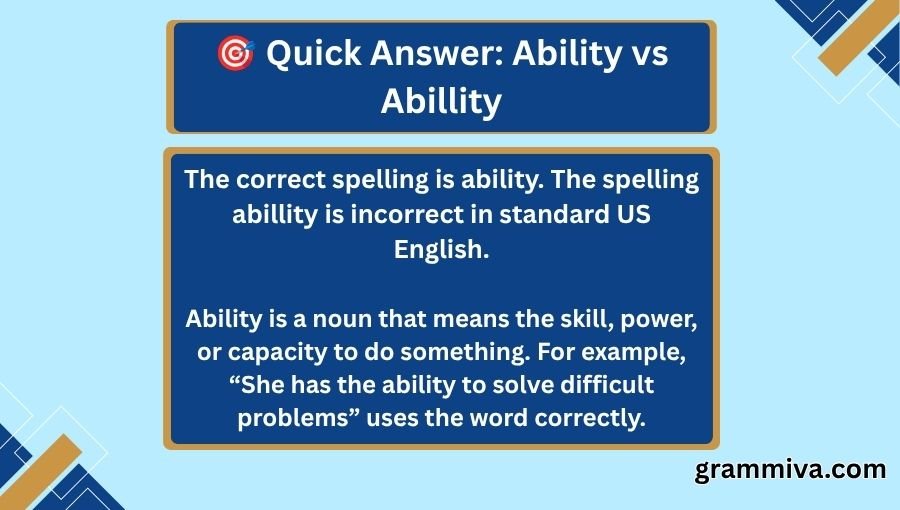
The correct spelling is ability. The spelling abillity is incorrect in standard US English.
Ability is a noun that means the skill, power, or capacity to do something. For example, “She has the ability to solve difficult problems” uses the word correctly.
Related Word Forms of Ability
The word has several useful related forms. Knowing them can make spelling easier because you can see how the base word changes when different endings are added.
| Form | Type | Example |
|---|---|---|
| ability | noun | His ability to lead is clear. |
| abilities | plural noun | Her abilities impressed the team. |
| able | adjective | He is able to finish the task. |
| ably | adverb | She ably handled the meeting. |
| inability | noun | His inability to focus caused delays. |
| unable | adjective | I was unable to attend. |
Notice that ability contains only one l before the final ity. The incorrect form adds an extra l.
That single-letter difference is the main issue.
🎯 Is Ability the Same as Abillity?
No. Ability is the correct English spelling, while abillity is a spelling error. They are not two different words with different meanings.
This is an important point because some spelling mistakes create confusion between two real words. That is not what happens here. There is no standard English word abillity with a separate meaning.
| Form | Type | Meaning | Example | Correct/Incorrect |
|---|---|---|---|---|
| ability | noun | Skill or capacity to do something | She has the ability to teach. | ✅ Correct |
| abillity | — | Not a standard spelling | She has the abillity to teach. | ❌ Incorrect |
| abilities | plural noun | More than one skill or capacity | His abilities are impressive. | ✅ Correct |
| able | adjective | Having the skill or capacity | She is able to help. | ✅ Correct |
Why the Extra L Looks Tempting
The mistake is easy to understand. The word ability is related to able, and English has many words where letters change when a suffix is added.
Writers may also think of words such as skill or still, where double letters are part of the normal spelling. That can make abillity look believable even though it is not correct.
I once caught myself typing an extra letter in a similar word while editing late at night. I knew the rule, but my fingers followed the sound and pattern they expected. That experience reminded me that even confident writers should proofread.
Ability vs Abillity: Key Differences
The main difference is spelling, not meaning. Ability is the standard noun, and abillity is an incorrect spelling of that noun.
Here are the key points:
- Ability has one l before ity.
- Abillity has an unnecessary second l.
- Ability is used in standard English.
- Abillity should be corrected in formal and informal writing.
- Both forms are normally intended to represent the same word.
| Feature | Ability | Abillity |
|---|---|---|
| Standard spelling | Yes | No |
| Number of Ls in the middle | One | Two |
| Word class | Noun | Incorrect form |
| Suitable for formal writing | Yes | No |
| Meaning | Skill, capacity, or power | Intended to mean “ability” |
| Example | Her ability is clear. | Her abillity is clear. |
What Does Ability Mean?
Ability means the skill, power, or capacity to do something. It can describe something a person can do because of skill, knowledge, talent, training, strength, or another form of capacity.
For example:
Maria has the ability to explain complex ideas clearly.
The noun ability identifies the capacity. The phrase to explain complex ideas clearly tells us what Maria can do.
Ability as a Skill
We often use the word when talking about a learned or natural skill.
Examples:
- He has the ability to play several instruments.
- Her ability to write clearly makes her a strong editor.
- The coach noticed his ability to stay calm under pressure.
In each case, the word refers to something the person can do.
Ability as Capacity
The word can also describe someone’s capacity to handle a task or situation.
For example:
The software improves the user’s ability to organize files.
Here, ability does not mean a talent like singing or drawing. It means the user’s capacity to perform a task effectively.
Ability in the Plural
The plural form is abilities.
For example:
The job requires strong communication and problem-solving abilities.
The plural is useful when you are talking about several skills or capacities.
Test Tip 💡
When you are unsure about the spelling, say the word slowly and write the base form first:
able → ability
Do not insert another l simply because the sound seems to suggest one.
| Meaning | Word Type | Example Sentence |
|---|---|---|
| Skill | Noun | Her ability to draw is impressive. |
| Capacity | Noun | The device increases our ability to work remotely. |
| General power to act | Noun | He has the ability to make quick decisions. |
| Several skills | Plural noun | His abilities match the job well. |
Why Do People Confuse Ability and Abillity?
People confuse these spellings mainly because English spelling does not always match pronunciation. When we hear the word, the sound does not clearly tell us whether there should be one l or two.
Typing habits also play a role.
A person may know that the word means “skill” but still type abillity because the fingers add an extra letter automatically. Autocorrect may sometimes catch the mistake, but writers should not depend on software to know every spelling choice.
The most common causes are:
- Fast typing — The fingers move faster than careful proofreading.
- Memory errors — A writer remembers the sound but not the exact spelling.
- Pattern confusion — Double letters are common in English words.
- Autocorrect assumptions — People may trust a keyboard suggestion without checking it.
- Lack of practice — A word that is rarely written may be harder to remember.
A student once submitted a short report to me with abillity several times. The student knew exactly what the word meant and used it correctly in every sentence. The only problem was the extra l. Once we corrected the spelling, the entire paper looked much more polished.
Ability vs Abillity in Real-Life Writing
Imagine that you are applying for a job. You want to write:
I have the ability to work well with customers and solve problems quickly.
That sentence sounds professional and clear.
Now imagine the same sentence with the misspelled form:
I have the abillity to work well with customers and solve problems quickly.
The meaning is still easy to understand, but the spelling error can make the writer look less careful.
Here is a practical workplace example.
📝 Case Study: A Resume Mistake
Suppose a job applicant writes a resume summary that says:
I have excellent communication skills and the abillity to manage multiple projects.
The recruiter can understand the sentence. However, the extra l creates an unnecessary error in a document designed to show the applicant’s communication skills.
The corrected version is:
I have excellent communication skills and the ability to manage multiple projects.
The change is tiny. The effect is useful. Correct spelling makes the document easier to trust.
| Situation | Incorrect Version | Correct Version |
|---|---|---|
| Resume | I have the abillity to lead. | I have the ability to lead. |
| She has the abillity to help. | She has the ability to help. | |
| School paper | This shows his abillity. | This shows his ability. |
| Workplace report | The tool improves our abillity. | The tool improves our ability. |
Grammar Rules Explanation
The correct noun is ability. It follows the standard spelling pattern of the word and should be used whenever you need a noun meaning skill, capacity, or power to do something.
The form abillity is not a standard alternative spelling. It is simply an incorrect spelling of ability.
The grammar rule is therefore straightforward: when you need this noun, write ability with one l in the middle.
The word can appear in several common structures:
- the ability to + verb
- someone’s ability to + verb
- ability in + noun
- ability as a + noun
- strong/limited/great ability
Examples include:
She has the ability to learn quickly.
His ability to communicate clearly is valuable.
The program tests students’ ability to solve problems.
Standard dictionaries and English reference sources agree on the standard spelling ability. The key lesson is not complicated: the extra l in abillity does not belong there.
Correct vs Incorrect at a Glance
| Sentence | Correct/Incorrect | Why |
|---|---|---|
| She has the ability to lead. | ✅ Correct | Ability is the standard spelling. |
| She has the abillity to lead. | ❌ Incorrect | The word has an unnecessary extra l. |
| His abilities are impressive. | ✅ Correct | Abilities is the correct plural. |
| His abillities are impressive. | ❌ Incorrect | The base spelling is wrong. |
| We need the ability to adapt. | ✅ Correct | The noun is spelled ability. |
How Can You Remember the Correct Spelling?
A simple memory trick is to connect ability with able.
Think:
able → ability
Then remember that the ending is -ity, not -lity added to a double-l form.
You can also break the spelling into parts:
a-bil-i-ty
The important visual point is that there is only one l.
Another helpful trick is to write the correct word three times:
ability — ability — ability
Then place it in a sentence:
I have the ability to learn.
This kind of short practice can be more useful than trying to memorize a long spelling rule.
| Memory Method | What to Remember | Example |
|---|---|---|
| Base-word link | Connect it to able | able → ability |
| Visual check | Look for one l | ability |
| Sentence practice | Use it in context | She has the ability to help. |
| Proofreading | Search for abillity | Replace it with ability |
Common Mistakes With Ability
The most common mistake is simply adding an extra l. But related forms can also cause trouble.
Fast typing is a major reason. When people type quickly, they may repeat a letter without noticing. Autocorrect can also make writers less careful. Finally, people who have not seen the word often may rely on how it sounds.
A useful proofreading habit is to search your document for abillity. If the search returns a result, replace it with ability.
Similar Spelling Confusions
| Confusion | Correct Form | Common Error | Main Reason |
|---|---|---|---|
| ability | ability | abillity | Extra letter |
| definitely | definitely | definately | Sound-based spelling |
| separate | separate | seperate | Memory or pronunciation |
| receive | receive | recieve | Letter-order confusion |
| necessary | necessary | neccessary | Double-letter confusion |
| beginning | beginning | begining | Missing repeated letter |
These errors are normal mistakes, but they should be corrected before you send or publish important writing.
Specific Wrong Spellings and Uses
| Wrong Form | What’s Wrong | Correct Form |
|---|---|---|
| abillity | Extra l | ability |
| abillities | Incorrect base spelling | abilities |
| abillity to | Misspelled noun | ability to |
| great abillity | Misspelled noun | great ability |
| strong abillity | Misspelled noun | strong ability |
| my abillity | Misspelled noun | my ability |
I once caught a similar typo in a document after reading it three times. The word looked familiar enough that my brain kept skipping over it. That is why I recommend proofreading suspicious words letter by letter rather than only reading for meaning.
Ability in Different Contexts
The word works naturally in many kinds of writing. The spelling does not change based on the setting.
Everyday Conversation
In conversation, people often use ability when talking about what someone can do.
Her ability to stay calm is amazing.
Professional Writing
In business writing, the noun often appears when discussing skills, performance, leadership, or capacity.
The candidate demonstrated the ability to manage several projects.
Creative Writing
Writers can use the word when describing a character’s skills or powers.
The character discovered an unusual ability to understand animals.
Social Media and Texting
Informal writing may contain spelling mistakes because people type quickly. Even so, ability remains the correct spelling.
| Context | Which Term to Use | Example |
|---|---|---|
| Everyday conversation | ability | He has the ability to make people laugh. |
| Professional writing | ability | Her ability to lead is valuable. |
| Creative writing | ability | The hero has a special ability. |
| Social media/texting | ability | I love your ability to stay positive! |
Common Phrases With Ability
There are several natural phrases that use ability. Learning these phrases can help reinforce the correct spelling.
| Phrase | Meaning |
|---|---|
| ability to learn | Capacity for learning |
| ability to communicate | Capacity for clear communication |
| ability to adapt | Capacity to adjust to change |
| ability to solve problems | Skill in finding solutions |
| ability to work under pressure | Capacity to function during stressful situations |
| ability to make decisions | Capacity to choose between options |
One of the most common structures is the ability to + verb.
For example:
She has the ability to explain difficult ideas.
The pattern is easy to recognize. If you see a phrase like the ___ to learn, the ___ to lead, or the ___ to adapt, ability may be the noun you need.
Synonyms and Alternatives
You do not always need to use the word ability. Depending on the sentence, another word may work.
However, synonyms are not always exact replacements. The best choice depends on what you mean.
| Alternative | Works When | Does Not Work When |
|---|---|---|
| skill | You mean a learned talent | You mean general capacity |
| capacity | You mean potential or capability | You specifically mean a trained skill |
| talent | You mean a natural gift | You mean a practical capacity |
| capability | You mean power or capacity to perform | A simple everyday sentence needs a more natural word |
| competence | You mean proven skill or effectiveness | You are talking about potential rather than demonstrated skill |
For example, skill works well in “She has excellent writing skills.” But ability may be better in “The machine has the ability to detect errors.”
Why Does Correct Spelling Matter?
Correct spelling helps readers understand your message without distractions. A one-letter error may not change the meaning, but it can change how readers judge the writing.
This matters especially in professional communication.
A resume with several careless spelling errors may appear less polished. A client email with mistakes may reduce confidence. A published article can lose credibility when readers notice repeated errors.
I like to use this simple rule with students and writers:
“Clear writing starts with words your reader can trust.”
The point is not to demand perfection for its own sake. The point is to make the message easy to read and easy to trust.
| Situation | Why Getting It Right Matters |
|---|---|
| Resume | Shows care and attention to detail |
| Client email | Supports a professional impression |
| Published content | Builds reader confidence |
| Social post | Makes the message look polished |
Ability vs Abillity in Digital Communication
Digital writing makes spelling mistakes especially easy to make. Phones have small keyboards, people type quickly, and messages are often sent without proofreading.
The problem becomes more noticeable when the same mistake appears several times.
If you are writing an important message, try this quick check:
- Finish your draft.
- Search for abillity.
- Replace it with ability if you find it.
- Read the sentence once more.
- Send or publish the final version.
This takes only a few seconds.
For longer documents, you can also use a spelling checker. However, software should support your proofreading rather than replace it.
Is There a Special Exception to the Spelling?
There is no normal English grammar exception that makes abillity correct. If you mean the noun referring to skill or capacity, use ability.
A rare appearance of abillity could occur as a deliberate typo, username, fictional name, or other nonstandard label. That would not make it the correct spelling of the English noun.
In ordinary writing, the choice is simple:
ability = correct
abillity = incorrect
Quick Recap Checklist ✅
Use this checklist whenever you are unsure.
| Question | If Yes → Use |
|---|---|
| Do I mean skill or capacity? | ability |
| Am I using the noun for what someone can do? | ability |
| Am I talking about more than one skill? | abilities |
| Did I accidentally type two Ls? | Correct it to ability |
| Am I writing a resume, email, paper, or article? | Use ability |
Practice Examples
- She has the ability to learn quickly.
- His communication abilities helped the team.
- The program improves our ability to organize information.
Try covering the bold words and spelling them yourself. If you can write them correctly without looking, the rule is likely becoming automatic.
FAQs About Ability vs Abillity
What is the correct spelling, ability or abillity?
The correct spelling is ability. Abillity is an incorrect spelling because it contains an extra l.
Is abillity a real English word?
No. Abillity is not the standard spelling of the English noun meaning skill or capacity. In normal English writing, use ability.
Why is ability spelled with one L?
The standard spelling is ability, with one l before the ending -ity. Adding another l creates the misspelling abillity.
How do you spell ability correctly?
Spell it a-b-i-l-i-t-y: ability. A useful memory link is able → ability.
What does ability mean?
Ability means the skill, power, or capacity to do something. For example, “She has the ability to solve problems” means she has the capacity or skill to solve problems.
What is the plural of ability?
The plural is abilities. For example, “The job requires several different abilities.”
Is “ability to” grammatically correct?
Yes. Ability to + verb is a very common and correct structure. For example, “He has the ability to communicate clearly.”
Is ability a noun or an adjective?
Ability is a noun. The related adjective is able, as in “She is able to help.”
How can I remember the spelling of ability?
Connect the word to able and remember that the standard noun is ability, with only one l. Writing the word in a few sentences can also help.
Is ability vs abillity a grammar or spelling issue?
It is mainly a spelling issue. The problem is not that the two forms use different grammar rules. One form is correctly spelled, while the other is a misspelling.
Final Thoughts on Ability vs Abillity
Ability vs abillity has a very simple answer: ability is the correct spelling, and abillity is an error caused by adding an unnecessary l. ✨
The word ability is a useful noun for talking about skill, capacity, or the power to do something. You can use it in casual conversation, school assignments, resumes, business emails, reports, creative writing, and online posts.
When proofreading, look closely at the middle of the word. You want ability, not abillity. If you need the plural, use abilities.
My best advice is to connect the word with able and memorize the visual shape of ability. Then make a quick search for the common misspelling whenever you finish an important document.
A tiny spelling check can make a big difference in how clear and professional your writing feels. Once the correct form becomes familiar, this is one of those mistakes you will probably catch almost instantly.
Remember: one L, one correct word — ability. ✅

I am Ethan Brooks, an English grammar and vocabulary writer. I work at Grammiva, where I create simple and helpful content to make English learning easier for students and everyday learners.
[…] examples, cover common mistakes, and give you quick tests you can use whenever you are unsure. 📚 Ability vs Abillity | Abscess vs Abcess | Calves vs […]
[…] how to remember the spelling, and how to avoid similar mistakes. 🎯 Business vs Bussiness | Ability vs Abillity | Abscess vs […]