
If you have ever stopped while writing and wondered whether practices vs practises is the right spelling, you are not alone. The two forms look almost identical, and the difference is easy to miss when you are typing quickly. 🙂 The good news is that the rule is much simpler in US English than it first appears.
In American English, practices is the standard spelling for both the plural noun and the verb. Practises is mainly a British English spelling used for the verb practise. That means a US writer normally does not need to switch between practice and practise based on whether the word is a noun or a verb.
I have taught and edited enough English writing to know that small spelling choices can cause big moments of doubt. Once you understand what each form does, however, this particular problem becomes easy to solve. In this guide, I will explain the difference, show you how the words work in real sentences, and give you simple tests you can use whenever you are unsure. Hoarder vs Horder | Tying vs Tieing | Eighteen vs Eiteen
🎯 Quick Answer: Practices vs Practises
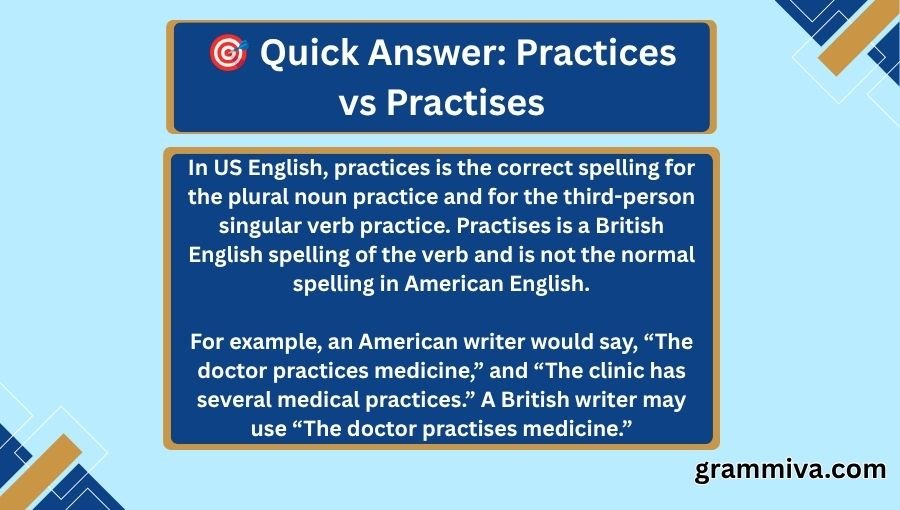
In US English, practices is the correct spelling for the plural noun practice and for the third-person singular verb practice. Practises is a British English spelling of the verb and is not the normal spelling in American English.
For example, an American writer would say, “The doctor practices medicine,” and “The clinic has several medical practices.” A British writer may use “The doctor practises medicine.”
| Form | Common US English use | Example |
|---|---|---|
| practice | Singular noun or base verb | Good practice takes time. |
| practices | Plural noun or third-person singular verb | The clinic has several practices. |
| practise | Not standard US spelling | British English may use practise as a verb. |
| practises | Not standard US spelling | British English may use practises as a verb. |
Is Practices the Same as Practises?
No. The forms have the same basic meaning when practises is used as a British verb, but they belong to different spelling systems.
The main distinction is geographical:
- US English: practice works as both a noun and a verb.
- British English: practice is generally the noun, while practise is the verb.
- US English plural noun: practices.
- US English third-person verb: practices.
- British English third-person verb: practises.
This means that an American writer should normally choose practices when the sentence requires that exact form.
A simple comparison
| Form | Language variety | Word type | Example |
|---|---|---|---|
| practice | US English | Noun or verb | I practice every day. |
| practices | US English | Plural noun or verb | She practices piano. |
| practise | British English | Verb | I practise every day. |
| practises | British English | Verb | She practises piano. |
The important point is that practises is not simply a “wrong” version of practices in every setting. It is a recognized British spelling. The issue is whether it fits the variety of English you are writing.
Why Do People Confuse Practices and Practises?
People confuse these spellings because the words sound the same in ordinary speech and have nearly identical meanings. The main difference is the letter c versus s.
I once edited a short training guide in which the writer used practise in one paragraph and practice in the next. The writer was not confused about the meaning at all. They had simply picked up two English spelling systems from different sources. Once we chose US English for the whole document, the problem disappeared.
There are three common reasons for the confusion:
- Different English varieties — American and British English use different spelling rules for this word.
- Fast typing — Writers often type the form that feels familiar without checking the sentence.
- Mixed exposure — Books, websites, teachers, software, and coworkers may use different varieties of English.
Autocorrect can make the situation even more confusing. A program set to British English may accept practises and suggest it automatically. A program set to US English will generally favor practices.
The easiest way to think about it
If you are writing for an American audience, keep the rule simple:
Use practice and practices. Do not switch to practise or practises.
That rule covers normal US English writing.
Practices vs Practises at a Glance
The clearest difference is shown by looking at the role each form plays in a sentence.
| Form | US English? | Main role | Example | Correct in US English? |
|---|---|---|---|---|
| practice | Yes | Noun or verb | We need more practice. | ✅ Correct |
| practices | Yes | Plural noun or verb | She practices daily. | ✅ Correct |
| practise | No, in standard US usage | British verb | They practise daily. | ❌ Not standard US spelling |
| practises | No, in standard US usage | British third-person verb | He practises daily. | ❌ Not standard US spelling |
| practices | Yes | Third-person verb | He practices daily. | ✅ Correct |
Notice something important: practices has two jobs in American English.
It can be a plural noun:
The company follows safe workplace practices.
Or it can be a verb:
The company practices careful data handling.
The sentence tells you which job the word is doing.
What Does Practice Mean as a Noun?
As a noun, practice can refer to an activity, a usual way of doing something, training, or a professional business or operation.
The plural form is practices.
Meaning 1: Repeated training
When practice means repeated activity that helps someone improve, its plural can refer to several training activities or routines.
Daily practice improves your writing.
Here, practice is a noun. It names the activity of training.
When there is more than one type or set of training activity, practices can be used:
The coach introduced new practices for the team.
Meaning 2: A usual method or way of working
Practice can also mean a method or habit.
Good safety practice reduces mistakes.
In the plural:
The company reviewed its safety practices.
Here, practices means methods or habits followed by the company.
Meaning 3: A professional business
In American English, practice can describe a professional business, especially one run by a doctor, lawyer, dentist, or similar professional.
She opened a dental practice.
In the plural:
The city has several dental practices.
Meaning 4: The actual use of an idea or skill
The word can also describe the real-world use of a skill, idea, or rule.
The course connects theory with practice.
This sense is usually uncountable in that expression, so you would not automatically make it plural.
Meaning summary
| Meaning | Word type | Example sentence |
|---|---|---|
| Training or repeated activity | Noun | Regular practice builds skill. |
| Method or habit | Noun | Safe practices protect workers. |
| Professional business | Noun | The doctor runs a private practice. |
| Real-world use | Noun | The lesson connects theory with practice. |
How Is Practices Used as a Verb?
In US English, practices is also a verb. It is the third-person singular form of practice.
You use it with subjects such as:
- he
- she
- it
- a person
- a company
- an organization
- a singular noun
Examples:
She practices the piano every evening.
He practices law in Chicago.
The company practices careful quality control.
The athlete practices before every competition.
In each sentence, practices describes an action performed by one third-person subject.
Compare the verb forms
| Subject | Verb | Example |
|---|---|---|
| I | practice | I practice every morning. |
| You | practice | You practice every morning. |
| We | practice | We practice every morning. |
| They | practice | They practice every morning. |
| He | practices | He practices every morning. |
| She | practices | She practices every morning. |
| It | practices | It practices a useful pattern. |
This pattern is one of the best ways to remember the spelling in American English.
Is Practises Ever Correct?
Yes, but normally not in standard US English. Practises is the British English third-person singular form of the verb practise.
For example, British English can use:
She practises the piano every day.
American English normally uses:
She practices the piano every day.
Both forms represent the same basic verb meaning. The spelling reflects the English variety being used.
This matters when you are writing for a specific audience. If you are preparing an American resume, school paper, business email, or website, practices is the normal choice.
If you are quoting or reproducing British writing, however, changing every spelling may not be appropriate. The original variety may need to remain intact.
💡 Test Tip: How Can You Choose the Right Spelling?
Here is the fastest test I teach writers:
Are you writing in US English?
If yes, choose practice or practices, depending on the grammar of the sentence.
If you are writing in British English, ask whether the word is a noun or verb. British English generally uses practice for the noun and practise for the verb.
For US English, you can reduce the entire problem to one question:
Would this sentence use practice as a noun or verb?
Then choose the form required by the sentence.
A quick substitution test
Try replacing the word with train, use, or method.
If the sentence needs an action:
She practices every afternoon.
If it needs a thing or method:
These safety practices are effective.
The spelling remains practices in both cases because the writing is American English.
What Does Practices Mean in Professional Writing?
In professional writing, practices is especially common when discussing methods, procedures, habits, or standards.
You may see phrases such as:
- business practices
- workplace practices
- accounting practices
- safety practices
- hiring practices
- teaching practices
- marketing practices
- management practices
- medical practices
- research practices
These are all normal American English expressions.
For example:
The company updated its hiring practices.
Here, practices is a plural noun. It refers to the company’s methods or habits.
Professional writing also uses the verb form:
The company practices responsible data management.
Here, practices is a verb.
Professional examples
| Expression | Role | Example |
|---|---|---|
| business practices | Plural noun | The firm changed its business practices. |
| safety practices | Plural noun | Employees must follow safety practices. |
| teaching practices | Plural noun | The school reviewed its teaching practices. |
| practices law | Verb | She practices law in Texas. |
| practices medicine | Verb | He practices medicine in Boston. |
📝 Case Study: A Workplace Email
Imagine that an American manager is writing an email to a team:
“We are reviewing our current customer service practices. Starting next month, the support team practices a new response process during training.”
The first practices is a plural noun. It refers to methods or habits.
The second practices is a verb. It describes what the team does.
Now imagine that someone writes:
“We are reviewing our customer service practises.”
For a US English document, that spelling would be out of place.
The practical lesson is simple: the noun/verb distinction matters for grammar, but it does not create a c-versus-s spelling change in standard American English.
| Workplace sentence | Role of the word | US English |
|---|---|---|
| We changed our practices. | Plural noun | ✅ Correct |
| She practices law. | Verb | ✅ Correct |
| We changed our practises. | Plural noun | ❌ Incorrect |
| She practises law. | Verb | ❌ Not standard US spelling |
Why Does American English Use Practices for Both Forms?
American English treats practice as both a noun and a verb. The spelling does not normally change when the word changes grammatical role.
That means:
- noun: practice
- plural noun: practices
- verb: practice
- third-person singular verb: practices
British English uses a spelling distinction for the noun and verb:
- noun: practice
- verb: practise
- plural noun: practices
- third-person singular verb: practises
The difference is therefore not about which meaning is “real.” It is mainly a difference between established spelling conventions.
Standard English reference works and style guides recognize these regional differences. The key for a writer is consistency.
Grammar Rules Explanation
In standard US English, practice functions as both a noun and a verb. Its plural noun form is practices, and its third-person singular present-tense verb form is also practices.
The form practises belongs to a different spelling convention. In British English, practise is commonly used as the verb, while practice is used as the noun. The third-person singular verb therefore becomes practises.
For an American English document, writing practises introduces a British spelling into an otherwise American spelling system.
This is similar to other regional spelling differences. English has many pairs that vary across countries. The important thing is not to mix systems without a reason.
Correct vs Incorrect at a Glance
| Sentence | Correct/Incorrect | Why |
|---|---|---|
| She practices yoga every morning. | ✅ Correct | US English uses practices as the verb. |
| She practises yoga every morning. | ❌ Incorrect in US English | Practises is a British verb spelling. |
| The company has good safety practices. | ✅ Correct | Practices is a plural noun. |
| The company has good safety practises. | ❌ Incorrect in US English | The plural noun is spelled practices. |
| He practices medicine in Ohio. | ✅ Correct | Practices is the third-person singular verb. |
The most useful rule is therefore straightforward: If your document follows US English, use c in both forms: practice and practices.
⚠️ Common Mistakes With Practices and Practises
Most mistakes happen because writers remember that British English separates the noun and verb but forget that American English normally does not.
I once caught myself typing practise in a US-focused draft after reading several British articles earlier that morning. I noticed the spelling during proofreading because the rest of the document consistently used American English. That small mistake was a useful reminder: language exposure can affect spelling even when you know the rule.
Similar grammar confusions
| Confusion | Correct pair | Main difference |
|---|---|---|
| it’s / its | it’s / its | Contraction vs possessive |
| your / you’re | your / you’re | Possessive vs “you are” |
| their / there / they’re | their / there / they’re | Possession, place, contraction |
| affect / effect | affect / effect | Often verb vs noun, with exceptions |
| then / than | then / than | Time/order vs comparison |
| advice / advise | advice / advise | Noun vs verb |
These pairs show why English spelling can be tricky. A single letter can change the role or meaning of a word. In the case of practice and practise, the issue also involves regional English.
Why mistakes happen
Fast typing: When you are focused on your ideas, you may type the first spelling that comes to mind.
Autocorrect: Your keyboard or writing software may be set to British English, American English, or another language variety.
Lack of knowledge: A writer may know that both forms exist but not know which one belongs to US English.
Mixed reading: You may read British websites, American textbooks, Canadian content, and Australian articles in the same week.
Specific wrong forms to avoid in US English
| Wrong form | What’s wrong | Correct form |
|---|---|---|
| practises | British verb spelling | practices |
| practise | British verb spelling | practice |
| practicies | Misspelling | practices |
| practiseses | Incorrect extra ending | practices |
| practize | Nonstandard spelling in this context | practice |
| practicess | Extra letter | practices |
The first two are especially important. They are not random spelling errors. They are forms associated with another major English spelling convention.
Where Does the Practice/Practise Difference Come From?
The spelling difference is a long-standing regional feature of English. Over time, different English-speaking communities developed and maintained different spelling conventions.
The important history for a modern writer is not a list of exact dates. It is the development of two familiar systems:
- British English generally kept a distinction between the noun practice and the verb practise.
- American English adopted and maintained practice for both noun and verb use.
- The plural noun is practices in both systems.
- The third-person verb differs: US practices, British practises.
Simplified history of the spelling
| Period | Form or pattern | General note |
|---|---|---|
| Earlier English | Related noun and verb spellings | English spelling was less standardized than today. |
| Later British usage | practice / practise | The noun and verb became commonly distinguished in British spelling. |
| American usage | practice / practice | American English generally uses the same spelling for both roles. |
| Modern US English | practice / practices | This remains the normal American pattern. |
| Modern British English | practice / practise | The noun/verb distinction remains common in British spelling. |
You do not need to memorize the history to use the words correctly. The modern regional rule is what matters most.
How Should You Use the Words in Different Contexts?
Your choice depends first on the English variety you are using. In US English, practice and practices are the normal forms in all four contexts below.
| Context | Which term to use in US English | Example |
|---|---|---|
| Everyday conversation | practice / practices | She practices every evening. |
| Professional writing | practice / practices | The firm changed its business practices. |
| Creative writing | practice / practices | He practiced the speech before dinner. |
| Social media/texting | practice / practices | I need more practice before the test. |
Social media is more relaxed, but that does not change the standard spelling. Informal writing may contain shortened words or slang, yet practices remains the normal US spelling when the word is needed.
Common Phrases With Practice and Practices
There are many common expressions containing practice and practices. These are useful because they help you see the words in natural settings.
| Phrase | Meaning |
|---|---|
| in practice | In real use or real life |
| practice makes perfect | Repeated effort can improve a skill |
| put into practice | Start using an idea or plan |
| best practices | Methods widely regarded as useful within a field |
| business practices | Methods used to run a business |
| safe practices | Actions or methods designed to reduce risk |
For example:
The plan sounds good in theory, but we need to see how it works in practice.
And:
The training teaches best practices for customer service.
These expressions are common in US English and provide useful models for your own writing.
What Can You Use Instead of Practices?
Sometimes another word can make your sentence simpler. The best replacement depends on what practices means in context.
| Alternative | Works when | Does not work when |
|---|---|---|
| methods | You mean ways of doing something | You mean repeated physical training |
| habits | You mean repeated behaviors | You mean a professional business |
| procedures | You mean formal steps | You mean personal skill training |
| routines | You mean repeated activities | You mean a company’s formal methods |
| techniques | You mean specific ways to perform a task | You mean a professional office or business |
For example:
The company changed its practices.
could become:
The company changed its methods.
But:
She practices the piano.
cannot normally become “She methods the piano.” The word practices has a different function there.
This is why context matters more than simply looking for a synonym.
How Can You Remember the Difference?
For American English, the easiest memory trick is:
US English uses C: practice, practices.
You do not need to remember a separate American spelling for the verb.
Try these three checks:
- Writing for Americans? → practice / practices
- Need a plural noun? → practices
- Need a third-person singular verb? → practices
A useful visual trick is to remember that practices has the same final -ices pattern whether you are talking about methods or an action.
A second memory rule
Think:
One practice, many practices. She practices.
That gives you three common US forms in one line.
Why Does Getting Practices Right Matter?
Correct spelling helps readers understand your writing without stopping to question what you mean. This is especially useful in professional documents.
A spelling difference may seem tiny, but consistency tells readers that you understand the style of English you are using.
Clear writing lets the reader focus on the message, not the spelling puzzle.
| Situation | Why getting it right matters |
|---|---|
| Resume | Shows attention to standard US writing conventions |
| Client email | Keeps professional communication consistent |
| Published content | Supports a consistent editorial style |
| Social post | Makes the intended spelling clear to readers |
This does not mean every British spelling is “bad.” It means that your spelling should match your intended audience and style.
If you are writing an American article, report, resume, or business message, use American spelling consistently from beginning to end.
Can You Use British Spelling in an American Document?
You can, but there should be a reason.
For example, you may quote a British source exactly. You may also be writing dialogue for a British character. In those cases, retaining practise or practises may help preserve the original voice or spelling.
Outside those situations, mixing British and American spelling can make a document look inconsistent.
| Situation | Recommended approach |
|---|---|
| US school assignment | Use US spelling |
| US business report | Use US spelling |
| US website | Use US spelling consistently |
| British publication | Follow its style |
| Direct British quotation | Preserve the original spelling when appropriate |
The key is consistency rather than treating one regional system as universally correct.
How Does the Rule Work in Real Sentences?
Here are several examples that show the difference clearly.
Example 1: A skill
Maria practices her presentation every morning.
Why: Practices is a third-person singular verb in US English.
Example 2: A method
The company follows ethical practices.
Why: Practices is a plural noun.
Example 3: A profession
Dr. Lee practices medicine in Seattle.
Why: Practices is a verb.
Example 4: Multiple businesses
The state has hundreds of medical practices.
Why: Practices is a plural noun.
Example 5: British English
She practises law in London.
Why: This is a British English spelling of the verb. It would normally be changed to practices in a US English document.
What Are the Most Common Searches About Practices vs Practises?
People usually ask this question for one of four reasons: they are writing in American English, they are reading British English, they need to choose between noun and verb forms, or they want to check a sentence quickly.
The answers are closely related.
If the document is American English, practices is the safe standard spelling for both the plural noun and the third-person singular verb.
If the document is British English, the noun is generally practice, while the verb is practise, with practises as the third-person singular form.
How Do I Know Whether to Write Practice or Practices?
Use practice when the noun is singular or when the verb is in its base form.
Use practices for a plural noun or for a third-person singular verb in US English.
Compare:
The doctor has a practice.
The doctors have several practices.
I practice every day.
She practices every day.
The subject and grammar determine whether you need practice or practices.
Is Practises Wrong in American English?
Yes, it is not the standard US spelling for the ordinary verb. Practises is associated with British English spelling.
For an American audience, write:
She practices piano.
rather than:
She practises piano.
The distinction is about spelling convention, not a different basic action.
Do Americans Use Practise as a Verb?
In standard American English, practice is used as the verb.
For example:
I practice my speech.
He practices medicine.
American writers generally do not switch to practise for the verb. That noun/verb spelling split is a feature of British English.
Is Practices a Noun or a Verb?
It can be either.
As a noun:
The company has strong safety practices.
As a verb:
The company practices careful quality control.
The surrounding sentence tells you which role the word has.
This is one reason the US spelling is convenient. The same spelling can serve both grammatical roles.
What Is the Difference Between Practice and Practise?
In US English, practice can be both a noun and a verb.
In British English, practice is generally the noun and practise is the verb.
So:
| English variety | Noun | Verb |
|---|---|---|
| American English | practice | practice |
| British English | practice | practise |
For the third-person singular:
| English variety | Third-person verb |
|---|---|
| American English | practices |
| British English | practises |
Which Is Correct: Practices or Practises in a Resume?
For a US resume, use practices.
For example:
Developed efficient customer service practices.
or:
Practices clear communication when working with clients.
If the resume is intended for a British employer and follows British English, practise/practises may be appropriate for verbs.
The best choice depends on the English style required by the document.
Which Is Correct in Academic Writing?
For American academic writing, use practice and practices.
For example:
The study examines teaching practices in public schools.
And:
Students practice the method before the final assessment.
Academic writing should follow the style guide or institution’s required language variety. If the assignment calls for US English, keep American spelling throughout.
Quick Recap Checklist
Use this checklist whenever you are unsure.
| Question | If Yes → Use |
|---|---|
| Am I writing in standard US English? | practice / practices |
| Do I mean more than one method or habit? | practices |
| Is a singular person doing the action? | practices |
| Am I writing in standard British English? | practice/practise according to role |
| Is practises a US English verb? | No → use practices |
Practice examples
- She ___ the piano every evening.
Answer: practices - The company changed its safety ___.
Answer: practices - He ___ medicine in California.
Answer: practices
A quick final check is enough in most cases: American English uses practice/practices; British English commonly uses practice/practise according to grammatical role.
FAQs About Practices vs Practises
Is practices correct in American English?
Yes. Practices is standard in American English. It can be the plural of the noun practice or the third-person singular form of the verb practice.
Is practises correct in American English?
Practises is not the standard American spelling. It is commonly associated with British English as the third-person singular form of practise.
Which is correct: she practices or she practises?
For US English, she practices is correct. British English commonly uses she practises.
Which is correct: business practices or business practises?
Business practices is correct in US English. Here, practices is a plural noun meaning methods or ways of operating.
Is practice a noun or a verb?
In American English, practice can be both a noun and a verb. For example, “Practice helps” uses the noun, while “I practice daily” uses the verb.
Why does British English use practise?
British English commonly uses practice for the noun and practise for the verb. This creates a spelling distinction that is generally not used in American English.
How do you spell practices in US English?
The standard spelling is practices, with a c before the final -es.
Is “he practises medicine” correct?
It is correct in British English. In US English, write “He practices medicine.”
Should I use practices on an American website?
Yes. If the website follows standard US English, practices is the normal spelling for both the plural noun and third-person singular verb.
Are practice and practise pronounced differently?
In normal modern speech, the two spellings are generally pronounced alike. The main difference for writers is the spelling convention used by American versus British English.
Conclusion
Practices vs practises becomes much easier once you know which English variety you are using. In standard US English, use practice and practices for both noun and verb functions. You do not normally change the spelling to practise or practises when the word becomes a verb.
The key examples are simple: “She practices every day” and “The company follows good practices.” The first uses practices as a verb. The second uses it as a plural noun. Both are correct American English.
If you are reading British English, you may see practise and practises. Those spellings follow a different regional convention, so they are not random errors. 🇺🇸
When writing for an American audience, keep one rule in mind: practice and practices are your standard choices. Once that habit is fixed, this spelling question becomes one less thing to worry about. ✨
Remember: In US English, practice is the noun and verb, and practices is its plural or third-person singular form.

I am Ethan Brooks, an English grammar and vocabulary writer. I work at Grammiva, where I create simple and helpful content to make English learning easier for students and everyday learners.

[…] end, you should be able to choose the right form without stopping to second-guess yourself. ✍️ Practices vs Practises | Hoarder vs Horder | Tying vs […]
[…] mistakes, and gives you a quick test you can use whenever you hesitate. Optimize vs Optimise | Practices vs Practises| Hoarder vs […]