Have you ever typed traveled vs travelled and stopped because both spellings looked right? You are not alone. I teach and edit English writing, and this is one of those spelling questions that can make even strong writers pause. ✈️
The good news is simple: traveled and travelled have the same meaning.
The main difference is the variety of English being used.
Traveled is the standard spelling in American English, while travelled is the standard spelling in British English and several other varieties.
That means neither spelling is simply a “bad” version of the other.
The best choice depends on your audience, publication, school, workplace, or style guide.
In this guide, I’ll explain the difference in plain US English.
You’ll see examples, common mistakes, memory tricks, tables, and answers to the questions writers ask most often.
By the end, you should be able to choose the right spelling without stopping to second-guess yourself. 😊 Rough vs Ruff | Aging vs Ageing | Programs vs Programmes
🎯 Quick Answer: Traveled vs Travelled
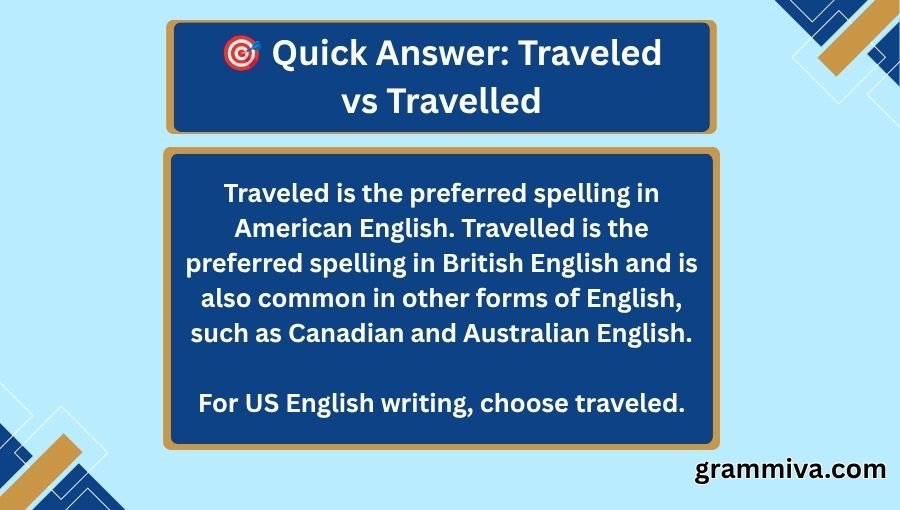
Traveled is the preferred spelling in American English. Travelled is the preferred spelling in British English and is also common in other forms of English, such as Canadian and Australian English.
For US English writing, choose traveled.
| Spelling | Main variety | Example |
|---|---|---|
| traveled | American English | She traveled to Boston last year. |
| travelled | British English | She travelled to London last year. |
So, if you are writing an American resume, school paper, website, report, or email, traveled is usually the right choice.
Related Word Forms and Their Uses
The spelling difference also appears in other forms of the word. The basic pattern is worth learning because it helps you avoid making the same mistake with related words.
| Form | Type | Example |
|---|---|---|
| travel | Base verb | I travel often for work. |
| travels | Third-person singular verb | He travels every month. |
| traveling | Present participle/gerund | She is traveling today. |
| traveled | American past tense/past participle | We traveled by train. |
| traveller | British noun spelling | The traveller arrived early. |
| traveler | American noun spelling | The traveler arrived early. |
| travelled | British past tense/past participle | We travelled by train. |
| travelling | British present participle/gerund | She is travelling today. |
The important point is that American English usually keeps one l before the endings in traveling and traveled. British English normally uses two l’s in travelling and travelled.
Is Traveled the Same as Travelled?
Yes. Traveled and travelled have the same basic meaning. They are different regional spellings of the past tense and past participle of travel.
For example:
- She traveled across the country. ✅
- She travelled across the country. ✅
Both sentences mean that she went from one place to another across the country. The spelling does not change the action.
The difference is mainly one of English variety. An American writer will normally choose traveled, while a British writer will normally choose travelled.
This is similar to other spelling differences between American and British English. The language has more than one accepted spelling system, and writers often follow the system used by their audience.
Traveled vs Travelled at a Glance
The quickest way to understand the difference is to compare the forms side by side.
| Form | Type | Meaning | Example | Correct/Incorrect |
|---|---|---|---|---|
| traveled | US spelling | Went from one place to another | I traveled to Chicago. | ✅ Correct in US English |
| travelled | UK spelling | Went from one place to another | I travelled to London. | ✅ Correct in UK English |
| traveld | Misspelled form | No standard meaning | I traveld yesterday. | ❌ Incorrect |
| travelld | Misspelled form | No standard meaning | We travelld by car. | ❌ Incorrect |
| traveling | US form | Going from place to place | She is traveling now. | ✅ Correct in US English |
| travelling | UK form | Going from place to place | She is travelling now. | ✅ Correct in UK English |
The one-line rule
If you are writing American English, use traveled.
If you are writing British English, use travelled.
That single rule solves most cases.
What Is the Difference Between Traveled and Travelled?
The difference is spelling convention, not meaning. Both words are forms of the verb travel, and both describe going from one place to another.
Consider these examples:
- I traveled to New York last summer. ✅
- I travelled to New York last summer. ❌ in standard US English
The second sentence is understandable to an American reader. It is not a meaning error. However, travelled follows a British spelling pattern rather than the usual American spelling pattern.
Now reverse the setting:
- I travelled to Manchester last summer. ✅
- I traveled to Manchester last summer. ❌ in a strict British-English style
Again, the meaning is perfectly clear. The issue is consistency with the chosen variety of English.
Why the extra “l” matters
American English often uses one l in words such as:
- traveled
- traveling
- traveler
British English generally uses two:
- travelled
- travelling
- traveller
This does not mean that British English has “more correct” spelling. It simply follows a different spelling convention.
| Feature | American English | British English |
|---|---|---|
| Past tense | traveled | travelled |
| Present participle | traveling | travelling |
| Person who travels | traveler | traveller |
| Meaning | Same | Same |
| Best choice for US writing | Yes | Usually no |
Why Do People Confuse Traveled and Travelled?
People confuse these spellings because both are real English words. A writer may also see both forms online, in books, or in messages from people in different countries.
The internet makes this especially common. A US reader may regularly encounter British websites. A British reader may read American news, software documentation, or social posts.
I once reviewed a short travel article written for a US audience. The writer had used traveled, travelling, and traveller in the same three paragraphs. None of the words made the article impossible to understand, but the mixed spelling made the piece look unfinished. We changed the forms to match American English.
The lesson was simple: the real problem is often not choosing one spelling over the other. It is mixing spelling systems without a reason.
A simple way to think about it
Think of the two spellings as members of the same family:
American family
- travel
- traveled
- traveling
- traveler
British family
- travel
- travelled
- travelling
- traveller
Once you see the pattern, the spelling becomes easier to remember.
🎯 Traveled: Meaning and Correct Use
Traveled is the standard American English past tense and past participle of travel.
Use it when you are writing in American English and describing travel that happened in the past or is connected to a completed action.
Past action
Use traveled for a completed trip.
- We traveled to Miami in June. ✅
- We travelled to Miami in June. ❌ in standard US English
The word traveled tells us that the action happened in the past.
Present perfect constructions
You can also use traveled after forms of have or has.
- She has traveled to five states. ✅
- She has travelled to five states. ❌ in standard US English
Here, traveled works as a past participle.
Passive constructions
The word can also appear in passive structures.
- The distance was traveled by the team over several days. ✅
- The distance was travelled by the team over several days. ❌ in standard US English
This structure is less common in everyday conversation, but it follows the same spelling rule.
| Meaning | Word Type | Example Sentence |
|---|---|---|
| Completed journey | Past tense | We traveled yesterday. |
| Past experience | Past participle | I have traveled abroad. |
| Completed distance | Past participle | The road was traveled many times. |
💡 Test Tip
When you are writing for a US audience, look at the word travel and ask:
“Am I following American spelling?”
If yes, choose traveled, traveling, and traveler.
If your entire document follows British spelling, choose travelled, travelling, and traveller instead.
📝 Case Study: A Workplace Email
Imagine that an American employee is writing this email:
- I traveled to Denver last week and met with the regional team. ✅
- I travelled to Denver last week and met with the regional team. ❌ for a consistent US-English document
The first version fits standard American spelling.
Now imagine a British employee writing:
- I travelled to Manchester last week and met with the regional team. ✅
- I traveled to Manchester last week and met with the regional team. ❌ for a consistent British-English document
The key is not the destination. It is the spelling system used for the document.
I once caught a similar issue while editing a company report. The report was written for readers in the United States, but one paragraph had travelled because the writer had copied a sentence from a British source. The sentence was clear, but the spelling stood out. Changing it to traveled made the paragraph match the rest of the report.
That is a good example of why editing is about consistency as well as grammar.
Grammar Rules Explanation
In American English, travel normally forms its past tense and past participle as traveled. In British English, the usual spelling is travelled.
The difference comes from different spelling conventions for words ending in a consonant followed by l. American English often uses a single l before certain endings, while British English commonly doubles the l.
The same pattern can be seen in related forms:
- American: traveling
- British: travelling
And:
- American: traveler
- British: traveller
This is a spelling rule, not a difference in grammar meaning. Most standard dictionaries and style references recognize the regional nature of these forms.
Correct vs Incorrect at a Glance
| Sentence | Correct/Incorrect | Why |
|---|---|---|
| I traveled to Seattle last month. | ✅ Correct | Standard American spelling |
| I travelled to Seattle last month. | ❌ Usually incorrect for US style | British spelling |
| She has traveled extensively. | ✅ Correct | US past participle |
| She has travelled extensively. | ❌ Usually incorrect for US style | British spelling |
| They traveled by train. | ✅ Correct | Standard US past tense |
The word incorrect here needs a little care. Travelled is not wrong English in general. It is simply not the normal American spelling. In British English, it is correct.
⚠️ Common Mistakes With Traveled and Travelled
Most spelling mistakes happen for practical reasons. Writers type quickly. Autocorrect changes words. People read several forms of English every day. Some writers also do not know that American and British spelling systems differ.
Three common causes are:
- Fast typing — You may type the word without thinking about the spelling.
- Autocorrect — Your device may suggest or replace a form based on its language settings.
- Lack of knowledge — You may not realize that both spellings belong to different English varieties.
Similar spelling confusions
| Confusion | Correct Form | Main Issue |
|---|---|---|
| it’s / its | Depends on meaning | Contraction vs possession |
| your / you’re | Depends on meaning | Possession vs “you are” |
| they’re / their / there | Depends on meaning | Different words with similar sounds |
| than / then | Depends on meaning | Comparison vs time/order |
| traveled / travelled | Depends on English variety | US vs UK spelling |
These mistakes have something in common: the writer needs to check the role or spelling pattern of the word instead of relying only on how it sounds.
Common wrong spellings and uses
| Wrong Form | What’s Wrong | Correct Form |
|---|---|---|
| traveld | Missing the needed ending pattern | traveled |
| travelld | Incorrect spelling | traveled or travelled |
| travelled in a US report | British spelling in US style | traveled |
| traveled in a strict UK document | US spelling in UK style | travelled |
| traveling and travelled together in US copy | Mixed spelling systems | traveling and traveled |
| traveller in US copy | British noun spelling | traveler |
A quick spell-check can catch some of these problems. It cannot always catch a regional spelling choice, though. A spell-checker may accept both traveled and travelled.
That is why you need to know which variety you are writing.
How Do American and British Spelling Differ?
American and British English share the same core language, but they differ in some spelling rules and conventions.
The traveled/travelled difference is one example. Others include:
| American English | British English | Example Meaning |
|---|---|---|
| traveled | travelled | Went on a journey |
| traveling | travelling | Going on a journey |
| traveler | traveller | Person who travels |
| canceled | cancelled | Called off |
| labeling | labelling | Adding a label |
| modeled | modelled | Created a model |
There are exceptions and additional rules, so you should not assume that every word ending in l follows exactly the same pattern.
For ordinary US writing, however, the safest approach is to follow a recognized American style consistently.
When Should You Use Traveled?
Use traveled when your writing follows American English.
This includes many common situations:
Everyday conversation
In casual US conversation, you might say:
“We traveled through Texas last year.”
The spelling is not usually noticed when the word is spoken, but it matters when the sentence is written.
Professional writing
Use traveled in US workplace documents, resumes, reports, and business emails when American spelling is expected.
Creative writing
If your story uses American English, traveled will usually fit naturally.
However, if you are writing a character who is meant to use British English, travelled may fit that character’s speech or narration.
Social media and texting
Either form may appear online because social media brings together people from many countries. If you are writing for a US audience, traveled remains the standard American choice.
| Context | Which Term to Use | Example |
|---|---|---|
| US everyday writing | traveled | We traveled last weekend. |
| US professional writing | traveled | I traveled for the meeting. |
| US creative writing | traveled | They traveled across the desert. |
| US social media | traveled | Just traveled to three new cities! |
| UK professional writing | travelled | I travelled for the meeting. |
| UK creative writing | travelled | They travelled across the country. |
Is Travelled Ever Correct in American English?
Yes, travelled can appear in American writing without making the writer’s meaning unclear. But it is not the standard spelling choice for ordinary American English.
You might see it in:
- A quotation from a British writer
- The name of a product or organization
- A title that preserves its original spelling
- A text copied from a British source
- A publication that intentionally follows British spelling
This is why it is better to say that traveled is the standard US spelling, rather than saying travelled is always wrong.
Context matters.
Common Phrases With Travel
Unlike some verbs, travel does not have many fixed idioms that force one spelling. Still, several common phrases are useful for learning how the word works.
| Phrase | Meaning |
|---|---|
| traveled abroad | Went to another country |
| traveled by car | Made a journey using a car |
| traveled by train | Made a journey using a train |
| traveled around the world | Visited many parts of the world |
| traveled long distances | Went far from one place to another |
| traveled for work | Took trips because of a job |
For American writing, use traveled in these phrases when the action is in the past.
For example:
I traveled abroad for work last year. ✅
The British version would be:
I travelled abroad for work last year. ✅
Again, the meaning is the same.
How Can You Remember Traveled vs Travelled?
The easiest memory trick is to connect the spelling with the audience.
Think:
US = one L: traveled
Then:
UK = two L’s: travelled
You can also remember the whole family.
| American Pattern | British Pattern |
|---|---|
| traveled | travelled |
| traveling | travelling |
| traveler | traveller |
Do not try to memorize each word as a completely separate item. Learn the pattern.
If you are writing a US document and you see travelled, pause. Ask whether the source you copied from uses British English.
If you are writing a British document and see traveled, check whether your document should use British spelling.
Consistency is your best friend.
Synonyms and Alternatives for Traveled
Sometimes you can replace traveled with another word or phrase. This can make your writing more varied, but the alternatives are not always exact matches.
| Alternative | Works When | Does Not Work When |
|---|---|---|
| went | You mean someone moved to a place | You need to stress the journey itself |
| journeyed | You want a more formal or literary tone | You want very casual US English |
| visited | Someone went to and spent time at a place | You only mean movement between places |
| toured | Someone traveled around while seeing places | The trip had no sightseeing or tour element |
| moved | Someone changed location or residence | You mean a temporary trip |
For example, visited is not always a direct replacement.
“I traveled to Boston” tells us about the journey.
“I visited Boston” puts more attention on being in Boston.
That small difference can matter.
Why Does Correct Spelling Matter?
Correct spelling helps readers move through your writing without unnecessary distractions.
Clarity in communication
A consistent spelling system makes your writing easier to read. Readers do not need to stop and wonder whether a spelling change was intentional.
Professionalism
A single British spelling in an American business document is not a major language error. Still, a document full of mixed spelling choices can look poorly edited.
Digital communication
Websites, emails, resumes, and social posts are often read by people from many countries. Choosing a clear spelling standard helps establish the intended voice.
| Situation | Why Getting It Right Matters |
|---|---|
| Resume | Shows careful editing and consistency |
| Client email | Supports a polished professional tone |
| Published content | Keeps the publication’s style consistent |
| Social post | Helps match the intended audience |
A useful writing principle is:
Clear writing makes the reader’s job easier.
That is especially true when the difference is small enough that the reader may notice it without knowing why.
Does Traveled or Travelled Look More Professional?
Neither spelling is automatically more professional. The professional choice is the one that matches the English variety and style of your audience.
For a US company, traveled will usually look more natural.
For a UK company, travelled will usually look more natural.
The important thing is consistency. If a document uses American spelling throughout, suddenly changing to British spelling can look like a copy-and-paste error.
Can You Use Both Forms in One Document?
Usually, you should avoid switching between them without a clear reason.
A US document that says:
We traveled to New York.
We travelled to Boston.
looks inconsistent.
A better US version is:
We traveled to New York.
We traveled to Boston.
Likewise, a British document would normally use travelled in both sentences.
There can be exceptions. A quotation, brand name, title, or source may need to keep its original spelling. In those cases, preserving the original form can be appropriate.
What About Traveled vs Travelled in SEO Content?
For US-focused content, traveled is generally the natural choice when you are writing in American English.
SEO does not change the underlying spelling rule. Search engines can understand regional spelling differences, but your content should still match its target audience.
If your site serves readers in the United States, keep the surrounding content in American English. That means you may also prefer forms such as:
- traveler
- traveling
- canceled
- modeled
- labeled
If your site targets British readers, use the relevant British forms consistently.
The goal is not to repeat one spelling as many times as possible. Good SEO writing should answer the reader’s question naturally.
How Does Context Change the Best Choice?
Context can determine which spelling feels most natural.
Imagine three writers:
Writer A: An American teacher preparing a classroom worksheet.
Writer B: A British journalist writing a newspaper article.
Writer C: A US novelist creating a British character’s letter.
All three may reasonably make different choices.
| Writer or Setting | Natural Choice | Reason |
|---|---|---|
| American teacher | traveled | US English |
| British journalist | travelled | British English |
| American novelist using a British source | travelled may appear | Original British wording may be preserved |
| US company report | traveled | Professional US style |
| UK travel website | travelled | British audience |
The spelling should serve the writing context.
Quick Recap Checklist
Use this checklist whenever you hesitate.
| Question | If Yes → Use |
|---|---|
| Am I writing standard American English? | traveled |
| Am I writing standard British English? | travelled |
| Is my US document already using one-l spellings? | traveled |
| Is my UK document already using two-l spellings? | travelled |
| Am I quoting a source? | Keep the source’s original spelling when appropriate |
Practice Examples
- I traveled to California last year. ✅
- She traveled by train across the state. ✅
- They travelled around Scotland last summer. ✅
The first two fit American English. The third fits British English.
FAQs About Traveled vs Travelled
Is traveled correct in American English?
Yes. Traveled is the standard American English spelling of the past tense and past participle of travel.
Is travelled correct in British English?
Yes. Travelled is the standard British English spelling.
Which is correct in the US, traveled or travelled?
For standard US English, choose traveled.
Which is correct in the UK, traveled or travelled?
For standard UK English, choose travelled.
Does traveled mean something different from travelled?
No. The two spellings have the same basic meaning. The difference is regional spelling convention.
Why does British English use two l’s in travelled?
British English generally doubles the l in forms such as travelled, travelling, and traveller. American English normally uses one l in these forms.
Is “traveling” or “travelling” correct?
Both are correct in their respective varieties. Traveling is the usual American spelling. Travelling is the usual British spelling.
Is “traveler” or “traveller” correct?
Both are accepted regional spellings. Traveler is standard in American English. Traveller is standard in British English.
Should I use traveled or travelled on an American resume?
Use traveled if your resume follows American English. It matches the standard US spelling system.
Can I use traveled and travelled in the same article?
You can, but you generally should not mix them without a reason. Choose one English variety and stay consistent. A quotation or proper name may be an exception.
Final Rule to Remember
The simplest answer is this: traveled vs travelled is a regional spelling difference, not a difference in meaning.
If you write in American English, use traveled. If you write in British English, use travelled. The same regional pattern applies to related forms such as traveling/travelling and traveler/traveller.
When editing your work, do not ask only, “Which spelling is right?” Ask, “Which English variety am I using?” That question gives you the answer much faster.
I recommend choosing your target variety before you begin a long document. Then keep that choice steady from the first page to the last. It will make your writing look cleaner, sound more natural, and require fewer corrections later. ✈️
One audience, one spelling system, one clear choice.

I am Alex Morgan, an English grammar and vocabulary writer passionate about making language learning simple and useful. I work at Grammiva, where I create clear educational content and practical English examples for learners.


[…] make the difference easy to remember. 🎯 Traveled vs Travelled | Rough vs Ruff | Aging vs […]
[…] vs freshmen should feel like an easy choice rather than a grammar puzzle. 😊 Crummy vs Crumby | Traveled vs Travelled | Rough vs […]