Have you ever typed a sentence, looked at crummy vs crumby, and suddenly wondered which spelling belongs there? 😅 You are not alone.
These two words look almost the same, but they do not mean the same thing.
The confusion is easy to understand.
Both words contain the letters crum, and both can appear when we talk about something unpleasant or messy.
However, crummy and crumby have different meanings and different jobs in a sentence.
As an editor, I see this kind of spelling mix-up often.
The good news is that the rule is simple once you connect each spelling with its meaning.
Crummy usually describes something poor, unpleasant, or of low quality.
Crumby describes something that has crumbs or is covered with crumbs.
That small letter difference can change the whole meaning of a sentence.
If you write about a bad hotel, you need crummy.
If you describe a table covered in bread crumbs, you need crumby.
Let’s make the difference easy to remember. 🎯 Traveled vs Travelled | Rough vs Ruff | Aging vs Ageing
🎯 Quick Answer: Crummy vs Crumby
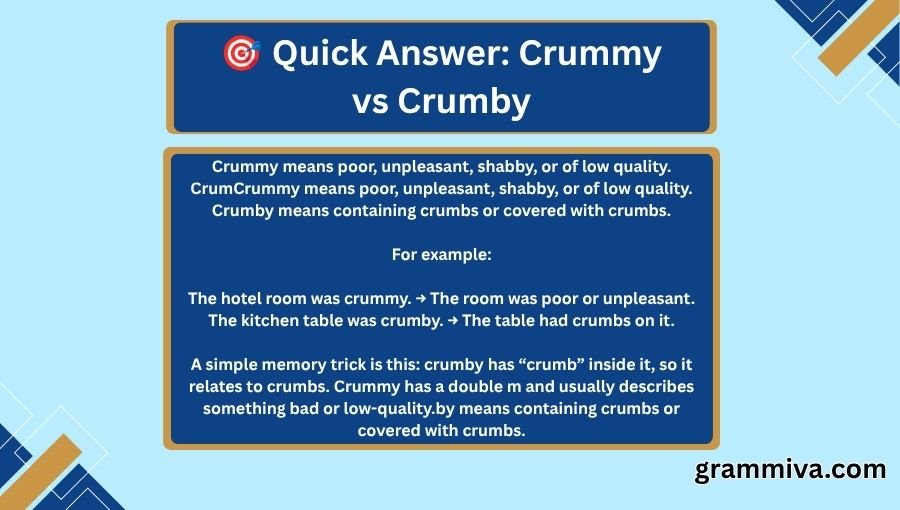
Crummy means poor, unpleasant, shabby, or of low quality. Crumby means containing crumbs or covered with crumbs.
For example:
- The hotel room was crummy. → The room was poor or unpleasant.
- The kitchen table was crumby. → The table had crumbs on it.
A simple memory trick is this: crumby has “crumb” inside it, so it relates to crumbs. Crummy has a double m and usually describes something bad or low-quality.
Is Crummy the Same as Crumby?
No. Crummy and crumby are different words with different meanings. The spelling you choose depends on what you want to describe.
| Form | Type | Meaning | Example | Correct/Incorrect |
|---|---|---|---|---|
| crummy | Adjective | Poor, unpleasant, or low-quality | We stayed in a crummy hotel. | ✅ Correct |
| crumby | Adjective | Containing or covered with crumbs | The counter is crumby. | ✅ Correct |
| crummy | Adjective | Covered with food crumbs | The table is crummy. | ❌ Usually incorrect |
| crumby | Adjective | Poor-quality or unpleasant | We stayed in a crumby hotel. | ❌ Usually incorrect |
The key is meaning, not just spelling.
If something is bad, crummy is usually the right choice.
If something has crumbs, crumby is the right choice.
That distinction solves most cases.
🧠 Crummy vs Crumby at a Glance
The fastest way to understand the difference is to compare the words side by side.
| Word | Main Idea | Typical Use | Example |
|---|---|---|---|
| crummy | Bad or unpleasant | A place, situation, object, or experience | It was a crummy day. |
| crumby | Full of or covered with crumbs | Food surfaces, clothing, floors, hands, tables | My shirt is crumby. |
| crummy | Low quality | Products, services, conditions | They gave us crummy service. |
| crumby | Messy with crumbs | Places or things that have crumbs | The sofa became crumby after lunch. |
There is one useful detail here: crumby is a real word. It is not simply a misspelling of crummy. The two spellings can both be correct, but they apply to different meanings.
Crummy: Meaning and Correct Use
Crummy is an informal adjective that describes something poor, unpleasant, shabby, or disappointing.
It often carries a negative feeling. You might call a bad meal, poor service, an uncomfortable room, or an unpleasant situation crummy.
Examples:
- We had a crummy meal at the restaurant.
- My old chair is crummy and uncomfortable.
- I had a crummy day at work.
- The weather was crummy all weekend.
- They gave us crummy customer service.
The word is usually casual. It works well in conversation and informal writing. In a formal report, you may want a more exact word such as poor, unsatisfactory, or low-quality.
Crumby: Meaning and Correct Use
Crumby is an adjective that describes something containing crumbs or covered with crumbs.
A crumb is a small piece of bread, cake, cookie, cracker, or another food. When a surface has lots of these small pieces, you can describe it as crumby.
Examples:
- The kitchen floor is crumby.
- My hands are crumby after eating the cookies.
- The picnic table became crumby.
- The baby’s clothes were crumby after lunch.
- Please wipe the crumby counter.
The word is especially useful when the presence of crumbs is the main detail you want to communicate.
Why the Extra M Matters
The spelling difference is small, but the meaning changes.
Crummy → poor, bad, unpleasant.
Crumby → containing crumbs.
Compare these:
- The sofa is crummy. → The sofa is poor, unpleasant, or in bad condition. ✅
- The sofa is crumby. → The sofa has crumbs on it. ✅
Both sentences can be correct. They simply tell the reader different things.
| Meaning | Word | Example Sentence |
|---|---|---|
| Poor quality | crummy | The printer is crummy. |
| Unpleasant | crummy | We had a crummy afternoon. |
| Shabby or poor condition | crummy | They rented a crummy apartment. |
| Covered with crumbs | crumby | The couch is crumby. |
| Containing crumbs | crumby | The table was crumby after breakfast. |
💡 How Can You Remember Crummy vs Crumby?
Use the word crumb as your memory clue. If you can replace the idea with “covered with crumbs,” choose crumby.
For everything else, ask whether you mean bad, poor, unpleasant, or low-quality. If so, crummy is probably the word you want.
Test Tip
Try this quick test:
Can I add “with crumbs” after the noun?
If yes, crumby probably fits.
- a crumby table → a table with crumbs ✅
- a crumby shirt → a shirt with crumbs ✅
Now try:
- a crummy table → a table with crumbs ❌
That does not match the usual meaning of crummy. Instead, crummy table suggests a table that is poor, unpleasant, damaged, or low-quality.
This little test works because it connects the spelling directly to the word crumb.
Why Do People Confuse Crummy and Crumby?
People often confuse crummy vs crumby because the two words look and sound closely related. Both begin with crum-, but their meanings are different.
There is also a spelling trap. When people hear crummy, they may think it must be connected to crumb. But spelling does not always work that neatly.
I once caught myself typing “crummy” while describing a desk covered in cookie crumbs. I reread the sentence and realized I was accidentally saying the desk was poor quality. That quick reread changed the meaning completely.
Other factors make the mistake even easier:
- Fast typing: People often type by sound instead of checking each letter.
- Autocorrect: A device may suggest a familiar word instead of the less common one.
- Lack of knowledge: If you have never seen crumby used before, it may look like a mistake.
- Similar sounds: The words are easy to confuse when spoken quickly.
- Context: Both words can describe something connected to a negative or messy experience.
The solution is not to memorize a complicated grammar rule. It is to remember the meanings.
✍️ Correct Meanings and Uses of Crummy
Crummy is most useful when you want to describe something as bad, poor, unpleasant, or disappointing.
1. Crummy for Poor Quality
Use crummy when something does not work well or is not very good.
We bought a crummy printer.
The speaker means the printer is poor in quality. It may jam, print badly, or simply be disappointing.
Another example:
The hotel had crummy Wi-Fi.
Here, the Wi-Fi is poor. It is not a statement about crumbs.
2. Crummy for an Unpleasant Experience
You can also use crummy to describe a situation or experience.
I had a crummy morning.
This means the morning was unpleasant or went badly.
You could also say:
Missing the train gave me a crummy start to the day.
The adjective expresses a negative judgment about the experience.
3. Crummy for Something Shabby
Crummy can describe something that looks or feels poor or run-down.
They lived in a crummy little apartment.
The sentence does not mean the apartment contained crumbs. It means the apartment was poor, unpleasant, or shabby.
| Meaning | Word Type | Example Sentence |
|---|---|---|
| Poor quality | Adjective | That is a crummy computer. |
| Unpleasant | Adjective | It was a crummy weekend. |
| Disappointing | Adjective | We received crummy service. |
| Shabby | Adjective | He rented a crummy room. |
🍞 Correct Meanings and Uses of Crumby
Crumby is used when crumbs are the key detail.
1. Crumby Surfaces
Use crumby for tables, counters, floors, desks, seats, or other surfaces that have crumbs on them.
The kitchen counter is crumby.
The sentence tells us that crumbs are scattered across the counter.
2. Crumby Clothing
You can describe clothing as crumby after someone eats messy food.
My black shirt is crumby after breakfast.
The focus is on the crumbs stuck to the shirt.
3. Crumby Hands or Fingers
The adjective can also describe hands or fingers that have crumbs on them.
Wash your crumby hands before touching the book.
The hands are not necessarily dirty in every way. The important detail is that they have crumbs on them.
4. Crumby Furniture
Furniture can become crumby when people eat on it.
The couch got crumby after movie night.
This means crumbs were left on the couch.
The exact wording may vary by context, but the central idea stays the same: crumby relates to crumbs.
📝 A Real-Life Case Study: The Office Kitchen
Imagine an employee sends this message to a coworker:
“The break-room table is crummy.”
What does that mean?
It could mean the table is poor, damaged, ugly, or generally unpleasant.
But suppose the employee actually means that someone left bread crumbs all over it.
The better sentence is:
“The break-room table is crumby.”
Now the message is clear.
I once edited a workplace note about a shared kitchen. The writer had used crummy when talking about a counter after a team breakfast. We changed it to crumby because the problem was crumbs, not the quality of the counter.
This is a small editing change, but it shows why word choice matters. A single letter can tell your reader what kind of problem you mean.
📚 Grammar Rules Explanation
The main rule is based on meaning and word choice, not on a complicated grammatical pattern.
Both crummy and crumby function as adjectives. They usually come before a noun or after a linking verb such as is, was, seems, or became.
The difference is what they describe.
Crummy describes a negative quality or condition. It can mean poor, unpleasant, disappointing, or shabby.
Crumby describes the presence of crumbs.
Standard English reference works recognize crummy and crumby as distinct forms with different uses. The safest approach is to choose the word that matches your intended meaning.
Consider the sentence structure:
The table is crumby.
- The table = subject
- is = linking verb
- crumby = adjective describing the table
- Meaning = the table has crumbs on it
Now compare:
The table is crummy.
- The table = subject
- is = linking verb
- crummy = adjective describing the table
- Meaning = the table is poor, unpleasant, or in bad condition
The grammar is nearly identical. The meaning is what changes.
Correct vs Incorrect at a Glance
| Sentence | Correct/Incorrect | Why |
|---|---|---|
| The kitchen floor is crumby. | ✅ Correct | It has crumbs on it. |
| We stayed in a crummy hotel. | ✅ Correct | The hotel was poor or unpleasant. |
| My sandwich made the table crummy. | ❌ Incorrect for crumbs | Use crumby if the table has crumbs. |
| The old car is crummy. | ✅ Correct | The car is poor or unpleasant. |
| His hands were crumby after eating cookies. | ✅ Correct | His hands had crumbs on them. |
Remember that an “incorrect” example can become correct if the intended meaning changes. For example, The table is crummy can be perfectly grammatical when the table itself is poor or unpleasant. It is only the wrong choice if you mean that the table has crumbs.
⚠️ Common Mistakes With Crummy and Crumby
Most mistakes with crummy vs crumby happen because writers remember the sound but forget the meaning.
Most mistakes happen because writers remember the sound but forget the meaning.
Another common problem is that crumby is less familiar to some readers. When a word looks unusual, people may automatically replace it with a more familiar spelling.
I once reviewed a short restaurant review where the writer called a table “crummy” because it was covered with cracker crumbs. The writer knew the intended meaning, but the spelling gave the sentence a different message. A simple context check fixed it.
Similar Spelling Confusions
| Confusing Pair | Correct Choice | Basic Rule |
|---|---|---|
| its / it’s | Depends on meaning | Its shows possession; it’s means it is or it has. |
| your / you’re | Depends on meaning | Your shows possession; you’re means you are. |
| their / there / they’re | Depends on meaning | Possession, place, or they are. |
| affect / effect | Depends on use | Usually a verb versus a noun, though both have wider uses. |
| crummy / crumby | Depends on meaning | Poor or unpleasant versus containing crumbs. |
These errors have something in common: the words look or sound close, but their meanings differ.
Specific Wrong Forms and Uses
| Wrong Form | What’s Wrong | Correct Form |
|---|---|---|
| crumby hotel, when you mean a bad hotel | Crumby refers to crumbs | crummy hotel |
| crummy table, when you mean crumbs | Crummy does not normally mean covered with crumbs | crumby table |
| crumby service | The intended meaning is usually poor service | crummy service |
| crummy shirt, when you mean covered with crumbs | The spelling points to poor quality | crumby shirt |
| crummby | Extra letters create a misspelling | crummy or crumby |
| crumbly, when you mean covered with crumbs | Crumbly has a different meaning | crumby |
Fast typing can make these errors worse. Autocorrect can also change an unfamiliar word. And if you have not learned the distinction, the two forms may seem interchangeable.
🗣️ How Crummy and Crumby Work in Different Contexts
Understanding crummy vs crumby becomes easier when you see how each word works in different writing situations. The setting can help you choose the right word, but meaning should always come first.
| Context | Which Term to Use | Example |
|---|---|---|
| Everyday conversation | Either, depending on meaning | That was a crummy day. / The table is crumby. |
| Professional writing | Usually a more precise word may be better | The service was poor. |
| Creative writing | Either, depending on the scene | He woke up in a crummy room. |
| Social media/texting | Either, depending on meaning | My couch is so crumby after movie night! |
In professional writing, crummy is often too casual. If you are writing a report, you might choose poor, unsatisfactory, or low-quality.
However, crumby can still be useful in an informal workplace message:
“The meeting-room table is crumby after lunch.”
For a formal cleaning report, you might simply write:
“The meeting-room table has food crumbs on it.”
That version is more direct.
💬 Common Phrases and Natural Uses
Neither word has a large group of fixed idioms that you need to memorize. Instead, both appear in ordinary adjective phrases.
| Phrase | Meaning |
|---|---|
| crummy day | A bad or unpleasant day |
| crummy service | Poor service |
| crummy hotel | A poor or unpleasant hotel |
| crummy job | An unpleasant or poor-quality job |
| crumby table | A table covered with crumbs |
| crumby couch | A couch with crumbs on it |
The best approach is to learn the word inside a natural phrase.
If you remember crummy service, you can connect crummy with poor quality.
If you remember crumby table, you can connect crumby with crumbs.
🔄 Synonyms and Alternatives for Crummy
Sometimes another word is clearer than crummy. Your best choice depends on the exact meaning.
| Alternative | Works When | Does Not Work When |
|---|---|---|
| poor | You mean low quality | You specifically mean covered with crumbs |
| unpleasant | You mean something feels bad | You need to describe physical crumbs |
| shabby | You mean worn or run-down | You mean a surface has food crumbs |
| terrible | You mean very bad | You need a neutral description of crumbs |
| low-quality | You need formal wording about quality | You are describing a crumb-covered object |
For example:
The hotel was crummy.
can become:
The hotel was poor.
or:
The hotel was unpleasant.
But if you mean:
The hotel room floor was crumby.
you could instead say:
The hotel room floor was covered with crumbs.
That is clearer in formal writing.
🔍 Crummy vs Crumby and the Role of Context
Context often gives the reader the final clue.
Consider:
“The couch is crummy.”
The reader may understand that the couch is old, poor, uncomfortable, or unpleasant.
Now consider:
“The couch is crumby.”
The reader will likely picture crumbs scattered across the cushions.
The noun does not automatically determine the word. The intended meaning does.
For example, table can work with either:
- The table is crummy. → The table is poor or unpleasant.
- The table is crumby. → The table has crumbs.
This is why replacing one spelling with the other without checking the meaning can create confusion.
🎯 How to Choose the Right Word in Seconds
When you are unsure, follow these three steps.
Step 1: Identify the Meaning
Ask yourself:
Am I talking about something being bad?
If yes, choose crummy.
Am I talking about crumbs?
If yes, choose crumby.
Step 2: Look for the Noun
Check what the adjective describes.
- crummy experience
- crummy service
- crummy car
- crumby table
- crumby floor
- crumby hands
The noun does not decide the answer by itself. It simply gives you context.
Step 3: Read the Sentence Again
Read the sentence as if you were the reader.
If you wrote:
“The counter is crummy.”
Ask whether you mean the counter is bad or whether it has crumbs.
If you mean crumbs, change it to:
“The counter is crumby.”
This final check takes only a few seconds.
⚠️ Is Crumbly the Same as Crumby?
No. Crumbly and crumby are also different words.
Crumbly usually describes something that breaks apart easily into crumbs or small pieces.
Crumby describes something that contains or is covered with crumbs.
Compare:
- The cookie is crumbly. → It breaks apart easily. ✅
- The cookie is crumby. → It has crumbs on it or around it. ✅
These meanings can overlap in a food-related situation, but they are not identical.
| Word | Meaning | Example |
|---|---|---|
| crummy | Poor or unpleasant | It was a crummy movie. |
| crumby | Covered with or containing crumbs | The plate is crumby. |
| crumbly | Easily breaking into crumbs or small pieces | The cookie is crumbly. |
This is a useful distinction because crumby and crumbly are sometimes treated as if they were interchangeable. They are not.
❓Can Crummy Describe Something Covered With Crumbs?
Usually, no. If your intended meaning is “covered with crumbs,” crumby is the clearer choice.
For example:
The table is crumby.
means that crumbs are on the table.
By contrast:
The table is crummy.
usually means that the table itself is poor, unpleasant, shabby, or in bad condition.
The context could make crummy understandable, but it is not the normal word for a crumb-covered surface.
❓Can Crumby Mean Bad or Poor Quality?
Generally, no. If you mean “bad,” “poor,” or “unpleasant,” use crummy.
For example:
We had a crummy experience.
This means the experience was unpleasant or disappointing.
Writing crumby experience would normally make the reader think about crumbs rather than quality.
❓Is Crumby a Real Word?
Yes. Crumby is a real English adjective. It describes something that contains crumbs or is covered with crumbs.
It should not automatically be treated as a misspelling of crummy.
For example:
The kitchen table is crumby after breakfast.
That sentence is valid when crumbs are the intended meaning.
❓Which Is Correct: Crummy Day or Crumby Day?
Crummy day is correct when you mean a bad or unpleasant day.
I had a crummy day at work. ✅
Crumby day would suggest a day involving crumbs, which is unusual and probably not what you mean.
❓Which Is Correct: Crummy Table or Crumby Table?
Both can be correct, but they mean different things.
The table is crummy. → The table is poor, shabby, or unpleasant.
The table is crumby. → The table has crumbs on it.
Choose the spelling based on your intended meaning.
❓How Do You Spell the Word for Something With Crumbs?
The spelling is crumby.
The word contains the base word crumb, which makes it easier to remember.
The counter is crumby. ✅
If you mean that something is poor or unpleasant, use crummy instead.
❓Is Crummy Formal English?
Crummy is generally informal. It is common in casual speech and informal writing.
In formal writing, a more exact word may be better.
Instead of:
The service was crummy.
you could write:
The service was poor.
or:
The service was unsatisfactory.
The best choice depends on your audience and purpose.
❓Is Crumby Formal English?
Crumby is understandable English, but it is also more natural in casual or everyday contexts.
In formal writing, you may prefer a direct phrase such as:
The table was covered with crumbs.
That wording removes any doubt about what you mean.
❓What Is the Easiest Way to Remember Crummy vs Crumby?
Connect crumby with crumb.
If crumbs are involved, think crumby.
If something is bad, poor, unpleasant, or shabby, think crummy.
A quick memory pair is:
Crummy = bad.
Crumby = crumbs.
That is short enough to remember when you are writing quickly.
❓Can I Use Crummy and Crumby in the Same Sentence?
Yes, if they describe different things.
For example:
We had a crummy meal at a crumby table.
Here, crummy says the meal was poor or disappointing. Crumby says the table had crumbs on it.
The sentence sounds informal, but the meanings are clear.
❓Why Does the Difference Matter in Writing?
The difference matters because the two spellings can create different pictures in the reader’s mind.
If you write:
The restaurant had crummy tables.
you are criticizing the tables.
If you write:
The restaurant had crumby tables.
you are saying the tables had crumbs.
In a casual text, the reader may understand your intended meaning from context. In professional or published writing, however, precise word choice is better.
📝 Quick Recap Checklist
Use this checklist whenever you hesitate between the two spellings.
| Question | If Yes → Use |
|---|---|
| Do I mean bad or unpleasant? | crummy |
| Do I mean poor quality? | crummy |
| Do I mean shabby or disappointing? | crummy |
| Does the object have crumbs on it? | crumby |
| Am I describing something containing crumbs? | crumby |
| Am I describing something that breaks into crumbs? | crumbly, not usually crumby |
Practice Examples
- The picnic blanket was covered in crumbs. → crumby blanket. ✅
- The hotel room was unpleasant and poorly maintained. → crummy hotel room. ✅
- The cookie breaks apart easily. → crumbly cookie. ✅
Try saying the meaning before choosing the spelling. That habit makes the answer much easier.
Why Getting Crummy and Crumby Right Matters
Knowing crummy vs crumby helps you choose the exact word your reader needs. Correct word choice improves clarity. It also makes your writing look careful and polished. Knowing crummy vs crumby helps you choose the exact word your reader needs.
A reader should not have to stop and guess what you mean. Even small spelling differences can change the picture created by a sentence.
A useful writing principle is:
“Choose the word that gives your reader the clearest picture.”
That rule applies far beyond these two adjectives.
| Situation | Why Getting It Right Matters |
|---|---|
| Resume | Casual words such as crummy may sound too informal. |
| Client email | Clear wording helps prevent confusion. |
| Published content | Precise spelling builds trust with readers. |
| Social post | Correct word choice keeps the message easy to understand. |
In digital writing, accuracy still matters. A short text message can survive a typo, but repeated mistakes can make readers question the care behind the rest of the writing.
How I Teach the Difference Between Crummy and Crumby
When I teach this distinction, I do not ask students to memorize a long definition. I give them a visual pair:
crummy hotel → bad hotel
crumby table → table with crumbs
That contrast is easy to picture.
Then I ask students to make their own examples. If they can use both words correctly in two different sentences, they usually understand the rule.
This method works because the brain remembers meaning better when the word is connected to a clear situation.
🔑 A Simple Memory Trick
Think of the letter pattern in crumby as a reminder of crumb.
crumb → crumby
Then give crummy the meaning of “bad.”
crummy → bad
You can also remember this tiny rhyme:
Crummy is bad. Crumby has crumbs.
It is not a formal grammar rule. It is simply a memory aid.
Crummy vs Crumby: Final Comparison
Here is the whole lesson in one table.
| Feature | Crummy | Crumby |
|---|---|---|
| Part of speech | Adjective | Adjective |
| Main meaning | Poor, unpleasant, shabby, or low-quality | Containing or covered with crumbs |
| Main clue | Bad | Crumbs |
| Tone | Usually informal | Usually everyday/informal |
| Example | That was a crummy experience. | The table is crumby. |
| Formal alternative | poor, unpleasant, low-quality | covered with crumbs |
Once you connect each spelling to its meaning, the distinction becomes much easier.
FAQs About Crummy vs Crumby
What does crummy mean?
Crummy usually means poor, unpleasant, shabby, disappointing, or low-quality. It is generally informal.
What does crumby mean?
Crumby means containing crumbs or covered with crumbs. For example, a table can be crumby after someone eats bread or cookies on it.
Is crumby a misspelling of crummy?
No. Crumby is a legitimate adjective with a meaning connected to crumbs. It is not simply a misspelling of crummy.
Should I write “a crummy hotel” or “a crumby hotel”?
Write a crummy hotel if you mean the hotel was poor, unpleasant, or low-quality.
Should I write “a crummy table” or “a crumby table”?
Use crummy table if the table itself is poor or unpleasant. Use crumby table if the table has crumbs on it.
Is “crumbly” the same as “crumby”?
No. Crumbly usually describes something that breaks apart easily into crumbs. Crumby describes something that contains or is covered with crumbs.
Is crummy a good word for formal writing?
Usually not. Crummy is informal, so formal writing may be clearer with words such as poor, unsatisfactory, or low-quality.
How can I remember crummy and crumby?
Remember crumb → crumby. If crumbs are involved, choose crumby. If something is bad or unpleasant, choose crummy.
Can both words describe the same object?
Yes. The meaning changes depending on the word. A crummy couch is a poor or unpleasant couch. A crumby couch is a couch with crumbs on it.
Conclusion: Crummy vs Crumby Made Simple
Crummy vs crumby is much easier once you focus on meaning instead of spelling.
Crummy means poor, unpleasant, shabby, disappointing, or low-quality.
Crumby means containing or covered with crumbs.
This final crummy vs crumby comparison brings the main differences together so you can check the correct form at a glance.
The easiest memory trick is simple: crumb → crumby.
If you are talking about crumbs, choose crumby.
If you are saying that something is bad or unpleasant, choose crummy.
Before you finish a sentence, ask yourself one quick question: “Am I talking about something being bad, or am I talking about crumbs?” That one check will usually give you the answer.
For formal writing, remember that crummy is casual.
You may want a more exact word such as poor or unsatisfactory.
When describing crumbs, a phrase such as covered with crumbs can also be clearer in formal writing.
Small spelling choices can make a big difference. 🍞
Once you remember crummy = bad and crumby = crumbs, this pair becomes easy to get right. ✨

I am Ethan Brooks, an English grammar and vocabulary writer. I work at Grammiva, where I create simple and helpful content to make English learning easier for students and everyday learners.
[…] the end, freshman vs freshmen should feel like an easy choice rather than a grammar puzzle. 😊 Crummy vs Crumby | Traveled vs Travelled | Rough vs […]
[…] to remember the rule without memorizing a long list of grammar terms. 🎯 Freshman vs Freshmen | Crummy vs Crumby | Traveled vs […]