Have you ever typed a word, looked at it twice, and wondered whether one extra letter changes everything? That happens often with programs vs programmes.
Both spellings are real. The tricky part is knowing where each spelling belongs.
If you write for an American audience, the choice is usually simple: programs is the standard US spelling.
Programmes is mainly associated with British English and other varieties that follow British spelling. 🇺🇸
I teach writers to think about this as a style-and-region question, not as a battle between a “right” word and a “wrong” word.
The meaning may stay the same, but the spelling tells readers something about the variety of English you are using.
This guide explains the difference in plain English.
I will cover the rules, examples, common mistakes, workplace writing, digital communication, and the questions readers ask most often.
By the end, you should be able to choose the right form without stopping to second-guess yourself. ✍️ Breath vs Breathe | Swiftie vs Swifty | Never Mind vs Nevermind
🎯 Quick Answer: Programs vs Programmes
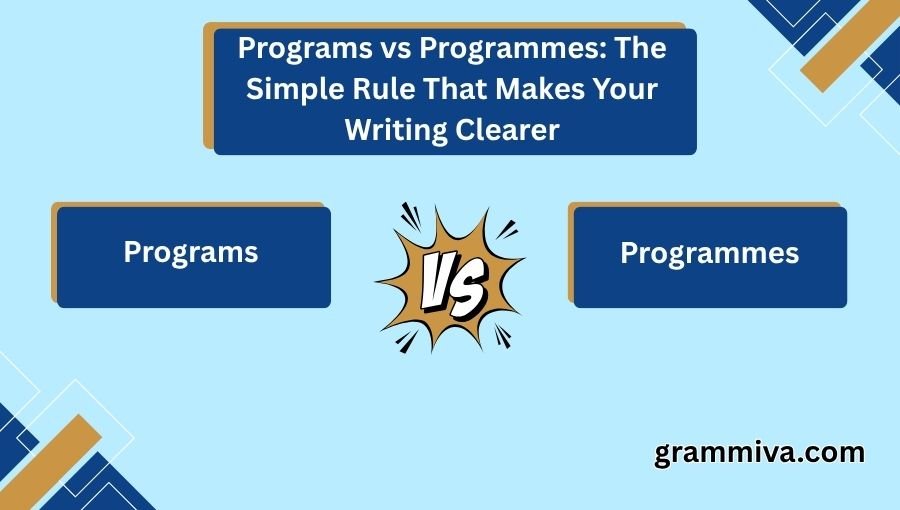
For US English, use programs. For British English, programmes is commonly used for many general meanings, while program remains standard in computing and some related technical uses.
So, if you are writing a resume, website, school paper, business email, or article for readers in the United States, programs is normally the best choice.
| Spelling | Main English variety | Example |
|---|---|---|
| programs | US English | The school offers several programs. |
| programmes | British English | The school offers several programmes. |
| program | US English singular | The program begins Monday. |
| programme | British English singular | The programme begins Monday. |
The key rule is simple: match your spelling to your target audience and keep that choice consistent.
What Are the Related Forms of Program and Programme?
The words have several useful forms. The biggest difference is between the US spelling program and the British spelling programme.
| Form | Type | Example |
|---|---|---|
| program | US singular noun | This program helps new teachers. |
| programs | US plural noun | These programs help new teachers. |
| program’s | Possessive noun | The program’s goal is clear. |
| programme | British singular noun | This programme helps new teachers. |
| programmes | British plural noun | These programmes help new teachers. |
| programme’s | British possessive noun | The programme’s goal is clear. |
| programming | Related noun/verb form | She is learning computer programming. |
| programmed | Past-tense/past-participle form | The device was programmed to stop. |
One detail matters here: programming and programmed are not simply British versions of programmes. They are related grammatical forms of the word program, and their spelling can depend on the English variety and context.
🎯 Programs vs Programmes: The Core Difference
The core difference is regional spelling. Programs is the normal plural spelling in American English, while programmes is widely used in British English for many non-computing meanings.
| Form | Type | Meaning | Example | Correct/Incorrect |
|---|---|---|---|---|
| program | US singular noun | An organized plan, service, event, or computer application | The city started a recycling program. | ✅ Correct in US English |
| programs | US plural noun | More than one program | The city started three recycling programs. | ✅ Correct in US English |
| programme | British singular noun | An organized plan, service, event, or broadcast | The city started a recycling programme. | ✅ Correct in British English |
| programmes | British plural noun | More than one programme | The city started three recycling programmes. | ✅ Correct in British English |
| programmes | US plural noun | Intended US plural spelling | The city started three recycling programmes. | ❌ Usually avoid in US English |
The important point is that programmes is not a misspelled form. It is a standard spelling in British English.
Likewise, programs is not wrong simply because a British reader may expect an extra -me.
Is Programs or Programmes Correct in American English?
Programs is the standard choice in American English. If your audience is in the United States, use program for the singular and programs for the plural.
For example:
- The university offers several programs.
- The company has training programs.
- The government created new assistance programs.
- Our computer programs need an update.
For most US readers, these spellings look natural and familiar.
| US English | British English |
|---|---|
| program | programme |
| programs | programmes |
| theater | theatre |
| center | centre |
| color | colour |
| organize | organise |
The pattern is useful because English has many spelling differences between American and British varieties.
When Should American Writers Use Programs?
Use programs when your writing follows US English conventions.
This applies to:
- School assignments
- College applications
- Resumes
- Business reports
- Marketing pages
- News content
- Blog posts
- Software documentation
- Government materials
- Emails for US readers
For example, a US university might write:
Our graduate programs prepare students for careers in science and technology.
A British institution might instead write:
Our graduate programmes prepare students for careers in science and technology.
Neither sentence has a grammar problem. The spelling reflects the intended English variety.
Does Programs Always Mean Computer Software?
No. Program has several common meanings.
It can refer to:
- An organized plan or service.
- A series of events.
- A course of study or training.
- A broadcast or media schedule.
- A computer program.
- A planned set of activities.
For example:
The community launched a youth program.
Here, program means an organized service.
In:
I installed three new programs on my laptop.
Programs means software applications.
This is why context matters. The spelling choice does not automatically tell you the meaning.
💡 How Can You Test Whether Programs Is the Right Choice?
The easiest test is to ask two questions: Who will read this? and Which English style am I following?
If the answer is “US readers” and “American English,” choose programs.
Test Tip: Replace the plural word with its singular form. If your US sentence needs program, the plural is normally programs.
| Sentence | Test | Result |
|---|---|---|
| The school offers several programs. | Singular: one program | ✅ Correct |
| The school offers several programmes. | British spelling in US text | ❌ Usually avoid |
| We created two training programs. | Singular: one program | ✅ Correct |
| We created two training programme. | Number does not match noun | ❌ Incorrect |
A second useful test is consistency. If your document uses color, center, and favorite, then programs fits that US style naturally.
📝 Case Study: A Workplace Email
Imagine that I am editing an American company’s internal newsletter. The writer sends me this sentence:
“Our new employee programmes will begin next month.”
The sentence is understandable. The grammar is fine. But the company uses American English everywhere else. Its website says employee programs, training programs, and career programs.
I would change the sentence to:
“Our new employee programs will begin next month.”
That small edit makes the document more consistent.
Now imagine a UK company using the same sentence. I would not change programmes merely because an American style guide would use programs. The company’s audience and house style matter.
This is one reason I tell writers not to label every spelling difference as a grammar error. Sometimes it is a variety-of-English issue instead.
| Situation | Better US Choice | Better British Choice |
|---|---|---|
| Employee training | training programs | training programmes |
| School courses | school programs | school programmes |
| Community services | community programs | community programmes |
| Computer software | computer programs | computer programs |
| Television content | TV programs | TV programmes |
⚙️ Grammar Rules Explanation
The difference between programs and programmes is primarily a spelling difference tied to regional English conventions. Both forms can function as plural nouns, but they belong to different spelling systems.
In standard US English, the noun is spelled program. Its plural is programs.
In British English, programme is commonly used for many general meanings, and its plural is programmes. However, British English commonly retains program for computing.
The grammatical role stays the same. The noun can still act as a subject or object.
For example:
The programs are popular.
Here, programs is the plural subject.
Or:
Students joined the programs.
Here, programs is the plural object.
The regional spelling does not change the basic grammar of the sentence.
Most major English dictionaries and style references recognize the regional distinction. The safest approach is to follow the style used by your publication, school, employer, or target audience.
Correct vs Incorrect at a Glance
| Sentence | Correct/Incorrect | Why |
|---|---|---|
| The university offers several programs. | ✅ Correct | Standard US spelling |
| The university offers several programmes. | ❌ Usually incorrect for US style | British spelling is being used in US text |
| I downloaded two computer programs. | ✅ Correct | Program is standard for software |
| The British school offers several programmes. | ✅ Correct | Fits British English |
| The program’s main goal is student success. | ✅ Correct | Correct US singular possessive |
The word incorrect in this table needs a little care. Programmes is not grammatically wrong. It is simply not the normal spelling choice for general US English.
Is Programs vs Programmes a Grammar Difference?
No. Programs vs programmes is mainly a spelling and regional-style difference, not a basic grammar difference.
Both can be plural nouns.
Compare:
The programs are popular.
and:
The programmes are popular.
The sentence structure is the same. The only major visible difference is the spelling of the noun.
This distinction matters because writers often say, “Which one is grammatically correct?” A better question is:
“Which spelling matches the English variety I am using?”
That question leads you to the right answer faster.
Why Do People Confuse Programs and Programmes?
People confuse the two forms because American and British English share most of their vocabulary but differ in many spellings.
I once edited a college application from a student who had switched between programs and programmes four times on one page. The student had copied phrases from different university websites. Each phrase looked correct on its own, but the page had no consistent style.
That is a common source of confusion. Writers see both forms online and assume one must be a mistake.
Other causes include:
- Reading websites from different countries
- Working with international teams
- Switching between US and UK style guides
- Autocorrect settings
- Copying text from older documents
- Learning English from mixed sources
- Fast typing
The solution is not to memorize every regional spelling difference. It is to know your audience and choose one style.
⚠️ Common Mistakes With Programs and Programmes
Most mistakes happen because writers type quickly or do not know which English variety they are using.
Autocorrect can also make the problem worse. A browser or word processor may be set to British English even when you are writing for an American audience.
| Common Confusion | Example | Main Problem |
|---|---|---|
| it’s / its | It’s raining / The dog wagged its tail. | Apostrophe changes the meaning |
| your / you’re | Your book / You’re ready. | Possessive vs contraction |
| there / their / they’re | They are over there. | Different words and roles |
| affect / effect | The change affected sales. | Verb vs noun in common uses |
| then / than | Better than before. | Comparison vs sequence |
| programs / programmes | US programs / UK programmes | Regional spelling |
Why These Errors Happen
Fast typing: Your brain may know the correct form, but your fingers move before you think.
Autocorrect: Your software may be configured for another country.
Lack of knowledge: You may have learned English without being taught regional spelling differences.
Mixed sources: A US writer may read British newspapers, academic papers, or websites every day.
None of these causes means you are a poor writer. They simply show why a final style check helps.
Specific Wrong Forms to Watch For
| Wrong Form | What’s Wrong | Correct Form |
|---|---|---|
| programms | Extra m | programs |
| programm | Extra m | program |
| programme’s | Not wrong in British English, but may conflict with US style | program’s in US English |
| programmes | British plural spelling | programs in US English |
| program’s | Incorrect when a plural is intended | programs |
| programs’ | Correct only for plural possession | programs’ |
The last two deserve special attention.
Programs means more than one program.
Program’s means something belongs to one program.
Programs’ means something belongs to more than one program.
For example:
The programs’ schedules were updated.
Here, several programs have schedules.
How Does Programs vs Programmes Work in Different Contexts?
The choice depends mostly on the English variety used by the audience or organization.
| Context | Which Term to Use | Example |
|---|---|---|
| Everyday US conversation | programs | The gym has great fitness programs. |
| Professional US writing | programs | Our training programs begin in June. |
| Creative writing for US readers | programs | The character joined several programs. |
| Social media for US audiences | programs | Check out our summer programs! |
| British professional writing | programmes | Our training programmes begin in June. |
| British computing | programs | The computer programs need updating. |
Everyday Conversation
In American speech, people normally say program and programs.
You might hear:
What programs does the community center offer?
or:
I signed up for two summer programs.
The British equivalent may use programme for many non-computing meanings.
Professional Writing
Professional writing benefits from consistency.
If your company’s style is American English, write:
Our leadership programs support new managers.
Do not switch to programmes in another section unless there is a specific reason.
Creative Writing
Creative writers have more freedom, but audience still matters.
An American novel can naturally use programs.
If a story is set in Britain and the narrator uses British English, programmes may be more natural for general meanings.
Social Media and Texting
Social media is informal, but spelling still communicates identity and audience.
A US nonprofit might post:
Applications for our youth programs are open!
A British organization might post:
Applications for our youth programmes are open!
Neither version needs to be changed simply because the other spelling exists.
🧭 Programs vs Programmes in International Writing
International writing can create a special challenge. A website may have readers from the United States, Canada, Britain, Australia, India, and many other places.
In that situation, consistency becomes especially valuable.
If your publication follows US English, use:
- program
- programs
- organization
- color
- center
- favorite
If it follows British English, its style may use:
- programme
- programmes
- organisation
- colour
- centre
- favourite
The exact house style can vary by organization and country, so do not assume that every English-speaking country follows one identical spelling system.
| Audience | Preferred General Spelling |
|---|---|
| United States | program / programs |
| United Kingdom | programme / programmes |
| American-focused global brand | program / programs |
| British-focused publication | programme / programmes |
| Technical software documentation | program / programs is widely used |
For international brands, a style guide can prevent accidental switching.
Are Programs and Programmes Pronounced Differently?
Usually, the spelling difference does not create a major pronunciation difference in ordinary speech.
When you hear someone say the word, you usually cannot tell whether they would spell it program or programme.
That is why this issue appears mainly in writing.
| Question | Answer |
|---|---|
| Are they different words? | They are regional spelling forms of the same basic noun. |
| Do they usually sound different? | Not in a way that reliably tells you the spelling. |
| Is one always wrong? | No. The appropriate form depends on English variety and context. |
| Which should US writers choose? | Programs. |
| Which should British writers commonly choose for general meanings? | Programmes. |
What About Computer Programs and Computer Programmes?
For software, program and programs are especially common in American English and are also widely used in British technical contexts.
A US writer should write:
I installed three computer programs.
British technical writing can also use:
I installed three computer programs.
This is an important exception to the simple “British equals programme” rule.
Do not change every instance of program into programme simply because the document is British.
The context matters.
| Meaning | US English | Common British Usage |
|---|---|---|
| Software | program | program |
| School course | program | programme |
| Government service | program | programme |
| TV schedule/show | program | programme |
| Organized public service | program | programme |
This is one of the most useful rules to remember.
Common Phrases With Programs
There are many ordinary phrases containing programs. They are not fixed idioms, but they are common combinations in US English.
| Phrase | Meaning |
|---|---|
| training programs | Organized learning for employees or students |
| education programs | Organized educational activities or courses |
| computer programs | Software applications or coded instructions |
| government programs | Public services or organized government efforts |
| health programs | Organized services or activities related to health |
| summer programs | Activities or courses offered during summer |
These phrases are useful because they show how naturally programs fits US professional and everyday writing.
For example:
The college offers summer programs for high school students.
Or:
The company has training programs for new employees.
Can You Replace Programs With Another Word?
Sometimes you can. The best alternative depends on what program means in the sentence.
| Alternative | Works When | Does Not Work When |
|---|---|---|
| plan | You mean an organized course of action | You mean computer software |
| course | You mean structured education | You mean a public service |
| initiative | You mean a new organized effort | You mean ordinary software |
| service | You mean help offered to users | You mean a school curriculum |
| application | You mean computer software | You mean a community activity |
For example:
The company launched a new training program.
could become:
The company launched a new training initiative.
But:
I installed three computer programs.
cannot always become:
I installed three computer initiatives.
The meaning changes too much.
🎯 How Can You Remember the Difference?
Use a simple country test.
US → program → programs
British English → programme → programmes for many general meanings
I use this shortcut with students because it removes unnecessary stress. You do not need a complicated grammar rule.
Think about the reader first.
If the reader expects American English, choose programs.
If the reader expects British English, check the organization’s style. For many general meanings, programmes will be the natural choice.
A Simple Memory Trick
Think:
America drops the extra letters.
This is not a complete rule for every spelling difference in English, but it is a helpful memory aid here.
| If Your Audience Is… | Think… | Use |
|---|---|---|
| US | American spelling | programs |
| British | British spelling | programmes for many general meanings |
| Technical/software | Computing term | programs is common |
| Mixed | House style first | Follow the publication’s guide |
Why Does Getting Programs vs Programmes Right Matter?
The difference may look tiny, but consistent spelling helps readers understand what kind of English they are reading.
| Situation | Why Getting It Right Matters |
|---|---|
| Resume | Shows attention to detail and fits the employer’s style |
| Client email | Creates a polished, professional impression |
| Published content | Keeps the publication’s spelling consistent |
| Social post | Makes the message fit its intended audience |
I once caught myself typing programmes in a US client report after spending the morning reading British news. I noticed it during the final proofread and changed it. The mistake was small, but it reminded me how easily our reading habits can influence spelling.
A useful writing principle is:
Clear writing gives readers fewer things to stop and question.
That is the real value of choosing the right regional form.
🏢 Programs vs Programmes in Resumes and Applications
US job seekers should generally use programs when describing software, training, education, or company initiatives.
For example:
Developed employee training programs for new hires.
Or:
Managed software programs used by the sales team.
If you are applying to a British organization, follow its spelling style when appropriate.
Consistency across the entire resume matters more than obsessing over one word.
| Resume Example | US Style |
|---|---|
| Training programs | ✅ Natural |
| Educational programs | ✅ Natural |
| Software programs | ✅ Natural |
| Training programmes | ⚠️ British style |
| Educational programmes | ⚠️ British style |
Is Programs vs Programmes Different From Other US and UK Spellings?
Yes and no. The basic issue is similar to other regional spelling differences, but the word has an extra detail because program remains common in British computing.
Consider:
- US: color
- UK: colour
- US: center
- UK: centre
- US: program
- UK: programme for many general meanings
But software often remains program in British English.
That means you should not build a rule that says:
“Every British use of program must become programme.”
That rule is too broad.
❓ Why Do British Writers Use Programmes?
British English commonly uses programmes for many general meanings where American English uses programs.
For example:
The charity runs several youth programmes.
The US version would normally be:
The charity runs several youth programs.
The meaning is essentially the same.
The difference comes from the spelling conventions used by the two varieties of English.
❓ Should an American Writer Ever Use Programmes?
Usually, an American writer should use programs when writing in standard US English.
There can be exceptions. For example, you might quote a British source, reproduce an organization’s official name, or intentionally write dialogue in a British voice.
In those cases, retaining programmes may be appropriate.
❓ Is Programme Wrong in American English?
It is not an impossible or meaningless word in American English, but it is not the normal US spelling for general uses.
If you are writing ordinary American prose, programs is the safer choice.
Use programme only when a specific name, quotation, source, or stylistic reason requires it.
❓ Is Programs Wrong in British English?
No. Program is widely used in British English for computing and related technical meanings.
For general meanings, British English often uses programme.
So the answer depends on what program means and what style your document follows.
❓ Which Is Correct: Training Programs or Training Programmes?
For US English, training programs is correct.
For British English, training programmes is commonly preferred.
Examples:
The company offers employee training programs. — US English
The company offers employee training programmes. — British English
The meaning does not change.
❓ Which Is Correct: Education Programs or Education Programmes?
In American English, use education programs.
In British English, education programmes is common for general educational offerings.
If you are writing for a US school, university, nonprofit, or government agency, programs is usually the appropriate choice.
❓ Should I Use Programs or Programmes on a US Website?
Use programs if the website follows US English.
That includes pages about:
- Academic programs
- Training programs
- Community programs
- Government programs
- Health programs
- Software programs
A consistent US spelling style makes the site feel more polished and intentional.
❓ Do Programs and Programmes Mean the Same Thing?
For many general uses, yes. They are regional spelling forms referring to the same basic idea.
The main difference is not meaning. It is spelling convention.
However, British English has a special computing use of program, so the two forms are not interchangeable in every British context.
❓ How Do I Choose Between Programs and Programmes?
Ask these three questions:
- Who is my audience?
- Which English variety does my organization use?
- Am I talking about software?
If your audience is American, choose programs.
If your audience is British, use the organization’s preferred style and remember that program remains common for computing.
❓ Is Programme Pluralized as Programmes?
Yes. Programme is singular, and programmes is its plural form in British English for meanings where programme is used.
For example:
One programme
Several programmes
In US English, the equivalent is:
One program
Several programs
The possessive forms are different again:
the program’s goal
the programmes’ goals
❓ How Can I Stop Mixing American and British Spelling?
Choose your English variety before you begin writing.
Then check your document for common differences such as:
- program/programme
- color/colour
- center/centre
- organization/organisation
- favorite/favourite
You can also set your word processor’s language to US English. That can reduce accidental spelling changes.
❓ What Is the Easiest Rule for Programs vs Programmes?
For general writing, remember:
US English: programs. British English: programmes.
Then remember the software exception:
Computer programs is common in both US and British English.
That two-part rule covers most everyday cases.
📋 Quick Recap Checklist
Use this checklist whenever you are unsure.
| Question | If Yes → Use |
|---|---|
| Am I writing for a US audience? | programs |
| Am I writing general British English? | programmes |
| Am I talking about software? | programs |
| Am I quoting a British source? | Keep the source’s spelling |
| Am I using an organization’s official wording? | Follow its official style |
| Am I writing a US resume? | programs |
| Am I writing a US business email? | programs |
Practice Examples
- The university offers several graduate programs.
- The British charity runs several community programmes.
- I installed three computer programs on my laptop.
The first and third examples fit US English. The second uses a British spelling for a general meaning.
🔎 Programs vs Programmes at a Glance
Here is the entire rule in one table.
| Feature | Programs | Programmes |
|---|---|---|
| Main variety | American English | British English |
| Singular | program | programme |
| Plural | programs | programmes |
| General US writing | ✅ Preferred | ❌ Usually avoid |
| General British writing | ⚠️ Usually not preferred | ✅ Preferred |
| Computer software | ✅ Standard | ⚠️ Usually use program |
| Resume for US employer | ✅ Preferred | ❌ Usually avoid |
| British organization | ⚠️ Check house style | ✅ Common |
The table shows why context matters more than simply memorizing one spelling.
🧠 Final Rule for Writers
If you are writing in US English, choose programs.
If you are writing in British English, use programmes for many general meanings, while keeping programs for computer software and following the style of the organization you are writing for.
The biggest mistake is not choosing the “wrong” regional form. The bigger problem is mixing styles without a reason.
A document that begins with programs, switches to programmes, then returns to programs can look careless even when every individual word is understandable.
Before publishing, take ten seconds to check your spelling style. That small habit can make your writing look much more polished.
Conclusion
Programs vs programmes is mainly a question of regional English style, not a simple right-versus-wrong grammar rule. 🇺🇸
For American readers, writers should normally choose programs. British English commonly uses programmes for many general meanings, while program remains common when referring to computer software.
The best approach is simple: identify your audience, choose a consistent English variety, and stick with it. If you are writing a US resume, business report, school paper, website, or email, programs will usually be the natural choice.
Do not let the extra two letters in programme make the issue seem harder than it is. The spelling tells readers which English style you are following. Once you know that, the choice becomes easy. ✨
When in doubt, know your audience, follow its English style, and write with consistency.

I am Ethan Brooks, an English grammar and vocabulary writer. I work at Grammiva, where I create simple and helpful content to make English learning easier for students and everyday learners.