If you have ever wondered about onto vs on to, you are not alone. These two forms look almost identical, but they can do different jobs in a sentence. ✍️ I have seen this tiny space cause surprisingly big confusion, especially when writers are working quickly.
The good news is that the rule is easier than it first seems. In this guide, I will explain when to use onto and when to use on to, with simple rules, clear examples, practical tests, and real-life situations. You will learn when the words should stay together, when they should stay apart, and how to spot the difference quickly. 😊
By the end, you should be able to make the right choice without stopping to second-guess every sentence. The key is to look at the meaning and the grammatical role of the words, not just their spelling. dreamed vs dreamt | Anyway vs Anyways | Drier vs Dryer
Quick Answer: onto vs on to🎯
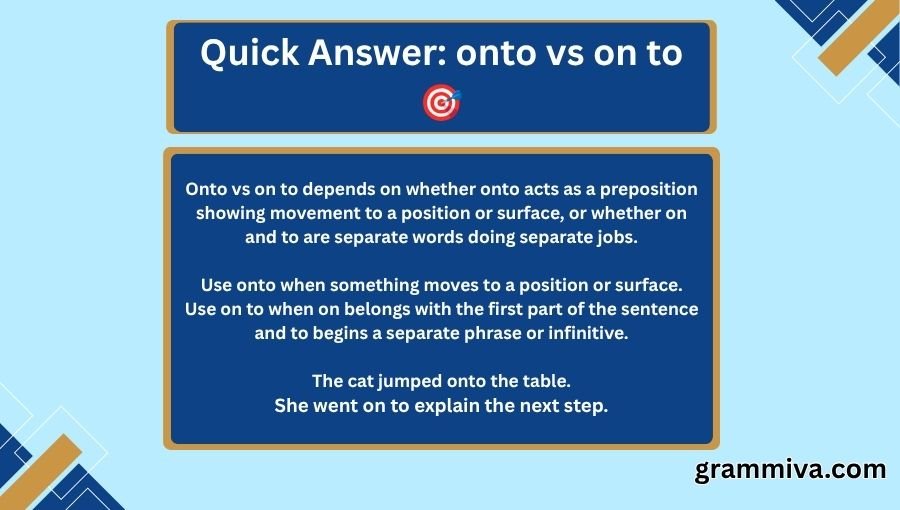
Onto vs on to depends on whether onto acts as a preposition showing movement to a position or surface, or whether on and to are separate words doing separate jobs.
Use onto when something moves to a position or surface. Use on to when on belongs with the first part of the sentence and to begins a separate phrase or infinitive.
The cat jumped onto the table.
She went on to explain the next step.
Is onto the same as on to?
No. Onto and on to can look alike, but they do not always have the same grammatical role.
Onto is normally one preposition. It often shows movement toward and then onto a place, surface, or position. On to contains two separate words. In this form, on may describe continuing an action, while to introduces another destination, verb, or phrase.
A simple comparison helps:
| Form | Type | Meaning | Example | Correct/Incorrect |
|---|---|---|---|---|
| onto | Preposition | Movement to a surface or position | The child climbed onto the bed. | ✅ Correct |
| on to | Two separate words | Continuing or moving forward to something else | We moved on to the next topic. | ✅ Correct |
| onto | Preposition | Used where separate words are required | She went onto discuss the plan. | ❌ Incorrect |
| on to | Two separate words | Used where one preposition is needed | He jumped on to the roof. | ❌ Usually incorrect |
| onto | Preposition | Movement toward a position | The bird flew onto the branch. | ✅ Correct |
The word usually matters in the last row. English has some cases where either form can appear depending on meaning and style. Context is the final judge.
What does onto mean? 📘
Onto is a preposition that commonly shows movement to a surface, position, or place. It tells us where someone or something ends up after moving.
For example:
The dog jumped onto the sofa.
The player stepped onto the field.
She placed the book onto the desk.
In each sentence, something moves to a new position.
Here is the basic pattern:
movement + onto + destination
Consider:
The child climbed onto the chair.
- The child = the person moving.
- climbed = the action.
- onto = shows the direction of movement.
- the chair = the destination.
The same idea works with many surfaces and positions.
| Meaning | Word Type | Example Sentence |
|---|---|---|
| Movement to a surface | Preposition | The cup fell onto the floor. |
| Movement to a position | Preposition | She stepped onto the platform. |
| Movement to an object | Preposition | The bird landed onto the branch. |
| Transfer to a place or position | Preposition | The files were moved onto the new system. |
The last example shows that onto does not always involve physical movement. English speakers also use it for movement between positions, systems, or stages.
When should you use on to?
Use on to when on and to have separate jobs.
A common pattern is:
move on + to + something
For example:
We finished the first lesson and moved on to the second.
Here, on belongs to the expression move on. The word to then introduces the next thing.
Another common pattern appears when to introduces a verb:
She went on to describe the problem.
Here, on means that she continued. To describe is an infinitive phrase.
| Sentence | Role of on | Role of to |
|---|---|---|
| We moved on to lunch. | Part of “move on” | Introduces the next destination |
| He went on to explain the rule. | Shows continuation | Begins the infinitive “to explain” |
| She carried on to the next room. | Shows continuation | Introduces destination |
| They went on to win the game. | Shows continuation | Begins the infinitive “to win” |
The easiest mistake to make is seeing the phrase went on to and assuming it should be written went onto. It should normally be went on to when the meaning is “continued and then did something.”
How can you tell onto and on to apart? 💡
The fastest way is to ask what the sentence means.
If something moves to a surface or position, onto is often the right choice.
If someone continues an action and then moves to another thing, use on to.
Try this quick test:
Can you replace the phrase with “to a position on”?
If yes, onto may work.
The cat jumped onto the table.
The cat moved to a position on the table.
Now try:
She went on to explain the answer.
You cannot replace on to with “to a position on.” The meaning is “she continued and then explained.”
| Sentence | Meaning | Best Form |
|---|---|---|
| The boy climbed ___ the roof. | Movement to a surface | onto |
| She went ___ discuss the results. | Continued to discuss | on to |
| The ball rolled ___ the field. | Movement to a surface/place | onto |
| We moved ___ the next chapter. | Continued to the next item | on to |
| The cat jumped ___ the chair. | Movement to a surface | onto |
💡 Test Tip
When you are unsure, temporarily insert the words “to a position on.”
If the meaning still makes sense, onto is a strong choice.
If the sentence means “continued and then…”, choose on to.
Why do people confuse onto and on to?
People confuse them because the two forms sound nearly the same in normal speech. The meaning can also be similar in sentences involving movement.
I once reviewed a short workplace guide where a writer had changed every on to into onto because they believed the single-word version was more modern. The result was several sentences that changed meaning. The writer was surprised because the difference was only one space.
That is the real problem: the space can represent a difference in grammar.
Other reasons include:
- Fast typing can make people ignore the space.
- Autocorrect may suggest one form automatically.
- Spell-checkers do not always understand the intended meaning.
- Writers may know one form but not the other.
- Spoken English does not clearly show the difference.
- Some sentences allow more than one interpretation.
Here are several common pairs:
| Correct Example | Incorrect Example | Why |
|---|---|---|
| The dog jumped onto the bed. | The dog jumped on to the bed. | The single preposition is the natural choice for movement to the surface. |
| We moved on to the next task. | We moved onto the next task. | “Moved on” means continued, while “to” introduces the next task. |
| She went on to become a teacher. | She went onto become a teacher. | “To become” is an infinitive. |
| The child climbed onto the table. | The child climbed on to the table. | The meaning is movement to the surface. |
| He went on to discuss the issue. | He went onto discuss the issue. | “To discuss” is an infinitive phrase. |
onto vs on to at a Glance 🔎
The central difference is simple: onto is normally a single preposition, while on to contains two separate words.
| Feature | Onto | On to |
|---|---|---|
| Number of words | One | Two |
| Main use | Movement to a surface or position | Continuation plus a following phrase |
| Example | She stepped onto the bus. | She went on to explain. |
| Common question answered | Where did it move? | What happened next? |
| Can “to” introduce a verb? | No | Yes |
| Can it describe movement to a surface? | Yes | Sometimes, but usually not the preferred form |
A useful way to remember this is:
Onto = movement to a position.
On to = continue + next thing.
Can onto show movement without a physical surface?
Yes. Onto can describe movement to a position that is not a literal flat surface.
For example:
The company moved onto a new platform.
The platform is digital rather than physical, but the sentence describes movement from one system or position to another.
You may also see:
The discussion moved onto a new subject.
This means the discussion shifted to a different subject.
However, the more abstract the sentence becomes, the more important context is. If on and to have clearly separate meanings, keeping them apart can make the sentence easier to understand.
| Example | Type of Movement | Preferred Form |
|---|---|---|
| The child climbed onto the roof. | Physical | onto |
| The company moved onto a new platform. | Digital/system | onto |
| The discussion moved onto another subject. | Abstract | onto |
| We moved on to another subject. | Continuation | on to |
When can on and to remain separate?
On and to should remain separate when they perform different jobs in the sentence.
One very common pattern is go on to + verb.
He went on to write three books.
The meaning is not that he moved physically onto “write three books.” Instead, he continued and later wrote three books.
Other examples include:
She went on to win the award.
They went on to build a larger company.
I went on to study history.
The speaker went on to answer questions.
In all these sentences, to introduces an action.
| Pattern | Example | Meaning |
|---|---|---|
| go on to + verb | She went on to teach. | She later taught. |
| move on to + noun | We moved on to the next lesson. | We continued with the next lesson. |
| move onto + surface | He moved onto the stage. | He physically moved to the stage. |
| step onto + noun | She stepped onto the bus. | She moved onto the bus. |
What are the most common uses of onto?
The most common uses of onto involve movement to a surface, location, position, or new system.
Movement to a physical surface
The child jumped onto the bed.
Movement to a raised place
The hikers climbed onto the rocks.
Movement to a platform or vehicle
She stepped onto the train.
Movement to a new system or platform
The team moved onto the new software system.
The word does not simply mean “to.” It normally adds the idea of reaching a position or surface.
What are the most common uses of on to?
The most common uses of on to involve continuation.
Continuing to another subject
Let’s move on to the next question.
Continuing to another task
After lunch, we moved on to the final task.
Continuing and later doing something
She went on to become a successful writer.
Continuing with an action
He went on to explain the details.
These uses are especially common in teaching, news writing, biographies, speeches, and professional communication.
Case Study: A Workplace Email 📝
This workplace example shows why onto vs on to is more than a spelling choice. Imagine that a project manager sends this message:
“We have finished the budget review. Now let’s move on to the hiring plan.”
That is correct because move on means “continue.” The word to then introduces the next topic.
Now imagine this message:
“The speaker walked onto the stage.”
That is also correct. The speaker physically moved to the stage.
Here is the difference:
| Workplace Sentence | Correct Form | Reason |
|---|---|---|
| Let’s move on to the next item. | on to | Continue to another item |
| The manager stepped onto the stage. | onto | Physical movement |
| The team went on to discuss costs. | on to | Continued and then discussed |
| The worker climbed onto the platform. | onto | Movement to a surface |
| We moved on to the final section. | on to | Continued to the next section |
The trick is to focus on the action rather than the spelling.
Grammar Rules Explanation
Onto functions as a preposition when it connects an action of movement with a destination, surface, or position. In a sentence such as “The cat jumped onto the table,” the preposition connects jumped with the table. The grammar behind onto vs on to becomes clearer…
On to consists of two separate words. The word on may belong to a verb phrase such as go on, move on, or carry on. The word to then begins another phrase.
Consider:
She went on to explain the problem.
The verb phrase is went on. The word to introduces explain, which is a verb in the infinitive form.
Now compare:
She stepped onto the platform.
Here, onto connects stepped with the platform. It expresses movement to a position on the platform.
Most standard English references treat these as distinct uses, while also recognizing that real sentences can sometimes be flexible. The safest approach is to check the meaning and the grammatical job of each word.
Correct vs Incorrect at a Glance
| Sentence | Correct/Incorrect | Why |
|---|---|---|
| The cat jumped onto the table. | ✅ Correct | Movement to a surface |
| She went onto explain the plan. | ❌ Incorrect | “To explain” needs separate words |
| We moved on to the next lesson. | ✅ Correct | “Move on” means continue |
| He climbed on to the roof. | ❌ Usually incorrect | The intended meaning is movement onto the roof |
| They went on to win the match. | ✅ Correct | “To win” is an infinitive |
Why does one small space matter?
A space can change the grammatical structure of a sentence. That does not mean every missing or added space changes the meaning, but with onto and on to, it often can.
Compare:
The dog jumped onto the couch.
This describes physical movement.
Now:
The dog went on to chase the ball.
This describes one action followed by another.
The difference is not just spelling. It is meaning.
| Form | Basic Idea | Example |
|---|---|---|
| onto | Move to a position | The bird flew onto the roof. |
| on to | Continue to another thing | The speaker went on to answer questions. |
| onto | Arrive on a surface | The child climbed onto the chair. |
| on to | Move forward in a sequence | We moved on to chapter five. |
Common Mistakes ⚠️
Most errors with this pair come from three sources: fast typing, autocorrect, and lack of knowledge. Many mistakes with onto vs on to happen because…
Fast typing encourages writers to use whichever form comes to mind first. Autocorrect may not know what the sentence means. And if someone has never learned the difference, the two forms can seem interchangeable.
I once caught myself typing onto in the sentence “I went on to explain the change.” I had written the sentence quickly and noticed the problem only when I reread it. That quick reread saved me from sending the wrong form in a work message.
Other grammar pairs cause similar problems.
| Confusion | Correct Choice | Basic Difference |
|---|---|---|
| it’s / its | Depends on meaning | “It’s” = it is; “its” = possession |
| your / you’re | Depends on meaning | “Your” = possession; “you’re” = you are |
| they’re / their / there | Depends on meaning | Different grammar and meaning |
| then / than | Depends on meaning | Time/order vs comparison |
| onto / on to | Depends on meaning | One preposition vs two separate words |
Specific Wrong Forms
| Wrong Form | What’s Wrong | Correct Form |
|---|---|---|
| went onto explain | “To explain” is an infinitive | went on to explain |
| moved onto the next topic | Often confuses continuation with physical movement | moved on to the next topic |
| climbed on to the roof | Usually unnecessarily separates a single preposition | climbed onto the roof |
| went onto win | “To win” is an infinitive | went on to win |
| jumped on to the bed | Usually treats one preposition as two words | jumped onto the bed |
| moved on the next topic | Missing the needed preposition | moved on to the next topic |
The word usually is useful because context can affect whether a writer chooses one form or another.
How should you use onto and on to in everyday conversation?
In everyday speech, the distinction is often clear from context even when listeners cannot see the spelling.
For example:
“The cat jumped onto the counter.”
Everyone understands the physical movement.
But:
“Let’s move on to the next question.”
Everyone understands that the speaker wants to continue.
| Context | Which Term to Use | Example |
|---|---|---|
| Everyday conversation | onto | Get onto the bus. |
| Everyday conversation | on to | Let’s move on to dinner. |
| Professional writing | onto | The data was transferred onto the new platform. |
| Professional writing | on to | We will move on to the next stage. |
| Creative writing | onto | She ran onto the beach. |
| Creative writing | on to | He went on to discover the truth. |
| Social media/texting | Either, based on meaning | Jumped onto the trend / Moved on to something new |
Are there common phrases with onto?
Yes. Onto appears in many ordinary phrases that describe movement or transfer to a place or position.
| Phrase | Meaning |
|---|---|
| jump onto | Move quickly to a surface |
| climb onto | Move upward to a surface or position |
| step onto | Move by stepping to a surface |
| get onto | Move onto something or begin using/entering it |
| move onto | Move to another surface, position, or system |
| land onto | Reach a surface by landing |
Notice that move onto and move on to can have different meanings.
The child moved onto the stage.
The child physically entered the stage area.
The teacher moved on to the next lesson.
The teacher continued with another lesson.
That distinction is worth remembering because move onto and move on to look almost identical.
How can synonyms help you choose the right form?
Sometimes replacing the phrase with another expression makes the meaning clearer.
For onto, try “to a position on” when the context allows it.
The cat jumped onto the sofa.
The cat jumped to a position on the sofa.
For on to, try “continued to” or “then”, depending on the sentence.
She went on to explain the rule.
She continued to explain the rule.
These substitutions are not perfect replacements in every sentence. They are tests that can reveal the intended meaning.
| Alternative | Works When | Does Not Work When |
|---|---|---|
| to a position on | Physical or positional movement | The sentence means “continued” |
| continued to | A person or thing carries on with an action | Simple movement onto a surface |
| next | Moving through a sequence | Physical movement |
| toward | General direction | You specifically mean reaching a position on a surface |
| then | Showing what happened afterward | Describing where something moved |
Why does getting this difference right matter? ✅
Correct word choice improves clarity. It also makes your writing look careful and professional.
A reader may understand a sentence with the wrong form, but a pattern of small grammar errors can make a document feel less polished.
This matters especially in:
| Situation | Why Getting It Right Matters |
|---|---|
| Resume | Shows attention to writing details |
| Client email | Supports a professional tone |
| Published content | Makes the copy easier to trust and read |
| Social post | Prevents avoidable grammar mistakes |
A simple rule I often give writers is:
“Good grammar should make your meaning easier to see.”
That is exactly what happens with this pair. The right form removes a small point of friction for the reader.
How can you remember the difference? 🧠
Use the surface test and the continue test. The easiest memory trick for onto vs on to is…
Surface test
If something moves to a surface or position, think onto.
The rabbit hopped onto the box.
Continue test
If someone continues and then does something else, think on to.
The speaker went on to answer questions.
Verb test
If to is followed by a verb, on to is usually the correct form.
went on to explain
went on to become
went on to win
went on to describe
This is not a rule that covers every possible sentence, but it is a powerful quick check.
| Question to Ask | If Yes | Use |
|---|---|---|
| Does something move to a surface? | Yes | onto |
| Does something move to a position? | Yes | onto |
| Does “on” belong to a phrase like “move on”? | Yes | on to |
| Does “to” introduce a verb? | Yes | on to |
| Does the sentence mean “continue”? | Yes | on to |
Can both forms appear in similar sentences?
Yes. This is one reason the pair can be tricky.
Compare:
The player moved onto the field.
This means the player physically entered the field.
Now:
The player moved on to the next game.
This means the player continued to another game.
The words around the pair determine the meaning.
| Sentence | Meaning |
|---|---|
| The actor walked onto the stage. | The actor physically entered the stage. |
| The actor went on to perform another role. | The actor later performed another role. |
| The student stepped onto the platform. | The student physically moved onto it. |
| The student moved on to the next exercise. | The student continued with another exercise. |
This is why memorizing a single spelling rule is not enough. You need to read the entire sentence.
What is the easiest rule for students?
I recommend this three-step method:
- Find the action.
- Ask whether the action ends with movement to a surface or position.
- If not, check whether “on” means continue and “to” introduces the next thing.
For example:
The dog jumped ___ the couch.
The dog physically moved to the couch. Choose onto.
The teacher went ___ explain the answer.
The teacher continued and then explained. Choose on to.
Practice Examples
Fill in each blank with onto or on to.
- The kitten climbed ___ the chair.
- We moved ___ the next chapter.
- She went ___ describe the results.
- The boy jumped ___ the mattress.
- The team went ___ win the final game.
Answers:
- onto
- on to
- on to
- onto
- on to
Quick Recap Checklist ✅
The quickest way to choose between the two is to ask what the sentence means.
| Question | If Yes → Use |
|---|---|
| Is there movement to a surface? | onto |
| Is there movement to a position? | onto |
| Does “move on” mean continue? | on to |
| Does “go on” mean continue? | on to |
| Is “to” followed by a verb? | on to |
Try these
The bird flew onto the roof.
We moved on to the next topic.
She went on to become a doctor.
If you can identify the meaning, the spelling usually becomes easy.
FAQs About onto vs on to
Is onto one word or two words?
Onto is normally one word when it functions as a preposition showing movement to a surface, position, or destination.
Is on to always two words?
When on and to perform separate grammatical jobs, yes. For example, “She went on to explain the problem” uses two words.
Should I write “go onto explain”?
No. The standard form is go on to explain because to explain is an infinitive phrase and on belongs to go on.
Should I write “jump onto the bed”?
Yes. Jump onto the bed is the natural form when you mean that someone or something jumps to a position on the bed.
Is “move onto the next topic” wrong?
Not always, but it can change the meaning. Move onto the next topic can suggest moving directly to that topic, while move on to the next topic clearly emphasizes continuing from one topic to another.
What is the easiest way to remember onto vs on to?
Think onto = movement to a position and on to = continue to the next thing. If to introduces a verb, such as “to explain,” use the two-word form.
Is “onto” a preposition?
Yes. Onto commonly works as a preposition that connects movement with a surface, place, or position.
Why does “went on to” have a space?
Because on belongs to the phrase went on, while to introduces what happens next. For example, “She went on to win” means she continued and later won.
Can I use “on to” for physical movement?
Sometimes context can allow separate on and to, but when the intended meaning is movement onto a surface or position, onto is normally the clearer choice.
Which is correct: “onto the next step” or “on to the next step”?
When you mean continue to the next step, on to is generally the clearer choice: “Let’s move on to the next step.”
Conclusion: Master onto vs on to With One Simple Test 🌟
Onto vs on to becomes much easier when you stop looking only at the space and start looking at the meaning.
Use onto when something moves to a surface, position, place, or new system. Use on to when on belongs to a phrase such as go on or move on, and to introduces the next thing or an action.
Remember these two examples:
The cat jumped onto the table.
She went on to explain the answer.
The first sentence is about movement to a position. The second is about continuing and then doing something else.
When you are unsure, ask yourself: “Is this about moving onto something, or moving on to something?” That one question will solve most cases.
Once you learn to hear the meaning behind the words, the spelling becomes much more natural. Keep the rule simple, check the sentence, and trust the context. ✨ One small space can change the grammar, but understanding the meaning makes the choice clear.

I am Adam Wilson, an English language content writer with an interest in grammar and vocabulary. I work at Grammiva and focus on creating clear explanations and practical examples for English learners.

[…] means, when to use it, how to spell it, and which form works best in formal and casual writing. onto vs on to | dreamed vs dreamt | Anyway vs […]