Have you ever typed a sentence and stopped because you could not decide between dreamed vs dreamt? You are not alone. Both forms look right, and both are used by fluent English speakers.
The tricky part is that they are not equally common everywhere. In American English, dreamed is usually the safer and more natural choice. Dreamt is also correct, but it is more common in British English and some other varieties of English.
I teach and edit English for a living, and this is one of those grammar questions that seems harder than it really is. Once you know where each form is most common, the choice becomes much easier. 😊
This guide explains the difference, shows real sentence patterns, covers American and British usage, and gives you simple tests you can use when you are writing an email, school paper, story, or social post. Anyway vs Anyways | Drier vs Dryer | Labeler vs Labeller
🎯 Quick Answer: dreamed vs dreamt
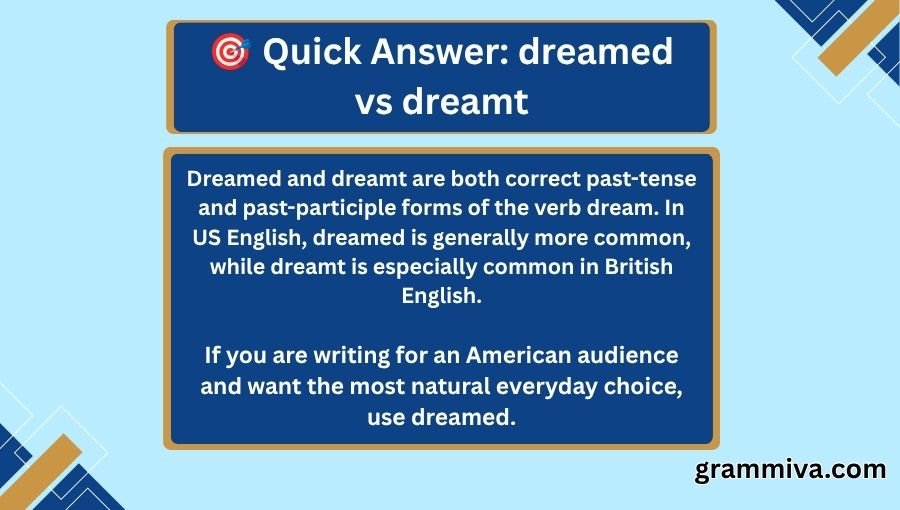
Dreamed and dreamt are both correct past-tense and past-participle forms of the verb dream. In US English, dreamed is generally more common, while dreamt is especially common in British English.
If you are writing for an American audience and want the most natural everyday choice, use dreamed.
| Form | Type | Example |
|---|---|---|
| dream | Base verb | I dream about traveling. |
| dreams | Present-tense form | She dreams of becoming a pilot. |
| dreamed | Past tense/past participle | I dreamed about the ocean. |
| dreamt | Past tense/past participle | I dreamt about the ocean. |
| dreaming | Present participle/gerund | He is dreaming about his vacation. |
Is dreamed the same as dreamt?
Yes. Dreamed and dreamt can have the same basic meaning when they are used as past forms of dream. The main difference is not meaning but regional preference and style.
For example:
- ✅ Correct: I dreamed about my old school last night.
- ✅ Correct: I dreamt about my old school last night.
Both sentences tell us that the speaker had a dream in the past.
The difference becomes clearer when we look at the kind of English being used. American writers usually favor dreamed. British writers often use dreamt, although dreamed is not wrong in British English.
A quick regional guide
| Variety or setting | More common form | Example |
|---|---|---|
| American English | dreamed | I dreamed about you. |
| British English | dreamt | I dreamt about you. |
| Formal US writing | dreamed | She dreamed of becoming a doctor. |
| Casual US speech | dreamed | I dreamed I was flying. |
| British conversation | dreamt | I dreamt I was flying. |
There is no rule saying that one form is grammatically correct and the other is grammatically wrong. The better choice often depends on the audience.
Why do people confuse dreamed and dreamt?
People confuse these forms because English has many verbs with two accepted past forms. The pattern can feel inconsistent.
Compare:
- dream → dreamed/dreamt
- learn → learned/learnt
- burn → burned/burnt
- spell → spelled/spelt
English speakers also learn different versions depending on where they live or what they read.
I once marked a student’s short story in which she used dreamed in one paragraph and dreamt in the next. Neither word was grammatically wrong. The problem was consistency. Once I explained the regional difference, she changed both to dreamed because her class was using American English.
Three things can make the confusion worse
- Regional English: American and British English often favor different forms.
- Reading habits: A person who reads British novels may see dreamt often.
- Style memory: Some writers simply prefer the form they learned first.
| Reason for confusion | What happens | Simple solution |
|---|---|---|
| Different varieties of English | Writers see both forms | Match your audience |
| Reading British books | Dreamt may look more familiar | Remember that dreamed is common in US English |
| School instruction | A teacher may prefer one style | Follow the required style |
| Fast writing | The writer chooses without thinking | Use the US default: dreamed |
| Autocorrect | Software may suggest another form | Check the sentence yourself |
dreamed vs dreamt at a Glance
The key difference between dreamed and dreamt is usage preference, not basic meaning. Both can describe a past dream or a past hope, depending on the sentence.
| Form | Grammar role | Basic meaning | Example | Correct/Incorrect |
|---|---|---|---|---|
| dreamed | Past tense | Had a dream or imagined something | I dreamed about Paris. | ✅ Correct |
| dreamt | Past tense | Had a dream or imagined something | I dreamt about Paris. | ✅ Correct |
| dreamed | Past participle | Used with helping verbs | She has dreamed of this day. | ✅ Correct |
| dreamt | Past participle | Used with helping verbs | She has dreamt of this day. | ✅ Correct |
| dreamming | Supposed past form | Incorrect spelling | I dreamming about it. | ❌ Incorrect |
The last example is different because dreamming is not an accepted spelling. The correct present participle is dreaming.
When should you use dreamed?
Use dreamed when you are writing in American English and want the most familiar form. It works for both literal dreams during sleep and hopes or goals.
1. Dreams during sleep
Use dreamed to describe something that happened while you were asleep.
For example:
- I dreamed about my childhood home.
- She dreamed that she was flying.
- We dreamed of being back at the beach.
The word does not have to be followed by about. You can use several patterns.
| Pattern | Example |
|---|---|
| dreamed about + noun | I dreamed about my old house. |
| dreamed of + noun | She dreamed of her childhood. |
| dreamed that + clause | He dreamed that he could fly. |
| dreamed + clause | I dreamed I was late for work. |
2. Hopes and goals
Dreamed can also describe a strong hope or goal.
For example:
- She dreamed of becoming a writer.
- He dreamed about opening his own restaurant.
- They dreamed of building a house near the lake.
Here, the word does not describe sleep. It describes something a person wanted deeply.
💡 Test Tip
Ask yourself: Am I writing for an American audience?
If the answer is yes, dreamed is usually the easiest choice.
You can also ask whether the sentence describes a past event. If it does, both dreamed and dreamt can work. Your audience then determines which one sounds more natural.
| Meaning | Word Type | Example Sentence |
|---|---|---|
| A dream during sleep | Verb, past tense | I dreamed about my brother. |
| A past hope | Verb, past tense | She dreamed of becoming a nurse. |
| A past imagined event | Verb, past tense | He dreamed that he won the race. |
When should you use dreamt?
Use dreamt when it fits the variety of English you are writing. It is especially common in British English.
For example:
- I dreamt about my grandmother.
- She dreamt that she was flying.
- He dreamt of owning a small farm.
These sentences are grammatically sound.
However, if you are writing a college paper, business email, website article, or other material for a US audience, dreamed will usually sound more natural.
Dreamt can also describe hopes
Just like dreamed, dreamt can describe an ambition.
- She dreamt of becoming an artist.
- He dreamt about a better life.
- They dreamt of owning a home.
The choice between the two words is therefore not mainly about meaning.
| Sentence | US preference | British preference |
|---|---|---|
| I dreamed about it. | Natural | Natural |
| I dreamt about it. | Correct, less common | Natural |
| She dreamed of success. | Very natural | Natural |
| She dreamt of success. | Correct | Very natural |
dreamed vs dreamt: American and British English
American English generally favors dreamed, while British English makes more frequent use of dreamt. Both forms can be understood across English-speaking regions.
This is a good example of a larger pattern in English. Some verbs have both a regular form ending in -ed and a shorter form ending in -t.
| Verb | Common US form | Common UK form |
|---|---|---|
| dream | dreamed | dreamt |
| learn | learned | learnt |
| burn | burned | burnt |
| spell | spelled | spelt |
| smell | smelled | smelt |
These differences do not mean that every American always uses the first form or every British speaker always uses the second. Real language is more flexible.
The best rule is simple: choose the form that fits your audience and stay consistent.
How do you use dreamed in a sentence?
Use dreamed as the past tense or past participle of dream. It can refer to sleep dreams, hopes, plans, or imagined situations.
Here are common sentence patterns:
Past tense
I dreamed about the trip last night.
Past participle with a helping verb
I have dreamed about this moment for years.
Dream as a goal
She dreamed of becoming a scientist.
Dream as an imagined event
He dreamed that he had won the lottery.
Notice that the meaning comes from the context. The same verb can describe sleep or ambition.
Sentence breakdown
Take this sentence:
I dreamed about my old neighborhood last night.
- I = subject
- dreamed = past-tense verb
- about my old neighborhood = information about the dream
- last night = tells us when it happened
Now consider:
She dreamed of becoming a doctor.
Here, dreamed means she strongly hoped to become a doctor. It does not mean that she was asleep.
How do you use dreamt in a sentence?
Use dreamt in the same grammatical places where dreamed can appear. The main difference is style and regional preference.
For example:
- I dreamt about my old neighborhood.
- She had dreamt of becoming a doctor.
- They dreamt that they were on a ship.
The form works as both a simple past form and a past participle.
| Grammar pattern | Dreamed | Dreamt |
|---|---|---|
| Simple past | I dreamed. | I dreamt. |
| Past with object | I dreamed a strange dream. | I dreamt a strange dream. |
| Perfect tense | I have dreamed. | I have dreamt. |
| Past perfect | I had dreamed. | I had dreamt. |
| Passive-style construction where appropriate | I was dreamed of as a future leader. | I was dreamt of as a future leader. |
The final row is grammatically possible in unusual contexts, but it is not a normal everyday construction. The first four patterns are much more useful.
Grammar Rules Explanation
The verb dream has two accepted past forms: dreamed and dreamt. Both can function as the simple past and as the past participle.
The regular form is dreamed. It follows the common English pattern of adding -ed to a verb.
The shorter form is dreamt. It belongs to a group of verbs that can form the past with -t rather than -ed.
Neither form changes the basic tense. Compare:
I dreamed about the ocean.
and:
I dreamt about the ocean.
Both describe a past event.
The same is true with perfect constructions:
I have dreamed about that place.
and:
I have dreamt about that place.
Both are grammatically possible.
The key issue is therefore usage preference, especially by region. For US English, dreamed is generally the more natural choice. For British English, dreamt is often more familiar.
Standard dictionaries and major English reference works recognize the two forms. The important lesson is not that one is “right” and the other is “wrong.” The useful lesson is knowing which form best fits your audience.
Correct vs Incorrect at a Glance
| Sentence | Correct/Incorrect | Why |
|---|---|---|
| I dreamed about you last night. | ✅ Correct | Dreamed is a standard past form. |
| I dreamt about you last night. | ✅ Correct | Dreamt is also a standard past form. |
| I dreamming about you last night. | ❌ Incorrect | The spelling should be dreaming for the -ing form. |
| She has dreamed of this moment for years. | ✅ Correct | Dreamed works as a past participle. |
| She has dreamt of this moment for years. | ✅ Correct | Dreamt can also work as a past participle. |
Why does American English usually favor dreamed?
American English generally favors the regular -ed form, dreamed, in ordinary modern writing. That makes it the best default for US-focused content.
If you are writing for an American school, company, website, or publication, dreamed will rarely attract attention. That is useful because good grammar should often disappear into the background.
For example:
- ✅ US-friendly: Maria dreamed of becoming a pilot.
- ❌ Not grammatically wrong, but less typical in US English: Maria dreamt of becoming a pilot.
The second sentence is still understandable and grammatical. Calling it “incorrect” would be misleading.
Why does British English often use dreamt?
British English often uses dreamt as a natural past form of dream. This is a regional preference rather than a difference in meaning.
You may see dreamt often in British books, articles, conversations, and other writing. If your audience is mainly in the UK, using dreamt can make your writing feel more natural and consistent.
That does not mean British writers cannot use dreamed. They can. The two forms overlap.
| Audience | Recommended default |
|---|---|
| US readers | dreamed |
| UK readers | dreamt |
| Mixed international readers | dreamed is a safe general choice |
| British-style creative writing | dreamt can sound natural |
| US academic writing | dreamed |
📝 Case Study: A Real-World Writing Choice
Imagine that you are writing a company newsletter about an employee who finally reached a career goal.
Your first draft says:
For ten years, Marcus dreamt of leading a design team.
The sentence is grammatically acceptable. But the company publishes in American English. The editor may prefer:
For ten years, Marcus dreamed of leading a design team.
The meaning has not changed. Only the preferred form has changed.
I once edited a short company profile that used dreamt several times. The writer was an excellent English speaker who had spent years reading British novels. The company, however, was based in the United States. I changed the forms to dreamed so the article matched the company’s US style.
That small edit made the piece feel more consistent without changing its message.
| Original style | US-focused revision | Reason |
|---|---|---|
| She dreamt of starting a business. | She dreamed of starting a business. | More typical US usage |
| He dreamt about the project. | He dreamed about the project. | More typical US usage |
| They dreamt of success. | They dreamed of success. | Consistent US style |
⚠️ Common Mistakes With dreamed and dreamt
Most mistakes happen because writers think one form must be wrong. That is not the case.
Another problem is switching forms without realizing it.
Similar grammar confusions
| Confusion | Correct forms | Main issue |
|---|---|---|
| it’s / its | it’s = it is; its = belonging to it | Apostrophe changes the meaning |
| your / you’re | your = belonging; you’re = you are | Sound alike |
| their / there / they’re | Different meanings | Sound similar |
| then / than | Time vs. comparison | Similar spelling |
| dreamed / dreamt | Both can be correct | Regional preference |
Three common causes are especially easy to avoid:
Fast typing: You may type the first form that comes to mind.
Autocorrect: Your device may suggest a word based on its language settings.
Lack of knowledge: If you have never learned that both forms are accepted, you may assume one must be a typo.
Common wrong spellings and uses
| Wrong Form | What’s Wrong | Correct Form |
|---|---|---|
| dreammed | Extra m | dreamed or dreamt |
| dreamming | Incorrect doubling | dreaming |
| dreampt | Wrong combination | dreamed or dreamt |
| dreamded | Incorrect ending | dreamed |
| dreamp | Incorrect past form | dreamed or dreamt |
| dreamt abouted | Double past marking | dreamt about |
I once caught myself typing dreammed while editing quickly. My brain knew the word, but my fingers followed the sound instead of the spelling. That was a useful reminder: even experienced writers can make simple spelling errors when they type too fast.
How do you choose between dreamed and dreamt?
Choose based on three factors: audience, consistency, and context.
Use dreamed when:
- You are writing for a US audience.
- You want the most common American form.
- Your school or workplace uses American English.
- You want a simple default choice.
Use dreamt when:
- You are writing in British English.
- Your publication follows British usage.
- You are matching an existing British style.
- You prefer the shorter form in creative writing.
Use either when:
- Regional style does not matter.
- You are quoting or preserving someone’s original wording.
- You are writing informal international English.
| Question | Best choice |
|---|---|
| Is this US English? | dreamed |
| Is this British English? | dreamt is a strong choice |
| Does the text already use one form? | Stay consistent |
| Am I unsure in general writing? | dreamed |
| Am I matching a British source? | dreamt |
Usage in Different Contexts
The best choice can depend on where your writing will appear. For US-focused communication, dreamed is usually the safest default.
| Context | Which Term to Use | Example |
|---|---|---|
| Everyday conversation | dreamed in US English | I dreamed about work last night. |
| Professional writing | dreamed for US audiences | She dreamed of leading the team. |
| Creative writing | Either, based on style | He dreamt of a distant island. |
| Social media/texting | Either | I dreamed about that place again! |
| British English writing | dreamt is common | I dreamt about school last night. |
Everyday conversation
In casual American speech, you are more likely to hear dreamed.
I dreamed I was back in high school.
Professional writing
For business reports, resumes, company profiles, and US websites, dreamed is usually the cleanest choice.
She dreamed of building a company that helped small businesses.
Creative writing
Creative writers have more freedom. Dreamt can fit a particular voice or rhythm, especially when the writer wants a British feel.
He dreamt of a house beside the sea.
But American writers can use dreamed just as effectively.
Social media and texting
Both forms are easy to understand.
I dreamed about pizza last night 😂
Or:
I dreamt about pizza last night 😂
For US social media, dreamed remains the natural default.
Common Phrases With dreamed and dreamt
Neither form creates a large set of fixed idioms, but both appear in common patterns.
| Phrase | Meaning |
|---|---|
| dreamed of | Hoped strongly for something |
| dreamed about | Had a dream involving something |
| dreamed that | Imagined an event in a dream |
| dreamed of becoming | Hoped to have a certain career or role |
| dreamed up | Created an idea or plan in the imagination |
The last expression, dreamed up, is especially useful because it means someone invented or created an idea.
For example:
The team dreamed up a clever solution.
In British English, you may also encounter:
The team dreamt up a clever solution.
Both forms can work.
What is the difference between dreamed of and dreamed about?
Dreamed of often describes a goal, hope, or desired future. Dreamed about more often describes the subject of a sleep dream, although the two patterns can overlap.
Compare:
She dreamed of becoming a doctor.
This normally means that becoming a doctor was her goal.
Now compare:
She dreamed about becoming a doctor.
This can mean that becoming a doctor appeared in her dream while she was sleeping.
Context can change the exact meaning.
| Phrase | Common meaning | Example |
|---|---|---|
| dreamed of | Hoped for | He dreamed of owning a farm. |
| dreamed about | Had a dream involving | I dreamed about my old friend. |
| dreamed that | Dreamed a specific event | She dreamed that she was flying. |
| dreamed up | Invented | They dreamed up a new plan. |
Synonyms and Alternatives
Sometimes you do not need either form. You can rewrite the sentence with another verb.
This can be useful when you want to avoid repetition.
| Alternative | Works When | Does Not Work When |
|---|---|---|
| imagined | Talking about something pictured in the mind | You specifically mean a sleep dream |
| hoped | Talking about a goal or wish | You mean a literal dream during sleep |
| envisioned | Talking about a future plan or picture | You want a casual everyday word |
| wished | Talking about a desire | You need to describe an actual dream |
| pictured | Talking about forming a mental image | The meaning is specifically about sleep |
For example:
She dreamed of becoming a teacher.
can become:
She hoped to become a teacher.
But:
I dreamed about my grandmother last night.
cannot always become:
I hoped about my grandmother last night.
That changes the grammar and meaning.
Why does getting dreamed vs dreamt right matter?
Getting the choice right matters because good writing is not only about grammar. It is also about audience, tone, and consistency.
Clarity in communication
Readers should not have to stop and wonder whether a word is a typo. Choosing a standard form makes your message easier to read.
Professionalism
A consistent style makes business writing look carefully edited.
Digital communication
Online readers often scan quickly. Familiar word choices help them understand your message without distraction.
A useful writing principle is:
Good word choice should make your meaning easier to see, not harder to notice.
| Situation | Why Getting It Right Matters |
|---|---|
| Resume | Creates a polished impression |
| Client email | Supports a professional tone |
| Published content | Keeps regional style consistent |
| Social post | Makes the message feel natural to its audience |
Does dreamed ever mean something different from dreamt?
Usually, no. When the two forms are used as past forms of dream, they generally carry the same meaning.
The major difference is how common each form is in a particular variety of English.
For example:
- I dreamed about the beach.
- I dreamt about the beach.
The basic meaning is the same.
However, dreamed can sometimes feel more natural in American writing because it matches the regular -ed pattern that many US speakers prefer.
Can you use dreamed and dreamt in the same article?
Yes, but you usually should not switch between them without a reason.
A consistent style looks cleaner.
For example, this is grammatically possible:
She dreamed about the trip. Later, she dreamt about it again.
But if there is no reason for the switch, the change may look accidental.
A better US-English version is:
She dreamed about the trip. Later, she dreamed about it again.
A better British-English version could be:
She dreamt about the trip. Later, she dreamt about it again.
The rule is not “never mix them.” The better rule is “do not mix them by accident.”
How To Remember The Difference
The easiest memory trick is this:
US English → dreamed.
Think of the regular -ed ending as the safe American default.
British English → dreamt.
Think of the shorter -t ending as a form you are more likely to see in British writing.
You can also remember this sentence:
If I am writing for the US, I dreamed.
That one line will solve most everyday cases.
| Memory Question | Answer |
|---|---|
| Writing for Americans? | dreamed |
| Writing for British readers? | dreamt is common |
| Still unsure? | dreamed is a safe US choice |
| Already chose one form? | Stay consistent |
| Is the other form automatically wrong? | No |
dreamed vs dreamt Practice Examples
Try choosing the form before looking at the answer.
Example 1
Last night, I ___ about my childhood home.
For American English, the answer is dreamed.
- ✅ I dreamed about my childhood home.
- ❌ I dreammed about my childhood home.
Example 2
She ___ of becoming a professional dancer.
In US English, dreamed is the natural default.
- ✅ She dreamed of becoming a professional dancer.
- ❌ She dreampt of becoming a professional dancer.
Example 3
For British English, dreamt may be the preferred form.
- ✅ I dreamt about the ocean.
- ❌ I dreamt abouted the ocean.
Example 4
With a perfect tense, both forms can work.
- ✅ I have dreamed about that place.
- ✅ I have dreamt about that place.
Example 5
Do not add an extra ending to dreamt.
- ❌ I dreamted about it.
- ✅ I dreamed about it.
- ✅ I dreamt about it.
Quick Recap Checklist
Before you finish your sentence, ask yourself these questions.
| Question | If Yes → Use |
|---|---|
| Am I writing standard US English? | dreamed |
| Am I writing standard British English? | dreamt is often preferred |
| Am I describing a past dream? | dreamed or dreamt |
| Am I describing a past hope? | dreamed or dreamt |
| Have I already chosen one form in my article? | Keep using that form |
| Did I type a strange spelling such as dreammed? | Correct it |
Three quick practice sentences
- Last night, I ___ about my old school.
Answer: dreamed for US English. - She ___ of becoming a writer.
Answer: dreamed for US English; dreamt is also correct. - He has ___ about that moment for years.
Answer: dreamed or dreamt.
The key is not memorizing a complicated grammar rule. It is knowing the regional preference.
FAQs About dreamed vs dreamt
Is dreamed or dreamt correct?
Both dreamed and dreamt are correct past forms of dream. Dreamed is generally more common in American English, while dreamt is especially common in British English.
Is dreamed more correct than dreamt?
No. Neither form is universally more correct. For US English, dreamed is usually the better default. For British English, dreamt is often preferred.
Which should I use in American English?
Use dreamed as your normal choice in American English. It is familiar, standard, and natural in everyday and professional writing.
Is dreamt British English?
Dreamt is strongly associated with British English and is especially common there. It is not limited to Britain, however, and it can appear in other varieties of English.
Can I use dreamt in American English?
Yes. American readers will understand dreamt, and the form is grammatically acceptable. It may simply sound less typical than dreamed in US English.
Is it dreamed about or dreamt about?
Both are possible. Use dreamed about in standard US English when you want the most natural American form. Dreamt about is also correct and is common in British English.
Is it dreamed of or dreamt of?
Both are correct. Dreamed of is a common US-English choice, while dreamt of is common in British English. The phrase often describes a hope or ambition.
Can dreamed and dreamt be used as past participles?
Yes. Both can function as past participles.
For example:
I have dreamed about this moment.
and:
I have dreamt about this moment.
Both are grammatically acceptable.
Why does English have both dreamed and dreamt?
English has several verbs with more than one accepted past form. In this case, dreamed follows the regular -ed pattern, while dreamt is a shorter traditional past form. Modern usage varies by region.
Should I use dreamed or dreamt in a US school paper?
Use dreamed unless your teacher or style guide specifically asks for another variety of English. It is the most straightforward choice for standard US English.
Conclusion: dreamed vs dreamt Made Simple
Dreamed vs dreamt is mainly a question of regional preference, not a battle between a correct word and an incorrect one. Both forms can be used as the past tense and past participle of dream. The biggest practical difference is that dreamed is generally preferred in American English, while dreamt is especially common in British English.
When I am editing US-English content, I normally choose dreamed unless there is a clear reason to keep dreamt. That keeps the writing familiar and consistent. If you are writing for British readers, dreamt can be the more natural choice.
The most useful rule is simple:
US English → dreamed.
British English → dreamt is common.
Do not worry if you have used dreamt in an American sentence. It is not automatically a grammar error. Focus instead on audience and consistency. ✨
When in doubt, remember one short rule: For American English, dreamed is your safest choice.
I am Ryan Mitchell, a writer focused on English grammar, vocabulary, and everyday language. I work at Grammiva, creating easy-to-understand articles that help readers improve their English with confidence.
[…] The key is to look at the meaning and the grammatical role of the words, not just their spelling. dreamed vs dreamt | Anyway vs Anyways | Drier vs […]
[…] This guide explains die vs dye in plain US English. You will learn what each word means, how each one works in a sentence, common mistakes to avoid, memory tricks, examples from real-life situations, and answers to the questions writers ask most often. ✍️ Bougie vs Boujee | onto vs on to | dreamed vs dreamt […]