Have you ever typed a sentence about clothes, weather, or a room and suddenly stopped at drier vs dryer? You are not alone. These two words look almost the same, sound very similar in many forms of speech, and both are connected to the word dry. Yet they do different jobs.
The good news is that the rule is simple once you see the pattern. Drier usually means “more dry.” Dryer usually refers to something that makes things dry, especially a machine used for clothes or hair.
I have taught and edited enough everyday writing to know that this small spelling difference can cause a surprising amount of trouble. A single letter can change an adjective into a noun. That matters in school writing, work emails, product descriptions, instructions, and casual messages. ✨
This guide explains the difference in plain US English. You will learn when to use each word, how to remember the rule, what mistakes to avoid, and how to answer the question quickly when you are unsure. Labeler vs Labeller | Patient vs Patience | Tomatoes vs Tomatos
🎯 Quick Answer: Drier vs Dryer
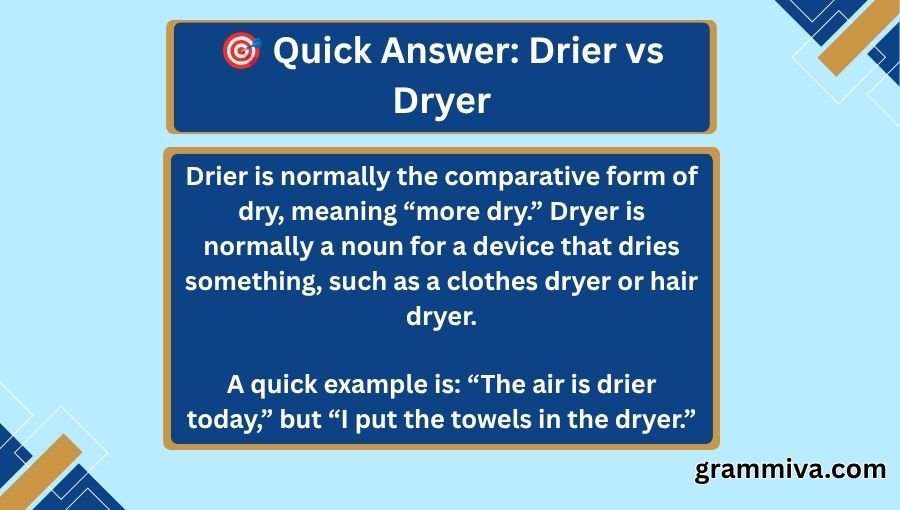
Drier is normally the comparative form of dry, meaning “more dry.” Dryer is normally a noun for a device that dries something, such as a clothes dryer or hair dryer.
A quick example is: “The air is drier today,” but “I put the towels in the dryer.”
| Word | Main job | Simple meaning | Example |
|---|---|---|---|
| drier | Adjective | More dry | The desert air is drier. |
| dryer | Noun | A machine that dries | The dryer is running. |
| drier | Noun, less common | A substance or device that helps something dry | The paint contains a drying agent. |
| dryer | Adjective, rare/technical use | Related to drying | The dryer cycle takes 30 minutes. |
🔎 Drier vs Dryer: Understanding the Basics
The core difference is that drier compares levels of dryness, while dryer usually names something that dries. Think of the spelling as a clue: drier comes from the adjective dry, while dryer commonly refers to a thing.
Here is the basic rule:
Dry → drier means “more dry.”
Dry → dryer usually means “a thing that dries.”
The basic comparison
| Form | Type | Meaning | Example | Correct/Incorrect |
|---|---|---|---|---|
| dry | Adjective | Not wet | The towel is dry. | ✅ Correct |
| drier | Comparative adjective | More dry | This towel is drier. | ✅ Correct |
| dryer | Noun | A machine or device that dries | The dryer is hot. | ✅ Correct |
| dryer | Comparative adjective | Usually not the standard spelling for “more dry” | The air is dryer today. | ❌ Usually incorrect |
| dryest | Superlative adjective | Most dry | This is the dryest month. | ✅ Correct |
The most common mistake is using dryer when the sentence needs a comparison.
For example:
- “Arizona is drier than Florida.”
- “I need to buy a new dryer.”
The first sentence compares two places. The second names a machine.
Why the extra letter matters
English often uses -er to form a comparative adjective.
Examples include:
- cold → colder
- fast → faster
- bright → brighter
- dry → drier
The spelling of dry changes slightly. The y becomes i before the comparative ending:
dry → drier
But dryer can be formed as a noun from dry + -er. In that use, the spelling keeps the y:
dry + er → dryer
That tiny spelling difference gives you a useful clue.
💡 What Does Drier Mean?
Drier means “more dry.” It is most often an adjective used to compare two things, places, times, or conditions.
For example:
This winter has been drier than last winter.
The word drier tells us that one winter had less moisture than the other.
Drier for weather
Weather is one of the most common settings for this word.
- The western part of the state is drier than the coast.
- September was drier than August.
- The forecast suggests a drier week ahead.
In each case, something is being compared.
Drier for objects
You can also compare the dryness of physical things.
- This towel feels drier than that one.
- The second coat is drier now.
- Leave the clay outside until it becomes drier.
The word does not have to describe weather. It can describe anything where dryness can be compared.
Drier for conditions
The comparison can also be less physical.
- The soil is drier near the surface.
- The room became drier after the heater was turned on.
- This paint dries drier than the older formula.
The exact meaning depends on the sentence, but the basic idea remains “more dry.”
| Meaning | Word Type | Example Sentence |
|---|---|---|
| More dry | Comparative adjective | The ground is drier today. |
| Less moist | Comparative adjective | The air is drier indoors. |
| Having less water | Comparative adjective | The soil is drier near the wall. |
| Showing a lower level of moisture | Comparative adjective | The second towel is drier. |
💡 Test Tip: Try “more dry”
When you are unsure, replace the word with more dry.
If the sentence still makes sense, drier is probably the right choice.
For example:
The climate is ___ than it was before.
Try:
The climate is more dry than it was before.
That makes sense, so drier is the natural choice.
Now try:
I put my clothes in the ___.
“More dry” does not make sense. You need the name of a machine.
So:
I put my clothes in the dryer.
🧺 What Does Dryer Mean?
Dryer most commonly means a machine or device that dries something.
You will see this word in homes, stores, manuals, and product descriptions.
Common examples include:
- clothes dryer
- hair dryer
- hand dryer
- food dryer
- industrial dryer
A dryer performs an action. It helps remove moisture.
Clothes dryer
A clothes dryer is a machine used to dry clothing, towels, sheets, and similar items.
For example:
The clothes are in the dryer.
Here, dryer is a noun. It names the machine.
Hair dryer
A hair dryer is a device that blows warm or cool air over hair to help dry it.
For example:
I left my hair dryer at the hotel.
Again, dryer names a device.
Other types of dryers
The word is not limited to clothing or hair.
You might hear:
- hand dryer
- grain dryer
- fruit dryer
- vacuum dryer
- commercial dryer
The shared idea is simple: the object helps something become dry.
| Dryer Type | What It Does | Example |
|---|---|---|
| Clothes dryer | Dries clothing | The shirts are in the clothes dryer. |
| Hair dryer | Dries hair | She packed her hair dryer. |
| Hand dryer | Dries hands | The restroom has an automatic hand dryer. |
| Food dryer | Removes moisture from food | The food dryer is used for fruit. |
| Industrial dryer | Dries materials in a production process | The factory installed a new dryer. |
🤔 Is Drier the Same as Dryer?
No. Drier and dryer are related, but they normally have different meanings.
Drier means “more dry,” while dryer usually means “a device that dries.”
Consider these two sentences:
The air is drier in winter.
The clothes are in the dryer.
The first sentence describes a condition. The second names an object.
A useful question to ask is:
Am I describing something, or am I naming a thing?
If you are describing something as more dry, choose drier. If you are naming a machine or device, choose dryer.
📝 Case Study: A Simple Workplace Example
I once edited a short workplace message about a building renovation. The writer had typed, “The storage room is much dryer after the new ventilation system was installed.”
The intended meaning was that the room had less moisture than before. The correct word was drier.
The revised sentence was:
“The storage room is much drier after the new ventilation system was installed.”
The mistake was easy to understand. The writer had seen dryer many times on appliance labels and naturally connected it with the word dry. But the sentence was comparing the room’s condition, not naming a machine.
Now imagine a different workplace sentence:
“Please put the uniforms in the dryer.”
Here, dryer is exactly right because the sentence names a machine.
This is why context matters more than sound.
📚 Grammar Rules Explanation
The grammar rule is straightforward. Drier is the regular comparative form of the adjective dry. It describes something that has a greater degree of dryness than another thing.
For example:
The desert is drier than the forest.
The adjective dry describes the desert. The comparative form drier tells us that the desert has a greater degree of dryness.
Dryer, on the other hand, is commonly a noun. It identifies a device that dries something.
For example:
The dryer stopped working.
Here, dryer is the subject of the sentence. It names a machine.
The spelling difference comes from two different word-building patterns:
- dry → drier: comparative adjective
- dry → dryer: noun for something that dries
Standard English reference works and major dictionaries recognize these as distinct uses. A dictionary such as Merriam-Webster can also be useful when you want to check a spelling or word form.
Correct vs Incorrect at a Glance
| Sentence | Correct/Incorrect | Why |
|---|---|---|
| The climate is drier this year. | ✅ Correct | It compares the level of dryness. |
| Put the sheets in the dryer. | ✅ Correct | Dryer names a machine. |
| The climate is dryer this year. | ❌ Incorrect in standard comparative use | The intended meaning is “more dry.” |
| My dryer stopped working. | ✅ Correct | Dryer names an appliance. |
| This towel is drier than mine. | ✅ Correct | It compares two towels. |
⚠️ Common Mistakes With Drier and Dryer
People confuse these words because they share the same root and almost the same letters. The final y is easy to overlook, especially when typing quickly.
I once caught myself typing dryer in a sentence about dry winter air. I noticed it only because the sentence looked odd when I read it aloud. That small pause was enough to catch the error.
Why these mistakes happen
Fast typing: When people type quickly, the difference between drier and dryer can disappear from attention.
Autocorrect: Spell-check tools may not understand the meaning you intend. Both words can be valid English words.
Lack of knowledge: A writer may know what the words mean but not know which spelling matches each grammatical job.
Sound confusion: In normal speech, the distinction may not be obvious.
Visual similarity: The words contain nearly the same letters, so the eye can skim over the difference.
Similar spelling and grammar confusions
| Confusion | Correct Use 1 | Correct Use 2 |
|---|---|---|
| its / it’s | its = belonging to it | it’s = it is / it has |
| your / you’re | your = belonging to you | you’re = you are |
| their / there / they’re | their = belonging to them | there = place; they’re = they are |
| then / than | then = time or sequence | than = comparison |
| affect / effect | affect = usually influence | effect = usually result |
| drier / dryer | drier = more dry | dryer = drying machine/device |
Specific wrong forms to watch for
| Wrong Form | What’s Wrong | Correct Form |
|---|---|---|
| The air is dryer. | Uses the noun spelling for a comparison. | The air is drier. |
| This towel is dryer than that one. | The sentence compares dryness. | This towel is drier than that one. |
| Put it in the drier. | The intended word is the machine. | Put it in the dryer. |
| Buy a new drier for the laundry room. | The appliance is a dryer. | Buy a new dryer for the laundry room. |
| The room became dryer after the heater ran. | The sentence needs the comparative adjective. | The room became drier after the heater ran. |
| Which drier should I buy? | The intended noun is an appliance. | Which dryer should I buy? |
🧠 How to Remember the Difference
A simple memory trick can make this almost automatic.
Think:
Drier = drier air.
Dryer = dryer machine.
The i in drier can remind you of a comparison:
“This room is drier.”
The y in dryer can stay with dry when you are naming a device:
“The dryer dries clothes.”
Another useful trick is to look for the word than.
If you see a comparison such as:
This room is drier than that room.
you almost certainly need drier.
If you see words such as:
machine, appliance, clothes, hair, laundry, cycle
you may need dryer.
| Clue in the Sentence | Likely Word | Example |
|---|---|---|
| than | drier | The air is drier than yesterday. |
| more dry | drier | The soil is more dry → drier. |
| machine | dryer | The dryer is broken. |
| appliance | dryer | We need a new dryer. |
| clothes | dryer | Put the clothes in the dryer. |
| hair | dryer | Where is my hair dryer? |
🌎 Drier vs Dryer in Different Contexts
The correct choice stays the same across different forms of writing. What changes is the kind of sentence you are likely to see.
Everyday conversation
In casual speech, you might say:
“It feels drier outside today.”
Or:
“Can you move the clothes from the washer to the dryer?”
Both are natural.
Professional writing
Professional writing needs extra care because spelling mistakes can distract readers.
For example:
“The warehouse is drier after the ventilation upgrade.”
This clearly describes a change in conditions.
Creative writing
Writers may use drier to create a sense of place or mood.
“The farther they walked, the drier the land became.”
Dryer might appear when a character interacts with an object:
“She heard the dryer humming in the next room.”
Social media and texting
Informal writing often contains spelling shortcuts, but these two words should still be kept separate when clarity matters.
“The weather is getting drier!”
versus
“My dryer finally works again!”
| Context | Which Term to Use | Example |
|---|---|---|
| Everyday conversation | Depends on meaning | The air is drier today. |
| Professional writing | Depends on meaning | The storage area is drier now. |
| Creative writing | Depends on meaning | The land became drier. |
| Social media/texting | Depends on meaning | The dryer is finally fixed! |
✍️ Sentence Patterns That Make the Rule Easy
Learning a few sentence patterns can be more useful than memorizing a definition.
Pattern 1: “X is drier than Y”
This is the clearest comparative pattern.
The north side is drier than the south side.
Pattern 2: “Something became drier”
Use drier when something changes to a state with less moisture.
The towels became drier after an hour.
Pattern 3: “The dryer is…”
Use dryer when talking about a machine.
The dryer is making a strange noise.
Pattern 4: “Put something in the dryer”
This is one of the most common everyday uses.
Put the blankets in the dryer.
Pattern 5: “Which dryer…”
Use dryer when choosing an appliance.
Which dryer has the largest capacity?
| Sentence Pattern | Correct Word | Example |
|---|---|---|
| X is ___ than Y | drier | The soil is drier than before. |
| X became ___ | drier | The air became drier. |
| The ___ is broken | dryer | The dryer is broken. |
| Put X in the ___ | dryer | Put the towels in the dryer. |
| Which ___ should I buy? | dryer | Which dryer should I buy? |
💬 Common Phrases With Drier and Dryer
Neither word has a large set of special idioms, but both appear in common everyday phrases.
| Phrase | Meaning |
|---|---|
| drier climate | A climate with less moisture |
| drier air | Air with less moisture |
| drier conditions | Conditions with less moisture |
| clothes dryer | A machine that dries clothes |
| hair dryer | A device that dries hair |
| tumble dryer | A rotating machine used to dry clothes |
The phrases are useful because they show how context controls the spelling.
🔄 Synonyms and Alternatives
Sometimes you can avoid the spelling problem by choosing a different phrase. This can help when you are writing for a broad audience.
For drier, alternatives might include:
- less humid
- less moist
- with less moisture
- more arid
These are not always exact replacements. For example, less humid usually refers to air, while drier can describe many different things.
For dryer, alternatives include:
- drying machine
- drying device
- clothes-drying machine
- hair-drying device
These can work when you need to explain the object rather than use its common name.
| Alternative | Works When | Does Not Work When |
|---|---|---|
| less humid | Talking about air | Talking about a towel or machine |
| less moist | Talking about physical moisture | Naming an appliance |
| more arid | Talking about land or climate | Casual talk about laundry |
| drying machine | Explaining what a dryer is | A short everyday sentence needs the common word |
| drying device | Describing a device generally | You specifically mean a standard clothes dryer |
🎯 Why Drier vs Dryer Matters
This may look like a tiny spelling issue, but accurate word choice helps readers understand your meaning immediately.
Clarity in communication
Compare:
The room is dryer.
with:
The room is drier.
The second version clearly signals a comparison. The first can make the reader pause because dryer commonly means a machine.
Professionalism
A small spelling error will not always ruin a document. But repeated word-choice mistakes can make writing look rushed.
This matters in:
- resumes
- reports
- client emails
- school assignments
- websites
- product descriptions
Digital communication
Messages are often read quickly on phones. Clear spelling helps the reader understand the sentence without stopping.
A useful writing rule is:
“Choose the word that makes your meaning clear on the first read.”
| Situation | Why Getting It Right Matters |
|---|---|
| Resume | Shows care with written details |
| Client email | Reduces confusion |
| Published content | Builds reader trust |
| Social post | Keeps the message clear |
📖 A Short History of the Two Spellings
The difference between these words becomes easier to understand when you see that English uses -er in more than one way.
One use forms a comparative adjective:
dry → drier
Another use can form a noun for a person or thing that performs an action:
dry → dryer
The same broad pattern appears in many English words. The ending does not always perform exactly the same grammatical job.
Because spelling and word formation can change over time, older texts may show forms that look different from modern everyday usage. For practical US English today, the modern distinction is the one that matters most.
| Period | Form | Note |
|---|---|---|
| Earlier English | dry | Basic adjective describing lack of moisture |
| Later English development | comparative forms | English developed regular ways to compare adjectives |
| Modern English | drier | Standard comparative form of dry |
| Modern English | dryer | Common noun for a drying device |
🧩 Why Do People Confuse Drier and Dryer?
People confuse these words because they are almost identical in spelling and closely related in meaning.
The biggest trap is that both words can appear in sentences connected to drying.
For example:
The towel is drier.
and:
The towel is in the dryer.
Both sentences are about the same general topic. But one describes the towel’s condition, while the other names the machine.
A student once wrote “The weather will be dryer tomorrow” on a homework assignment. I asked the student what dryer meant in the sentence. After a moment, the student said, “More dry.” That answer revealed the problem immediately. Once we changed dryer to drier, the rule made sense.
The lesson is simple: do not choose the word based only on the topic. Choose it based on the job the word performs.
🛠️ A Fast Editing Method
When editing your writing, use this three-step check.
Step 1: Find the word.
Look for drier or dryer.
Step 2: Ask what it means.
Does it mean “more dry”? Or does it name a machine or device?
Step 3: Replace it mentally.
Try more dry.
If that works, use drier.
If you are naming a device, use dryer.
| Step | Question | Result |
|---|---|---|
| 1 | Did I write drier or dryer? | Identify the form. |
| 2 | Do I mean “more dry”? | Use drier. |
| 3 | Do I mean a machine or device? | Use dryer. |
| 4 | Am I still unsure? | Read the whole sentence again. |
🚦 Special Exception: The Word “Dryer” Can Have Other Uses
There is a small edge case worth knowing. Dryer can appear in technical or specialized contexts where it describes something connected with drying rather than simply naming a household appliance.
For most everyday US English, however, the safest rule remains:
- drier = more dry
- dryer = a thing or machine that dries
You do not need to memorize unusual technical uses to write ordinary sentences correctly.
When the word appears in a technical manual, industry document, or specialized field, follow the terminology used in that field. Context can sometimes give a word a narrower meaning.
✅ Quick Recap Checklist
Use this checklist whenever you hesitate.
| Question | If Yes → Use |
|---|---|
| Does the word mean “more dry”? | drier |
| Am I comparing two levels of dryness? | drier |
| Am I talking about a machine? | dryer |
| Am I talking about an appliance? | dryer |
| Could I replace the word with “more dry”? | drier |
| Could I put “machine” after the idea? | dryer |
Practice examples
- The desert is drier than the coast.
- Please put the towels in the dryer.
- The air became drier after the storm passed.
Try making your own sentence with each word. If the sentence describes a level of dryness, choose drier. If it names something that dries, choose dryer.
❓ FAQs About Drier vs Dryer
What is the difference between drier and dryer?
Drier means “more dry.” Dryer usually means a machine or device that dries something.
Is “drier” the correct spelling for “more dry”?
Yes. Drier is the standard comparative form of dry in ordinary US English.
For example:
This towel is drier than that one.
Is “dryer” a machine?
Usually, yes. A dryer commonly means a machine or device that dries something.
Examples include a clothes dryer, hair dryer, and hand dryer.
Should I write “the weather is drier”?
Yes. If you mean that the weather has less moisture than before or compared with another place, drier is correct.
Example:
The weather is drier this week.
Should I say “clothes dryer” or “clothes drier”?
Clothes dryer is the standard modern term for the appliance.
Example:
The clothes are still in the dryer.
Why does drier have an “i” but dryer has a “y”?
They have different grammatical roles. Drier is the comparative form of dry, while dryer is commonly a noun for something that dries.
Can “dryer” ever be an adjective?
Yes, in some specialized or less common uses. However, for ordinary comparisons, use drier.
For example:
The air is drier today.
Is “more dry” grammatically correct?
Yes, more dry can be understood and may appear in some contexts, but drier is the normal concise comparative form in everyday English.
Which is correct: “drier climate” or “dryer climate”?
Use drier climate when you mean a climate with less moisture.
Example:
The region has a drier climate than the coast.
Which is correct: “my drier broke” or “my dryer broke”?
Use my dryer broke when you mean a clothes-drying appliance.
Example:
My dryer broke yesterday, so I had to hang the clothes outside.
🏁 Conclusion
Drier vs dryer becomes easy once you focus on the job each word performs. Drier means “more dry,” while dryer usually names a machine or device that dries something.
When you see a comparison, think drier:
The air is drier today.
When you see an appliance or drying device, think dryer:
The dryer is running.
My best editing trick is to test the word with “more dry.” If that replacement works, choose drier. If you are naming a machine, choose dryer.
Do not rely only on how the word sounds. Look at the meaning of the whole sentence. That one habit will prevent most mistakes.
Once you remember drier = more dry and dryer = drying machine, the spelling choice becomes much faster. 🧠✨
When in doubt, check the job of the word—not just the way it looks.

I am Alex Morgan, an English grammar and vocabulary writer passionate about making language learning simple and useful. I work at Grammiva, where I create clear educational content and practical English examples for learners.

[…] use whenever you are unsure. By the end, choosing between these two words should feel automatic. Drier vs Dryer | Labeler vs Labeller | Patient vs […]
[…] By the end, you should be able to make the right choice without stopping to second-guess every sentence. The key is to look at the meaning and the grammatical role of the words, not just their spelling. dreamed vs dreamt | Anyway vs Anyways | Drier vs Dryer […]