Have you ever typed a sentence, looked at the word gray, and wondered whether it should be grey instead? You are not alone. This small spelling difference can make even confident writers pause. The good news is that gray vs grey is much easier to understand once you know the main rule.
Both spellings describe the same color between black and white. Both are real English words. The main difference is regional preference. In American English, gray is the standard spelling. In British English and several other varieties of English, grey is more common.
That means neither spelling is simply “wrong.” The best choice depends on your audience, location, style guide, or the name of a specific person, product, or organization.
I have seen this issue cause needless worry in school papers, emails, and website copy. So in this guide, I will break down the difference in plain English. By the end, you will know which spelling to choose, when the other form is correct, and how to remember the rule. ✨ Ensure vs Insure | Anytime vs Any Time | well-being vs wellbeing
🎯 Quick Answer: Gray vs Grey
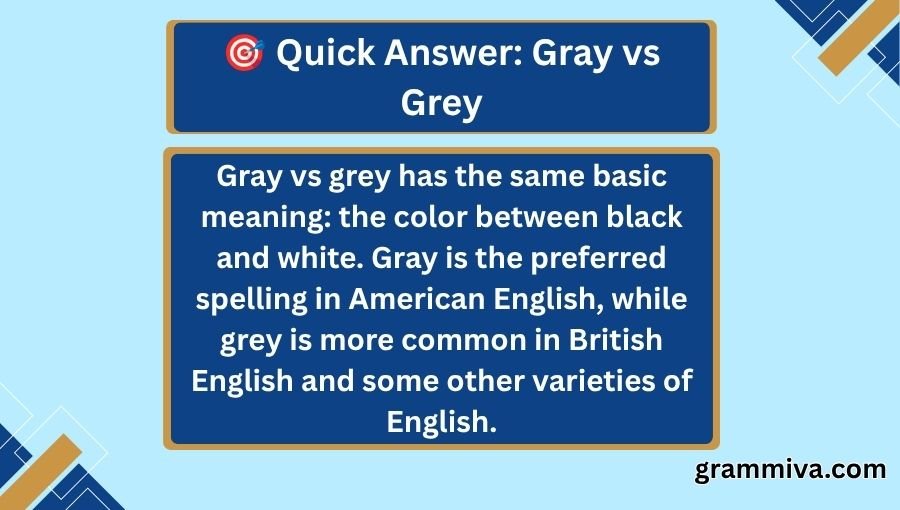
Gray vs grey has the same basic meaning: the color between black and white. Gray is the preferred spelling in American English, while grey is more common in British English and some other varieties of English.
| Spelling | Main Use | Example |
|---|---|---|
| gray | American English | She wore a gray jacket. |
| grey | British English and other varieties | She wore a grey jacket. |
For a US audience, choose gray in most cases.
Gray vs Grey: Meaning and Correct Use
The two forms have the same core meaning. They can describe a color, a thing that has that color, or something related to that color.
For example:
- Gray clouds means clouds that look gray.
- A gray shirt means a shirt that is gray.
- The sky turned gray means the sky took on that color.
The spelling changes by region, but the basic meaning does not.
Is gray the standard spelling in American English?
Yes. Gray is the usual spelling in American English.
If you are writing for readers in the United States, gray is normally the safest choice. This applies to school assignments, business writing, news copy, websites, product descriptions, and most other forms of US writing.
Correct: The walls are painted gray.
Less typical for US writing: The walls are painted grey.
The second sentence is understandable and not a spelling error in English. It simply follows a spelling style that is more strongly associated with British English.
Is grey the standard spelling in British English?
Yes. Grey is widely preferred in British English.
A writer in the United Kingdom may naturally write:
The old building has a grey roof.
An American writer would usually write:
The old building has a gray roof.
Both sentences communicate the same idea.
Can both forms be used as nouns?
Yes. Both gray and grey can refer to the color itself.
For example:
- Gray is one of my favorite colors.
- Grey is one of my favorite colours.
The spelling of color/colour often changes along with the regional style. If you are writing in US English, consistency matters. Use gray with other US spellings.
Can both forms be used as verbs?
Yes. The word can also describe something becoming gray.
For example:
- His hair began to gray.
- Her hair began to grey.
Again, the regional spelling changes, but the basic idea stays the same.
Quick meaning table
| Meaning | Word Type | Example Sentence |
|---|---|---|
| A color between black and white | Noun | Gray is a neutral color. |
| Having that color | Adjective | He bought a gray coat. |
| To become that color | Verb | Her hair began to gray. |
| Related to the color or appearance | Adjective | The gray sky looked heavy. |
🧠 Gray vs Grey at a Glance
The easiest rule is simple: use gray for American English and grey for British English unless a proper name or established name requires another spelling.
| Form | Type | Meaning | Example | Correct/Incorrect |
|---|---|---|---|---|
| gray | Adjective | Having the color gray | She has a gray car. | ✅ Correct in US English |
| grey | Adjective | Having the color grey | She has a grey car. | ✅ Correct in British English |
| gray | Noun | The color | Gray looks good here. | ✅ Correct |
| grey | Noun | The color | Grey looks good here. | ✅ Correct |
| graey | Spelling | Incorrect spelling | The wall is graey. | ❌ Incorrect |
A useful way to remember it
Think of the letter A in gray as standing for America.
GRAY → America
That is not a formal language rule. It is simply a memory trick. It can help when you are writing quickly.
Why Do People Confuse Gray and Grey?
People confuse the spellings because both are accepted English forms. The problem is not that one word is correct and the other is always wrong. The problem is choosing the form that matches your audience.
Regional English also creates many spelling differences. For example:
- American color vs. British colour
- American favorite vs. British favourite
- American center vs. British centre
- American gray vs. British grey
I once reviewed a student’s essay that switched between gray and grey several times. The student had copied examples from two websites without realizing they followed different regional styles. The words themselves were fine. The inconsistency was the real problem.
That is an important lesson: choose a style and stay consistent.
| Reason for Confusion | What Happens |
|---|---|
| Regional English | Different countries favor different spellings. |
| Reading international websites | Writers may encounter both forms. |
| Autocorrect | Software may change the spelling automatically. |
| School or work requirements | A required style may differ from personal preference. |
| Proper names | Some names use Grey even in US writing. |
💡 Test Tip: How Can You Remember Gray vs Grey?
If you are writing for readers in the United States, ask yourself one question:
“Am I writing in American English?”
If the answer is yes, choose gray unless you are copying or preserving a proper name.
Here is a second test. Look at nearby words. If your writing uses:
- color
- favorite
- center
- theater
- traveled
then gray will usually fit the same US style.
If your writing uses:
- colour
- favourite
- centre
- theatre
- travelled
then grey may fit the British style.
This is not a rule that says every British writer must use every British spelling. It is a consistency check.
📝 Case Study: Choosing the Right Form at Work
Imagine that you work for a US clothing company. You are writing a product description:
“This soft gray sweater is available in three sizes.”
For an American audience, gray is the natural choice.
Now imagine the company sells the same product on a UK website. The copy might say:
“This soft grey jumper is available in three sizes.”
The spelling and some vocabulary have changed to match the audience.
I once caught myself typing grey in US-focused copy after reading several British design websites earlier that morning. I noticed the mismatch during proofreading and changed it to gray. The mistake was easy to fix because I had a clear style rule before publishing.
The lesson is practical: your audience should guide your spelling.
| Writing Situation | Best Choice for US Audience | Example |
|---|---|---|
| US school paper | gray | The gray wolf moved away. |
| US business email | gray | Please select the gray option. |
| UK publication | grey | The grey sky cleared. |
| International copy | Follow the chosen style | Keep one form throughout. |
| Proper name | Preserve the official spelling | Use the name exactly as established. |
Grammar Rules Explanation
Both gray and grey are standard English spellings. The difference is mainly one of regional spelling preference, not grammar.
In American English, gray is the usual form. In British English, grey is generally more common. The word can function as a noun, adjective, or verb in either spelling.
The important point is that changing gray to grey does not normally change the grammar of a sentence. It changes the spelling style.
For example:
The gray house stood near the road.
and
The grey house stood near the road.
Both sentences are grammatically sound. The first follows the usual US spelling. The second follows a British spelling preference.
Most major English dictionaries recognize both forms. You should therefore avoid telling a British writer that grey is simply incorrect. It is not.
Correct vs. Incorrect at a Glance
| Sentence | Correct/Incorrect | Why |
|---|---|---|
| The dog has gray fur. | ✅ Correct | Standard US spelling. |
| The dog has grey fur. | ✅ Correct | Standard British spelling. |
| The wall is graey. | ❌ Incorrect | Graey is not the standard spelling. |
| I bought a gray sweater. | ✅ Correct | Natural US English. |
| I bought a grey sweater for the US catalog. | ⚠️ Usually avoid | Understandable, but gray better matches US style. |
⚠️ Common Mistakes With Gray and Grey
Most mistakes happen because writers treat the two forms as completely different words. They are not. They are two accepted spellings of the same basic word.
Other errors happen because people type quickly. Autocorrect can also change one form to another. A writer may then assume the software has chosen the “right” spelling for every audience.
It has not.
Another common problem is lack of knowledge about regional English. A person may see grey in a book and assume American writers should always use it. Or they may see gray online and assume grey is wrong.
Neither conclusion is accurate.
Similar spelling and grammar confusions
| Confusion | Correct Choice | Basic Rule |
|---|---|---|
| it’s / its | Depends on meaning | It’s means it is or it has. |
| your / you’re | Depends on meaning | You’re means you are. |
| their / there / they’re | Depends on meaning | Each has a different job. |
| then / than | Depends on meaning | Than is used for comparisons. |
| gray / grey | Depends on style | US English favors gray; British English favors grey. |
Common wrong spellings and uses
| Wrong Form | What’s Wrong | Correct Form |
|---|---|---|
| graey | Letters are in the wrong order. | gray or grey |
| greay | Incorrect letter order. | gray or grey |
| grEy | Unnecessary capitalization in normal use. | gray or grey |
| gray/grey used randomly | Style is inconsistent. | Pick one style. |
| Grey in US copy | Not grammatically wrong, but may conflict with US style. | gray |
| Gray in UK copy | Not necessarily wrong, but may conflict with UK style. | grey |
Fast typing can cause mistakes
When people type fast, they often focus on meaning instead of spelling. That is normal.
Autocorrect adds another layer. Different keyboards and writing tools may favor different regional forms.
The best fix is simple: proofread for consistency rather than trusting autocorrect alone.
Word Origin and History
The two spellings have a shared history. English developed both gray and grey as spelling forms for the same color word. Over time, different English-speaking regions developed different preferences.
The important point for modern writers is not the exact historical path. It is that both forms have a long place in English writing.
| Period | Form | General Note |
|---|---|---|
| Early English | Related older forms | Earlier English used forms related to the modern word. |
| Middle English | Several spellings | Spelling was less standardized than it is today. |
| Later English | Gray and grey | Both forms became established. |
| Modern American English | Gray | Gray became the usual US spelling. |
| Modern British English | Grey | Grey remains the common British preference. |
The spelling split is therefore best understood as a regional spelling difference, not as two words with completely different meanings.
Usage in Different Contexts
The correct choice in gray vs grey depends mainly on your audience, region, and writing style.
The correct choice depends mainly on the English variety you are using.
Everyday conversation
In speech, there is no spelling difference because the words are spoken rather than written. The distinction appears when you write the word.
If you are texting an American friend, gray is a natural US choice. If you are writing in British English, grey fits that style.
Professional writing
Professional writers should follow the style required by their employer, client, publication, or audience.
For a US company, gray is generally the best choice.
Creative writing
Authors have more flexibility, but consistency still matters. A writer may also preserve a spelling used in a character’s name, place name, or title.
Social media and texting
Either spelling can be understood easily. Still, your usual regional style is the safest choice.
| Context | Which Term to Use | Example |
|---|---|---|
| Everyday US conversation in writing | gray | I like that gray shirt. |
| Professional US writing | gray | Select the gray button. |
| British creative writing | grey | The grey mist covered the field. |
| US social media | gray | That gray sky looks amazing. |
Gray and Grey in Common Phrases
The two spellings appear in many ordinary descriptions. The spelling normally follows the regional style of the writer.
Some expressions are also part of names. That means you should not automatically change grey to gray just because you are writing in the United States.
| Phrase | Meaning |
|---|---|
| gray area | A situation without a clear yes-or-no answer |
| gray matter | The part of the brain often described by this color term |
| gray hair | Hair that has lost much of its original color |
| gray skies | A sky covered by gray clouds |
| gray market | Trade outside normal authorized channels |
| gray scale | A range of shades from black to white |
In British writing, you may see these written with grey instead.
Synonyms and Alternatives
Sometimes you do not need either spelling. You can choose another phrase when it gives you a clearer description.
For example, instead of saying gray sky, you could say cloudy sky if the weather is what matters. However, these alternatives are not always exact replacements.
| Alternative | Works When | Does Not Work When |
|---|---|---|
| silver | The color has a bright, metallic look | You mean ordinary gray |
| charcoal | You mean a very dark gray | The shade is light |
| slate | You mean a cool, dark gray | The color is warm or pale |
| ash-colored | You want a pale, soft gray | You mean a bright or metallic shade |
| neutral | You mean a color with little strong color bias | You need to name the exact color |
The best word depends on what you are trying to describe. Gray is broad. More specific color words can create a stronger picture.
🎯 Key Differences Between Gray and Grey
There are only a few differences worth remembering.
First, gray is the standard US spelling.
Second, grey is the standard or more common form in British English and is also used in other English varieties.
Third, both forms have the same basic meaning.
Fourth, some proper names use one spelling regardless of your regional writing style.
| Difference | Gray | Grey |
|---|---|---|
| Meaning | Same color | Same color |
| US English | Preferred | Less typical |
| British English | Less typical | Preferred |
| Can be an adjective? | Yes | Yes |
| Can be a noun? | Yes | Yes |
| Can be a verb? | Yes | Yes |
| Always interchangeable in names? | No | No |
Is Gray or Grey Better for American English?
Gray is better for standard American English. If your readers are primarily in the United States, use gray unless you are preserving an official name or quotation.
This applies to most normal writing:
- gray hair
- gray eyes
- gray sweater
- gray paint
- gray clouds
- gray wolf
- gray area
- gray matter
You do not need to avoid grey because it is “wrong.” Instead, think of it as a regional alternative.
Is Gray or Grey Better for British English?
Grey is generally the better choice for British English. If your audience is in the UK and your publication follows British spelling, use grey.
For example:
The grey cat sat beside the window.
A US publication would normally write:
The gray cat sat beside the window.
Both are clear. The difference is style.
Does Gray vs Grey Change the Meaning?
Usually, no. Gray and grey have the same basic meaning when they describe the color.
The difference is normally spelling rather than meaning.
However, proper names are an important exception. A name may officially contain Grey or Gray. In that case, changing the spelling can turn an accurate name into an inaccurate one.
For example, if a company, person, book, show, or product officially uses Grey, keep Grey.
This is why writers should not apply the US spelling rule mechanically to every occurrence.
Special Exceptions and Proper Names
Proper names deserve special attention because names keep their established spelling.
For example, Earl Grey is the established name of a type of tea. You should not change it to Earl Gray simply because you are writing for an American audience.
Similarly, a person whose surname is Grey should not have the name changed to Gray during editing.
Other names can contain either spelling. The rule is simple:
When a word is part of an official name, preserve the official spelling.
This is especially important in:
- Names of people
- Company names
- Product names
- Titles
- Organizations
- Places
- Quoted material
Why It Matters: Clarity and Professionalism
Understanding gray vs grey can help you keep your writing clear, consistent, and appropriate for your audience. A one-letter difference may seem tiny, but consistent spelling makes writing easier to trust.
Good writing does not require every reader to stop and think about your word choices. When your spelling matches your audience, the text feels natural.
I once edited a short US marketing page that used grey in three places and gray in two others. No sentence was impossible to understand. Still, the mixed spelling made the page look as if several people had edited it without checking the final style. A five-minute consistency pass fixed the problem.
That is why spelling choices matter even when both forms are technically valid.
Clear writing makes the reader’s job easier.
| Situation | Why Getting It Right Matters |
|---|---|
| Resume | Consistent US spelling looks polished. |
| Client email | Regional consistency supports professionalism. |
| Published content | Readers expect a clear style. |
| Social post | Consistency makes the brand voice stronger. |
How to Remember the Difference
A simple way to remember gray vs grey is to connect gray with American English. Here is the shortest memory trick I teach:
A = America → gray
If you are writing for an American audience, think:
America → A → gray
If you are writing in British English, remember:
British English → grey
You can also remember that both words contain the same basic sound and meaning. Only the spelling changes.
Three-step check
- Who will read this?
- Which English style am I using?
- Is the word part of a proper name?
If the audience is American and the word is not a proper name, gray is usually your answer.
Common Questions Writers Ask
Should I always use gray in an American essay?
Yes, gray is the normal choice for an essay written in standard American English. If your teacher has given you a specific style guide, follow that guide.
Is grey a spelling mistake in the United States?
No. Grey is a recognized English spelling. It is simply less typical in standard American English.
Is gray wrong in British English?
No. Gray can be understood and is an established spelling, but grey is generally the preferred British form.
Which spelling should a US website use?
A US website should normally use gray. The main exception is when grey appears in an official name or other text that should be preserved exactly.
FAQs About Gray vs Grey
Is gray or grey correct in American English?
Gray is the standard preferred spelling in American English. Grey is also recognized but is more closely associated with British English and other regional varieties.
Is grey or gray correct in British English?
Grey is generally the preferred spelling in British English. Gray is still understandable and exists as an English spelling.
Are gray and grey pronounced differently?
No. In normal English use, the two spellings represent the same word and are not normally distinguished by pronunciation.
Does gray mean something different from grey?
No. When referring to the color, gray and grey have the same basic meaning. The main difference is regional spelling preference.
Should I use gray or grey in a US resume?
Use gray if you are writing a resume in standard American English. This keeps your spelling consistent with the expected US style.
Why does Google show both gray and grey?
Because both spellings are valid forms of the English word. Search results come from writers and sources using different regional varieties of English.
Can I use gray and grey in the same document?
You can, but you generally should not when both refer to the same color. Choose the spelling that matches your regional or editorial style and use it consistently.
Is “gray area” spelled with gray or grey?
In American English, gray area is the usual spelling. In British English, you may see grey area.
Should I change Grey to Gray when editing American English?
Not if Grey is part of a proper name or another form that must be preserved. For ordinary color descriptions, changing grey to gray is usually appropriate in US-focused copy.
Which one should I learn as an American English student?
Learn gray as the standard American spelling. It is the form you will most often need in US school, workplace, and everyday writing.
✅ Quick Recap Checklist
Use this checklist whenever you are unsure.
| Question | If Yes → Use |
|---|---|
| Am I writing standard American English? | gray |
| Am I writing standard British English? | grey |
| Is the word part of an official name? | Keep the official spelling |
| Am I mixing both forms without a reason? | Choose one and stay consistent |
| Am I writing for an international audience? | Follow the publication’s style guide |
Practice examples
1. The old house had a ___ roof.
For US English: gray.
2. The British article described a ___ morning.
For British English: grey.
3. The tea was called ___ tea.
If the established name is Earl Grey, keep Grey.
Gray vs Grey: Final Rule to Remember
Gray vs grey is not a battle between a correct spelling and an incorrect spelling. Both forms are valid. The main difference is regional style.
For American English, choose gray. For British English, choose grey. When you see either form in an official name, preserve the name’s established spelling.
The biggest mistake is not choosing the “wrong” regional form. It is switching between forms without a reason. Consistent spelling makes your writing cleaner, easier to read, and more professional.
If you write primarily for US readers, make gray your default. If you write for UK readers, make grey your default. And when a proper name uses the other spelling, leave it alone.
Once you connect A with America, the choice becomes much easier. 🇺🇸
Remember: same color, different regional spelling, one simple rule.

I am Alex Morgan, an English grammar and vocabulary writer passionate about making language learning simple and useful. I work at Grammiva, where I create clear educational content and practical English examples for learners.


[…] the end, you should be able to choose the right word without stopping to second-guess yourself. ✨ Gray vs Grey | Ensure vs Insure | Anytime vs Any […]