Have you ever stopped in the middle of a sentence and wondered about anytime vs any time? You are not alone. I have seen this small spacing choice cause confusion in emails, school papers, websites, and even polished business copy. ✍️
The tricky part is that both forms are correct. The problem is that they do not always work in the same way. One word is usually an adverb that means “at any time.” The two-word form is a phrase that often refers to an unspecified amount or point of time.
That tiny space can change the grammar of a sentence.
If you understand the role each form plays, the choice becomes much easier. You will not need to guess, reread the sentence five times, or rely on autocorrect. 😊
In this guide, I will explain anytime vs any time in simple US English. I will show you the rules, common mistakes, real-life examples, memory tricks, and practical ways to choose the right form. well-being vs wellbeing | Occurring vs Occuring | Laid vs Layed
🎯 Quick Answer: Anytime vs Any Time
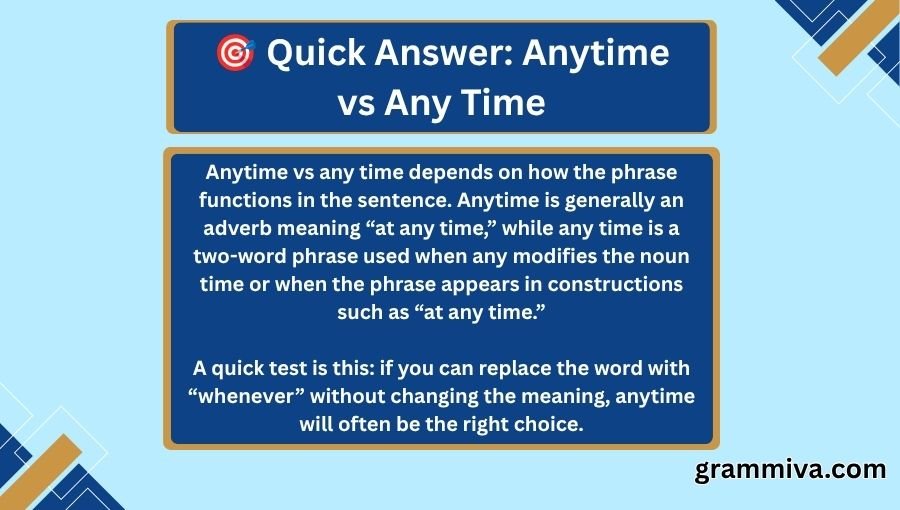
Anytime vs any time depends on how the phrase functions in the sentence. Anytime is generally an adverb meaning “at any time,” while any time is a two-word phrase used when any modifies the noun time or when the phrase appears in constructions such as “at any time.”
A quick test is this: if you can replace the word with “whenever” without changing the meaning, anytime will often be the right choice.
- “Call me anytime.” → “Call me whenever.”
- “Do you have any time to talk?” → “Do you have some time to talk?”
That simple test solves many cases.
What Is the Difference Between Anytime and Any Time?
The core difference is grammatical.
Anytime is normally used as an adverb. It tells us that something can happen at an unspecified time.
Any time contains the adjective or determiner any and the noun time. It refers to time as a thing, amount, or possible point in time.
| Form | Type | Meaning | Example | Correct/Incorrect |
|---|---|---|---|---|
| anytime | Adverb | At any time; whenever | You can call me anytime. | ✅ Correct |
| any time | Phrase | Any amount or point of time | Do you have any time today? | ✅ Correct |
| anytime | Adverb | Used before a noun | Do you have anytime today? | ❌ Incorrect |
| any time | Phrase | Used after “at” | You can call me at any time. | ✅ Correct |
| anytime | Adverb | Meaning “whenever” | Visit anytime you are nearby. | ✅ Correct |
The important point is that anytime and any time are not simply two spellings that can be swapped at random.
Anytime vs Any Time at a Glance
Here is the easiest way I teach the difference:
- Anytime = “whenever” or “at any time.”
- Any time = “any amount of time” or a specific phrase where time acts as a noun.
- At any time = the traditional two-word construction.
- Anytime works especially well in informal and modern everyday writing.
| Sentence | Best Form | Reason |
|---|---|---|
| You can visit anytime. | anytime | It means “whenever you want.” |
| Do you have any time this afternoon? | any time | “Time” is a noun referring to an amount of free time. |
| You may leave at any time. | any time | The phrase follows the preposition “at.” |
| Call me anytime you need help. | anytime | It means “whenever you need help.” |
| I don’t have any time today. | any time | It means any amount of available time. |
A useful rule is to look at the word after the phrase. If time is behaving like a noun, keep the words separate. If the entire word means “whenever,” anytime is usually appropriate.
When Should You Use Anytime?
Use anytime when it acts as an adverb and means “at any time” or “whenever.”
For example:
You can email me anytime.
The word anytime tells us when the action can happen. It does not describe an amount of time.
Another example:
Stop by anytime you are in the neighborhood.
Here, anytime means “whenever you are in the neighborhood.”
Anytime as “Whenever”
This is one of the easiest uses to recognize.
Anytime you need help, call me.
You could rewrite it as:
Whenever you need help, call me.
The meaning stays almost the same.
Anytime at the End of a Sentence
This use is very common in conversation and informal writing.
You can come anytime.
Feel free to call anytime.
We can talk anytime.
These sentences all use anytime as an adverb.
Anytime in Friendly Communication
You will often see anytime in emails, texts, chats, and casual workplace messages.
Thanks for your help! Anytime!
Here, anytime is short for a friendly expression such as “anytime you need help” or “you are welcome.”
| Meaning | Word Type | Example Sentence |
|---|---|---|
| Whenever | Adverb | Come anytime you want. |
| At an unspecified time | Adverb | We can meet anytime. |
| At the speaker’s convenience | Adverb | Send the file anytime. |
| Friendly reply | Adverb-like use | “Thanks!” “Anytime!” |
💡 Test Tip: Try “Whenever”
When you are unsure, replace anytime with whenever.
If the sentence still sounds natural, anytime is probably correct.
You can call me anytime.
You can call me whenever.
The second version is shorter, but the basic meaning remains clear.
Now compare:
Do you have anytime to talk?
Replacing it with “whenever” does not work:
Do you have whenever to talk?
That tells you that anytime is not correct there.
When Should You Use Any Time?
Use any time when time is a noun and any describes it.
For example:
Do you have any time to review this?
Here, the speaker is asking whether the person has any amount of free time.
Another example is:
I don’t have any time this morning.
The sentence is not saying “whenever.” It is talking about the amount of available time.
Any Time as an Amount
Consider this sentence:
I need any time I can get.
The speaker is talking about time as something that can be gained or used.
Other examples include:
Do you have any time after lunch?
We don’t have any time to waste.
If you have any time, please check the report.
Any Time After a Preposition
The phrase at any time is especially important.
You can cancel at any time.
The rules may change at any time.
Employees can request assistance at any time.
In these sentences, any time is part of the prepositional phrase at any time.
For formal writing, at any time is a safe and widely accepted choice.
| Use | Example | Why |
|---|---|---|
| Amount of time | I don’t have any time. | “Time” is a noun. |
| Available time | Do you have any time today? | The phrase asks about free time. |
| Point in time | At any time, the situation may change. | “Any time” follows “at.” |
| Time available for an action | If you have any time, call me. | “Any” modifies “time.” |
Is Anytime the Same as Any Time?
They can express closely related ideas, but they do not have exactly the same grammatical role.
Anytime normally functions as an adverb. Any time is a phrase in which time remains a noun.
Compare:
You may visit anytime.
and:
You may visit at any time.
The meaning is nearly identical. The first sentence uses the one-word adverb. The second uses the prepositional phrase at any time.
But look at:
Do you have any time?
This cannot normally become:
Do you have anytime?
The noun time is needed because the sentence asks whether the person has an amount of time available.
| Example | Meaning | Preferred Form |
|---|---|---|
| Call me anytime. | Whenever you want | anytime |
| Call me at any time. | At an unspecified time | any time |
| Do you have any time? | Do you have free time? | any time |
| Visit anytime. | Visit whenever you want | anytime |
| I need any time I can get. | I need whatever time is available | any time |
Why Do People Confuse Anytime and Any Time?
People confuse these forms because they sound exactly alike. When we speak, there is no audible space between the two versions.
That means the difference appears only when we write.
Another reason is that English has many word pairs that shift between one word and two words. Writers may know the meaning but still be unsure about the spelling.
I once edited a short company email that said, “Please contact our team at anytime.” The writer clearly knew the intended meaning. The only issue was the extra at. I changed it to “at any time” and explained why. The writer later told me that this was the first time the difference had made sense.
Common Causes of Confusion
- The two forms sound identical.
- People type quickly.
- Autocorrect may not catch the problem.
- Informal writing often favors anytime.
- Writers may not know that time can function as a noun.
- The phrase at any time is very common.
- Style preferences can vary by context.
The safest approach is not to memorize dozens of sentences. Learn what role the words play.
📝 Case Study: A Workplace Email
Imagine that a manager sends this message:
Please call me anytime if you have questions.
This is correct. The manager means:
Please call me whenever you have questions.
Now imagine a different email:
Do you have any time tomorrow to discuss the project?
This is also correct. The writer is asking about the recipient’s available time.
Here is a longer workplace example:
Hi Jordan,
Do you have any time tomorrow afternoon to review the draft? If tomorrow is busy, feel free to send me a message anytime this week.
Thanks!
Notice how both forms can appear in the same message. They simply perform different jobs.
| Workplace Sentence | Form | Explanation |
|---|---|---|
| Do you have any time tomorrow? | any time | Asks about available time. |
| Call me anytime. | anytime | Means “whenever.” |
| You can reach me at any time. | any time | Part of “at any time.” |
| Send questions anytime this week. | anytime | Means “whenever this week.” |
Grammar Rules Explanation
The grammatical difference comes from the role of the words in the sentence.
Anytime is generally an adverb. It modifies a verb, clause, or the timing of an action. It commonly means “whenever” or “at any time.”
Any time is a phrase. In this phrase, any modifies the noun time.
Consider:
Call me anytime.
The word anytime modifies the action call. It tells us when the call can happen.
Now consider:
Do you have any time?
Here, any describes the noun time. The sentence asks whether any amount of time is available.
A useful grammatical clue is the word at.
When the sentence contains at any time, keep the words separate:
You may leave at any time.
The one-word form generally does not follow at in standard usage:
You may leave at anytime.
This is commonly treated as incorrect in edited English.
Most standard English reference sources recognize the distinction between the adverb anytime and the phrase any time. When writing for school, business, or publication, following the grammatical function is more useful than simply asking which version “looks right.”
Correct vs Incorrect at a Glance
| Sentence | Correct/Incorrect | Why |
|---|---|---|
| You can call me anytime. | ✅ Correct | “Anytime” means “whenever.” |
| You can call me at any time. | ✅ Correct | “Any time” follows “at.” |
| Do you have anytime today? | ❌ Incorrect | “Time” is being used as a noun. |
| Do you have any time today? | ✅ Correct | The sentence asks about available time. |
| Please contact us at anytime. | ❌ Incorrect | Use “at any time” after “at.” |
The key is not that one spelling is always right. Both are useful. The grammar decides which one belongs in the sentence.
⚠️ Common Mistakes With Anytime and Any Time
The most common mistakes happen when writers focus on sound instead of grammar.
Mistake 1: Adding “At” Before Anytime
A frequent error is:
❌ You can contact me at anytime.
The better version is:
✅ You can contact me at any time.
Or, if you do not need at:
✅ You can contact me anytime.
Mistake 2: Using Anytime Before a Noun
A sentence such as:
❌ I don’t have anytime today.
is not the usual standard form.
Write:
✅ I don’t have any time today.
Here, time is the noun being described by any.
Mistake 3: Treating the Forms as Interchangeable
The following pairs are not interchangeable in every sentence:
✅ Call me anytime.
❌ Call me any time.
The second version may appear in some styles and historical usage, but in modern edited US English, anytime is generally the clearest adverbial form in this sentence.
On the other hand:
✅ Do you have any time?
❌ Do you have anytime?
The second sentence changes the grammatical structure and is not the standard choice.
Why These Mistakes Happen
| Similar Confusion | Example | Why People Make It |
|---|---|---|
| it’s / its | It’s raining. / Its color is bright. | Both sound alike. |
| your / you’re | Your book. / You’re ready. | Fast typing and sound. |
| their / they’re / there | They’re over there. | Similar sounds. |
| affect / effect | The change affected sales. | Similar pronunciation and meaning. |
| anytime / any time | Call anytime. / Have any time? | Same sound, different grammar. |
Three causes appear again and again:
- Fast typing — Writers often type what they hear.
- Autocorrect — Software may not understand the grammar of the whole sentence.
- Lack of knowledge — If the difference was never explained, guessing feels natural.
I once caught myself typing “at anytime” in a quick note to a colleague. I knew the rule, but I was moving fast and had typed the phrase almost automatically. That was a good reminder that even experienced writers benefit from a quick proofreading pass.
Common Wrong Forms
| Wrong Form | What’s Wrong | Correct Form |
|---|---|---|
| at anytime | “At” should be followed by “any time.” | at any time |
| have anytime | “Time” is being used as a noun. | have any time |
| don’t have anytime | Refers to an amount of time. | don’t have any time |
| any time you want | Often better as the adverbial form in this meaning. | anytime you want |
| contact us at anytime | Incorrect combination in standard edited usage. | contact us at any time |
| anytime available | “Time” is being treated as a noun. | any time available |
How to Remember the Difference
You do not need a complicated grammar formula.
Use these three questions:
1. Can I replace it with “whenever”?
If yes, choose anytime in most cases.
Call me anytime.
Call me whenever.
2. Am I talking about an amount of time?
If yes, use any time.
Do you have any time?
3. Does the phrase come after “at”?
Use at any time.
You may leave at any time.
| Question | Answer | Form |
|---|---|---|
| Does it mean “whenever”? | Yes | anytime |
| Does it mean an amount of time? | Yes | any time |
| Does it follow “at”? | Yes | any time |
| Is it an informal “you are welcome” response? | Yes | Anytime! |
A short memory trick is:
Anytime = whenever. Any time = any amount of time.
That one line handles most everyday cases.
Usage in Different Contexts
The best choice can become clearer when you consider the type of writing.
Everyday Conversation
In everyday speech and casual writing, anytime is extremely natural.
Come over anytime.
Call me anytime tonight.
Professional Writing
Both forms are useful in business writing.
Use anytime when it means “whenever.”
Please contact me anytime if you need assistance.
Use any time when talking about available time.
Do you have any time Thursday morning?
For a more formal tone, at any time is also a strong choice.
Creative Writing
Creative writers can choose based on rhythm and voice.
She knew he could return anytime.
The one-word form can make the sentence feel smooth and direct.
Social Media and Texting
Casual digital writing often uses anytime.
Anytime! 😊
You can text me anytime.
The two-word form remains necessary when time is functioning as a noun.
| Context | Which Term to Use | Example |
|---|---|---|
| Everyday conversation | Usually anytime for “whenever” | Come by anytime. |
| Professional writing | Depends on grammar | Contact me anytime. |
| Creative writing | Depends on meaning and style | He could return anytime. |
| Social media/texting | Usually anytime for “whenever” | Message me anytime! |
Common Phrases With Anytime and Any Time
There are several useful patterns worth learning.
| Phrase | Meaning |
|---|---|
| anytime soon | At any point in the near future |
| anytime you want | Whenever you want |
| anytime now | Expected to happen very soon |
| at any time | At an unspecified time |
| any time of day | Any possible period during a day |
| any time you need help | Any amount or point of time available when help is needed |
Examples:
You can visit anytime you want.
I don’t expect the package anytime soon.
The bus should arrive anytime now.
You may request a refund at any time.
Notice that anytime is common in expressions about an unspecified occasion. Any time remains natural when time functions as a noun.
Alternatives to Anytime
Sometimes you can replace anytime with another expression. This can help when you want a more formal or more precise tone.
| Alternative | Works When | Does Not Work When |
|---|---|---|
| whenever | You mean “at any time that” | You are asking about an amount of time |
| at any time | You want a clear, formal phrase | You want a very casual one-word expression |
| whenever you like | You mean the other person has freedom | You need to discuss available time |
| at your convenience | You mean the person can choose a suitable time | You mean literally every possible moment |
| any time | “Time” is being used as a noun | You need an adverb meaning “whenever” |
For example:
Call me anytime.
can become:
Call me whenever you like.
Or:
Call me at any time.
But:
Do you have any time tomorrow?
cannot be replaced with “whenever” without changing the sentence’s meaning.
Does Formal Writing Prefer Any Time?
Formal writing often benefits from at any time when the intended meaning is “at an unspecified time.”
For example:
Customers may cancel their subscription at any time.
This is clear and formal.
However, there is no need to avoid anytime simply because a sentence appears in professional writing. If it is being used correctly as an adverb, it can be perfectly natural.
For example:
Please contact the support team anytime you need help.
The choice should come from grammar and tone, not from the idea that one spelling is automatically “professional” and the other is “casual.”
Why Getting This Difference Right Matters
A one-word versus two-word choice may seem tiny, but small grammar errors can affect how readers view a piece of writing.
| Situation | Why Getting It Right Matters |
|---|---|
| Resume | Shows careful editing and attention to detail. |
| Client email | Makes instructions clear and professional. |
| Published content | Prevents avoidable grammar errors. |
| Social post | Makes short messages easier to understand. |
A simple principle I use when editing is:
Clear grammar makes the reader’s job easier.
That matters even when the error is small.
A client may understand “at anytime,” but correct wording removes the distraction. A student may understand the rule, but using it correctly shows control of written English.
Is There a Special Exception?
There is one important style point worth remembering: anytime and any time can sometimes overlap in informal usage, especially when the meaning is close to “whenever.”
You may encounter sentences such as:
You can come any time you want.
This two-word form is widely understood because time can still be viewed as a noun within the phrase.
In careful modern US English, however, anytime is a useful standard adverb when the intended meaning is simply “whenever.”
When in doubt, rewrite the sentence.
For example:
You can contact me at any time.
is clear.
Or:
You can contact me anytime.
is also clear.
A clean rewrite can be better than arguing over a tiny distinction.
Anytime vs Any Time: A Practical Decision Guide
Here is the process I recommend when proofreading.
First, identify what you mean.
If your meaning is “whenever,” choose anytime.
If your meaning is “any amount of time,” choose any time.
If the phrase follows at, write at any time.
| Meaning You Want | Best Choice | Example |
|---|---|---|
| Whenever | anytime | Call anytime. |
| At an unspecified time | anytime | We can meet anytime. |
| Any amount of available time | any time | Do you have any time? |
| After “at” | any time | Come at any time. |
| Whenever a condition occurs | anytime | Anytime you need help, ask. |
This approach is more reliable than trying to remember isolated examples.
What Does the Spacing Actually Tell You?
The space is not just a spelling detail. It signals a difference in grammatical structure.
Compare:
I can meet you anytime.
Here, anytime acts as one adverb.
Now compare:
I don’t have any time.
Here, any and time are separate because time is a noun.
This is similar to other English word combinations that have developed distinct uses when written as one word or as separate words. The key is to learn the role of the complete expression.
Practice Examples
Try choosing the correct form before checking the answers.
Example 1
You can call me ___ if the problem continues.
Answer: anytime
Why? It means “whenever.”
Example 2
Do you have ___ to help me today?
Answer: any time
Why? The speaker is asking about available time.
Example 3
Employees may request assistance ___.
Answer: anytime
Why? It means “whenever they need to.”
Example 4
Employees may request assistance at ___.
Answer: any time
Why? The phrase follows at.
| Practice Sentence | Answer | Reason |
|---|---|---|
| Call me ___ you need help. | anytime | Means “whenever.” |
| Do you have ___ this afternoon? | any time | Refers to available time. |
| You may leave at ___ . | any time | Follows “at.” |
✅ Quick Recap Checklist
Use this checklist whenever you hesitate.
| Question | If Yes → Use |
|---|---|
| Does it mean “whenever”? | anytime |
| Does it mean an amount of time? | any time |
| Does it follow “at”? | any time |
| Is it an informal reply meaning “you’re welcome”? | Anytime |
| Can you rewrite it with “whenever”? | Usually anytime |
Three Final Practice Examples
1. “Feel free to email me ___.”
✅ anytime
2. “Do you have ___ to review this?”
✅ any time
3. “You may change your settings at ___.”
✅ any time
If you remember only one rule, remember this:
Anytime means “whenever.” Any time refers to time as a noun.
FAQs About Anytime vs Any Time
Is anytime one word or two words?
Both anytime and any time are correct forms, but they serve different grammatical purposes. Use anytime mainly as an adverb meaning “whenever.” Use any time when time functions as a noun or in phrases such as at any time.
Is “anytime” grammatically correct?
Yes. Anytime is grammatically correct when it functions as an adverb meaning “at any time” or “whenever.”
For example:
You can call me anytime.
The word modifies the timing of the action.
Is “any time” grammatically correct?
Yes. Any time is correct when any modifies the noun time.
For example:
Do you have any time today?
It is also correct in the phrase:
You can leave at any time.
Should I write “at anytime” or “at any time”?
Write at any time.
✅ You may cancel at any time.
❌ You may cancel at anytime.
The phrase contains the preposition at, so the standard form is the two-word any time.
Can I say “call me anytime”?
Yes. Call me anytime is correct and natural. Here, anytime means “whenever.”
You can also say:
Call me at any time.
The meaning is very similar.
Can I say “do you have anytime”?
No, not in standard edited US English when you mean “Do you have any amount of available time?”
Use:
Do you have any time?
Here, time is a noun.
Is “anytime soon” correct?
Yes. Anytime soon is a common expression meaning at any point in the near future.
For example:
I don’t expect the package anytime soon.
Is “anytime you want” correct?
Yes. Anytime you want is correct when it means “whenever you want.”
For example:
You can visit anytime you want.
The word anytime introduces the timing of the action.
Is “any time you want” also correct?
It can be used and is understandable, but in modern edited US English, anytime is generally the cleaner choice when the meaning is “whenever you want.”
Compare:
You can visit anytime you want.
The adverbial meaning is clear.
Which is better for formal writing, anytime or any time?
Neither is automatically more formal in every sentence. The correct choice depends on grammar. Anytime is correct as an adverb, while any time is required when time is functioning as a noun or after at.
For formal writing, at any time is also a clear option when you mean “at an unspecified time.”
Conclusion
Anytime vs any time becomes much easier once you focus on the job each form does in a sentence. Use anytime when it means “whenever” or “at any time.” Use any time when you are treating time as a noun, such as when asking about available time. After at, use the two-word form: at any time.
The biggest mistake is thinking that one form is always right and the other is always wrong. Both have a place in standard English. The difference is grammatical, not simply a matter of spelling.
When proofreading, ask yourself three quick questions:
- Does it mean whenever? → anytime
- Am I talking about an amount of time? → any time
- Does it follow at? → at any time
With those three checks, this common grammar problem becomes simple. Keep the rule close, watch for the most common mistakes, and let meaning guide your spelling. ✨
When you know what the words are doing, the space stops being a mystery.

I am Ryan Mitchell, a writer focused on English grammar, vocabulary, and everyday language. I work at Grammiva, creating easy-to-understand articles that help readers improve their English with confidence.
[…] a common error in emails, reports, school assignments, business documents, and online content. Anytime vs Any Time | well-being vs wellbeing | Occurring vs […]
[…] to choose, when the other form is correct, and how to remember the rule. ✨ Ensure vs Insure | Anytime vs Any Time | well-being vs […]
[…] By the end, you should be able to choose the right word without stopping to second-guess yourself. ✨ Gray vs Grey | Ensure vs Insure | Anytime vs Any Time […]