Have you ever typed a sentence, stared at laid vs layed, and wondered which one looks right? You are not alone.
I have seen this mix-up in school papers, work emails, social posts, and even polished drafts that otherwise looked perfect.
The trouble is that laid and layed look like they should follow the same spelling pattern as many regular past-tense verbs.
But English does not treat lay that way.
The good news is that the rule is simple once you know it.
In this guide, I will show you exactly when to use laid, why layed is usually wrong, and how to remember the difference without memorizing a long grammar rule. 😊
By the end, you should be able to choose the right form quickly and confidently. Theater vs Theatre | Yea vs Nay | Acknowledgment vs Acknowledgement
Quick Answer: Laid vs Layed 🎯
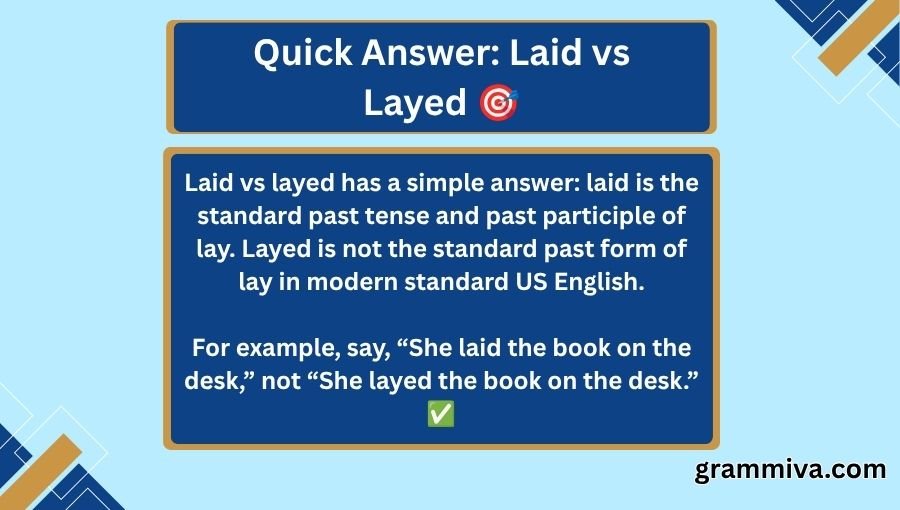
Laid vs layed has a simple answer: laid is the standard past tense and past participle of lay. Layed is not the standard past form of lay in modern standard US English.
For example, say, “She laid the book on the desk,” not “She layed the book on the desk.” ✅
Related Word Forms
The word lay has several forms, and some are easy to confuse with lie. Here is the basic set:
| Form | Type | Example |
|---|---|---|
| lay | Base verb | Please lay the keys here. |
| lays | Present-tense form | He lays the papers on my desk. |
| laid | Past tense / past participle | She laid the papers down. |
| laying | Present participle | She is laying the papers down. |
| layed | Nonstandard form | ❌ She layed the papers down. |
The key point is that layed is not the normal past-tense form of lay. The correct form is laid.
Understanding Laid vs Layed at a Glance
The core difference is spelling and standard usage: laid is correct when lay means to put or place something somewhere, while layed is normally incorrect in standard English.
| Form | Type | Meaning | Example | Correct/Incorrect |
|---|---|---|---|---|
| lay | Base verb | Put or place something | Lay the folder here. | ✅ Correct |
| laid | Past tense | Put or placed something | I laid the folder here. | ✅ Correct |
| laid | Past participle | Used with helping verbs | She has laid the folder here. | ✅ Correct |
| laying | -ing form | Putting or placing | He is laying the folder here. | ✅ Correct |
| layed | Nonstandard spelling | Intended as past tense of lay | He layed the folder here. | ❌ Incorrect |
Why “Laid” Looks Unusual
Many English verbs form the past tense by adding -ed. For example:
- walk → walked
- clean → cleaned
- open → opened
- call → called
That pattern can make layed seem logical. But lay is an irregular verb. Its past form is laid, not layed.
This is one reason learners make the mistake. The incorrect form looks as if it follows a familiar pattern.
What Does Laid Mean?
Laid is the past tense and past participle of lay, when lay means to put or place something somewhere.
For example:
I laid the keys on the kitchen counter.
The action happened in the past. The person put the keys on the counter.
Here are a few more examples:
She laid the blanket on the bed.
We laid the documents on the table.
He laid his phone beside the computer.
The important detail is that lay normally takes an object. You lay something somewhere.
Meaning and Sentence Structure
A useful way to understand the verb is to ask, “What was put somewhere?”
Consider this sentence:
Maria laid the book on the chair.
The parts are easy to identify:
- Maria = the person doing the action
- laid = the past action
- the book = the thing being placed
- on the chair = where it was placed
If you can identify something being placed, lay/laid may be the verb you need.
| Meaning | Word Type | Example Sentence |
|---|---|---|
| Put something in a place | Verb | She laid the letter on the desk. |
| Put something down | Verb | He laid the bag beside the door. |
| Put something in position | Verb | They laid the boards across the opening. |
Is Layed Ever Correct?
In standard US English, layed is generally not the correct past tense of lay. If you mean “put” or “placed,” use laid.
So these sentences should be written this way:
- ❌ She layed the baby in the crib.
- ✅ She laid the baby in the crib.
- ❌ He layed the papers on my desk.
- ✅ He laid the papers on my desk.
There can be unusual appearances of layed in names, quotations, dialect writing, or other special contexts. Those cases do not change the normal grammar rule. In everyday and professional US English, choose laid.
Why Do People Confuse Laid and Layed?
People confuse these forms because lay does not follow the regular -ed pattern. The spelling also looks close enough to make the wrong version feel natural.
I once edited a short business report in which the writer had used layed three times. The writer knew exactly what each sentence meant. The problem was simply that they had assumed lay behaved like a regular verb. Once I showed them laid, they fixed every example in less than a minute.
Fast typing makes the problem worse. Autocorrect may not always catch a word that looks like a possible English spelling. People also sometimes learn the word by hearing it rather than seeing it in writing.
| Cause of Confusion | What Happens | Better Habit |
|---|---|---|
| Fast typing | Fingers add “-ed” automatically | Pause before submitting |
| Autocorrect | Software may not flag the form | Proofread manually |
| Lack of knowledge | The irregular form was never learned | Memorize “lay → laid” |
| Confusion with other verbs | Lay and lie get mixed up | Check whether there is an object |
| Sound-based spelling | The writer guesses the spelling | Look at the written form |
Laid vs Layed: Meaning and Correct Use
The practical rule is short: when lay means “put” or “place,” its past form is laid. Do not change it to layed.
Here are several common uses.
Placing an Object
I laid my wallet on the table.
The wallet is the object being placed.
Putting Something Down
She laid the package on the floor.
Again, something is being moved into a position.
Arranging Something
They laid the plates on the dining table.
The verb describes placing the plates in position.
Present Perfect Use
Laid can also appear after helping verbs such as has, have, or had.
She has laid the documents on the desk.
We had laid everything out before the meeting.
The form stays laid.
How Can You Test Whether Laid Is Correct? 💡
The easiest test is to replace laid with put. If the sentence makes sense with put, you are probably dealing with lay and should use laid for the past.
For example:
She laid the book on the table.
Try:
She put the book on the table.
That works. So laid is correct.
Another example:
He laid the coat on the chair.
Try:
He put the coat on the chair.
Again, it works.
Test Tip 💡
Ask yourself:
“Did someone put something somewhere?”
If the answer is yes and the action happened in the past, laid is usually the form you need.
A Real-Life Case Study 📝
Imagine that you are writing an email after a meeting. You want to tell your manager that you placed the signed papers in the correct folder.
You might write:
I laid the signed forms in the blue folder before leaving.
That sentence is correct.
A common mistake would be:
I layed the signed forms in the blue folder before leaving.
The meaning is clear, but the spelling is not standard.
I once caught myself typing layed while editing a quick note late in the afternoon. I stopped because the word looked suspicious on the screen. I changed it to laid, then checked the rest of the sentence. That small pause is often all it takes.
| Situation | Incorrect Version | Correct Version |
|---|---|---|
| Work email | I layed the report on your desk. | I laid the report on your desk. |
| Home | She layed the blanket on the bed. | She laid the blanket on the bed. |
| School | We layed the papers on the table. | We laid the papers on the table. |
| Conversation | He layed his phone down. | He laid his phone down. |
Grammar Rules Explanation
The verb lay is an irregular verb when it means “to put” or “to place.” Its past tense is laid, and its past participle is also laid.
The pattern is:
lay → laid → laid
For comparison:
walk → walked → walked
The important difference is that lay does not form its past tense by simply adding -ed. Therefore, layed is not the standard past form.
There is another source of confusion: lay is closely related in everyday use to lie, but the two verbs do not have the same grammar pattern. Lay normally takes an object, while lie normally describes a person or thing being in a resting position.
For example:
She laid the book on the table.
Here, the book is the object.
But:
She lay on the sofa.
Here, there is no object being placed. The person is resting.
Most standard English reference sources agree on the ordinary modern rule: use laid, not layed, when the intended verb is lay.
Correct vs Incorrect at a Glance
| Sentence | Correct/Incorrect | Why |
|---|---|---|
| She laid the keys on the desk. | ✅ Correct | Laid is the past form of lay. |
| She layed the keys on the desk. | ❌ Incorrect | Layed is not the standard past form. |
| He has laid the book on the table. | ✅ Correct | Laid is also the past participle. |
| We layed the papers on the counter. | ❌ Incorrect | The correct form is laid. |
| They laid the foundation carefully. | ✅ Correct | The action involves putting something in place. |
Common Mistakes ⚠️
The most common mistake is simple: writers see lay and assume that adding -ed gives layed. That is a reasonable guess if you have not learned the irregular form.
Another problem is confusion between lay, laid, and lie. These verbs are related in meaning, but their forms behave differently.
Common Grammar Mix-Ups
| Confusion | Correct Forms | Common Mistake |
|---|---|---|
| lay / laid | lay → laid | lay → layed |
| lie / lay | lie → lay | lie → lied when meaning “rest” |
| its / it’s | its = belonging; it’s = it is | Mixing the two |
| your / you’re | your = belonging; you’re = you are | Mixing the two |
| their / they’re | their = belonging; they’re = they are | Mixing the two |
Specific Laid and Layed Mistakes
| Wrong Form | What’s Wrong | Correct Form |
|---|---|---|
| layed the book | Incorrect past form | laid the book |
| has layed the papers | Incorrect past participle | has laid the papers |
| had layed the coat down | Incorrect past participle | had laid the coat down |
| layed it on the desk | Incorrect past form | laid it on the desk |
| was layed there | Wrong form for standard use | was laid there |
Why Does “Layed” Feel So Natural?
“Layed” feels natural because many English verbs use -ed to make the past tense. The brain often applies a familiar pattern before it remembers an exception.
Think about these pairs:
- jump → jumped
- play → played
- paint → painted
- wash → washed
Then compare:
- lay → laid
The second pattern must be learned as a unit. That is why I recommend memorizing lay → laid, rather than trying to build the past form each time you write.
Laid in Everyday, Professional, Creative, and Digital Writing
Laid works in all four settings because it is the standard form of the verb.
| Context | Which Term to Use | Example |
|---|---|---|
| Everyday conversation | laid | I laid my phone on the counter. |
| Professional writing | laid | The team laid the documents on the conference table. |
| Creative writing | laid | She laid the letter beside the old photograph. |
| Social media/texting | laid | I laid everything out before the guests arrived. |
In informal texting, people may write layed. That does not make it standard. If accuracy matters, choose laid.
Common Phrases With Laid
Laid appears in many familiar phrases. Learning these expressions can help you recognize the correct spelling.
| Phrase | Meaning |
|---|---|
| laid out | Arranged or explained clearly |
| laid down | Put down or established |
| laid off | Dismissed from a job |
| laid to rest | Buried or brought to an end |
| laid the groundwork | Created the basic conditions for something |
| laid the foundation | Established a base for something |
Notice that all of these use laid, not layed.
For example:
The manager laid out the plan for the team.
The project laid the groundwork for future work.
Alternatives to Laid
Sometimes you can replace laid with another word. The best choice depends on the exact meaning.
| Alternative | Works When | Does Not Work When |
|---|---|---|
| placed | You mean put something somewhere | You mean a fixed idiom such as “laid off” |
| put | You mean physically moved something into position | You need a different tense or a special expression |
| set | You mean put something in a particular position | The context specifically requires lay |
| arranged | You mean organized several things | You simply mean putting one object down |
| spread | You mean placing something over an area | You mean placing a single solid object |
For instance:
She laid the blanket on the grass.
can become:
She spread the blanket on the grass.
But the two sentences are not always exact matches. Laid focuses on placing. Spread focuses on covering an area.
How Does Laid Compare With Lay?
The difference between lay and laid is mainly one of tense.
Use lay for the base or present form:
Please lay the folder on my desk.
Use laid when describing a completed action:
She laid the folder on my desk.
| Time or Form | Correct Word | Example |
|---|---|---|
| Base form | lay | Please lay the book here. |
| Present with he/she/it | lays | She lays the book here every day. |
| Simple past | laid | She laid the book here yesterday. |
| Past participle | laid | She has laid the book here. |
| -ing form | laying | She is laying the book here. |
How Does Laid Compare With Lie?
This is one of the most important related grammar points. Lay means to put or place something, while lie normally means to rest or be in a position.
Compare:
I laid the baby on the bed.
The person is placing the baby.
The baby lay on the bed.
The baby is resting on the bed.
The past form of lie in this meaning is lay, which is why the two verbs cause so much confusion.
| Meaning | Present | Past | Example |
|---|---|---|---|
| Put/place something | lay | laid | I laid the book down. |
| Rest/recline | lie | lay | I lay on the sofa. |
The difference becomes easier when you ask whether there is an object.
How To Remember the Difference 🧠
The fastest memory trick is:
Lay = put. Laid = put in the past.
You can even say the sequence out loud:
lay → laid → laid
Then connect it with a simple sentence:
Today I lay the book down.
Yesterday I laid the book down.
I have laid the book down before.
The word layed does not belong in that pattern.
Another helpful trick is to remember “laid has an i.” When you see the past form, picture the spelling l-a-i-d.
Why Correct Spelling Matters
Using laid instead of layed may seem like a tiny detail, but small grammar errors can affect how polished your writing feels.
| Situation | Why Getting It Right Matters |
|---|---|
| Resume | Shows care with basic written English |
| Client email | Helps your message look polished |
| Published content | Protects clarity and credibility |
| Social post | Makes your writing easier to trust and understand |
A useful writing rule is simple:
Clear writing removes small distractions so readers can focus on your message.
That is exactly what happens here. When a reader sees laid, the sentence feels normal. When they see layed, they may pause and wonder whether the writer knows the correct form.
Quick Recap Checklist ✅
Use this checklist whenever you are unsure.
| Question | If Yes → Use |
|---|---|
| Do you mean “put” or “place”? | lay or laid |
| Did the placing happen in the past? | laid |
| Are you using has, have, or had before the verb? | laid |
| Are you writing “layed” as the past of lay? | Change it to laid |
| Is someone or something resting rather than placing something? | Check whether lie is needed |
Practice Examples
- Yesterday, I laid my notebook on the desk.
- Please lay the towels on the bed.
- She has laid the papers in the correct folder.
A quick test is to replace the verb with put. If “put” expresses the same basic action, lay/laid may be the right family of verbs.
FAQs About Laid vs Layed
Is “layed” a word?
Layed can appear in unusual contexts, such as names, quotations, or nonstandard writing, but it is not the standard past tense of lay in modern US English. For normal writing, use laid.
Is “laid” the past tense of “lay”?
Yes. Laid is the simple past form of lay when lay means “put” or “place.”
Example:
She laid the book on the table.
Is “layed” ever correct in American English?
For the ordinary verb lay, layed is not the standard form in American English. In normal speech and writing, use laid.
What is the difference between lay and laid?
Lay is the base form, while laid is the past form and past participle.
Please lay the book here.
She laid the book here yesterday.
What is the past tense of lay?
The past tense of lay is laid.
The basic pattern is:
lay → laid → laid
Why is “layed” wrong?
Lay is an irregular verb, so it does not form its past tense by simply adding -ed. The standard past form is laid.
Is “laid” the same as “lie”?
No. Lay means to put or place something. Lie usually means to rest or be in a position.
She laid the baby down.
The baby lay on the bed.
Should I write “I layed it down” or “I laid it down”?
Write “I laid it down.” The word laid is the correct past form of lay.
What is the easiest way to remember laid vs layed?
Remember this short pattern:
lay → laid
If you mean “put something” and the action happened in the past, choose laid.
Final Takeaway: Laid vs Layed
Laid vs layed becomes much easier once you remember one simple rule: the standard past tense of lay is laid, not layed. Use lay for the base form, laid for the past and past participle, and laying for the -ing form.
When you are unsure, ask yourself whether someone put or placed something. If the action happened in the past, laid is the form you want. If you catch yourself writing layed, stop and change it to laid.
English has plenty of irregular verbs, but you do not need a complicated trick here. Just remember:
Lay today. Laid yesterday. Laid before. ✨
Once that pattern becomes familiar, this common spelling trap becomes one less thing to worry about.

I am Adam Wilson, an English language content writer with an interest in grammar and vocabulary. I work at Grammiva and focus on creating clear explanations and practical examples for English learners.

[…] to remember the difference, and how to use the word naturally in different types of writing. 😊 Laid vs Layed | Theater vs Theatre | Yea vs […]
[…] break down the rule, look at real examples, and make the choice easy. 😊 Occurring vs Occuring | Laid vs Layed | Theater vs […]