Have you ever typed a sentence and suddenly wondered about inpatient vs impatient? 😅 These two words look almost identical, but they describe very different ideas.
One is linked to medical care, while the other describes how someone feels when they do not want to wait.
The confusion is easy to understand. Both words contain the letters patient, and the prefix in- appears in both.
Yet their meanings are not closely related in modern everyday use.
Knowing the difference can save you from awkward mistakes in emails, school assignments, medical forms, and everyday conversations.
As an editor and language teacher, I see this mix-up often.
The good news is that the rule is simple once you connect each word with its meaning.
In this guide, I will show you exactly when to use each one, give you clear examples, and share easy memory tricks.
By the end, inpatient vs impatient should feel like a very easy choice. 📚 Elude vs Allude | Relieving vs Reliving | Gray vs Grey
🎯 Quick Answer: Inpatient vs Impatient
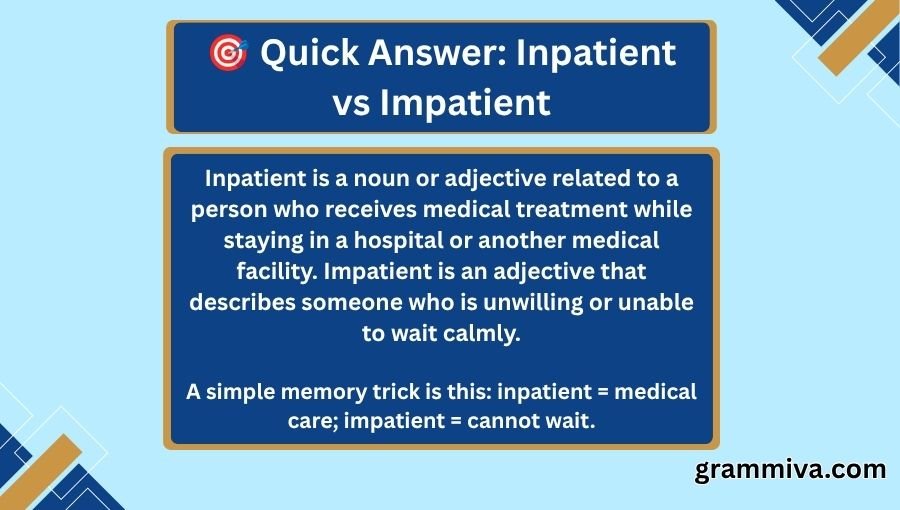
Inpatient is a noun or adjective related to a person who receives medical treatment while staying in a hospital or another medical facility. Impatient is an adjective that describes someone who is unwilling or unable to wait calmly.
A simple memory trick is this: inpatient = medical care; impatient = cannot wait.
Related Word Forms
The two words have a few useful forms, but they do not form one shared word family in meaning. Understanding their common forms can make writing easier.
| Form | Type | Example |
|---|---|---|
| inpatient | noun/adjective | The hospital admitted an inpatient. |
| inpatients | plural noun | The nurses checked on the inpatients. |
| impatient | adjective | The customer became impatient. |
| impatiently | adverb | She waited impatiently. |
| impatience | noun | His impatience was easy to see. |
Notice the spelling difference. Inpatient contains the word patient as a complete part of the word. Impatient changes the prefix to im-.
Understanding Inpatient vs Impatient
The basic difference is meaning. Inpatient relates to receiving medical treatment while staying at a facility. Impatient relates to a person’s lack of patience.
| Form | Type | Meaning | Example | Correct/Incorrect |
|---|---|---|---|---|
| inpatient | Noun | A person staying in a medical facility for treatment | The inpatient received medication. | ✅ Correct |
| inpatient | Adjective | Related to treatment that involves staying at a medical facility | She needs inpatient care. | ✅ Correct |
| impatient | Adjective | Unable or unwilling to wait calmly | The child became impatient. | ✅ Correct |
| impatient | Adjective | Eager for something to happen | We were impatient for the results. | ✅ Correct |
| inpatient | Noun | A person who simply does not like waiting | He was an inpatient in the checkout line. | ❌ Incorrect |
The key is to look at the meaning of the sentence, not just the spelling.
If the sentence involves a hospital stay, medical treatment, or a patient who remains at a facility, inpatient is probably the right word.
If the sentence involves waiting, frustration, eagerness, or a lack of patience, impatient is the right choice.
Is Inpatient the Same as Impatient?
No. Inpatient and impatient have different meanings and different uses.
An inpatient is generally a person who stays at a medical facility for treatment. For example, a patient may be admitted to a hospital and spend several nights there.
An impatient person does not want to wait. For example, someone might become impatient while waiting for a late bus.
Compare these sentences:
- The doctor spoke with the inpatient before surgery.
- The doctor became impatient when the meeting ran late.
The first sentence concerns medical care. The second concerns a person’s attitude toward waiting.
Inpatient: Meaning and Correct Use
Inpatient is commonly used as a noun for a person receiving medical care while staying at a hospital or similar facility. It can also work as an adjective when describing medical services or care.
Inpatient as a Noun
When used as a noun, inpatient refers to the person.
Examples:
- The hospital admitted a new inpatient this morning.
- The nurse checked on each inpatient.
- The doctor reviewed the inpatient’s chart.
- The clinic transferred the inpatient to another unit.
Here, the word names a person who is receiving care while staying at the facility.
Inpatient as an Adjective
The word can also describe care, treatment, programs, or services.
Examples:
- The patient requires inpatient care.
- The doctor recommended an inpatient program.
- The hospital has expanded its inpatient services.
- The center offers both inpatient and outpatient treatment.
The opposite term often used in medical settings is outpatient. An outpatient receives care without staying overnight or being admitted as an inpatient.
A Simple Inpatient Summary
| Use | Meaning | Example |
|---|---|---|
| Person | Someone receiving care while staying at a medical facility | The inpatient met with the doctor. |
| Care | Medical care involving a stay at a facility | She needs inpatient care. |
| Program | A program in which patients stay at the facility | He entered an inpatient program. |
| Services | Medical services provided to admitted patients | The hospital improved its inpatient services. |
💡 Test Tip
Ask yourself: “Am I talking about a hospital stay?”
If the answer is yes, inpatient is likely correct.
If your sentence is about waiting or frustration, stop. You probably need impatient instead.
Impatient: Meaning and Correct Use
Impatient is an adjective. It describes someone who does not want to wait or who has little patience.
It can describe frustration with delays:
- The customer became impatient.
- She was impatient while waiting for the train.
- The students grew impatient after the long delay.
It can also describe strong eagerness for something to happen:
- The children were impatient to open their gifts.
- He was impatient to hear the final decision.
- We were impatient for the new season to begin.
In each case, the idea involves waiting or wanting something to happen soon.
Forms Related to Impatient
| Word | Part of Speech | Meaning | Example |
|---|---|---|---|
| impatient | Adjective | Not willing to wait calmly | She became impatient. |
| impatiently | Adverb | In an impatient manner | He tapped his foot impatiently. |
| impatience | Noun | Lack of patience | Her impatience was obvious. |
| impatiently waiting | Adjective + verb phrase | Waiting with frustration or eagerness | They were impatiently waiting outside. |
Why Do People Confuse Inpatient and Impatient?
People confuse these words because they look and sound very similar. Both contain patient, and both begin with a short prefix.
The difference becomes easier when you focus on the complete meaning.
I once edited a student’s essay about hospital care. The student wrote that a patient was “impatient” after being admitted for several days. The sentence sounded funny because the student meant the medical term inpatient. We changed the word and then used the waiting test to check the rest of the essay.
Fast typing also causes mistakes. When people type quickly, the brain often recognizes the general shape of a word before checking every letter. Autocorrect can make the problem worse because a spell checker may not know what meaning the writer intended.
| Confusing Pair | Correct Difference | Example |
|---|---|---|
| inpatient / impatient | Medical stay vs. lack of patience | The inpatient waited patiently. |
| it’s / its | It is vs. possession | It’s cold. The dog wagged its tail. |
| your / you’re | Possession vs. you are | Your bag is here. You’re early. |
| their / they’re | Possession vs. they are | Their car is new. They’re outside. |
| affect / effect | Usually influence vs. result | Noise can affect sleep. The effect was clear. |
| then / than | Time/order vs. comparison | We ate, then left. She is taller than me. |
The same lesson applies to all these pairs: similar spelling does not guarantee similar meaning.
Inpatient vs Impatient at a Glance
Here is the fastest side-by-side comparison.
| Feature | Inpatient | Impatient |
|---|---|---|
| Main idea | Medical care while staying at a facility | Lack of patience |
| Typical word type | Noun or adjective | Adjective |
| Common setting | Hospital or medical facility | Everyday life |
| Connected idea | Admission and treatment | Waiting and frustration |
| Example | The inpatient met the nurse. | The customer became impatient. |
| Opposite or contrast | Outpatient | Patient |
This table gives you the core rule in seconds.
Correct Meanings and Uses
The easiest way to master these words is to study the situations in which they naturally appear.
Medical Treatment
Use inpatient when discussing a person who has been admitted for treatment.
The hospital has 120 inpatient beds.
Here, inpatient describes beds intended for people who stay at the hospital.
Waiting and Delays
Use impatient when someone is unhappy about waiting.
Mark became impatient after waiting for an hour.
The sentence does not involve medical treatment. It describes Mark’s reaction to a delay.
Eagerness
Impatient can also show that someone strongly wants something to happen.
The fans were impatient for the concert to begin.
The fans are not angry with anyone necessarily. They simply want the event to start.
Medical Adjective Use
Inpatient can describe a type of treatment or service.
The doctor recommended inpatient treatment.
That means the person would receive treatment while staying at the facility.
| Meaning | Word Type | Example Sentence |
|---|---|---|
| Person receiving admitted medical care | Noun | The inpatient spoke with the nurse. |
| Medical care involving a stay | Adjective | The patient needs inpatient treatment. |
| Unable to wait calmly | Adjective | The customer became impatient. |
| Eager for something to happen | Adjective | She was impatient to begin. |
📝 Case Study: A Workplace Email
Imagine that a hospital employee is writing an email to a supervisor.
An employee might write:
“The inpatient was becoming impatient because the test results were delayed.”
This sentence uses both words correctly.
Inpatient identifies the person receiving medical care. Impatient describes the person’s reaction to the delay.
Now consider this incorrect version:
“The impatient was becoming inpatient because the test results were delayed.”
That version changes both meanings and makes the sentence unclear.
A few years ago, I caught a similar mix-up in a short workplace notice. The writer had described “impatient services” when the intended phrase was inpatient services. One letter changed the meaning completely. That is why context matters more than visual similarity.
| Sentence | Word Needed | Reason |
|---|---|---|
| The hospital expanded its ___ unit. | inpatient | The sentence concerns hospital care. |
| The customer became ___ after waiting. | impatient | The sentence concerns waiting. |
| The ___ asked about discharge. | inpatient | The word identifies a medical patient. |
| The children grew ___ before lunch. | impatient | The children did not want to wait. |
Grammar Rules Explanation
Inpatient and impatient are not interchangeable. Their different meanings determine where they belong in a sentence.
Use inpatient when the word relates to a person who stays at a medical facility for treatment or to medical care that involves such a stay.
Use impatient when the word describes a person’s lack of patience, frustration with waiting, or strong eagerness for something to happen.
The spelling gives you a useful clue. Inpatient keeps the full word patient after in-. Impatient uses im- and expresses the opposite of being patient.
Standard English reference sources and major dictionaries distinguish these words by meaning and grammatical use.
A useful rule is:
Hospital stay → inpatient.
Waiting problem → impatient.
Correct vs Incorrect at a Glance
| Sentence | Correct/Incorrect | Why |
|---|---|---|
| The inpatient was discharged on Friday. | ✅ Correct | The person was receiving admitted medical care. |
| The patient became impatient during the delay. | ✅ Correct | The person did not want to wait. |
| The hospital offers impatient treatment. | ❌ Incorrect | The intended medical term is inpatient treatment. |
| The inpatient customer complained about the long line. | ❌ Incorrect | A person waiting in a line may be impatient, not an inpatient. |
| The children were impatient for the movie to start. | ✅ Correct | They were eager and unwilling to wait. |
⚠️ Common Mistakes With These Words
The most common error is choosing the word based on appearance instead of meaning.
Here are the main reasons mistakes happen:
- Fast typing: Your fingers may produce the familiar-looking word automatically.
- Autocorrect: Software can sometimes accept a correctly spelled word that is wrong for the sentence.
- Lack of knowledge: If you have never learned the difference, the words can seem interchangeable.
- Visual similarity: Both words contain “patient,” so they are easy to mix up.
- Weak context checking: Writers sometimes focus on spelling instead of asking what the sentence actually means.
I once caught myself typing impatient in a sentence about hospital admissions. I was writing quickly and noticed the error only when I reread the paragraph. That small mistake reminded me that even experienced writers benefit from a quick context check.
Common Wrong Spellings and Uses
| Wrong Form or Use | What’s Wrong | Correct Form |
|---|---|---|
| impatient care | Usually means care that lacks patience | inpatient care |
| inpatient with a long line | Does not describe frustration | impatient with a long line |
| an impatient was admitted | Wrong noun for a medical patient | an inpatient was admitted |
| the inpatient child kept complaining about waiting | May be correct only if the child is also an inpatient; context matters | inpatient or impatient, depending on meaning |
| impatient services | Wrong medical term when referring to admitted care | inpatient services |
| she was inpatient for the bus | Wrong word for waiting | she was impatient for the bus |
The fourth example shows an important point: a sentence can contain both words correctly if the meanings fit. Context always wins.
How To Remember the Difference
A simple memory trick can make this pair much easier.
Think of inpatient as:
IN the hospital → inpatient
Then think of impatient as:
I’M tired of waiting → impatient
You can also use a two-word test:
Hospital = inpatient.
Waiting = impatient.
Try these examples mentally:
- “She stayed at the hospital.” → inpatient
- “He hates waiting.” → impatient
- “The hospital added more beds.” → inpatient
- “The customer kept checking the clock.” → impatient
This method works because it connects spelling to meaning instead of asking you to memorize a complicated grammar rule.
Usage in Different Contexts
The correct choice can become obvious when you consider where the word appears.
| Context | Which Term to Use | Example |
|---|---|---|
| Everyday conversation | impatient for waiting behavior; inpatient for medical care | I became impatient waiting for the bus. |
| Professional writing | inpatient for medical services; impatient for behavior | The report discusses inpatient care. |
| Creative writing | Either, depending on meaning | The impatient traveler checked the clock. |
| Social media/texting | Either, depending on meaning | I’m so impatient for the weekend! |
In medical writing, inpatient is especially common. In everyday conversations, impatient may appear more often because people frequently talk about waiting, delays, and frustration.
Common Phrases With Inpatient and Impatient
There are several natural combinations worth remembering.
| Phrase | Meaning |
|---|---|
| inpatient care | Medical care provided while the patient stays at a facility |
| inpatient treatment | Treatment involving admission and a stay |
| inpatient unit | A hospital area for admitted patients |
| inpatient services | Services provided to admitted patients |
| become impatient | Start losing patience |
| grow impatient | Gradually become less willing to wait |
Learning common phrases can make correct usage feel automatic.
Synonyms and Alternatives
Sometimes you can avoid the confusion by choosing a different word. However, not every synonym works in every sentence.
| Alternative | Works When | Does Not Work When |
|---|---|---|
| admitted patient | You need to describe a person staying for medical care | You are describing frustration with waiting |
| hospital patient | You need a broad medical description | You specifically need the technical idea of inpatient care |
| frustrated | Someone is upset by a problem or delay | You need to describe medical admission |
| eager | Someone strongly wants something to happen | The person is simply a hospital inpatient |
| restless | Someone cannot stay calm or still | You need a medical term for admitted care |
For example, “The customer was frustrated” may work instead of “The customer was impatient.” But “frustrated” does not have exactly the same meaning in every situation.
Why It Matters
Getting these words right improves clarity. A single letter can change the meaning of a sentence.
It also matters in professional writing. Medical documents, workplace emails, school papers, and published articles all depend on precise word choice.
A useful writing principle is:
Clear words make clear ideas.
| Situation | Why Getting It Right Matters |
|---|---|
| Resume | Correct word choice makes your writing look careful and professional. |
| Client email | A wrong word can make a message confusing or embarrassing. |
| Published content | Readers expect accurate spelling and meaning. |
| Social post | Small mistakes can change what readers think you mean. |
In healthcare writing, precision matters even more. Inpatient and impatient can describe completely different ideas, so replacing one with the other may confuse readers.
Is Inpatient Always a Medical Word?
In standard modern use, inpatient is strongly connected with medical care and admission to a facility.
You will often see it in phrases such as:
- inpatient care
- inpatient treatment
- inpatient unit
- inpatient admission
- inpatient services
- inpatient facility
The exact details of what qualifies someone as an inpatient can vary by healthcare system and setting. For ordinary grammar purposes, however, the main distinction is simple: the term concerns someone receiving care while staying at a medical facility.
Can a Person Be Both Inpatient and Impatient?
Yes. A person can be both at the same time.
For example:
The inpatient became impatient while waiting for the doctor.
Here, inpatient tells us who the person is in the medical setting. Impatient tells us how the person feels about waiting.
This is one of the best sentences to memorize because it shows the meanings side by side.
| Person’s Situation | Correct Word |
|---|---|
| Staying in a hospital for treatment | inpatient |
| Angry about a long wait | impatient |
| Staying in a hospital and annoyed about waiting | both |
| Waiting for a bus | impatient |
| Receiving admitted medical care | inpatient |
How Context Changes the Meaning
Context is the strongest clue.
Consider the sentence:
“She was waiting.”
By itself, it does not tell us whether she was impatient.
Now add:
“She was waiting and checking the clock every few seconds.”
Impatient becomes a natural choice.
Now change the sentence:
“She was staying at the hospital for treatment.”
That points toward inpatient.
The surrounding words often make the choice clear.
| Context Clue | Likely Word |
|---|---|
| hospital | inpatient |
| admitted | inpatient |
| medical treatment | inpatient |
| hospital unit | inpatient |
| waiting | impatient |
| delay | impatient |
| frustrated | impatient |
| eager | impatient |
Practice Examples: Choose the Right Word
Try filling in each blank before checking the answers.
- The hospital admitted a new ______ yesterday.
- The customer became ______ after waiting for 30 minutes.
- The doctor recommended ______ treatment.
- The children were ______ for the party to begin.
- The nurse checked on every ______.
- The traveler grew ______ because the train was late.
Answers
| Number | Answer | Reason |
|---|---|---|
| 1 | inpatient | It refers to a person receiving admitted medical care. |
| 2 | impatient | The customer was unhappy about waiting. |
| 3 | inpatient | The phrase describes medical treatment involving admission. |
| 4 | impatient | The children were eager for something to happen. |
| 5 | inpatient | The nurse is checking admitted patients. |
| 6 | impatient | The traveler is frustrated by a delay. |
Quick Recap Checklist
Use this checklist whenever you are unsure.
| Question | If Yes → Use |
|---|---|
| Is the sentence about hospital admission? | inpatient |
| Is it about a person staying for medical treatment? | inpatient |
| Is it about medical care provided during a stay? | inpatient |
| Is someone unhappy about waiting? | impatient |
| Is someone eager for something to happen? | impatient |
| Does the sentence involve frustration with a delay? | impatient |
Three Final Practice Examples
Example 1:
The doctor recommended inpatient care.
✅ The sentence concerns medical treatment.
Example 2:
The patient became impatient while waiting for the test results.
✅ The sentence concerns frustration with waiting.
Example 3:
The inpatient was impatient about the delayed meal.
✅ Both words are correct because they describe two different things.
FAQs About Inpatient vs Impatient
What is the main difference between inpatient and impatient?
Inpatient relates to medical care while a person stays at a medical facility. Impatient describes someone who does not want to wait or who is eager for something to happen.
Is an inpatient a person in a hospital?
Usually, yes. An inpatient is a person who has been admitted to a medical facility and stays there while receiving care.
What does impatient mean?
Impatient means unwilling or unable to wait calmly. It can also describe someone who is very eager for something to happen.
Is it inpatient care or impatient care?
The correct medical phrase is inpatient care. It refers to care provided to patients who stay at a medical facility.
Is it inpatient treatment or impatient treatment?
The correct phrase is inpatient treatment when you mean treatment that involves staying at a medical facility.
Can someone be both an inpatient and impatient?
Yes. A person can be an inpatient because they are staying in a medical facility and impatient because they are tired of waiting.
How can I remember inpatient vs impatient?
Use this shortcut: inpatient = in medical care; impatient = not willing to wait.
Is inpatient a noun or an adjective?
It can be both. As a noun, it refers to a person receiving admitted medical care. As an adjective, it can describe medical care, services, treatment, or facilities related to admitted patients.
Is impatient an adjective?
Yes. Impatient is an adjective. Related forms include impatiently, an adverb, and impatience, a noun.
Why are inpatient and impatient so easy to confuse?
They look very similar and both contain patient. Their meanings are different, though, so the safest way to choose is to focus on the sentence’s meaning rather than its spelling.
Final Rule to Remember
Inpatient vs impatient becomes easy when you stop looking at the letters alone and focus on the situation. 🧠
Use inpatient for a person who stays at a medical facility for treatment or for medical care connected with that stay. Use impatient for someone who does not want to wait, feels frustrated by a delay, or strongly wants something to happen.
The fastest test is simple: Is this about a hospital stay? Choose inpatient. Is it about waiting or frustration? Choose impatient.
If you remember that one question, you can avoid most mistakes with these two words. And remember that both can appear in the same sentence: an inpatient can certainly become impatient while waiting for a doctor.
Good writing is often about small choices that make a big difference. When you choose the word that matches your meaning, your writing becomes clearer, sharper, and easier to trust. ✨

I am Adam Wilson, an English language content writer with an interest in grammar and vocabulary. I work at Grammiva and focus on creating clear explanations and practical examples for English learners.



[…] the end, you should be able to choose the correct form without stopping to think. ✨ Inpatient vs Impatient | Elude vs Allude | Relieving vs […]
[…] tricks, workplace examples, and FAQs so you can use both words with confidence. Setup vs Set Up | Inpatient vs Impatient | Elude vs […]