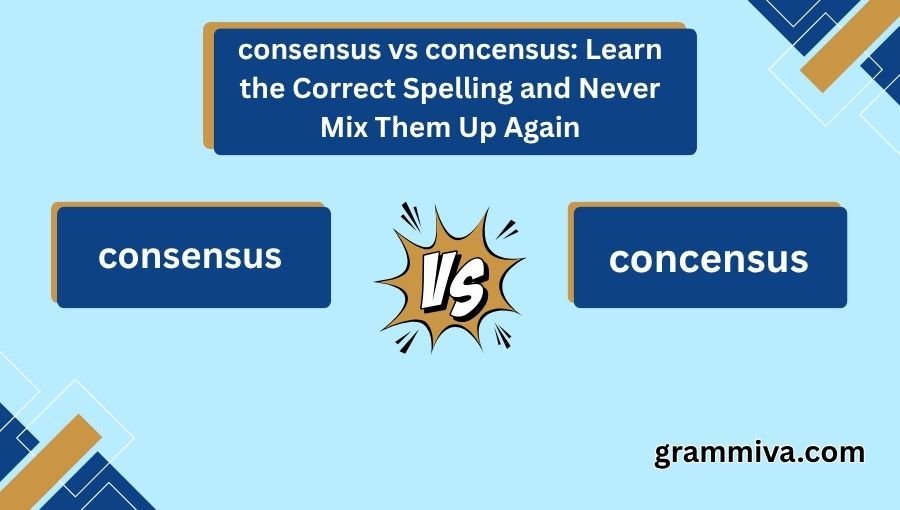
Have you ever typed a word, looked at it twice, and suddenly wondered if it looks right? That happens often with consensus vs concensus. The two forms look almost identical, and the extra c in concensus can feel natural when you type quickly. But only one spelling is standard in modern US English.
The correct word is consensus. It means general agreement among a group of people. Concensus is a common misspelling of that word. It may appear in emails, school papers, online posts, and even informal workplace messages, but that does not make it the accepted spelling.
I teach writers to solve this kind of spelling problem by focusing on the word’s structure rather than trusting how it sounds. Once you learn the pattern, this pair becomes much easier to remember. 😊
In this guide, I will explain the difference, show you correct examples, cover common mistakes, and give you simple memory tricks. By the end, you should be able to choose the right form without stopping to second-guess yourself. ✍️ Apparent vs Aparent | Camouflage vs Camoflage | Acknowledge vs acknowlege
🎯 Quick Answer: consensus vs concensus
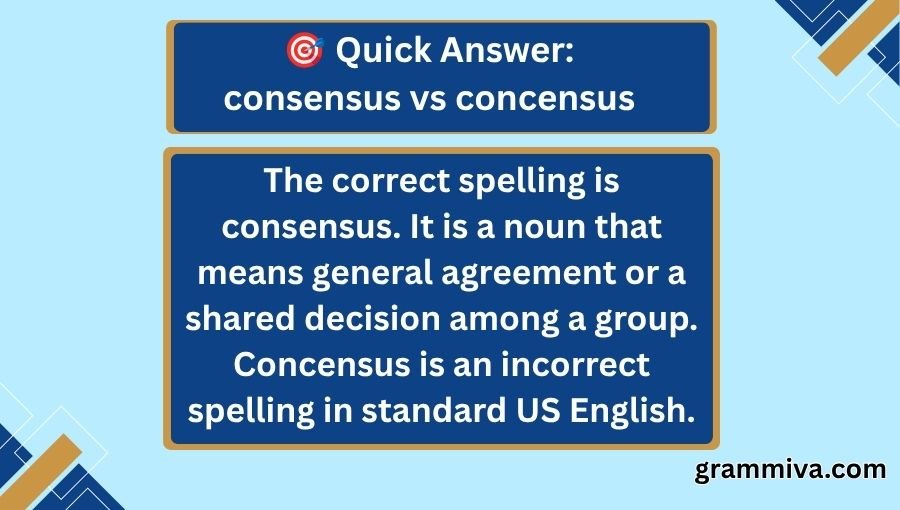
The correct spelling is consensus. It is a noun that means general agreement or a shared decision among a group. Concensus is an incorrect spelling in standard US English.
| Form | Correct? | Meaning | Example |
|---|---|---|---|
| consensus | ✅ Yes | General agreement | The team reached a consensus. |
| concensus | ❌ No | Not the standard spelling | The team reached a concensus. |
A simple rule is enough: Use consensus when you mean general agreement. Do not add the extra “c.”
Is consensus the same as concensus?
No. Consensus is the standard English word, while concensus is a misspelling. The difference is only one letter, but that letter matters in formal writing.
Think of the spelling this way:
con + sensus = consensus
The word does not need another c after con.
| Word | Letter Pattern | Status | Example |
|---|---|---|---|
| consensus | c-o-n-s-e-n-s-u-s | ✅ Correct | We reached a consensus. |
| concensus | c-o-n-c-e-n-s-u-s | ❌ Incorrect | We reached a concensus. |
This is a spelling issue, not a difference in meaning. If someone writes concensus, they normally mean consensus.
What does consensus mean?
Consensus means general agreement within a group. It does not always mean that every person agrees with every detail. Instead, it usually means that the group has reached a shared view or decision.
For example:
The committee reached a consensus on the new policy.
Here, the committee has reached a shared decision.
Another example is:
There was broad consensus that the plan needed changes.
This means that most or all of the group shared the same basic view.
| Meaning | Word Type | Example Sentence |
|---|---|---|
| General agreement | Noun | The board reached a consensus. |
| Shared view | Noun | There was consensus among the teachers. |
| Group agreement on a decision | Noun | The team reached consensus on the next step. |
Can consensus mean complete agreement?
Not always. Consensus usually describes broad or general agreement, not necessarily perfect agreement on every small point.
For example:
The group reached a consensus, although two members still had concerns.
The group agrees on the main decision, but individual members may still have questions or reservations.
That distinction is useful in meetings, reports, news writing, and academic work.
Why do people confuse consensus and concensus?
The easiest way to understand consensus vs concensus is to focus on the extra c in the incorrect form. People often confuse these spellings because the incorrect version looks like it should work. The word consensus contains several sounds close together, and when people say it quickly, the spelling can be hard to picture.
There is also a familiar pattern that causes trouble. English has many words containing con-, and writers may insert another c when they try to spell the word by sound.
I once edited a short team report in which a writer used concensus three times. The writer knew exactly what the word meant. The problem was simply that the extra c had become part of their mental spelling. Once we removed it from the first example, the rest of the edits were easy.
Here is the key point:
You are not choosing between two meanings. You are choosing between the standard spelling and a misspelling.
| Possible Reason | What Happens | Helpful Fix |
|---|---|---|
| Fast typing | Extra letters appear | Slow down for important words |
| Sound-based spelling | The writer spells what they hear | Learn the written form |
| Memory of the wrong form | The incorrect spelling looks familiar | Memorize the correct pattern |
| Autocorrect failure | Software does not catch every error | Proofread manually |
| Lack of exposure | The word is rarely seen in print | Read and write it often |
🧠 consensus vs concensus at a Glance
The easiest way to understand consensus vs concensus is to compare the letters directly. The correct form has no second c after con.
| Form | Spelling | Meaning | Example | Correct/Incorrect |
|---|---|---|---|---|
| consensus | c-o-n-s-e-n-s-u-s | General agreement | The group reached a consensus. | ✅ Correct |
| concensus | c-o-n-c-e-n-s-u-s | Intended to mean agreement | The group reached a concensus. | ❌ Incorrect |
The spelling rule in one line
Consensus has one c at the beginning, followed by “onsensus.”
A useful visual reminder is:
con + sensus → consensus
Not:
con + census → concensus
The second version adds an unnecessary c.
What are the correct meanings and uses of consensus?
The word consensus is used when people, groups, teams, or organizations share a general opinion or reach a shared decision.
Consensus as group agreement
This is the most common use.
The members reached a consensus after an hour of discussion.
The sentence tells us that the members came to a shared decision.
Consensus as a shared opinion
The word can also describe a broad opinion.
There is growing consensus that the project needs more time.
Here, consensus refers to a widely shared view rather than one specific vote.
Consensus in decision-making
Businesses, committees, schools, and community groups often use the word when discussing decisions.
The managers reached a consensus about the hiring plan.
This does not necessarily mean that every manager loved the plan. It means the group reached enough agreement to move forward.
| Use | What It Means | Example |
|---|---|---|
| Group decision | People agree on what to do | The team reached a consensus. |
| Shared opinion | People hold a similar view | There is consensus on the issue. |
| Broad agreement | A large degree of agreement exists | Scientists reached broad consensus. |
💡 Test Tip
When you are unsure, replace the word with general agreement.
If the sentence still makes sense, consensus may be the word you need.
For example:
The committee reached a consensus.
Replace it:
The committee reached general agreement.
The meaning stays clear. That is a good sign that consensus is correct.
If you are writing the misspelled form concensus, remember that changing it to consensus fixes the spelling without changing the meaning.
How should consensus be used in a sentence?
A common pattern is:
subject + reached + consensus
Examples include:
The board reached a consensus.
The students reached a consensus.
The team reached a consensus on the proposal.
Another common pattern is:
there is + consensus + that…
For example:
There is consensus that the policy should change.
You may also see:
There was broad consensus among the members.
The exact sentence pattern can change, but the spelling does not.
| Sentence Pattern | Example |
|---|---|
| reach a consensus | The team reached a consensus. |
| reach consensus | The leaders reached consensus. |
| there is consensus | There is consensus on the issue. |
| broad consensus | The proposal has broad consensus. |
| consensus among a group | There was consensus among the members. |
📝 Case Study: A workplace email
Imagine that a project manager sends this email:
After reviewing the three proposals, we reached a consensus on the second option.
This is correct. The manager is telling the team that the group agreed on a choice.
Now imagine this version:
After reviewing the three proposals, we reached a concensus on the second option.
The meaning is still understandable, but the spelling is wrong.
I once caught this exact kind of problem while reviewing a workplace message before it was sent to a large group. The writer had used concensus in the subject line. We corrected it to consensus before sending the message. The change took one second, but it made the email look much more polished.
| Workplace Situation | Recommended Sentence |
|---|---|
| Team decision | We reached a consensus on the plan. |
| Meeting summary | The meeting ended with a consensus. |
| Project update | There is consensus on the next step. |
| Client communication | The group reached consensus on the proposal. |
What is the grammar rule behind consensus vs concensus?
The grammar rule is simple: consensus is the standard noun used for general agreement, and concensus is not the standard spelling of that noun in modern US English.
The issue is spelling rather than sentence grammar. You can place consensus in different grammatical structures, but changing the spelling to concensus does not create a new grammatical form.
Standard reference works and major dictionaries consistently treat consensus as the accepted English spelling. The important lesson for writers is not to create an extra c based on how the word may sound.
Spelling, not meaning
Consider these sentences:
The committee reached a consensus.
The committee discussed the consensus.
The consensus was clear.
The noun stays spelled consensus in each sentence.
The form does not become concensus simply because its role in the sentence changes.
Correct vs Incorrect at a Glance
| Sentence | Correct/Incorrect | Why |
|---|---|---|
| The committee reached a consensus. | ✅ Correct | Consensus is the standard spelling. |
| The committee reached a concensus. | ❌ Incorrect | The extra c is not part of the standard spelling. |
| There was broad consensus among the members. | ✅ Correct | The noun is used correctly. |
| There was broad concensus among the members. | ❌ Incorrect | Concensus is a misspelling. |
| The group agreed by consensus. | ✅ Correct | Consensus correctly describes group agreement. |
The important pattern is easy to see: the correct sentence uses consensus every time.
⚠️ Common Mistakes With Consensus
Most mistakes with this word are spelling mistakes rather than grammar mistakes. Writers usually know the meaning but remember the letters incorrectly.
Why does the wrong spelling look so convincing?
The incorrect form concensus looks familiar because English contains many words with the letters con followed by another consonant. When people type from memory, the brain may fill in an extra c without the writer noticing.
The problem becomes more likely when someone is typing quickly.
| Mistake Type | Example | Better Approach |
|---|---|---|
| Extra letter | concensus | Write consensus |
| Sound-based spelling | A spelling based on pronunciation | Check the written form |
| Fast typing | A repeated typo | Proofread key terms |
| Autocorrect trust | Assuming software catches everything | Read the sentence yourself |
| Memory error | Remembering the wrong pattern | Use a spelling trick |
Similar spelling and grammar confusions
The same general problem appears with other English pairs.
| Confusion | Correct Form | Common Error | Quick Reminder |
|---|---|---|---|
| its / it’s | its / it’s | Mixing possession and contraction | It’s = it is |
| your / you’re | your / you’re | Mixing possession and contraction | You’re = you are |
| their / there / they’re | their / there / they’re | Choosing by sound | Check the meaning |
| affect / effect | affect / effect | Mixing related terms | Check the sentence role |
| then / than | then / than | Confusing comparison and time | Than is common in comparisons |
| consensus / concensus | consensus | Adding an extra c | No second c |
Specific wrong spellings to avoid
| Wrong Form | What’s Wrong | Correct Form |
|---|---|---|
| concensus | Extra c | consensus |
| consencus | Letters are in the wrong order | consensus |
| consensous | Incorrect ending | consensus |
| consenus | Missing s | consensus |
| consenssus | Extra s | consensus |
| consenus | Missing a letter | consensus |
Some of these errors are less common than concensus, but they show why spelling from sound can be risky.
What is the history of the word consensus?
The history of consensus is useful because it helps explain why the word does not need the extra c. The English word comes from Latin, where consensus relates to agreement or shared feeling.
You do not need to memorize the full history to spell it correctly. The practical lesson is that the standard form has been established as consensus, not concensus.
| Period | Form | Note |
|---|---|---|
| Latin usage | consensus | Associated with agreement or shared judgment |
| Later European usage | consensus | The form continued to be used for agreement |
| English usage | consensus | The word became established in English |
| Modern US English | consensus | This is the standard spelling today |
The historical detail is less important than the modern rule: write consensus when you mean general agreement.
How does consensus work in different contexts?
The word works well in everyday speech, professional writing, creative writing, and digital communication. The context changes, but the spelling stays the same.
| Context | Which Term to Use | Example |
|---|---|---|
| Everyday conversation | consensus | We finally reached a consensus. |
| Professional writing | consensus | The board reached a consensus. |
| Creative writing | consensus | A quiet consensus formed within the village. |
| Social media/texting | consensus | Looks like we have a consensus! |
Everyday conversation
You might say:
We all talked about it and reached a consensus.
This sounds natural when describing group agreement.
Professional writing
The word is especially useful in reports and meeting notes.
The committee reached a consensus regarding the proposed changes.
In formal writing, correct spelling matters because readers may judge the quality of the entire document from small errors.
Creative writing
Writers can use consensus when describing a group’s shared view.
After several tense conversations, the family reached a quiet consensus.
Social media and texting
Informal writing is more relaxed, but the standard spelling remains consensus.
Okay, we have a consensus! 🎉
Being online does not change the spelling rule.
Are there common phrases with consensus?
Yes. Consensus appears in several common phrases, especially when people describe group agreement or shared views.
| Phrase | Meaning |
|---|---|
| reach a consensus | Come to general agreement |
| build consensus | Work toward agreement |
| broad consensus | Strong or widespread agreement |
| general consensus | General agreement |
| consensus among members | Shared view within a group |
| consensus on an issue | Agreement about a topic |
One phrase deserves special attention: general consensus.
It is common, but some writers consider it repetitive because consensus already refers to general agreement. Still, the phrase is widely used and understandable.
For simple, clean writing, you can often use consensus by itself.
Instead of:
There was a general consensus among the group.
You can write:
There was consensus among the group.
Or:
The group reached a consensus.
How can you remember the spelling?
A simple way to remember consensus vs concensus is to notice that the correct word has no extra c. The best memory trick is to break the word into a simple visual pattern:
CON + SENSUS
Notice that the middle begins with s, not c.
A second trick is to connect the word with sense:
consensus → sense → shared sense or agreement
This is not a formal spelling rule. It is simply a memory aid.
You can also write the word three times:
consensus
consensus
consensus
Seeing the correct form repeatedly helps replace the incorrect mental image.
| Memory Trick | How It Helps |
|---|---|
| CON + SENSUS | Reminds you that the middle starts with s |
| Think “shared sense” | Connects spelling with meaning |
| Remove the extra c | Fixes concensus quickly |
| Type it three times | Builds visual memory |
| Use it in a sentence | Connects spelling with real use |
consensus vs concensus: The easiest rule to remember
When comparing consensus vs concensus, do not ask which word sounds better. Ask which spelling you have seen in reliable English writing.
The correct form is:
consensus
The incorrect form is:
concensus
The extra c is the problem.
Here is the fastest test:
Does the word mean general agreement?
If yes, write consensus.
| Question | Answer |
|---|---|
| Does it mean general agreement? | Use consensus |
| Does it contain an extra c after “con”? | Remove it |
| Are you writing a formal document? | Definitely use consensus |
| Did autocorrect change the word? | Check the spelling yourself |
| Are you unsure? | Write consensus |
What alternatives can replace consensus?
Sometimes you can replace consensus with another phrase. The best choice depends on what you want to emphasize.
| Alternative | Works When | Does Not Work When |
|---|---|---|
| agreement | You mean people agree | You need to stress a group decision |
| shared view | You mean people hold a similar opinion | There is a formal decision |
| common ground | People find a position they share | The group simply votes |
| general agreement | You want very clear wording | You need a shorter phrase |
| unity | You want to stress togetherness | People agree only on one issue |
For example:
The team reached a consensus.
could become:
The team reached an agreement.
Both can work, but consensus specifically fits situations involving broad group agreement.
💬 Why does getting consensus right matter?
Correct spelling supports clear communication. A misspelled word may not prevent readers from understanding you, but repeated spelling errors can distract them and make your writing seem less polished.
I once reviewed a short professional report that had excellent ideas but several small spelling errors. The writer had done the hard thinking. Yet the errors made the report feel less finished. Fixing small details helped the ideas stand out.
A useful writing principle is:
Clear words make clear ideas easier to trust.
| Situation | Why Getting It Right Matters |
|---|---|
| Resume | Shows care and attention to detail |
| Client email | Creates a polished professional impression |
| Published content | Builds reader confidence |
| Social post | Makes the message easier to read and share |
Clarity in communication
If you write consensus, readers can quickly recognize the word. If you write concensus, many readers will understand you, but some may pause and notice the error.
Professionalism
Small spelling errors can affect how polished a report, proposal, or email feels.
Digital communication
Search engines, spell-check tools, and readers all benefit from standard spelling. Correct wording also makes your writing easier to reuse in documents and other content.
Is there a special exception to the spelling rule?
There is no common modern US English exception that makes concensus an accepted spelling of the noun meaning general agreement. In ordinary writing, use consensus.
If you encounter concensus in an old document, a user-generated post, a typo-filled text, or another informal source, treat it as a spelling error unless the context clearly shows that it is being used as something else, such as a proper name.
For normal English writing, the choice is simple:
consensus = correct
concensus = incorrect
✅ Quick Recap Checklist
Use this checklist whenever you are unsure.
| Question | If Yes → Use |
|---|---|
| Do you mean general agreement? | consensus |
| Are you describing a shared group view? | consensus |
| Are you writing about a group decision? | consensus |
| Did you type an extra c after “con”? | Remove it |
| Are you writing formal US English? | consensus |
Practice examples
- The committee reached a consensus after a long discussion.
- There was broad consensus among the team members.
- The two departments worked together to build consensus.
Remember: none of these sentences needs concensus.
FAQs About consensus vs concensus
Is consensus the correct spelling?
Yes. Consensus is the correct standard spelling for the noun meaning general agreement.
Is concensus a word?
Concensus is generally treated as a misspelling of consensus in standard modern US English. If you mean general agreement, write consensus.
What is the difference between consensus and concensus?
There is no standard difference in meaning. Consensus is the accepted spelling. Concensus is an incorrect spelling.
How do you spell consensus correctly?
Spell it c-o-n-s-e-n-s-u-s: consensus.
The key detail is that there is no extra c after con.
What does consensus mean?
Consensus means general agreement among members of a group. It can describe agreement about an opinion, decision, plan, or issue.
Can I say “reach a consensus”?
Yes. Reach a consensus is a common and natural phrase.
Example:
The team reached a consensus on the proposal.
Is “general consensus” grammatically correct?
Yes, general consensus is widely used and understood. However, because consensus already involves general agreement, you can often make your writing shorter by using consensus alone.
Can consensus mean everyone agrees?
Not necessarily. Consensus usually means broad or general agreement. A group can reach consensus even when some members have small concerns or reservations.
How can I remember consensus spelling?
Remember:
CON + SENSUS = consensus
Think of the middle as starting with s, not c. If you see concensus, remove the extra c.
Is consensus formal or informal?
Consensus works in both formal and informal settings. You can use it in casual conversation, workplace writing, reports, academic writing, and social media.
🎯 Final Takeaway: consensus vs concensus
consensus vs concensus has a simple answer: consensus is the correct spelling, while concensus is a misspelling. The correct word is a noun that describes general agreement, a shared view, or a group decision.
The best way to avoid the error is to remember the spelling as con + sensus. Do not add another c after con. When you see concensus in your draft, correct it to consensus.
This small spelling rule can save you from an easy mistake in emails, reports, schoolwork, articles, and everyday messages. Once the correct form becomes familiar, you will probably stop noticing the temptation to add that extra letter. 😊
So the next time you pause over the word, keep one simple line in mind:
Consensus means agreement. Consensus is the correct spelling. ✅
Write it once, write it right, and let your ideas take center stage.

I am Ryan Mitchell, a writer focused on English grammar, vocabulary, and everyday language. I work at Grammiva, creating easy-to-understand articles that help readers improve their English with confidence.

[…] you publish or send your writing. By the end, Caribbean vs Carribean should be an easy choice. 😊 consensus vs concensus | Apparent vs Aparent | Camouflage vs […]
[…] you should be able to choose the right form quickly and confidently. 😊 Caribbean vs Carribean | consensus vs concensus | Apparent vs […]