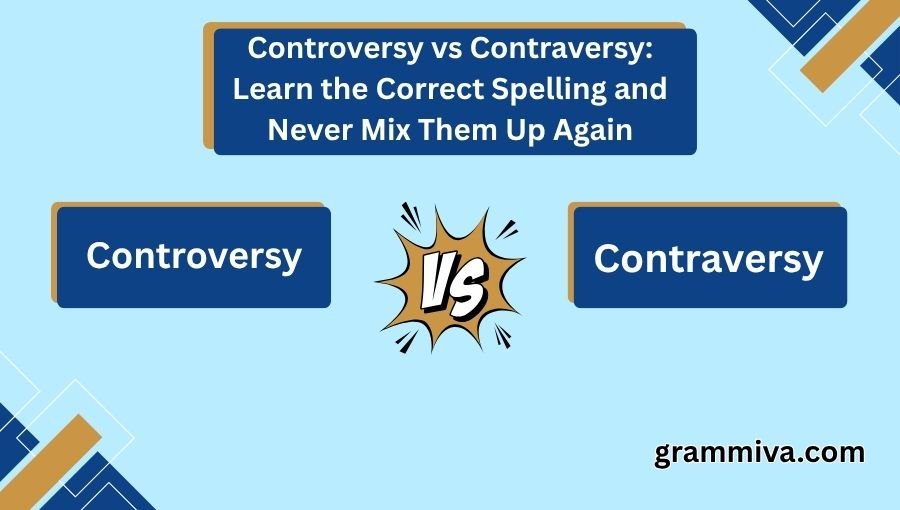
Have you ever typed a word, looked at it twice, and suddenly wondered whether you spelled it correctly? I have seen this happen with one word again and again: controversy vs contraversy. The two forms look close enough to fool a tired writer, especially when typing quickly. But there is a clear answer. One spelling is standard English, while the other is a common spelling error.
The correct word is controversy. It is a noun that describes a disagreement, debate, or dispute about an issue. Contraversy is not the standard spelling of the word. ❌
This small spelling difference can matter more than you might expect. A misspelled word can make an email look rushed. It can also distract readers from an otherwise strong article, report, essay, or social post. ✍️
I have edited many pieces of writing where one wrong spelling stood out more than the writer expected. The good news is that this mistake is easy to fix once you understand the correct form and learn a simple way to remember it. A Lot vs Allot | Caribbean vs Carribean | consensus vs concensus
🎯 Quick Answer: Controversy vs Contraversy
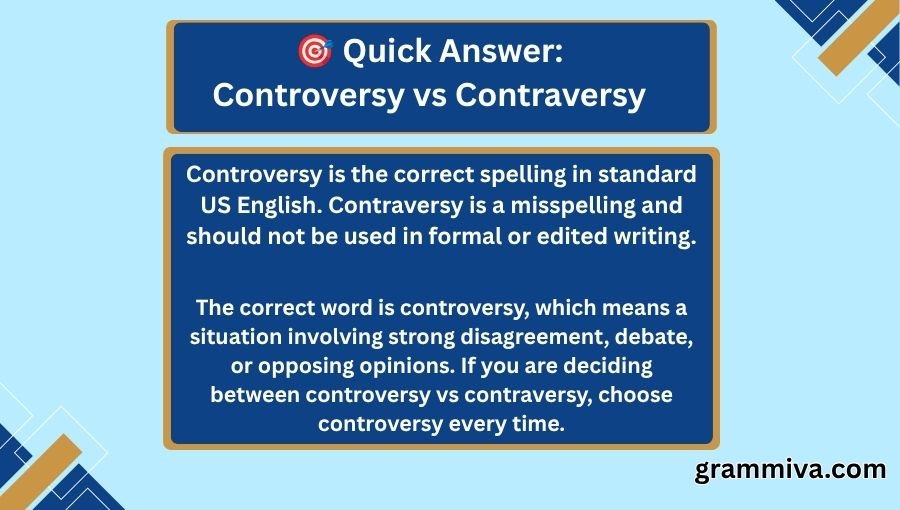
Controversy vs contraversy has a simple answer: controversy is the correct standard spelling, while contraversy is a misspelling.
Use controversy when you mean a public or personal disagreement, debate, or dispute. For example: “The new rule caused controversy among local residents.”
| Form | Status | Example |
|---|---|---|
| controversy | ✅ Correct | The decision sparked controversy. |
| contraversy | ❌ Incorrect | The decision sparked contraversy. |
Is Controversy the Same as Contraversy?
No. Controversy is the correct English word. Contraversy is a common misspelling that should normally be avoided in standard writing.
The confusion comes from the way the word sounds. Some speakers may hear or say a vowel sound that makes the incorrect spelling feel natural. When that sound is turned into letters, contraversy can seem reasonable.
It is not, however, the standard written form.
| Word | Correct? | Basic meaning |
|---|---|---|
| controversy | ✅ | A dispute, disagreement, or debated issue |
| contraversy | ❌ | Nonstandard spelling of controversy |
| controversies | ✅ | Plural form of controversy |
| controversy’s | ✅ | Possessive form when grammatically needed |
📝 Controversy: Meaning and Correct Use
Controversy is a noun. It refers to a situation, subject, or decision that causes strong disagreement or debate. In the controversy vs contraversy spelling question, only controversy is correct. The word refers to a disagreement, disputed issue, or public debate.
The word can describe a small disagreement, but it is often used for issues that attract public attention. Politics, sports, business decisions, school rules, entertainment, and social issues can all become subjects of controversy.
Here are several correct examples:
- The policy created controversy in the community.
- The athlete became involved in a controversy.
- The controversy continued for several weeks.
- The company tried to respond to the controversy.
- The film generated controversy after its release.
The important point is that the word always contains -vers- in the middle:
controversy
Not:
contraversy
| Meaning | Word Type | Example Sentence |
|---|---|---|
| Public disagreement | Noun | The decision caused controversy. |
| Heated debate | Noun | The issue remains a source of controversy. |
| Disputed matter | Noun | The controversy drew national attention. |
When Should You Use Controversy?
Use controversy when you are talking about an issue that people disagree about or debate.
For example:
The school dress-code change caused controversy among parents.
Here, controversy is the subject of the sentence. It tells us that the change created disagreement.
Another example is:
The referee’s decision became a major controversy.
The word identifies the disputed matter.
Can Controversy Describe a Personal Disagreement?
Yes, although the word often suggests a wider or more noticeable dispute.
For a very small personal disagreement, words such as argument, dispute, or disagreement may sound more natural.
For example:
- “They had an argument about dinner.”
- “The new law caused controversy.”
The second sentence describes a broader issue.
💡 Test Tip: How To Remember the Correct Spelling
I use a simple visual test when checking this word: look for “vers” in the middle.
Think:
contro + vers + y
That middle vers can help you reject the tempting spelling contraversy.
Another useful trick is to connect the word with a familiar form:
controversial → controversy
If you know how to spell controversial, the correct noun becomes easier to remember.
| Memory Check | Result |
|---|---|
| Does it contain “vers”? | ✅ Correct |
| Does it contain “avers” instead? | ❌ Check the spelling |
| Is the word “controversy”? | ✅ Standard spelling |
| Is the word “contraversy”? | ❌ Misspelling |
Why Do People Confuse Controversy and Contraversy?
People confuse these spellings mainly because English spelling does not always match pronunciation perfectly. The word also has several letters in a row that can be easy to rearrange when writing from memory. When comparing controversy vs contraversy, the main issue is usually spelling rather than meaning. Readers often recognize the word but hesitate when they have to write it.
Fast typing makes the problem worse. A writer may know the word but type the first spelling that seems right.
I once caught myself typing contraversy in a draft after working through several pages of notes. I knew the correct word, but my fingers followed the sound instead of the spelling. That small mistake reminded me why proofreading matters even when you know the vocabulary well.
Other causes include:
- writing too quickly;
- relying on sound alone;
- seeing the incorrect spelling online;
- autocorrect failing to catch the mistake;
- not reading the final draft carefully;
- confusing similar-looking letter patterns.
| Cause | Why It Causes Trouble | Simple Fix |
|---|---|---|
| Fast typing | Fingers may follow sound | Slow down for tricky words |
| Pronunciation | Sound may suggest the wrong letters | Check the written form |
| Autocorrect | Software may miss unusual errors | Proofread manually |
| Limited exposure | The correct spelling may not feel familiar | Read more edited English |
| Memory lapse | Known words can still be mistyped | Use a spelling trick |
Controversy vs Contraversy at a Glance
The key difference is spelling. Controversy is the standard word, and contraversy is the incorrect form.
| Form | Type | Meaning | Example | Correct/Incorrect |
|---|---|---|---|---|
| controversy | Noun | Disagreement or disputed issue | The decision caused controversy. | ✅ Correct |
| contraversy | — | Intended as “controversy” | The decision caused contraversy. | ❌ Incorrect |
| controversies | Plural noun | More than one controversy | Several controversies followed. | ✅ Correct |
| controversy’s | Possessive noun | Belonging to a controversy | The controversy’s impact was clear. | ✅ Correct |
What Does Controversy Mean in Everyday English?
In everyday English, controversy means a subject that causes disagreement or debate. The disagreement may involve two people, groups, organizations, or large parts of the public.
For example:
The restaurant’s new policy became a local controversy.
This means people disagreed about the policy or had strong opinions about it.
The word does not automatically mean that one side is right and the other side is wrong. It simply tells us that the subject is disputed or debated.
| Situation | Natural Example |
|---|---|
| School decision | The new rule caused controversy. |
| Sports | The referee’s call created controversy. |
| Business | The merger became a source of controversy. |
| Entertainment | The show attracted controversy. |
How Is Controversy Used in Professional Writing?
Professional writers should use controversy when describing a disputed issue in a clear and neutral way. Understanding controversy vs contraversy also helps you avoid carrying a spelling mistake into otherwise correct sentences.
It works well in reports, news-style writing, business communication, academic work, and formal presentations.
For example:
The proposed change has generated controversy among customers.
This sentence is professional because it reports disagreement without making an unnecessary claim about who is right.
In a formal setting, avoid using the misspelling contraversy. A spelling error can reduce confidence in the rest of your writing, even when the information itself is accurate.
| Professional Setting | Recommended Use |
|---|---|
| Business report | The proposal caused controversy. |
| Client email | The issue has attracted controversy. |
| Academic paper | The policy remains controversial. |
| News-style article | The decision sparked controversy. |
📝 Case Study: A Workplace Email
Imagine that an employee sends this message:
The new office policy has caused some contraversy among staff.
The meaning is understandable, but the spelling error is visible. A better version is:
The new office policy has caused some controversy among staff. ✅
I once edited a workplace memo where a single spelling mistake appeared in a heading and then appeared twice in the body. The writer had excellent ideas and clear facts. Still, the repeated error made the document look less polished. Once corrected, the memo immediately felt more professional.
This shows why spelling is not just about school tests. It affects how readers judge written communication.
| Original | Revised |
|---|---|
| The policy caused contraversy. ❌ | The policy caused controversy. ✅ |
| Staff discussed the contraversy. ❌ | Staff discussed the controversy. ✅ |
| The controversy was widely discussed. ✅ | The controversy was widely discussed. ✅ |
Grammar Rules Explanation
The standard English noun is controversy. It is spelled with -vers- in the middle, not -avers-. The controversy vs contraversy question is a spelling issue, not a choice between two different standard English nouns. Use controversy in standard US English.
The form contraversy is not the standard spelling used for the noun meaning a disputed issue. Therefore, writers should replace it with controversy in normal English writing.
The difference is not a grammar rule about sentence structure. It is primarily a spelling issue. The word class remains a noun in both the correct intended use and the common misspelling.
Most standard dictionaries and edited English references use controversy as the accepted spelling. When in doubt, checking a trusted dictionary or spell checker can confirm the form.
Correct vs Incorrect at a Glance
| Sentence | Correct/Incorrect | Why |
|---|---|---|
| The decision caused controversy. | ✅ Correct | “Controversy” is correctly spelled. |
| The decision caused contraversy. | ❌ Incorrect | “Contraversy” is a misspelling. |
| The controversy lasted for months. | ✅ Correct | The standard noun is used correctly. |
| Several controversies followed the announcement. | ✅ Correct | “Controversies” is the correct plural. |
| The issue became a contraversy. | ❌ Incorrect | Replace “contraversy” with “controversy.” |
Is Controversy a Noun?
Yes. Controversy is a noun.
A noun names a person, place, thing, or idea. In this case, controversy names a disputed issue or situation.
You can place it after articles such as a or the:
- a controversy;
- the controversy;
- this controversy;
- that controversy.
You can also make it plural:
- controversies.
| Form | Example |
|---|---|
| Singular | The controversy continues. |
| With “a” | It became a controversy. |
| With “the” | The controversy received attention. |
| Plural | Several controversies emerged. |
| Possessive | The controversy’s effects were serious. |
Controversy and Its Related Word Forms
The base noun is controversy, but related forms are useful because writers sometimes confuse them.
The adjective is controversial. It describes something that causes or involves disagreement.
For example:
The decision was controversial.
The noun version is:
The decision caused controversy.
The two words are related, but they do different jobs in a sentence.
| Form | Type | Example |
|---|---|---|
| controversy | Noun | The controversy continued. |
| controversies | Plural noun | Several controversies followed. |
| controversy’s | Possessive noun | The controversy’s effects were clear. |
| controversial | Adjective | The decision was controversial. |
Common Mistakes With Controversy
The biggest mistake is simply writing contraversy instead of controversy. Other problems can happen when writers choose the wrong related form or use a different word class.
I once worked with a student who had learned the word controversial first. When the student needed the noun, they wrote controversial in a sentence where controversy was required. The spelling was close, but the grammar changed the meaning and structure of the sentence. The controversy vs contraversy mistake usually happens when writers spell the word according to how they think it sounds.
Common English Confusions
| Confusion | Correct Form | Common Error | Main Issue |
|---|---|---|---|
| its / it’s | its / it’s | Mixing them | Possession vs contraction |
| your / you’re | your / you’re | Mixing them | Possession vs “you are” |
| their / there / they’re | their / there / they’re | Mixing them | Different meanings |
| affect / effect | affect / effect | Swapping them | Different grammatical roles |
| then / than | then / than | Swapping them | Time vs comparison |
| controversy / contraversy | controversy | contraversy | Spelling |
Specific Wrong Spellings and Uses
| Wrong Form | What’s Wrong | Correct Form |
|---|---|---|
| contraversy | Incorrect vowel pattern | controversy |
| contraversies | Incorrect spelling plus plural | controversies |
| controvesy | Missing “r” | controversy |
| controversey | Extra “e” | controversy |
| controversiality | Often an unnecessary or awkward choice | controversial / controversy, depending on meaning |
⚠️ Why Do These Spelling Mistakes Happen?
Most spelling mistakes are not caused by a lack of intelligence. They happen because the brain often recognizes a word before it carefully checks every letter.
Three common causes are especially worth remembering.
Fast typing: Your fingers may move faster than your proofreading.
Autocorrect: Spell-check tools are useful, but they do not replace human review. Some errors can slip through because the software does not always understand what you intended.
Lack of knowledge: If you have rarely seen the correct spelling, the wrong form may look normal.
A good correction method is simple: stop, look at the word, and compare it with a trusted reference.
How To Remember the Difference
The easiest memory trick is to focus on the middle.
Write it like this:
contro-VERS-y
The spelling contains vers, not avers.
You can also remember the related adjective:
controversy → controversial
Both forms begin with contro- and keep the vers pattern.
| Remember This | Avoid This |
|---|---|
| contro + vers + y | contra + vers + y |
| controversy | contraversy |
| controversial | — |
| controversies | contraversies |
Is There a Word Called Contraversy?
In standard English, contraversy should be treated as a misspelling of controversy, not as the normal alternative spelling.
If you see the incorrect form in a message or online post, the writer almost certainly intended controversy.
That does not mean every appearance of the letters is impossible in every context. Names, usernames, product labels, or deliberately invented terms can use unusual spellings. But those special cases do not change the standard spelling of the English noun.
Usage in Different Contexts
The correct spelling remains controversy in everyday conversation, professional writing, creative writing, and digital communication. The context may change the tone, but it does not change the standard spelling. Whether you are writing an email, school assignment, social media post, or article, the answer to controversy vs contraversy stays the same: use controversy.
| Context | Which Term to Use | Example |
|---|---|---|
| Everyday conversation | controversy | That decision caused a lot of controversy. |
| Professional writing | controversy | The proposal generated controversy. |
| Creative writing | controversy | The controversy followed him for years. |
| Social media/texting | controversy | The announcement started a controversy. |
Even in casual texting, the correct spelling is usually worth using. Informal writing may contain slang or abbreviations, but that does not make contraversy a standard alternative.
Common Phrases With Controversy
Controversy appears in several natural phrases. Learning these phrases can make the spelling easier to remember.
| Phrase | Meaning |
|---|---|
| cause controversy | Create disagreement or debate |
| spark controversy | Suddenly create strong public debate |
| generate controversy | Lead to disagreement or discussion |
| attract controversy | Become the subject of dispute |
| surrounded by controversy | Connected with a disputed issue |
| a source of controversy | Something that causes disagreement |
Examples include:
- The announcement sparked controversy.
- The policy became a source of controversy.
- The actor was surrounded by controversy.
- The proposal generated controversy.
These common phrases also give you useful models for writing the word correctly.
What Are Good Synonyms for Controversy?
Several words can replace controversy, but they are not perfect matches in every sentence. The best choice depends on the size, tone, and type of disagreement.
| Alternative | Works When | Does Not Work When |
|---|---|---|
| disagreement | Two or more sides hold different views | You need a stronger public-debate tone |
| dispute | People or groups are openly challenging something | The issue is simply being discussed |
| debate | Different views are being examined | The situation is mainly hostile |
| argument | People are directly arguing | You mean a broad public issue |
| conflict | The disagreement is serious or ongoing | You only mean a difference of opinion |
For example, debate can work when people are calmly discussing an issue. Conflict may sound too strong for a mild disagreement.
Why Does Getting the Spelling Right Matter?
Correct spelling helps readers understand your message without distraction. It also makes your writing look careful and professional.
A single typo rarely destroys good writing. But repeated mistakes can change how readers judge the writer. This matters especially when the writing represents a business, school, organization, or professional service.
A useful rule is:
Clear writing earns trust one small choice at a time.
| Situation | Why Getting It Right Matters |
|---|---|
| Resume | Shows care and attention to detail |
| Client email | Supports a professional impression |
| Published content | Builds reader confidence |
| Social post | Makes the message easier to read |
How Does Controversy Appear in Digital Writing?
Digital writing moves quickly, so spelling mistakes are common. Posts, comments, messages, and captions are often written without a final review.
Still, controversy is easy to check once you know the correct form.
If you are writing a public post, try searching your draft for contraversy before publishing. If you find it, change it to controversy.
This quick check can also catch related mistakes such as contraversies.
| Digital Situation | Better Practice |
|---|---|
| Text message | Use controversy if clarity matters |
| Social post | Proofread before publishing |
| Blog post | Run spelling and grammar checks |
| Business message | Review carefully before sending |
How To Check Your Sentence Quickly
You do not need a long grammar test to check this word. Use a three-step process.
- Find the word.
- Look at the middle letters.
- Confirm that they read “vers.”
For example:
controversy → correct
contraversy → incorrect
If you still feel unsure, replace the word temporarily with dispute. Then check the spelling of the original word before finalizing your sentence.
| Step | Question | Example |
|---|---|---|
| 1 | What word do I mean? | A disputed issue |
| 2 | What is the standard noun? | controversy |
| 3 | Is “vers” present? | Yes |
| 4 | Is the sentence natural? | The issue caused controversy. |
Can You Use Controversial Instead of Controversy?
Sometimes, but not always. Controversial is an adjective, while controversy is a noun.
Compare these sentences:
The decision was controversial.
The decision caused controversy.
The first sentence describes the decision. The second names the disagreement or disputed issue.
| Word | Part of Speech | Example |
|---|---|---|
| controversy | Noun | The controversy continued. |
| controversial | Adjective | The decision was controversial. |
Do not swap them simply because they refer to the same general idea.
How To Avoid Similar Spelling Errors
The best way to prevent mistakes is to build a short proofreading habit. Do not depend entirely on spell check.
Before submitting important writing, look specifically for words that you often type from sound.
For this word, remember:
controversy = correct
contraversy = incorrect
You can also read your writing aloud. Hearing the sentence helps you notice awkward wording, repeated words, and missing punctuation. It may not catch every spelling error, but it is a useful final check.
Frequently Asked Questions About Controversy vs Contraversy
What is the correct spelling, controversy or contraversy?
The correct spelling is controversy. Contraversy is a common misspelling and should not be used in standard English writing.
Why is controversy spelled with “vers”?
The standard spelling contains vers in the middle: controversy. Remembering this letter group is a useful way to avoid the common contraversy error.
Is contraversy a real English word?
Contraversy is not the standard spelling of the English noun. In ordinary writing, it should be corrected to controversy.
How do you spell controversy correctly?
Spell it c-o-n-t-r-o-v-e-r-s-y. A helpful memory cue is to focus on vers in the middle.
What does controversy mean?
A controversy is a disputed issue or situation that causes disagreement or debate. It can involve individuals, groups, organizations, or the public.
What is the plural of controversy?
The plural is controversies. For example: “The organization faced several controversies.”
Is controversy a noun or an adjective?
Controversy is a noun. The related adjective is controversial.
What is the difference between controversy and controversial?
Controversy names the disputed issue. Controversial describes something that causes or involves disagreement.
Example:
The decision caused controversy.
The decision was controversial.
How can I remember the spelling of controversy?
Remember the middle letters vers. Think of the word as contro + vers + y. This makes it easier to reject the incorrect form contraversy.
Is controversy used in formal writing?
Yes. Controversy is suitable for formal, professional, academic, journalistic, and everyday writing. The correct spelling should be used in all of these settings.
Quick Recap Checklist
The fastest way to review the rule is to ask yourself whether the word contains the correct middle letters.
| Question | If Yes → Use |
|---|---|
| Do you mean a disputed issue? | controversy |
| Are you writing the singular noun? | controversy |
| Are you writing about several disputed issues? | controversies |
| Are you describing something that causes disagreement? | controversial |
| Does your draft say “contraversy”? | Change it to controversy |
Practice Examples
- The new law caused controversy among residents. ✅
- Several controversies followed the announcement. ✅
- The decision was highly controversial. ✅
Now try to remember the core pattern without looking:
controversy = C-O-N-T-R-O-V-E-R-S-Y
Conclusion
Controversy vs contraversy has one clear winner: controversy is the correct standard spelling, while contraversy is a misspelling. The word is a noun used for a disputed issue, disagreement, or debate.
The easiest way I know to remember it is to focus on the middle: vers. If you see avers in the word, stop and check it.
Use controversy in emails, essays, reports, articles, social posts, and everyday writing. Use controversies for the plural and controversial when you need the adjective.
Spelling may seem like a small detail, but small details shape how readers experience your writing. A correctly spelled word keeps the reader focused on your ideas instead of your errors. ✨
So the next time you hesitate, remember one simple rule: controversy has “vers” in the middle. Get that pattern right, and you will never need to wonder about contraversy again. ✅

I am Ethan Brooks, an English grammar and vocabulary writer. I work at Grammiva, where I create simple and helpful content to make English learning easier for students and everyday learners.

[…] can use whenever you are unsure. By the end, category vs catagory should be an easy choice. ✍️ Controversy vs Contraversy | A Lot vs Allot | Caribbean vs […]
[…] learn one quick memory trick, you can avoid the error with confidence. 👍 Category vs Catagory | Controversy vs Contraversy | A Lot vs […]