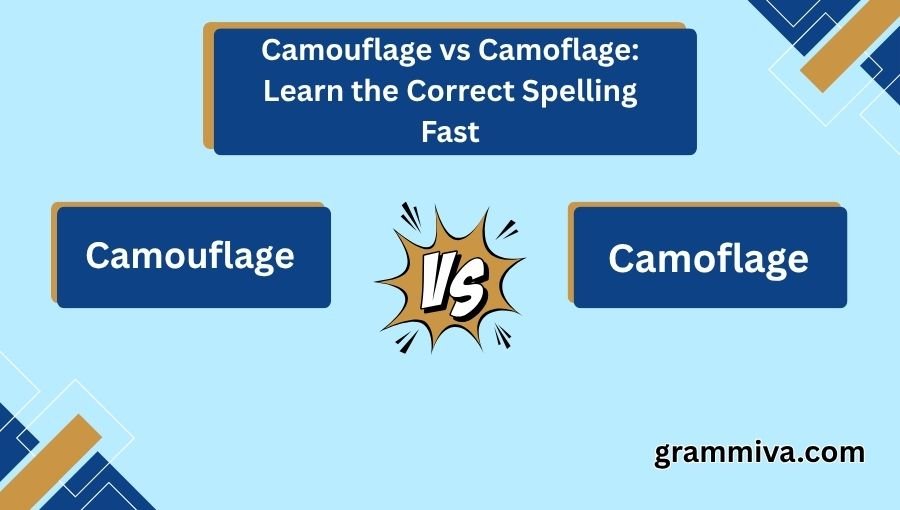
Have you ever typed a word, looked at it twice, and suddenly wondered whether it looks right? camouflage vs camoflage is a perfect example. The two forms look almost identical, and the missing letters are easy to overlook when you are typing quickly. 😅
I have seen this spelling mix-up in school assignments, work documents, online posts, and even notes written by strong English speakers. The good news is that the rule is simple once you know what to look for.
Camouflage is the correct standard English spelling. Camoflage is a misspelling. The extra u after the o and the second a are part of the standard spelling of the word.
In this guide, I will explain the difference in plain US English. We will look at the meaning, correct uses, common mistakes, word forms, examples, memory tricks, and frequently asked questions. By the end, you should be able to spot the correct form without stopping to think about it. 🎯 Acknowledge vs acknowlege | Conscious vs Concious | Conscientious vs Consciencious
🎯 Quick Answer: Camouflage vs Camoflage
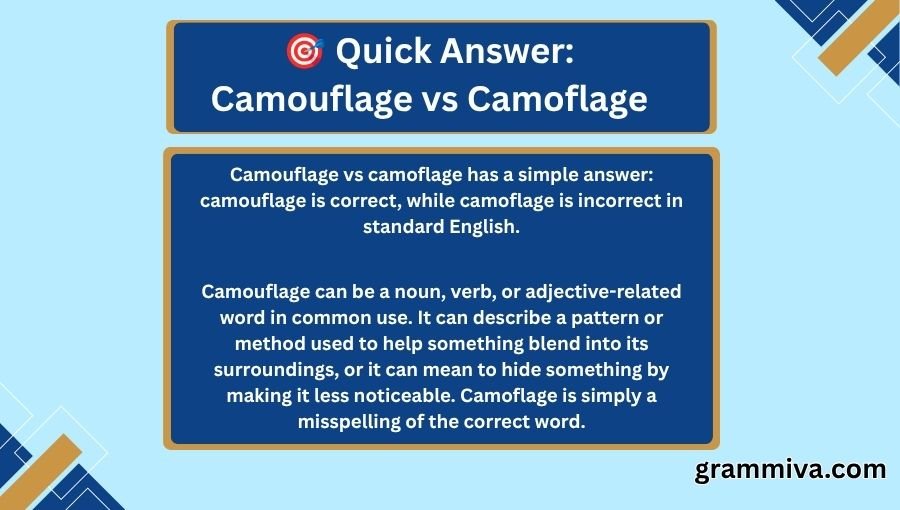
Camouflage vs camoflage has a simple answer: camouflage is correct, while camoflage is incorrect in standard English.
Camouflage can be a noun, verb, or adjective-related word in common use. It can describe a pattern or method used to help something blend into its surroundings, or it can mean to hide something by making it less noticeable. Camoflage is simply a misspelling of the correct word.
| Spelling | Status | Meaning | Example |
|---|---|---|---|
| camouflage | ✅ Correct | A way to hide or blend in | The soldiers wore camouflage. |
| camoflage | ❌ Incorrect | Not the standard spelling | She wrote “camoflage” in her report. |
If you only remember one thing, remember this: camouflage has “ouflage” at the end.
Is Camouflage the Same as Camoflage?
No. Camouflage and camoflage are not two different English words. The first is the correct spelling, while the second is a common spelling error.
The confusion happens because camouflage contains several letters that do not sound as clearly as they appear. When people say the word quickly, they may not notice every vowel in the written form.
For example:
- ✅ The jacket has a camouflage pattern.
- ❌ The jacket has a camoflage pattern.
The meaning is clear in both sentences, but only the first spelling is standard.
Camouflage as a noun
As a noun, camouflage refers to something that helps a person, animal, object, or place blend into its surroundings.
Examples:
- The bird’s feathers provide natural camouflage.
- The hunters wore camouflage clothing.
- The truck was covered with green camouflage paint.
In these examples, the word names the method, pattern, or material that helps something remain less visible.
Camouflage as a verb
Camouflage can also be used as a verb. In this form, it means to hide or disguise something so that it is harder to notice.
Examples:
- The workers camouflaged the equipment with branches.
- The dark paint camouflages the vehicle.
- The designer used fabric to camouflage the damaged area.
Notice that the spelling stays based on camouflage.
Camouflage as an idea
The word does not always refer to military clothing or animals. It can also be used more broadly.
For example:
The large tree helped camouflage the small cabin.
Here, the tree makes the cabin harder to see.
I often tell students to focus on the meaning first. If you are talking about hiding, blending in, or making something less noticeable, camouflage is the spelling you want.
What Is the Correct Spelling of Camouflage?
The correct spelling is camouflage: c-a-m-o-u-f-l-a-g-e.
The incorrect form camoflage leaves out letters from the standard spelling. This is why a quick visual check can help.
| Form | Letters | Status | Example |
|---|---|---|---|
| camouflage | c-a-m-o-u-f-l-a-g-e | ✅ Correct | Camouflage can help an animal hide. |
| camoflage | c-a-m-o-f-l-a-g-e | ❌ Incorrect | “Camoflage” is a spelling mistake. |
| camouflaged | c-a-m-o-u-f-l-a-g-e-d | ✅ Correct | The vehicle was camouflaged. |
| camouflaging | c-a-m-o-u-f-l-a-g-i-n-g | ✅ Correct | They were camouflaging the equipment. |
| camouflages | c-a-m-o-u-f-l-a-g-e-s | ✅ Correct | The paint camouflages the object. |
The key visual pattern is camou near the middle of the word. If you see camof-, stop and check the spelling.
Why Do People Confuse Camouflage and Camoflage?
People confuse these spellings because the word is easy to hear incorrectly and hard to spell from memory. The sequence of vowels can also make the written form feel less obvious than the spoken form.
I once reviewed a student’s short science report about insects. The student had written “camoflage” several times. The science ideas were excellent. The spelling problem came from copying the word from memory rather than checking the original source.
Three common causes explain mistakes like this:
- Fast typing — We often type from sound instead of checking each letter.
- Autocorrect — A device may not always flag a misspelling in the way we expect.
- Lack of familiarity — If you rarely write the word, its letter pattern may not feel natural.
This is why even experienced writers can make the mistake.
A simple visual trick
Break the word into two parts:
camou + flage
Then remember:
Camouflage has “ou” before “flage.”
That small pattern is often easier to remember than the entire word.
| Memory Check | Correct | Incorrect |
|---|---|---|
| Starts with “camo” | ✅ | ✅ |
| Has “ou” after “camo” | ✅ | ❌ |
| Ends with “flage” | ✅ | Usually not enough to identify the whole word |
| Full standard spelling | camouflage | camoflage |
Camouflage vs Camoflage at a Glance
The main difference is spelling, not meaning. Camouflage is the standard form used in English, while camoflage is a misspelling.
| Form | Type | Meaning | Example | Correct/Incorrect |
|---|---|---|---|---|
| camouflage | Noun | A method, pattern, or material used to hide | The animal’s camouflage was effective. | ✅ Correct |
| camouflage | Verb | To hide or disguise | Leaves helped camouflage the nest. | ✅ Correct |
| camouflaged | Verb/adjective form | Hidden or disguised | The vehicle was camouflaged. | ✅ Correct |
| camouflaging | Verb form | Hiding or disguising | They were camouflaging the wall. | ✅ Correct |
| camoflage | Misspelling | No standard separate meaning | He typed camoflage by mistake. | ❌ Incorrect |
Test Tip 💡
When you are unsure, type the word slowly in your head:
cam-ou-flage
If your spelling begins camoflage, you have skipped the u.
For an even faster test, remember the ending as a unit:
-ouflage
That ending appears in the standard spelling camouflage.
Correct Meanings and Uses of Camouflage
When learning camouflage vs camoflage, it helps to see how the correct word works in different sentences and meanings. The word camouflage has several useful applications. Its central idea is always connected to hiding, blending in, or making something harder to notice.
1. Camouflage for animals
Animals often have colors, shapes, or patterns that make them difficult to see.
- A moth can use natural camouflage on tree bark.
- The lizard’s skin provides camouflage among the leaves.
- The snowshoe hare has seasonal coloring that helps with camouflage.
Here, camouflage is a noun.
2. Camouflage in clothing
Camouflage is also strongly associated with clothing and outdoor gear.
- He wore a camouflage jacket.
- The store sells camouflage backpacks.
- Her pants have a green camouflage print.
In these examples, the word describes a pattern or style.
3. Camouflage in military settings
Military forces have long used colors and patterns designed to make people or equipment less noticeable in certain surroundings.
- The soldiers wore camouflage uniforms.
- The vehicle was painted with a camouflage pattern.
- The equipment was placed under camouflage netting.
The exact design can vary depending on the environment.
4. Camouflage in everyday language
The word can also describe hiding something in a less literal way.
- The humor helped camouflage his nervousness.
- The bright artwork camouflaged the damaged wall.
- The extra details can camouflage the main problem.
Here, the word means to make something less easy to notice.
| Meaning | Word Type | Example Sentence |
|---|---|---|
| Hiding through blending | Noun | The insect’s camouflage was excellent. |
| A printed pattern | Noun | She bought a camouflage shirt. |
| Hiding or disguising | Verb | The bushes camouflage the fence. |
| Making something less noticeable | Verb | The joke camouflaged his concern. |
How Should You Use Camouflage in a Sentence?
Use camouflage when you need a noun for a hiding pattern or method, or a verb for the act of hiding or disguising something.
Compare these examples:
- ✅ The fox’s fur provides camouflage.
- ❌ The fox’s fur provides camoflage.
- ✅ The paint helped camouflage the wall.
- ❌ The paint helped camoflage the wall.
- ✅ He bought a camouflage backpack.
- ❌ He bought a camoflage backpack.
The sentence structure does not change the spelling. Whether the word is a noun or a verb, the base spelling remains camouflage.
📝 Case Study: A Workplace Spelling Check
A few years ago, I edited a short workplace document that described outdoor equipment. One sentence said that a certain cover would “camoflage the equipment.” The writer had used the word correctly in terms of meaning but incorrectly in spelling.
I changed it to:
“The cover will camouflage the equipment.”
The writer’s mistake was easy to understand. The word had been typed from memory. There was no confusion about the intended meaning.
This is a useful lesson for professional writing: a word can be used correctly in context and still be spelled incorrectly.
| Workplace Example | Result | Better Version |
|---|---|---|
| “The net provides camoflage.” | ❌ Spelling error | “The net provides camouflage.” |
| “The cover will camoflage the gear.” | ❌ Spelling error | “The cover will camouflage the gear.” |
| “The gear uses camouflage.” | ✅ Correct | No change needed |
| “The gear was camouflaged.” | ✅ Correct | No change needed |
What Are the Grammar Rules for Camouflage?
The spelling rule for camouflage vs camoflage is straightforward: camouflage is the standard form, while camoflage is a misspelling. The grammar rule is simple: camouflage is the standard spelling of the word, and its related verb forms keep the same base spelling.
The spelling does not change to camoflage simply because the word is used as a noun, verb, or modifier. The standard base form remains camouflage.
The most useful forms include:
- camouflage — base noun or verb
- camouflaged — past tense or past participle
- camouflaging — present participle
- camouflages — third-person singular verb form
The mistake in camoflage is not a special grammar form. It is simply a spelling error.
Most standard English reference works agree on the spelling camouflage. When a word looks unusual, a trusted dictionary or spell-check tool can confirm the standard form.
Correct vs Incorrect at a Glance
| Sentence | Correct/Incorrect | Why |
|---|---|---|
| The soldiers wore camouflage. | ✅ Correct | Camouflage is correctly spelled. |
| The soldiers wore camoflage. | ❌ Incorrect | Camoflage is a misspelling. |
| The leaves camouflage the nest. | ✅ Correct | The verb is correctly spelled. |
| The leaves camoflage the nest. | ❌ Incorrect | The u is missing. |
| The animal’s camouflage is hard to see. | ✅ Correct | The noun is correctly spelled. |
The grammar is not difficult here. The main challenge is remembering the letters.
⚠️ Common Mistakes With Camouflage
One reason camouflage vs camoflage causes confusion is that the word contains several vowels that are easy to miss when typing quickly.
Most mistakes with this word are spelling mistakes rather than grammar mistakes. Writers usually know what they want to say but leave out one or more letters.
Similar spelling and grammar confusions
The same general problem appears with many English words. Writers often rely on sound, speed, or memory.
| Confusion | Correct Form | Incorrect Form | Why It Happens |
|---|---|---|---|
| Possession vs contraction | its | it’s | Sound is the same |
| Possession vs contraction | your | you’re | Fast typing |
| Their/there/they’re | their | they’re/there | Similar sounds |
| Spelling | camouflage | camoflage | Missing letters |
| Spelling | separate | seperate | Pronunciation influence |
I once caught myself typing camoflage in a draft after writing the word several times. I knew the correct spelling, but my fingers followed the sound pattern. That small mistake reminded me that familiarity does not make anyone immune to typing errors.
Specific wrong spellings of camouflage
| Wrong Form | What’s Wrong | Correct Form |
|---|---|---|
| camoflage | Missing the u | camouflage |
| camoflauge | Letters are in the wrong order | camouflage |
| camoflage | Missing letters from the standard form | camouflage |
| camouflauge | Extra letters and wrong order | camouflage |
| camoflaj | Incorrect ending | camouflage |
| camo-flage | Unnecessary hyphen in the standard word | camouflage |
Some of these forms may look more natural than others, but none should replace the standard spelling camouflage in normal US English.
How Does Camouflage Work in Different Contexts?
The difference between camouflage vs camoflage stays the same whether you are writing casually, professionally, or creatively.
The correct spelling stays the same across contexts. What changes is the meaning or role of the word in the sentence.
| Context | Which Term to Use | Example |
|---|---|---|
| Everyday conversation | camouflage | That shirt has a camouflage pattern. |
| Professional writing | camouflage | The report describes the use of camouflage. |
| Creative writing | camouflage | The fox disappeared into the camouflage of the forest floor. |
| Social media/texting | camouflage | Love this camouflage print! |
Even in casual texting, camouflage remains the standard spelling. Informal writing may allow slang or shortcuts, but a misspelling is still a misspelling.
Common Phrases With Camouflage
Camouflage appears in several common phrases, especially when people talk about clothing, patterns, animals, or hiding.
| Phrase | Meaning |
|---|---|
| camouflage pattern | A pattern designed to help something blend into its surroundings |
| camouflage clothing | Clothing with a camouflage design |
| camouflage netting | Material used to conceal an object or area |
| natural camouflage | A natural feature that helps an animal blend in |
| camouflage paint | Paint used to help an object blend into its setting |
| camouflage gear | Equipment or clothing designed for concealment or outdoor use |
These phrases all use camouflage, not camoflage.
For example:
- ✅ The store sells camouflage clothing.
- ❌ The store sells camoflage clothing.
What Words Can Replace Camouflage?
Sometimes you can replace camouflage with another word, but the best choice depends on the sentence. No synonym works perfectly in every situation.
| Alternative | Works When | Does Not Work When |
|---|---|---|
| concealment | You mean the act of hiding something | You specifically mean a printed pattern |
| disguise | Something is made to look different | You mean an animal’s natural coloring |
| cover | Something is physically hidden | You need a precise description of blending in |
| hiding | The language is casual and simple | You need a formal or technical term |
| conceal | You need a verb meaning “hide” | You specifically mean camouflage as a pattern |
For example, conceal can replace camouflage in some sentences:
The bushes camouflage the fence.
could become:
The bushes conceal the fence.
The meaning is close, but the focus changes slightly. Camouflage suggests blending or reducing visibility. Conceal is broader.
Why Does Correct Spelling Matter? ✨
Correct spelling helps readers understand your meaning quickly. It also makes your writing look careful and professional.
A misspelling such as camoflage may not prevent understanding. Most readers will know what you mean. Still, repeated spelling errors can distract readers and reduce confidence in a piece of writing.
| Situation | Why Getting It Right Matters |
|---|---|
| Resume | Shows attention to detail |
| Client email | Builds a professional impression |
| Published content | Supports credibility and readability |
| Social post | Makes the message look polished |
I tell writers that spelling is part of clarity. You do not need fancy words to sound professional. You need clear, correct words.
A useful rule is:
Good writing makes the reader’s job easier.
When the correct spelling is available, there is little reason to make the reader pause over a preventable error.
How Can You Remember the Correct Spelling?
A simple way to remember camouflage vs camoflage is to focus on the “ou” in the middle of the correct spelling. The easiest memory trick is to focus on the middle of the word.
Think:
CAMOU + FLAGE
Then write:
camouflage
Do not think of it as a long string of letters. Think of it as a few smaller pieces.
Memory method 1: Remember “OU”
The biggest clue is the ou:
c a m o u f l a g e
If you type camoflage, you have left out the u.
Memory method 2: Remember “FLAGE”
The final part is:
flage
Put that after camou:
camou + flage = camouflage
Memory method 3: Write it three times
If you frequently use the word, write:
camouflage
camouflage
camouflage
Then use it in a sentence:
The bird uses camouflage to blend into the leaves.
This simple practice can make the spelling much easier to recall.
| Memory Method | What to Remember | Example |
|---|---|---|
| Middle-letter method | ou | camouflage |
| Chunking | camou + flage | camou + flage |
| Visual repetition | Whole word | camouflage |
| Sentence practice | Word in context | The bird uses camouflage. |
Is Camouflage a Difficult Word to Spell?
Yes, camouflage can be difficult to spell because its written form contains several vowels that are easy to miss or rearrange. However, it becomes much easier once you remember the camou- pattern.
The word is not difficult because English has two accepted spellings. It does not. The difficulty comes from remembering the standard spelling.
That distinction matters.
If you see camoflage, do not assume it is an alternate US spelling. Treat it as a spelling error and change it to camouflage.
Does Camoflage Have a Different Meaning?
No. Camoflage does not normally represent a separate standard English word with a different meaning. It is a misspelling of camouflage.
That means you should not choose camoflage when writing a sentence about clothing, animals, military patterns, hiding, or disguises.
| Intended Meaning | Correct Word | Incorrect Choice |
|---|---|---|
| Animal blending into its environment | camouflage | camoflage |
| Printed clothing pattern | camouflage | camoflage |
| Concealing an object | camouflage | camoflage |
| Hiding something less literally | camouflage | camoflage |
How Does Camouflage Change in Other Forms?
The base word camouflage can take common English endings. The spelling changes slightly because of the added ending, but the core camoufla- pattern remains.
| Form | Use | Example |
|---|---|---|
| camouflage | Base noun or verb | The camouflage worked well. |
| camouflaged | Past form | The truck was camouflaged. |
| camouflaging | -ing form | They were camouflaging the equipment. |
| camouflages | Third-person singular | The pattern camouflages the object. |
A common mistake is to remove letters from the base word when adding an ending. Do not turn camouflage into an invented form such as camoflaged.
For example:
- ✅ The vehicle was camouflaged.
- ❌ The vehicle was camoflaged.
The first form keeps the standard spelling of the base word.
How Should You Use Camouflage in Formal Writing?
In formal writing, use camouflage exactly as you would in ordinary English, but choose the meaning carefully.
For example:
The study examined how natural camouflage helps small animals avoid detection.
That sentence is clear and professional.
Another example:
The report describes a camouflage pattern designed for woodland environments.
The word can work well in reports, essays, business documents, product descriptions, and educational material.
The main thing to avoid is the misspelling camoflage.
How Is Camouflage Used in Creative Writing?
Creative writers can use camouflage literally or figuratively.
Literal example:
The fox froze beneath the leaves, its fur almost perfect camouflage against the forest floor.
Figurative example:
His smile became camouflage for the worry he did not want anyone to see.
The second example shows why the word is useful beyond outdoor or military settings. It can describe anything that helps something remain hidden or less noticeable.
How Is Camouflage Used Online?
Online, you may see camouflage in product descriptions, social posts, gaming discussions, fashion comments, outdoor communities, and animal-related content.
Examples include:
- “I love this camouflage print.”
- “That bird has amazing camouflage.”
- “The new gear comes in a camouflage design.”
- “The pattern gives the object better camouflage.”
Even when the tone is casual, the standard spelling is still camouflage.
If you are writing a caption or post, using the correct spelling takes only a moment and makes the message look more polished.
Can Autocorrect Fix Camouflage?
Sometimes spelling tools can identify camoflage as an error, but you should not depend on autocorrect alone. Different apps use different dictionaries and settings.
A better habit is to learn the correct form yourself.
If you frequently write the word, save this visual pattern in your memory:
camou + flage
Then check the word before publishing.
| Tool or Habit | Benefit | Limitation |
|---|---|---|
| Spell-check | Can catch many mistakes | May miss some errors |
| Autocorrect | Fast correction | May not behave consistently |
| Dictionary | Confirms standard spelling | Requires an extra step |
| Memory trick | Works anywhere | Takes practice |
| Careful proofreading | Catches context errors too | Requires attention |
Is There a Special Exception to the Spelling?
There is no common standard-English exception that makes camoflage an acceptable alternative spelling of camouflage.
You may encounter unusual spellings in usernames, product names, business names, artwork titles, or other proper names. A name can intentionally use an unusual spelling. That does not make the spelling a standard English form.
For normal writing, use camouflage.
How Can You Check Camouflage Before Publishing?
If you are unsure, use a three-step check:
- Look at the middle: camou.
- Check the ending: flage.
- Read the whole word: camouflage.
Then check the sentence itself.
For example:
The camouflage helped the animal blend into the background.
If the word looks like camoflage, correct it before publishing.
This is especially useful when proofreading a resume, report, article, school paper, or business email.
🎯 Quick Recap Checklist
The central rule is easy: camouflage is correct, and camoflage is a misspelling.
| Question | If Yes → Use |
|---|---|
| Am I talking about a hiding pattern? | camouflage |
| Am I talking about blending into surroundings? | camouflage |
| Am I using the word as a verb meaning “hide”? | camouflage |
| Did I write “camoflage”? | Change it to camouflage |
| Am I unsure about the middle letters? | Check for ou |
Practice Examples
- The insect’s camouflage made it difficult to see.
- The designers used paint to camouflage the equipment.
- She bought a jacket with a camouflage pattern.
Try writing each sentence once. Then spell the word without looking.
What Is the Main Lesson From Camouflage vs Camoflage?
The main lesson is that camouflage is the correct standard spelling, while camoflage is not.
The error is easy to make because the word has a tricky group of vowels. Still, one small memory trick can solve the problem. Think camou + flage.
When you see camoflage, look for the missing u. Then replace the misspelling with camouflage.
That rule works whether you are talking about an animal’s natural coloring, a clothing pattern, military equipment, or a figurative way of hiding something.
FAQs About Camouflage vs Camoflage
Is camouflage the correct spelling?
Yes. Camouflage is the correct standard English spelling. Camoflage is a misspelling.
Why is camoflage wrong?
Camoflage is wrong because it leaves out letters from the standard spelling. The correct form is camouflage, which contains ou before flage.
How do you spell camouflage correctly?
Spell it c-a-m-o-u-f-l-a-g-e: camouflage.
A useful memory trick is camou + flage.
Is camoflage an accepted spelling in American English?
No. Camoflage is not the standard spelling in American English. Use camouflage instead.
What does camouflage mean?
Camouflage means a way of hiding or blending something into its surroundings. It can also mean the act of hiding or disguising something.
Is camouflage a noun or a verb?
It can be both. As a noun, it can describe a pattern or method of concealment. As a verb, it means to hide or disguise something.
What is the difference between camouflage and concealment?
Camouflage usually suggests hiding by blending in or making something less noticeable. Concealment is broader and simply refers to the act or state of being hidden.
How do you remember the spelling of camouflage?
Remember the two parts camou + flage. The most important detail is the ou in the middle.
Is camouflaged spelled with an e?
Yes. The past form is camouflaged. It keeps the base word camouflage and adds d.
What is the most common mistake when spelling camouflage?
A common mistake is leaving out the u and writing camoflage. Another mistake is rearranging the letters and writing forms such as camoflauge.
Conclusion
Camouflage vs camoflage comes down to one simple spelling rule: camouflage is correct, and camoflage is incorrect. 👍
The word can be used as a noun or a verb. It can describe an animal’s ability to blend in, a printed pattern on clothing, a method of hiding equipment, or a figurative way of making something less noticeable.
The easiest way to remember the spelling is to break it into two pieces: camou + flage. Pay special attention to the ou in the middle. If you write camoflage, you have left out the u.
I also recommend checking the whole word rather than relying only on how it sounds. Slow down for one second, look at the letters, and make the correction.
Once you remember camouflage, this spelling problem becomes much easier. Keep the ou, keep the flage, and you will have the standard form every time. ✨

I am Alex Morgan, an English grammar and vocabulary writer passionate about making language learning simple and useful. I work at Grammiva, where I create clear educational content and practical English examples for learners.
[…] you can use whenever you are unsure. By the end, choosing the correct form should feel automatic. Camouflage vs Camoflage | Acknowledge vs acknowlege | Conscious vs […]