Have you ever typed a word, stared at it, and suddenly wondered, “Wait, does that look right?” 😅 conscious vs concious is one of those spelling problems that can make even careful writers stop and check twice.
The confusion is easy to understand. Both forms look almost the same. They contain the same main letters, and the difference seems to be only one small vowel. But there is a clear rule: conscious is the correct standard spelling. Concious is a misspelling and should not be used in standard US English.
I have seen this mistake in school assignments, emails, online posts, and even polished documents that had already gone through several edits. The good news is that you do not need to memorize a complicated grammar rule. You mainly need to remember where the s belongs and learn a simple memory trick.
In this guide, I will explain the difference, show correct examples, cover common mistakes, and give you practical ways to remember the spelling. By the end, you should be able to choose the right form with confidence. 🌟 Conscientious vs Consciencious | buoyant vs bouyant | Calendar vs Calandar
🎯 Quick Answer: Conscious vs Concious
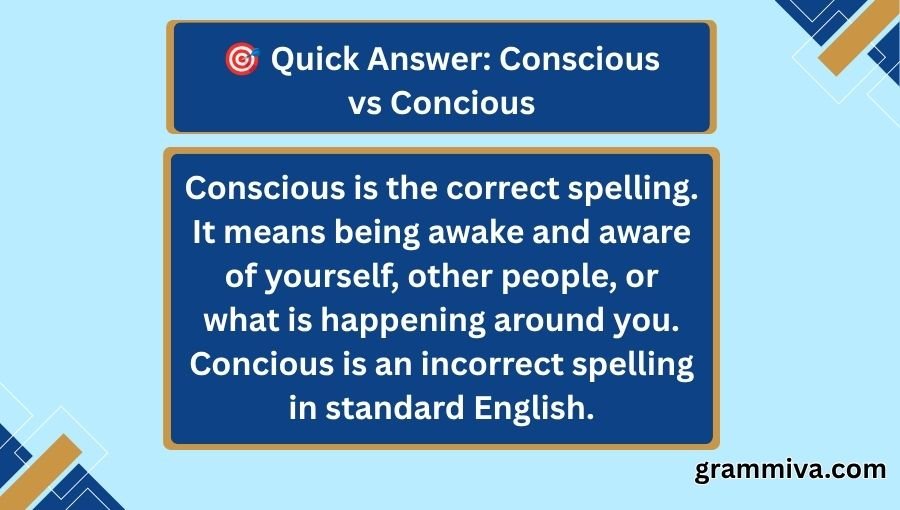
Conscious is the correct spelling. It means being awake and aware of yourself, other people, or what is happening around you. Concious is an incorrect spelling in standard English.
| Word | Correct? | Meaning | Example |
|---|---|---|---|
| conscious | ✅ Yes | Awake or aware | She remained conscious after the accident. |
| concious | ❌ No | No standard English word | He was concious of the noise. |
The simplest rule is this: always spell the word as conscious when you mean awake, aware, or deliberately aware of something.
Related Word Forms
The word conscious has several useful related forms. These forms are real English words, but they have different endings and meanings.
| Form | Type | Example |
|---|---|---|
| conscious | adjective | He was conscious of the risk. |
| consciously | adverb | She consciously avoided the topic. |
| consciousness | noun | He regained consciousness quickly. |
| unconscious | adjective | The patient was unconscious. |
| unconsciously | adverb | He unconsciously tapped his foot. |
| self-conscious | adjective | She felt self-conscious on stage. |
The spelling concious does not become correct when an ending is added. For example, consciously is correct, while conciously is not.
🎯 Understanding the Basics of Conscious vs Concious
Understanding conscious vs concious is mainly a spelling issue, not a difference in meaning. The main difference is simple: conscious is a real English word, while concious is a spelling error.
The correct form contains the letter s after con:
con + scious = conscious
A useful way to see the spelling is to focus on the middle:
conscious
The incorrect form leaves out that s:
concious ❌
| Form | Type | Meaning | Example | Correct/Incorrect |
|---|---|---|---|---|
| conscious | Adjective | Awake or aware | I was conscious of the mistake. | ✅ Correct |
| concious | Misspelling | No standard meaning | I was concious of the mistake. | ❌ Incorrect |
| consciously | Adverb | In an aware or deliberate way | She consciously changed her answer. | ✅ Correct |
| conciously | Misspelling | Incorrect spelling | She conciously changed her answer. | ❌ Incorrect |
| consciousness | Noun | State of being conscious | He slowly regained consciousness. | ✅ Correct |
Is Conscious the Correct Spelling?
Yes. Conscious is the correct spelling in standard US English.
It can describe someone who is awake or aware. It can also describe awareness of an idea, fact, action, or feeling.
For example:
- She was conscious after the fall.
- I am conscious of the time.
- He became conscious of his breathing.
- She made a conscious choice.
The word can therefore describe both physical awareness and mental awareness.
What Does Conscious Mean?
Conscious is an adjective. It commonly means awake, aware, or able to notice what is happening.
Consider this sentence:
Maria was conscious of the cold air.
Here, Maria is the subject. Was is the verb. Conscious describes Maria’s state. Of the cold air tells us what she was aware of.
The word also appears in phrases such as:
- conscious decision
- conscious effort
- conscious choice
- conscious thought
- conscious awareness
These phrases often describe something done deliberately or with awareness.
Can Conscious Describe a Choice?
Yes. A conscious choice is a choice made deliberately rather than by accident or without thought.
For example:
I made a conscious choice to leave my phone at home.
This means the speaker deliberately decided not to take the phone.
That is different from an accidental action:
I left my phone at home by mistake.
The first action is deliberate. The second is not.
❓ Is Conscious the Same as Concious?
No. Conscious and concious are not two different English words with different meanings. Conscious is the correct spelling, while concious is a common misspelling.
This matters because a spell checker may flag concious, but a reader may also notice it immediately. In formal writing, a spelling error can distract from an otherwise strong message.
I once edited a short workplace report in which the writer used concious three times. The meaning was perfectly clear each time. Still, the repeated spelling made the report look less polished. The fix took less than a minute, but it made the whole document feel more professional.
Conscious vs Concious at a Glance
| Feature | Conscious | Concious |
|---|---|---|
| Standard English word | Yes | No |
| Correct spelling | Yes | No |
| Can mean awake | Yes | No |
| Can mean aware | Yes | No |
| Used in formal writing | Yes | No |
| Common spelling mistake | No | Yes |
💡 Correct Meanings and Uses of Conscious
The word conscious has several closely related uses. Understanding them can make the spelling easier to remember because you will see the word in many common situations.
Conscious Means Awake
The most basic use describes someone who is awake rather than unconscious.
Examples:
- The patient is conscious.
- He remained conscious throughout the procedure.
- She was conscious but very tired.
Here, the word describes a person’s physical state.
Conscious Means Aware
The word can also mean aware of something.
Examples:
- I was conscious of the noise.
- She became conscious of the change in temperature.
- He is conscious of how his words affect others.
In these sentences, the person notices or understands something.
Conscious Means Deliberate
The word can describe an action or decision that is intentional.
Examples:
- She made a conscious decision to slow down.
- We made a conscious effort to listen.
- He took a conscious step toward better communication.
Here, conscious means that the person acted with awareness and purpose.
Conscious Can Describe Social Awareness
The word is also common when people discuss how aware someone is of appearance, behavior, or how others see them.
For example:
She felt self-conscious during the presentation.
Self-conscious means overly aware of yourself, especially in a way that makes you feel nervous or uncomfortable.
| Meaning | Word Type | Example Sentence |
|---|---|---|
| Awake | Adjective | The patient was conscious. |
| Aware | Adjective | I was conscious of the noise. |
| Deliberate | Adjective | It was a conscious choice. |
| Aware of yourself | Adjective in a compound | He felt self-conscious. |
💡 Test Tip: Use the Meaning Test
When you are unsure about the spelling, first ask:
Am I trying to say awake, aware, or deliberate?
If the answer is yes, the word you want is conscious.
You can then check the middle letters:
conscious
If your spelling does not contain that s, stop and fix it.
This test works well because it connects the spelling to the word’s meaning instead of asking you to memorize a random group of letters.
📝 Case Study: A Workplace Email
Imagine that a manager sends this email:
“Please be concious of the deadline when preparing the report.”
The reader will probably understand the message. However, concious is still misspelled.
The corrected version is:
“Please be conscious of the deadline when preparing the report.”
The phrase be conscious of means be aware of.
That makes the sentence easy to understand:
- be conscious of the deadline = be aware of the deadline
- be conscious of the budget = be aware of the budget
- be conscious of your audience = be aware of your audience
| Workplace Sentence | Correct? | Reason |
|---|---|---|
| Please be conscious of the deadline. | ✅ | Correct spelling and natural usage |
| Please be concious of the deadline. | ❌ | Missing s |
| We made a conscious effort to improve. | ✅ | Correct adjective |
| We made a concious effort to improve. | ❌ | Misspelled word |
Grammar Rules Explanation
Conscious is an adjective. It describes a person, state, action, choice, or awareness.
The spelling is fixed in standard English. The form concious is not an accepted alternative spelling for the same adjective.
The most useful spelling pattern is:
conscious
The word begins with con- and contains s before cious. Writers should not remove that s.
The same spelling pattern appears in related forms:
- conscious
- consciously
- consciousness
- unconscious
- self-conscious
The related forms can help reinforce the correct spelling. If you remember conscious, you have a useful base for remembering the other forms.
Most standard dictionaries and grammar references treat conscious as the standard spelling. Concious is generally identified as a misspelling rather than a separate word.
Correct vs Incorrect at a Glance
| Sentence | Correct/Incorrect | Why |
|---|---|---|
| She was conscious after the fall. | ✅ Correct | Conscious is spelled correctly. |
| She was concious after the fall. | ❌ Incorrect | The spelling is missing s. |
| He was conscious of the risk. | ✅ Correct | The phrase means “aware of the risk.” |
| He was concious of the risk. | ❌ Incorrect | Concious is a misspelling. |
| We made a conscious effort. | ✅ Correct | Conscious correctly describes a deliberate effort. |
❓ Why Do People Confuse Conscious and Concious?
When checking conscious vs concious, remember that only conscious is the correct standard spelling. People often confuse these spellings because the word does not look exactly the way it sounds. The letters in the middle can be easy to rearrange or forget.
Another problem is speed. When people type quickly, they often write the first spelling that feels familiar. Autocorrect can also make things confusing if a device does not catch the error.
I once caught myself typing concious in a draft email. I knew the correct word, but my fingers simply skipped the s. That small mistake reminded me that knowing a spelling and typing it correctly every time are not quite the same thing.
Common causes include:
- Fast typing — Writers may skip a letter.
- Autocorrect — A device may fail to identify the mistake.
- Lack of knowledge — Some writers have never learned the correct form.
- Visual confusion — The incorrect form can look familiar.
- Weak memory of spelling patterns — The middle of the word is easy to forget.
Similar Grammar and Spelling Confusions
| Confusion | Correct Forms | Common Problem |
|---|---|---|
| it’s / its | it’s, its | Apostrophe confusion |
| your / you’re | your, you’re | Possession vs. “you are” |
| they’re / their / there | they’re, their, there | Similar sound |
| affect / effect | affect, effect | Similar meaning and sound |
| then / than | then, than | Similar spelling |
| conscious / concious | conscious | Missing s |
These mistakes have different rules, but they share one feature: the incorrect form often looks or sounds close enough to feel right.
Common Wrong Spellings of Conscious
| Wrong Form | What’s Wrong | Correct Form |
|---|---|---|
| concious | Missing s | conscious |
| consious | Missing c | conscious |
| conscius | Missing o | conscious |
| conscous | Missing i | conscious |
| conscousness | Incorrect spelling of related noun | consciousness |
| conciously | Missing s in the base word | consciously |
The most important mistake to avoid is concious. If you remember only one thing from this section, remember that conscious needs the s.
❓ How Can You Remember the Spelling of Conscious?
A simple memory trick is to break the word into a visual pattern:
CON-SCIOUS
Think of the word as having an extra S before CIOUS.
Another useful trick is to connect the word with its related form consciousness. When you see the longer word, the s becomes more noticeable.
You can also use a short sentence:
I am conscious of the S.
The sentence itself reminds you to notice the s.
| Memory Trick | What to Remember |
|---|---|
| Letter check | Look for s before cious |
| Word split | CON + SCIOUS |
| Meaning check | Awake, aware, or deliberate |
| Related word | consciousness |
| Phrase practice | conscious of |
❓ When Should You Use Conscious in Everyday Writing?
Use conscious whenever you mean that someone is awake, aware, or acting deliberately.
In everyday conversation, you might say:
- “I wasn’t conscious of the time.”
- “She is very conscious of her surroundings.”
- “He made a conscious choice.”
- “Are you conscious of how loud that is?”
The word is common and natural. It is not limited to formal writing.
❓ How Is Conscious Used in Professional Writing?
Professional writing often uses conscious when discussing awareness, decisions, effort, or responsibility.
Examples include:
- conscious decision
- conscious effort
- conscious choice
- conscious awareness
- conscious of the impact
A business report might say:
“The team made a conscious effort to reduce delays.”
A workplace message might say:
“Please be conscious of the client’s schedule.”
The spelling must remain conscious in each case.
Conscious in Different Contexts
The correct word stays the same across different types of writing. What changes is the way you use it.
| Context | Which Term to Use | Example |
|---|---|---|
| Everyday conversation | conscious | I wasn’t conscious of the noise. |
| Professional writing | conscious | We made a conscious effort to improve. |
| Creative writing | conscious | He became conscious of footsteps behind him. |
| Social media/texting | conscious | Be conscious of how your words sound. |
Even in casual texting, concious is still a spelling mistake. Informal writing may use shortcuts, but the standard spelling does not change.
❓ Is Conscious Common in Fixed Expressions?
Yes. Several common phrases use conscious naturally.
| Phrase | Meaning |
|---|---|
| conscious of | Aware of something |
| conscious effort | A deliberate effort |
| conscious choice | A deliberate choice |
| conscious decision | A decision made deliberately |
| conscious mind | The part of mental activity involving awareness |
| self-conscious | Uncomfortable because of strong awareness of yourself |
The phrase conscious of is especially useful to remember because it appears often in both conversation and formal writing.
For example:
“She was conscious of the fact that everyone was waiting.”
A simpler version is:
“She knew everyone was waiting.”
The first sentence is more formal. Both communicate awareness.
❓ Can You Replace Conscious With Another Word?
Sometimes. The best replacement depends on the meaning.
| Alternative | Works When | Does Not Work When |
|---|---|---|
| aware | You mean noticing or knowing something | You mean physically awake in every context |
| awake | You mean not asleep or unconscious | You mean aware of an idea |
| deliberate | You mean intentional | You mean physically awake |
| mindful | You mean careful awareness | You mean simply not unconscious |
| alert | You mean ready and aware | You mean a deliberate decision |
For example:
“I was conscious of the noise.”
can become:
“I was aware of the noise.”
But:
“She made a conscious decision.”
cannot always be replaced naturally with awake.
Choosing a synonym therefore requires attention to the meaning.
💼 Why Does Correct Spelling Matter?
Correct spelling helps readers understand your message without distractions. One spelling error may not ruin a sentence, but repeated errors can affect how polished the writing feels.
Clarity in Communication
Good spelling makes your message easier to scan. Readers do not have to stop and wonder whether an unfamiliar form is intentional.
Professionalism
A correct spelling can make a report, resume, email, or proposal look more carefully prepared.
Digital Communication
Spelling still matters online. A social post may be informal, but clear writing helps people understand your point quickly.
A useful rule is:
Clear writing earns trust before the reader thinks about the writing itself.
| Situation | Why Getting It Right Matters |
|---|---|
| Resume | Shows care and attention to detail |
| Client email | Keeps communication professional |
| Published content | Protects readability and credibility |
| Social post | Makes the message easier to understand |
❓ What Is the Difference Between Conscious and Unconscious?
Conscious means awake or aware. Unconscious means not awake or not aware.
These words are opposites in many contexts.
| Word | Meaning | Example |
|---|---|---|
| conscious | Awake or aware | The patient was conscious. |
| unconscious | Not awake or not aware | The patient was unconscious. |
The same contrast can appear in mental contexts.
For example:
“She was conscious of the problem.”
means she knew about the problem.
By contrast:
“He made the movement unconsciously.”
means he did it without being aware of doing it.
❓ Is Concious Ever Correct?
No. Concious is not the standard spelling of the word meaning awake or aware.
There is no general US English situation in which you should replace conscious with concious.
If you see concious in an ordinary English sentence, it is almost certainly a spelling error.
This is different from words that have accepted alternate spellings. In this case, the safe standard form is simply conscious.
❓ What Is the Correct Spelling of Consciousness?
The correct spelling is consciousness.
It is built from the same base word:
conscious → consciousness
Do not write conciousness.
Examples:
- He slowly regained consciousness.
- The accident affected her consciousness.
- The story explores human consciousness.
The extra s in conscious remains important when the noun ending is added.
❓ How Do You Spell Consciously?
The correct spelling is consciously.
It means doing something with awareness or intention.
Examples:
- She consciously avoided the topic.
- He consciously changed his tone.
- I consciously slowed my breathing.
The incorrect form conciously should be avoided.
One useful strategy is to start with the correct base:
conscious → consciously
Do not try to build the longer word from the misspelling.
❓ Is Conscious an Adjective or a Noun?
Conscious is an adjective.
It describes a person, action, choice, or state.
Examples:
- She is conscious.
- He made a conscious decision.
- They were conscious of the risk.
The noun form is consciousness.
| Word | Part of Speech | Example |
|---|---|---|
| conscious | adjective | She was conscious. |
| consciously | adverb | He acted consciously. |
| consciousness | noun | She regained consciousness. |
| unconscious | adjective | He was unconscious. |
❓ What Does “Conscious of” Mean?
Conscious of means aware of or noticing something.
For example:
“I am conscious of the noise.”
This means:
“I am aware of the noise.”
More examples:
- She was conscious of the audience.
- He became conscious of his mistake.
- We are conscious of the cost.
- They were conscious of the deadline.
This is one of the easiest phrases to remember because conscious of is a common and useful combination.
❓ How Do You Avoid Spelling Conscious Incorrectly?
The best method is to combine memory with practice.
First, remember the visual form:
conscious
Second, notice the s before cious.
Third, practice the word in short sentences.
For example:
- I am conscious of the time.
- She made a conscious choice.
- He remained conscious.
- We made a conscious effort.
- She became conscious of the sound.
After repeated exposure, the correct form becomes much easier to recognize.
⚠️ Common Mistakes to Watch For
The biggest mistake is dropping the s. However, other letter combinations can also cause trouble.
Watch for:
- concious
- consious
- conscius
- conscous
- conciously
- conciousness
When proofreading, do not rely only on how the word sounds. Look at the letters.
A quick visual check can catch the error:
conscious ✅
versus:
concious ❌
❓ Does Autocorrect Always Catch Concious?
No. You should not depend completely on autocorrect.
Spell-check tools are useful, but they can miss errors for several reasons. A tool may not recognize a typo in a particular context, or it may behave differently depending on the software and language settings.
A quick human check is still valuable.
When proofreading, search the document for:
concious
If you find it, change it to:
conscious
This is especially helpful in long documents where the same spelling mistake may appear more than once.
🎯 Conscious vs Concious: A Practical Proofreading Method
When I proofread a document, I prefer a short process instead of rereading every sentence with the same level of attention. If you are unsure about conscious vs concious, check whether the word contains the s before “cious.”
For this word, use these steps:
- Find every occurrence of conscious.
- Look closely at the middle letters.
- Confirm the s appears before cious.
- Check related words such as consciously and consciousness.
- Read the sentence again for meaning.
| Step | Question | Action |
|---|---|---|
| 1 | Did I spell the base word correctly? | Check conscious |
| 2 | Is the s present? | Keep the spelling if yes |
| 3 | Am I describing awareness or being awake? | Conscious is likely correct |
| 4 | Is this a related form? | Check consciously or consciousness |
| 5 | Does the sentence sound natural? | Read it once more |
Quick Recap Checklist
| Question | If Yes → Use |
|---|---|
| Do you mean awake? | conscious |
| Do you mean aware? | conscious |
| Do you mean deliberate? | conscious |
| Are you describing awareness as a noun? | consciousness |
| Are you describing an action done with awareness? | consciously |
| Did you spell it “concious”? | Change it to conscious |
Practice Examples
Example 1
I was conscious of the noise. ✅
Example 2
She made a conscious effort to listen. ✅
Example 3
He was concious of the deadline. ❌
Correct it to:
He was conscious of the deadline. ✅
FAQs About Conscious vs Concious
Is “conscious” spelled with an s?
Yes. The correct spelling is conscious, with an s before cious.
Is “concious” a word?
No. Concious is a common misspelling of conscious. It is not the standard spelling used in US English.
What is the difference between conscious and concious?
There is no standard meaning difference. Conscious is correct, while concious is incorrect.
How do you spell conscious correctly?
Spell it:
c-o-n-s-c-i-o-u-s
The key point is the s after con.
What does conscious mean?
Conscious can mean awake, aware, or deliberate. For example, someone can be conscious after an accident, conscious of a sound, or make a conscious choice.
Is consciousness spelled with an s?
Yes. The correct noun is consciousness. It keeps the s from conscious.
Is consciously spelled with an s?
Yes. The correct form is consciously. It means doing something with awareness or intention.
What is a synonym for conscious?
Depending on the sentence, possible synonyms include aware, awake, alert, mindful, and deliberate. The best choice depends on the intended meaning.
Is “conscious of” correct grammar?
Yes. Conscious of is a common phrase meaning aware of.
For example:
“She was conscious of the time.”
How can I remember conscious vs concious?
Remember that conscious contains the extra s:
con-S-cious
You can also connect it with consciousness and consciously, which use the same base spelling.
Conclusion
Conscious vs concious has a simple answer: conscious is correct, and concious is a misspelling. The correct word contains an s before cious, and it can mean awake, aware, or deliberate.
When you need the noun, use consciousness. When you need the adverb, use consciously. When you mean not awake or not aware, use unconscious.
The easiest memory trick is to focus on the middle of the word: con-s-cious. That small s is the letter writers often leave out.
I have found that spelling becomes much easier when you connect a word’s letters with its meaning and use. Instead of trying to memorize a long string of letters, ask whether you mean awake, aware, or deliberate. Then check the spelling.
So the next time you hesitate, pause for one second and look for that s. ✨
Remember: if you are conscious of the spelling, you will not be caught by “concious.” 👍

I am Ryan Mitchell, a writer focused on English grammar, vocabulary, and everyday language. I work at Grammiva, creating easy-to-understand articles that help readers improve their English with confidence.

[…] show correct examples, give you memory tricks, and answer the questions people most often ask. | Conscious vs Concious | Conscientious vs Consciencious | buoyant vs […]
[…] In this guide, I will explain the difference in plain US English. You will see examples, memory tricks, common mistakes, workplace examples, and quick tests you can use whenever you are unsure. By the end, choosing the correct form should feel automatic. Camouflage vs Camoflage | Acknowledge vs acknowlege | Conscious vs Concious […]