Confusing affect vs effect is one of the most common problems I see in everyday English. The two words look and sound similar, but they usually do different jobs in a sentence. One is most often a verb, while the other is most often a noun. That simple difference can help you choose the right word quickly. 😊
The tricky part is that both words can act as either nouns or verbs in some situations. That is where even strong writers can hesitate. You may know the basic rule but still stop when writing an email, school paper, report, or social post.
I have taught and edited enough English to know that this confusion does not mean someone has poor writing skills. It often comes down to one small question: Are you talking about an action or a result?
This guide breaks the difference into simple steps. I will show you clear examples, common mistakes, memory tricks, real-life uses, and practical tests you can use whenever you are unsure. Advice vs Advise | Than vs Then | Your vs youre
🎯 Quick Answer: Affect vs Effect
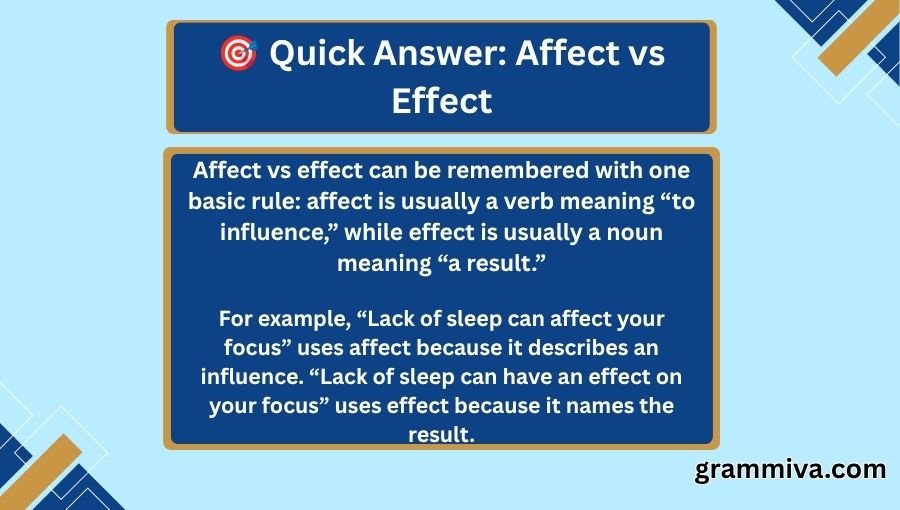
Affect vs effect can be remembered with one basic rule: affect is usually a verb meaning “to influence,” while effect is usually a noun meaning “a result.”
For example, “Lack of sleep can affect your focus” uses affect because it describes an influence. “Lack of sleep can have an effect on your focus” uses effect because it names the result.
| Word | Usual Type | Basic Meaning | Example |
|---|---|---|---|
| Affect | Verb | To influence or change something | Noise can affect your sleep. |
| Effect | Noun | A result or outcome | Noise can have an effect on your sleep. |
| Affect | Noun | A person’s visible emotional expression | The patient showed a flat affect. |
| Effect | Verb | To cause or bring about something | The new law may effect major changes. |
The last two uses are less common in everyday writing, but they are worth knowing.
Is Affect the Same as Effect?
No. Affect and effect are not normally interchangeable. Affect usually describes an action that influences something, while effect usually names the result of that influence.
Think of a simple chain:
Cause → influence → result
For example:
Heavy rain can affect traffic.
Heavy rain can have an effect on traffic.
The meaning is closely related, but the grammar is different.
Here is another way to see it:
| Form | Type | Meaning | Example | Correct/Incorrect |
|---|---|---|---|---|
| affect | Verb | influence | Stress can affect sleep. | ✅ Correct |
| effect | Noun | result | Stress can have an effect on sleep. | ✅ Correct |
| effect | Verb | cause or bring about | The policy could effect change. | ✅ Correct |
| affect | Noun | emotional expression | His affect seemed calm. | ✅ Correct |
| effect | Noun | result | Stress can affect your effect. | ❌ Incorrect in this meaning |
The key is not simply memorizing two spellings. You need to understand the job each word is doing.
💡 Why Do People Confuse Affect and Effect?
People confuse these words because they are very close in spelling, pronunciation, and meaning. Both can appear when one thing changes another.
I once reviewed a short workplace report where the writer had used effect in nearly every sentence. The writer clearly understood the ideas. The problem was that each sentence described an action, so affect was needed. Once we changed the verbs, the report became much clearer.
There are a few common reasons this mistake happens:
- The words sound similar.
- Both can relate to change.
- Both can be nouns and verbs.
- Fast typing makes small errors easy to miss.
- Spell-check tools may not catch the mistake.
- Writers sometimes remember only a simple rule such as “affect is a verb” and forget the exceptions.
The good news is that you do not need to memorize every grammar rule at once. Start with the most common pattern.
Affect = influence.
Effect = result.
That will solve most everyday cases.
Affect: Meaning and Correct Use
Affect is usually a verb. It means to influence something or someone.
When you use affect in this common sense, you are describing an action.
Consider these examples:
- Loud music can affect your concentration.
- The storm affected several flights.
- Your choice may affect the final result.
- Lack of sleep can affect your mood.
- The price increase will affect many customers.
In each sentence, something is doing the influencing.
How to Test Affect
Replace affect with influence.
If the sentence still makes sense, affect is probably the correct choice.
The weather can affect our plans.
The weather can influence our plans.
Because influence works, affect works too. ✅
This is one of the fastest tests I teach.
Affect as a Noun
There is also a less common noun use of affect. In psychology and medical writing, affect can describe the outward display of emotion.
For example:
The patient had a calm affect.
This use is different from the everyday verb affect. Most general writers will rarely need it.
| Meaning | Word Type | Example Sentence |
|---|---|---|
| Influence or change | Verb | Exercise can affect your energy. |
| Influence someone’s decision | Verb | The news affected her choice. |
| Influence a situation | Verb | Delays may affect the schedule. |
| Visible emotional expression | Noun | The patient displayed a calm affect. |
Effect: Meaning and Correct Use
Effect is usually a noun. It means a result or outcome caused by something.
For example:
- The medicine had a strong effect.
- The new rule had an immediate effect.
- Bright light can have an effect on sleep.
- The speech had a powerful effect on the audience.
- The storm caused serious effects across the region.
A useful test is to look for words such as:
- result
- outcome
- consequence
- impact
If one of these ideas fits, effect is often the right choice.
The new schedule had a positive effect on productivity.
You could say:
The new schedule had a positive result on productivity.
The second version is less natural, but the meaning shows why effect works as a result noun.
The Phrase “Have an Effect”
One of the easiest patterns to remember is:
have an effect on
Examples:
Exercise can have a positive effect on your health.
Noise can have a negative effect on concentration.
The decision had little effect on sales.
This structure almost always signals the noun effect.
| Pattern | Example | Correct? |
|---|---|---|
| affect + object | The heat affected the plants. | ✅ |
| have an effect on + noun | The heat had an effect on the plants. | ✅ |
| effect + object as ordinary verb | The heat effected the plants. | ❌ |
| have an affect on | The heat had an affect on the plants. | ❌ |
🎯 Affect vs Effect in Everyday Sentences
The easiest way to understand the difference is to compare pairs.
Pair 1: Influence vs Result
Poor sleep can affect your memory. ✅
Poor sleep can have an effect on your memory. ✅
The first sentence focuses on the influence. The second focuses on the result.
Pair 2: Verb vs Noun
The announcement affected the team. ✅
The announcement had a strong effect on the team. ✅
The grammar changes even though the basic idea is similar.
Pair 3: Cause and Result
High prices affect customer behavior. ✅
Changes in customer behavior are an effect of high prices. ✅
Here, affect identifies the action, while effect identifies the outcome.
📝 Case Study: A Workplace Email
Imagine that a manager needs to explain a schedule change.
A weak version might say:
The new schedule will have a big affect on the sales team.
The problem is the word affect. The writer needs the noun effect after “a big.”
The corrected version is:
The new schedule will have a big effect on the sales team. ✅
Another version would be:
The new schedule will affect the sales team. ✅
Both sentences are correct. The first uses effect as a noun. The second uses affect as a verb.
I once caught myself typing “affect” in a client note when I meant “effect.” I noticed it during a final read because the phrase was “a major ___ on.” That little phrase saved me. Since then, I often use the same check when editing.
| Sentence | Problem | Better Version |
|---|---|---|
| The change will have an affect on sales. | Affect is the wrong noun. | The change will have an effect on sales. |
| The change will effect sales. | Effect is not normally the verb for simple influence. | The change will affect sales. |
| The change had a strong effect on sales. | No problem. | The change had a strong effect on sales. |
| The change affected sales. | No problem. | The change affected sales. |
Grammar Rules Explanation
The most useful grammar rule is based on the most common word classes.
Affect is generally a verb when it means “influence.” Effect is generally a noun when it means “result.”
A verb tells us what someone or something does. A noun names a person, place, thing, idea, or result.
Compare:
The weather affected our plans.
Here, affected tells us what the weather did.
The weather had an effect on our plans.
Here, effect names the result or impact.
This explains why these two words cannot simply be swapped.
Why “Affect” Works as a Verb
In:
The noise affected my concentration.
Affected is an action. It tells us that the noise influenced concentration.
Why “Effect” Works as a Noun
In:
The noise had an effect on my concentration.
Effect names the result of that influence.
Most standard English reference works support this common distinction, although both words have additional uses.
The Less Common Verb “Effect”
Effect can also be a verb. In formal writing, it can mean to cause something to happen or bring about a change.
For example:
The committee hopes to effect major changes.
This does not simply mean “influence.” It means the committee hopes to bring about the changes.
That distinction matters.
The new rule will affect the company.
means the rule will influence the company.
The new leader hopes to effect change.
means the leader hopes to bring about change.
Correct vs Incorrect at a Glance
| Sentence | Correct/Incorrect | Why |
|---|---|---|
| The weather affected our plans. | ✅ Correct | Affected means influenced. |
| The weather had an effect on our plans. | ✅ Correct | Effect means result. |
| The weather had an affect on our plans. | ❌ Incorrect | The noun needed here is effect. |
| The weather effected our plans. | ❌ Usually incorrect | The intended meaning is influence, so use affected. |
| The policy effected major changes. | ✅ Correct | Here effected means brought about. |
⚠️ Common Mistakes With Affect and Effect
Most mistakes happen because writers focus on spelling instead of sentence structure.
Mistake 1: “An Affect”
If you see an before the blank, effect is usually the right answer when you mean a result.
The decision had an effect on morale. ✅
The decision had an affect on morale. ❌
Mistake 2: Using Effect as the Normal Influence Verb
When one thing influences another, use affect.
The heat affected the equipment. ✅
Not:
The heat effected the equipment. ❌
Mistake 3: Forgetting the Phrase “Effect On”
The pattern effect on is common.
The policy had a major effect on workers. ✅
But when the word itself is the action, use affect:
The policy affected workers. ✅
Why These Errors Happen
| Reason | What Happens |
|---|---|
| Fast typing | Writers choose the familiar-looking word without checking the sentence. |
| Autocorrect | Spell-check may see both words as correctly spelled. |
| Lack of knowledge | The writer may not know the noun/verb difference. |
| Similar sound | The words are easy to mix up while thinking quickly. |
| Similar meaning | Both can relate to change or influence. |
I once edited a blog post where the writer had written “affect” after the article “the.” The spelling looked fine at first glance. The grammar did not. Reading the sentence aloud made the problem obvious.
Common Affect and Effect Errors
| Wrong Form | What’s Wrong | Correct Form |
|---|---|---|
| an affect | Wrong noun for “result” | an effect |
| affect on | Usually missing the needed noun structure | effect on |
| effect the customer | Wrong verb for ordinary influence | affect the customer |
| effected by the weather | Wrong form for ordinary influence | affected by the weather |
| positive affect on sales | Wrong noun for result | positive effect on sales |
| affect of the change | Wrong noun for result | effect of the change |
How Can You Remember the Difference?
A simple memory trick can save you time.
Remember A = Action
Affect starts with A, and affect is usually an action word, or verb.
The noise affects my sleep.
Remember E = End Result
Effect starts with E, and an effect is often the end result.
The noise has an effect on my sleep.
This is not a complete rule because English has exceptions. Still, it is an excellent everyday shortcut.
Another trick is to memorize two short sentences:
Things affect things.
Things have effects.
If you can remember those two patterns, many confusing sentences become much easier.
Affect vs Effect in Different Contexts
The correct choice does not change simply because you are writing in a different setting. However, some contexts make certain forms more common.
| Context | Which Term to Use | Example |
|---|---|---|
| Everyday conversation | Affect for influence; effect for result | The heat affected my plans. |
| Professional writing | Usually the same basic rule | The change affected production. |
| Creative writing | Either, depending on meaning | The storm had a dramatic effect. |
| Social media/texting | Either, depending on grammar | The news really affected me. |
Everyday Conversation
People commonly say:
That really affected me.
Or:
That had a big effect on me.
Both are natural.
Professional Writing
Accuracy matters more in reports, proposals, emails, and business documents.
The delay affected our delivery time.
is concise and correct.
The delay had a negative effect on our delivery time.
is also correct.
Creative Writing
Writers may use effect to describe a powerful result:
The silence had an eerie effect on the room.
The word can help describe how a scene changes a character or mood.
Social Media and Texting
Informal writing often contains mistakes because people type quickly. Still, the same grammar rules apply.
That movie affected me more than I expected. ✅
That movie had a strange effect on me. ✅
Which Word Forms Should You Watch?
Several forms can appear in normal writing.
| Form | Word Type | Meaning | Example |
|---|---|---|---|
| affect | Verb | Influence | Stress can affect sleep. |
| affects | Verb | Influences | Stress affects sleep. |
| affected | Verb/adjective | Influenced; changed | The storm affected flights. |
| affecting | Verb | Influencing | The noise is affecting my work. |
| effect | Noun | Result | The effect was clear. |
| effects | Noun | Results | The effects were serious. |
| effected | Verb | Brought about | The reform effected change. |
| effective | Adjective | Producing a desired result | The treatment was effective. |
The word effective is related in spelling but should not be confused with effect in a sentence.
For example:
The plan was effective. ✅
This means the plan worked well.
Common Phrases With Effect
Effect appears in several common phrases. Learning these phrases can make correct usage easier.
| Phrase | Meaning |
|---|---|
| have an effect on | Influence or change something |
| take effect | Begin to work or become active |
| side effect | An additional result, often unwanted |
| cause and effect | The relationship between a cause and its result |
| in effect | In practice or currently operating |
| special effect | A visual or sound technique used to create an impression |
Examples include:
The new rule will take effect Monday.
The medicine caused a mild side effect.
We studied cause and effect in class.
These fixed patterns are worth learning as complete phrases.
Are There Useful Alternatives to Affect and Effect?
Yes. Sometimes another word can make your sentence clearer. The best alternative depends on the exact meaning.
| Alternative | Works When | Does Not Work When |
|---|---|---|
| influence | You mean “change or guide” | You need to name a result |
| impact | You mean a strong influence or result | Formal style requires a more precise word |
| change | You mean something becomes different | You mean a specific result |
| result | You mean an outcome | You need an ordinary verb meaning influence |
| consequence | You mean an outcome, often negative | You simply mean influence |
For example:
The news affected her decision.
could become:
The news influenced her decision.
But:
The news had a surprising effect on her decision.
should not automatically become “had a surprising influence.” The meaning and style are slightly different.
🎯 How Do You Tell Which Word to Use?
Start by asking what role the word plays.
Question 1: Does the word mean “influence”?
If yes, use affect in most ordinary cases.
Question 2: Does the word mean “result”?
If yes, use effect.
Question 3: Does “effect” mean “bring about”?
If yes, effect can work as a verb.
Try this three-step test:
- Find the word in the sentence.
- Ask whether it describes an action or names a result.
- Replace it with “influence” or “result” and check the meaning.
| Test | If the Answer Is Yes | Likely Choice |
|---|---|---|
| Does it mean influence? | The sentence describes an action | Affect |
| Does it mean result? | The sentence names an outcome | Effect |
| Does it mean bring about? | The sentence describes causing a change | Effect |
| Does it describe visible emotion? | It is a special noun use | Affect |
Why Does Getting Affect and Effect Right Matter?
Correct word choice makes writing easier to understand. It also helps your reader trust the care you put into your message. Learning affect vs effect is worthwhile because choosing the correct word improves clarity and makes your writing look more polished.
A small mistake can change how polished a sentence feels.
| Situation | Why Getting It Right Matters |
|---|---|
| Resume | Shows attention to language and detail |
| Client email | Makes your message look professional |
| Published content | Builds reader confidence |
| Social post | Makes short writing clearer |
A useful writing principle is:
Clear words make clear ideas easier to follow.
You do not need fancy vocabulary to sound professional. You need the right word in the right place.
This matters especially in short digital messages. When a sentence has only a few words, one wrong word can stand out more.
Compare:
The change will effect our results.
with:
The change will affect our results.
The second sentence immediately communicates the intended idea.
Is There a Special Exception for Affect?
Yes. The noun affect has a specialized use in psychology and medical writing. It refers to the way a person shows emotion outwardly.
For example:
The patient showed a restricted affect.
This is different from the ordinary verb:
The experience affected him deeply.
Most everyday writers do not need the specialized noun very often. Still, knowing it exists prevents confusion when you encounter it in professional or academic material.
There is also the formal verb effect, meaning to bring about something:
The organization hopes to effect meaningful change.
That sentence does not mean simply “influence meaningful change.” It means the organization hopes to bring about the change.
What Is the Difference Between Affect and Effect in One Sentence?
The shortest useful explanation is this:
Affect usually means “influence,” while effect usually means “result.”
Compare:
The cold weather affected attendance. ✅
The cold weather had an effect on attendance. ✅
The meaning is similar, but the grammar changes.
✅ Quick Recap Checklist
Use this checklist whenever you hesitate. Keep these affect vs effect rules in mind whenever you edit an important sentence.
| Question | If Yes → Use |
|---|---|
| Do I mean “influence”? | Affect |
| Do I mean “result”? | Effect |
| Do I have “an ___ on” and mean a result? | Effect |
| Can I replace the word with “influence”? | Affect |
| Can I replace the word with “result”? | Effect |
| Do I mean “bring about” in formal writing? | Effect |
| Am I describing visible emotional expression in a clinical context? | Affect |
Practice Examples
1. The loud music ___ my concentration.
Answer: affected.
Why? The music influenced concentration.
2. The loud music had a negative ___ on my concentration.
Answer: effect.
Why? The sentence names a result.
3. The new policy may ___ major changes.
Answer: effect can be correct if the meaning is “bring about.”
The most common everyday pattern remains simple:
Affect = influence.
Effect = result.
Frequently Asked Questions About Affect vs Effect
What is the main difference between affect and effect?
Affect is usually a verb meaning “to influence.” Effect is usually a noun meaning “a result.”
Example: “The weather affected our plans” uses affected as a verb. “The weather had an effect on our plans” uses effect as a noun.
Is affect a verb or a noun?
Affect is most commonly a verb when it means “influence.” It can also be a noun in specialized contexts, especially when describing outward emotional expression.
Is effect a verb or a noun?
Effect is most commonly a noun meaning “result.” It can also be a verb meaning “to bring about” or “to cause something to happen.”
Should I say “affect on” or “effect on”?
When you mean a result or influence as a noun, use effect on.
Correct:
The decision had an effect on sales.
When you use the verb affect, do not add “on” directly after it.
Correct:
The decision affected sales.
Is it “have an affect” or “have an effect”?
The usual expression is have an effect.
Correct:
The new rule had an effect on attendance.
Incorrect:
The new rule had an affect on attendance.
How can I remember affect vs effect?
Use the simple memory aid A = Action and E = End result.
Affect is usually the action of influencing something. Effect is usually the result.
This shortcut does not cover every special use, but it works for most everyday sentences.
Is “effected” ever correct?
Yes. Effected can be correct when effect means “brought about” or “caused to happen.”
Example:
The new policy effected major changes.
For ordinary influence, however, use affected:
The new policy affected employee morale.
Is “affected” always a verb?
No. Affected can also function as an adjective in some contexts. It may describe behavior that seems unnatural or deliberately performed.
However, in the common grammar problem involving affect and effect, affected is usually the past form of the verb affect.
Which is correct: “affect the result” or “effect the result”?
Usually, affect the result is correct when you mean “influence the result.”
Example:
Several factors can affect the result.
Effect the result would suggest “bring about the result,” which is a much more specialized and formal meaning.
How Can You Master Affect and Effect?
The best way to learn these words is not to memorize a long list. Practice the two main patterns until they become automatic. The easiest way to master affect vs effect is to practice the two main patterns until they become familiar.
When you see affect, think:
influence
When you see effect, think:
result
Then watch for the special cases.
If the sentence says:
“have an ___ on”
you almost certainly want effect when you mean a result.
If the sentence says:
“___ the outcome”
you probably want affect when you mean influence.
Read your sentence once before sending it. Ask what the word means. That tiny pause can prevent a surprisingly common grammar mistake.
Conclusion
Affect vs effect becomes much easier once you separate influence from result. In ordinary English, affect is usually the verb that means “influence,” while effect is usually the noun that means “result.”
Remember these two examples:
The heat affected the workers.
The heat had an effect on the workers.
The first describes what the heat did. The second names what happened because of it.
Keep the special cases in mind, too. Effect can be a formal verb meaning “bring about,” and affect can be a specialized noun for visible emotional expression. These uses are real, but they are much less common than the basic everyday rule.
When you are unsure, stop and ask one question: Do I mean influence or result? That simple test will solve most cases. ✨
Good grammar is not about making writing complicated. It is about choosing the word that makes your meaning clear.

I am Alex Morgan, an English grammar and vocabulary writer passionate about making language learning simple and useful. I work at Grammiva, where I create clear educational content and practical English examples for learners.


[…] and practical uses so you can choose the right spelling without stopping to think twice. ✍️ Affect vs Effect | Advice vs Advise | Than vs […]
[…] be able to spot the error quickly and write the word with confidence. ✍️ Humorous vs Humerous | Affect vs Effect | Advice vs […]