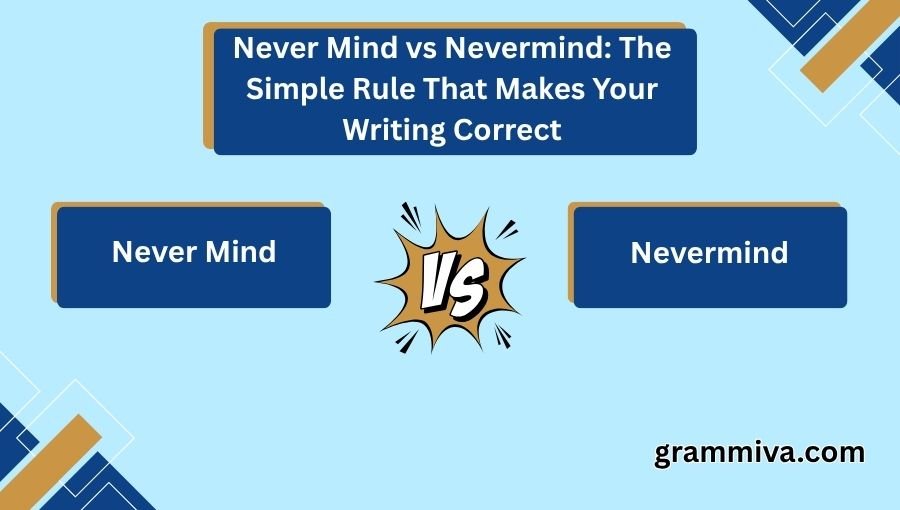
Have you ever paused while typing never mind vs nevermind and wondered which spelling is correct? 🤔 You are not alone.
These two forms look almost identical, and they sound the same in everyday speech, which makes the choice confusing for many writers.
The good news is that the rule is simple. Never mind is normally written as two words when you mean “forget it,” “do not worry about it,” or “it does not matter.”
The one-word form nevermind is generally not the standard spelling for this common expression in US English.
This small spelling difference can matter in school assignments, professional emails, blog posts, and other polished writing.
In this guide, I will explain the difference between never mind and nevermind, show you correct and incorrect examples, and give you a quick trick for remembering the right form.
By the end, you will know exactly when to write never mind and why nevermind is usually best avoided. ✍️ Sneaked vs Snuck | Gases vs Gasses | Disorganized vs Unorganized
🎯 Quick Answer: Never Mind vs Nevermind
The correct form for the usual expression is never mind, written as two words. Use it to mean “do not worry about it,” “forget what I said,” or “it does not matter.”
Nevermind as one word is generally not the standard form in modern US English for this expression. If you are writing an email, school paper, article, report, or professional message, choose never mind.
Quick examples
✅ Never mind. I found my keys.
❌ Nevermind. I found my keys.
✅ Never mind what I said earlier.
❌ Nevermind what I said earlier.
A useful shortcut is this: When you mean the common phrase, write two words: never mind.
Never Mind vs Nevermind: Meaning and Basic Difference
The core difference is spelling and standard usage. Never mind is the normal two-word expression, while never-mind is generally not used as the standard spelling of that expression in careful US English.
| Form | Type | Meaning | Example | Correct/Incorrect |
|---|---|---|---|---|
| never mind | Phrase | Forget it; do not worry; it does not matter | Never mind. I can do it myself. | ✅ Correct |
| nevermind | Nonstandard spelling for the usual phrase | Usually intended to mean “never mind” | Nevermind. I can do it myself. | ❌ Incorrect |
| never + mind | Two separate words | The same standard expression | Never mind the noise. | ✅ Correct |
| Nevermind | One-word form | Sometimes seen in informal or special uses | Nevermind. | ❌ Usually incorrect |
The key is not the sound. Both forms may sound the same in ordinary speech. The key is how the phrase functions in writing.
Is Never Mind the Same as Nevermind?
No. In standard US English, never mind is the normal spelling of the everyday expression. Writing it as one word is usually treated as a spelling or usage error.
Consider these examples:
✅ Never mind. We have plenty of time.
❌ Nevermind. We have plenty of time.
The meaning you intend is the same, but the written form is not equally standard.
This is similar to other English expressions that sound like they could be one word but are normally written separately. English spelling does not always follow pronunciation.
I once edited a short workplace guide where the writer used “never-mind” more than a dozen times. The writer knew exactly what the phrase meant. The problem was simply that the spelling had become a habit. We changed every ordinary use to never mind, and the document immediately looked cleaner.
A simple rule
If you can replace the phrase with “forget it,” “don’t worry about it,” or “it does not matter,” you almost certainly want never mind.
Never Mind vs Nevermind at a Glance
Here is the fastest comparison to keep in mind.
| Feature | Never mind | Nevermind |
|---|---|---|
| Standard spelling for the common expression | Yes | No |
| Written as two words | Yes | No |
| Used in professional writing | Yes | Generally no |
| Used to withdraw a request | Yes | No |
| Used to tell someone not to worry | Yes | No |
| Common in informal misspellings | Yes, correctly | Yes, but usually incorrectly |
| Best choice for school writing | Yes | No |
The safest choice is clear: write never mind as two words when you are using the familiar expression.
💡 Correct Meanings and Uses of Never Mind
Never mind has several closely related uses. The exact meaning depends on the situation, but the phrase usually tells someone to stop worrying, stop considering something, or forget an earlier point.
Never mind means “forget it”
You can use never mind when you no longer want to discuss something.
Example:
I was going to ask you a question, but never mind.
Here, the speaker has decided not to ask the question.
The phrase can stand alone:
“What did you want?”
“Never mind.”
It can also appear inside a longer sentence:
Never mind what I said before.
Never mind means “do not worry”
You can also use it to reassure someone.
Example:
Never mind the broken glass. I will clean it up.
The speaker is telling the other person not to focus on the problem.
Another example:
Never mind. We can fix it tomorrow.
In this case, never mind has a calming or reassuring purpose.
Never mind can mean “it does not matter”
The phrase may also show that something is no longer important.
Example:
I wanted to go to the store, but never mind. We already have everything we need.
The original plan has lost its importance.
Meaning summary
| Meaning | Word Type | Example Sentence |
|---|---|---|
| Forget it | Phrase | Never mind. I do not need your help. |
| Do not worry | Phrase | Never mind the mess. |
| It does not matter | Phrase | Never mind. We can try again tomorrow. |
| Withdraw a request | Phrase | Never mind my earlier question. |
💡 Test Tip
Try replacing never mind with “forget it.”
If the sentence still makes sense, the two-word form is probably what you need.
For example:
Never mind. I found the answer.
becomes:
Forget it. I found the answer.
That works.
Now consider:
Nevermind. I found the answer.
The meaning is understandable, but the spelling is not the standard choice for this phrase.
Why Do People Confuse Never Mind and Nevermind?
People confuse the forms mainly because the phrase is pronounced smoothly in speech. When two words are spoken together often, they can feel like one word when we write them.
There are three common reasons:
- The words sound connected.
- People type quickly.
- People see the one-word form online and assume it is standard.
I once caught myself typing “never-mind” in a quick message to a colleague. I stopped because the sentence looked wrong on the screen. I changed it to “never mind” before sending it. That small pause is often all it takes.
Another problem is visual memory. If you have seen a form many times, your brain may accept it automatically. Familiar does not always mean correct.
Why the mistake feels natural
English contains many compound words. Some began as separate words and later became one word. That can make writers wonder whether never mind has followed the same path.
For standard modern writing, however, the practical answer is simple: use never mind for the familiar expression.
Never Mind in Everyday Conversation
In everyday conversation, never mind is extremely useful because it can express several ideas with only two words.
You might say:
“What were you going to tell me?”
“Never mind.”
You might also say:
“Never mind. I will handle it.”
The tone matters. A friendly voice can make the phrase sound reassuring. A sharp voice can make it sound annoyed.
Correct and incorrect pairs
| Correct Example | Incorrect Example |
|---|---|
| ✅ Never mind. I will get it. | ❌ Nevermind. I will get it. |
| ✅ Never mind what he said. | ❌ Nevermind what he said. |
| ✅ Never mind. It is not important. | ❌ Nevermind. It is not important. |
| ✅ Never mind the delay. | ❌ Nevermind the delay. |
The correct spelling stays the same even when the tone changes.
Never Mind in Professional Writing
Professional writing requires extra care because small errors can affect how polished your message looks. Never mind is perfectly suitable when the meaning fits the situation, although a more direct phrase may sometimes sound better.
For example:
Never mind my previous email. I have the information now.
That is grammatically fine.
You could also write:
Please disregard my previous email. I have the information now.
The second version is more formal. The first is more natural in a friendly workplace.
Workplace examples
| Situation | Natural wording |
|---|---|
| You found the file yourself | Never mind. I found the file. |
| You no longer need help | Never mind. I can handle it. |
| You want to withdraw a question | Never mind my earlier question. |
| You want a formal tone | Please disregard my earlier message. |
For a formal report, never mind may be less useful because the phrase is conversational. But when it fits the tone, its spelling should still be two words.
📝 Case Study: A Workplace Email
Imagine that an employee sends this message:
Hi Jordan,
Could you send me the sales report from Friday?
Never mind. I just found it in the shared folder.
Thanks!
This is a perfectly normal use of never mind.
Now imagine the same email with this version:
Nevermind. I just found it.
The reader will probably understand it. However, the one-word spelling is not the standard form of the expression. In polished business writing, that small error is easy to avoid.
What this case teaches
The writer is using never mind to withdraw a request. The request was valid a moment ago, but it is no longer needed.
That is one of the most common uses of the phrase.
Grammar Rules Explanation
Never mind is normally written as two words because never and mind function together as a phrase rather than as the standard one-word spelling of this expression.
The word never is an adverb. The word mind can function as a verb or noun in English. In the expression never mind, the two words work together to communicate ideas such as “do not worry,” “forget it,” or “it does not matter.”
The spelling does not change simply because the phrase is used in a different sentence.
Most standard English reference works agree on the practical rule: when you use this familiar expression, write never mind as two words.
Correct vs Incorrect at a Glance
| Sentence | Correct/Incorrect | Why |
|---|---|---|
| Never mind. I found the book. | ✅ Correct | Standard two-word expression |
| Nevermind. I found the book. | ❌ Incorrect | One-word spelling is not standard here |
| Never mind what I said. | ✅ Correct | Standard phrase |
| Nevermind what I said. | ❌ Incorrect | The phrase should be written as two words |
| Never mind the cost. | ✅ Correct | “Never mind” works as the established phrase |
The important point is that this is a usage and spelling rule, not a rule about pronunciation.
Is Nevermind Ever Acceptable?
There are edge cases where Nevermind may appear as a name, title, label, or other special form. Those cases do not change the normal grammar rule.
For ordinary writing, the question is not whether someone might encounter “never-mind” somewhere. You might. The question is whether you should use it for the common expression.
The answer is no.
If you are writing:
Never mind. I changed my plans.
use the two-word form.
A special title or proper name should be treated according to its official spelling. That is different from using the word as an ordinary English phrase.
⚠️ Common Mistakes With Never Mind
The biggest mistake is simply joining the two words.
But several habits can lead writers to make the same error.
Fast typing
When people type quickly, they often remove spaces without noticing. This is common in texts and chat messages.
Autocorrect
Autocorrect can create unexpected changes. Some keyboards may learn a user’s preferred spelling. If a person repeatedly types “never-mind,” the keyboard may stop correcting it.
Lack of knowledge
Some writers have never been taught that the standard expression is two words. They may assume the one-word version is correct because it looks natural.
Similar grammar confusions
| Confusion | Correct Form | Common Wrong Form | Basic Rule |
|---|---|---|---|
| its / it’s | its; it’s | mixed up | “It’s” means “it is” or “it has” |
| your / you’re | your; you’re | mixed up | “You’re” means “you are” |
| their / they’re | their; they’re | mixed up | “They’re” means “they are” |
| a lot / alot | a lot | alot | “A lot” is two words |
| in to / into | depends on meaning | mixed up | Meaning controls the form |
| never mind / nevermind | never mind | nevermind | Use two words for the standard phrase |
Specific wrong forms to avoid
| Wrong Form | What’s Wrong | Correct Form |
|---|---|---|
| Nevermind. | One word for the usual phrase | Never mind. |
| nevermind it | Incorrectly joined expression | never mind it |
| never-mind | Unnecessary hyphen | never mind |
| never Mind | Random capitalization | never mind |
| Never mind! | Not wrong | Never mind! |
| never mind. | Correct lowercase use in a sentence | never mind. |
Notice the fifth row. Never mind! is completely correct. The exclamation mark changes punctuation and tone, not spelling.
How To Remember the Difference
The easiest memory trick is to think of never mind as an instruction.
If someone says:
Never mind.
they are basically saying:
Do not worry about it.
That meaning uses the two familiar words.
You can also remember this sentence:
“Never mind” is two words when you mean “forget it.”
Try these:
Never mind. I already called her.
Never mind the noise.
Never mind what happened.
All three use the same two-word form.
A quick mental test
Ask yourself:
Can I replace it with “forget it”?
If yes, write never mind.
| Your sentence | “Forget it” test | Result |
|---|---|---|
| Never mind. | Forget it. | ✅ Use two words |
| Never mind the question. | Forget the question. | ✅ Use two words |
| Never mind what I said. | Forget what I said. | ✅ Use two words |
This test is fast enough to use while writing.
Never Mind vs Nevermind in Different Contexts
The standard spelling does not change just because the setting changes. You should normally write never mind in everyday conversation, professional writing, creative work, and digital messages.
| Context | Which Term to Use | Example |
|---|---|---|
| Everyday conversation | never mind | Never mind. I will do it. |
| Professional writing | never mind | Never mind my earlier request. |
| Creative writing | never mind | “Never mind,” she said quietly. |
| Social media/texting | never mind | Never mind 😂 I figured it out. |
Informal writing may contain more spelling shortcuts, but that does not make every shortcut standard English.
If your goal is correct writing, choose never mind.
Common Phrases With Never Mind
Never mind appears in several useful expressions. The phrase keeps its two-word spelling in each one.
| Phrase | Meaning |
|---|---|
| Never mind | Forget it; do not worry |
| Never mind that | Do not focus on that |
| Never mind what… | Do not consider what… |
| Never mind the… | Do not worry about or focus on… |
| Never mind about… | Forget or stop worrying about… |
| Never mind me | Do not worry about me or my situation |
Examples:
Never mind about the tickets.
Never mind what they think.
Never mind me. You go ahead.
Each example uses never mind as two words.
Synonyms and Alternatives for Never Mind
Sometimes another phrase will fit better. The best choice depends on your tone and meaning.
| Alternative | Works When | Does Not Work When |
|---|---|---|
| Forget it | You want to withdraw a topic or request | You need a very formal tone |
| Don’t worry about it | You want to reassure someone | You mean “stop talking about it” in a sharp way |
| It doesn’t matter | Something is no longer important | You simply want someone to stop worrying |
| Please disregard it | You need a professional tone | You are having a casual conversation |
| No problem | You are responding to an apology or concern | You are withdrawing a question |
For example, in a business email, please disregard my previous message may sound more professional than never mind.
In a text to a friend, never mind may sound much more natural.
Why Getting Never Mind Right Matters
Correct spelling matters because readers form impressions from small details. One spelling mistake will rarely ruin a message, but repeated mistakes can make writing look careless.
Clarity in communication
A standard form makes your meaning easy to recognize.
Professionalism
In resumes, reports, emails, and client messages, correct spelling shows care.
Digital writing
Texts and social posts are informal, but correct spelling still helps readers understand you quickly.
“Clear writing makes the reader’s job easier.”
That simple idea applies to small phrases as much as long reports.
| Situation | Why Getting It Right Matters |
|---|---|
| Resume | Shows attention to written detail |
| Client email | Supports a polished professional image |
| Published content | Protects overall writing quality |
| Social post | Makes the message easier to read |
A single typo is not a disaster. But when the correct form is easy to remember, there is little reason to choose the incorrect one.
Does Never Mind Need a Hyphen?
No. The standard expression is never mind, with a space and no hyphen.
Correct:
✅ Never mind.
Incorrect:
❌ Never-mind.
Incorrect:
❌ Nevermind.
This is useful because writers sometimes try to solve the one-word problem by adding a hyphen. That does not produce the standard form.
Can You Use Never Mind at the Start of a Sentence?
Yes. Never mind can begin a sentence naturally.
Examples:
✅ Never mind. I have another plan.
✅ Never mind the delay. We can leave now.
It can also appear later in a sentence:
I was going to explain, but never mind.
Its position does not change its spelling.
Can Never Mind Be Used in Formal Writing?
Yes, but its suitability depends on tone. The spelling never mind is correct, but the phrase itself can sound conversational.
For a formal document, consider whether a more precise phrase would be better.
| Informal | More Formal |
|---|---|
| Never mind my last email. | Please disregard my previous email. |
| Never mind. We fixed it. | The issue has been resolved. |
| Never mind the delay. | The delay does not affect the schedule. |
This is a style choice, not a spelling correction. Never mind remains the correct spelling.
What About Texting and Social Media?
Texting and social media often contain shortened words, missing punctuation, and casual spelling. Even so, never mind remains the standard form when you want correct English.
For example:
Never mind 😂 I figured it out.
That is casual but correctly spelled.
A message such as:
Nevermind 😂 I figured it out.
will still be understood, but the one-word spelling is not the standard choice.
If you are writing for school, work, publishing, or public communication, always choose the standard form.
Never Mind vs Nevermind Spelling in School Writing
Students should use never mind in essays, assignments, answers, and other school work when the expression is needed.
Teachers often notice small spelling patterns because they affect the overall quality of a paper.
A simple editing trick is to search your document for:
never-mind
If you find it, check whether you meant the ordinary phrase. If you did, change it to:
never mind
This is especially useful before submitting a long paper.
💡 A Fast Editing Method
When I proofread, I like to check short phrases separately from major ideas. Small errors are easy to overlook because the brain focuses on meaning.
Use this three-step method:
- Search for “never-mind.”
- Ask whether it means “forget it” or “do not worry.”
- If yes, change it to “never mind.”
That takes only a few seconds.
You can also create a personal list of commonly confused forms:
- a lot / alot
- your / you’re
- its / it’s
- their / they’re
- never mind / never-mind
Small checks like these can greatly improve a final draft.
Quick Recap Checklist
The rule is simple: for the common expression, use never mind as two words.
| Question | If Yes → Use |
|---|---|
| Do you mean “forget it”? | never mind |
| Do you mean “do not worry”? | never mind |
| Are you withdrawing a request? | never mind |
| Are you saying something does not matter? | never mind |
| Are you writing formal or academic English? | never mind |
Practice examples
- Never mind. I found the missing file. ✅
- Never mind what I said earlier. ✅
- Nevermind, I already finished it. ❌
The first two use the standard form. The third should be changed to Never mind.
FAQs About Never Mind vs Nevermind
Is never-mind a word?
Nevermind is sometimes seen as a one-word form, but it is not the standard spelling for the common expression never mind. In ordinary US English writing, use never mind as two words.
Which is correct, never mind or never-mind?
Never mind is the correct standard form for the familiar expression. Use it when you mean “forget it,” “do not worry,” or “it does not matter.”
Is never mind one word or two words?
Never mind is two words. The space between “never” and “mind” is part of the standard spelling of the expression.
Why do people write never-mind?
People often write never-mind because the phrase sounds like one unit when spoken. Fast typing, autocorrect, and seeing the one-word form online can also reinforce the mistake.
Is “never mind” grammatically correct?
Yes. Never mind is a standard English phrase. It can be used by itself or as part of a longer sentence.
Can I use never mind in a professional email?
Yes. Never mind is correctly spelled and can work in a professional email when the tone is appropriate. For very formal writing, phrases such as please disregard my previous message may be a better stylistic choice.
Is “never-mind” correct?
No. The standard expression is not hyphenated. Write never mind, not never-mind.
Is “never mind” correct in texting?
Yes. Never mind is correct in texting, even though texting is informal. You may see “never-mind” in casual messages, but that does not make it the standard spelling.
How do I remember whether to use never mind or never-mind?
Remember this simple rule: If you mean “forget it,” write “never mind.” Think of the phrase as two separate words that work together.
Can never mind and never-mind change the meaning?
Usually, the writer intends the same meaning, but the spelling differs. Never mind is the standard form for the common expression. Using never-mind can make the sentence look like a spelling error.
Final Takeaway
Never mind vs never-mind is easier to solve than it first appears. For the ordinary English expression meaning “forget it,” “do not worry,” or “it does not matter,” write never mind as two words. ✨
The one-word form never-mind is commonly seen, especially in quick digital writing, but it should not replace the standard two-word expression in careful US English. If you are writing an email, school assignment, article, report, resume, or other polished text, choose never mind.
My best editing tip is simple: when you see never-mind, stop and ask whether you could replace it with “forget it.” If you can, write never mind.
Two words. One simple rule. When you mean “forget it,” never forget the space. 👍

I am Ryan Mitchell, a writer focused on English grammar, vocabulary, and everyday language. I work at Grammiva, creating easy-to-understand articles that help readers improve their English with confidence.