Have you ever typed a word, looked at it twice, and suddenly wondered if it is spelled right? 😅 desperate vs desparate is one of those spelling traps that can make even careful writers pause. The two forms look almost identical, but only one is standard English.
The correct spelling is desperate. The spelling desparate is a common misspelling and should not be used in standard American English.
I see this mistake often because the word sounds as if it could contain an “a” after the “r.”
That sound can make the incorrect spelling feel natural.
The problem becomes even more common when people type quickly or trust autocorrect without checking the final word.
In this guide, I will explain the difference in plain English.
We will look at meaning, grammar, examples, common mistakes, memory tricks, workplace use, and frequently asked questions.
By the end, you should be able to spot the correct form at a glance. ✍️ Seamless vs Seemless | Shiny vs Shiney | Capital vs Capitol
🎯 Quick Answer: Desperate vs Desparate
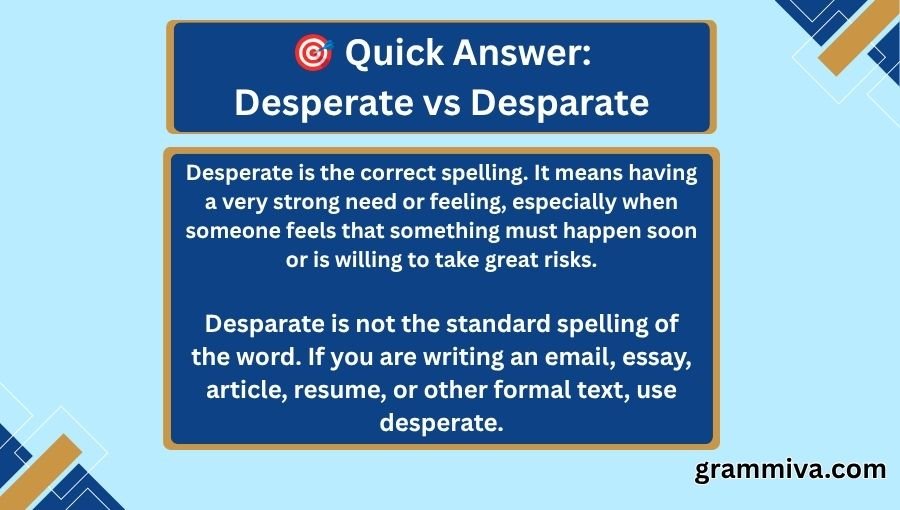
Desperate is the correct spelling. It means having a very strong need or feeling, especially when someone feels that something must happen soon or is willing to take great risks.
Desparate is not the standard spelling of the word. If you are writing an email, essay, article, resume, or other formal text, use desperate.
| Spelling | Correct? | Meaning | Example |
|---|---|---|---|
| desperate | ✅ Yes | Feeling a very strong need or desire | She was desperate for help. |
| desparate | ❌ No | Common misspelling of desperate | She was desparate for help. |
A simple rule is enough: When you mean extremely needy, urgent, or hopeless, spell it desperate.
Is Desperate the Same as Desparate?
No. Desperate is the standard English word, while desparate is a misspelling. They are not two different words with different meanings.
This is mainly a spelling issue rather than a grammar issue. The incorrect form often appears because the correct spelling does not match the way some speakers expect the word to sound.
For example:
- She was desperate to find a job. ✅
- She was desparate to find a job. ❌
The first sentence uses the accepted spelling. The second sentence contains a spelling error.
Why the Two Forms Look So Similar
The mistake is easy to make because desperate contains several letters that can be easy to reorder mentally.
The correct spelling is:
d-e-s-p-e-r-a-t-e
The incorrect version usually seen is:
d-e-s-p-a-r-a-t-e
The key difference is the order of the letters around the middle of the word.
Think of the correct word as:
des + per + ate
That visual pattern can make the spelling easier to remember.
Desperate: Meaning and Correct Use
Desperate is an adjective. It describes a person, situation, action, or feeling marked by a very strong need, desire, urgency, or lack of hope.
The exact meaning depends on the sentence.
For example:
I was desperate for water after the long hike.
Here, desperate means the speaker had a very strong need for water.
Now consider:
He made a desperate attempt to save the project.
Here, desperate describes an urgent attempt made because the situation was serious.
The word can also describe a person who feels that normal choices are no longer enough.
Meaning 1: Having a Very Strong Need
One common use is to describe someone who needs something badly.
Examples:
- We were desperate for food after missing lunch. ✅
- We were desparate for food after missing lunch. ❌
The phrase desperate for is especially common.
More examples include:
- She was desperate for sleep.
- They were desperate for information.
- He was desperate for a chance.
- The team was desperate for a win.
Meaning 2: Wanting Something Very Strongly
Desperate can also describe a powerful desire.
For example:
Maria was desperate to get the job.
This does not necessarily mean Maria was in physical danger. It means she wanted the job very badly.
Other common patterns include:
- desperate to succeed
- desperate to leave
- desperate to know
- desperate to help
- desperate to win
Meaning 3: In a Very Serious Situation
The word can describe a situation that is extremely serious.
For example:
The town was in desperate need of clean water.
The phrase in desperate need of means that something is needed very badly and urgently.
Another example is:
The company was in desperate financial trouble.
The sentence suggests that the financial problem was severe.
Meaning 4: Willing to Take Extreme Action
Desperate can also describe an action taken because someone feels that ordinary options have failed.
For example:
They made a desperate attempt to reach the airport on time.
The attempt was urgent and probably involved unusual effort.
This meaning often appears with words such as:
- attempt
- measure
- effort
- action
- situation
- struggle
Meaning Summary
| Meaning | Word Type | Example Sentence |
|---|---|---|
| Very strong need | Adjective | I was desperate for rest. |
| Very strong desire | Adjective | She was desperate to win. |
| Extremely serious | Adjective | The situation became desperate. |
| Extreme or urgent action | Adjective | He made a desperate attempt to escape. |
💡 Test Tip: How Can You Check the Spelling?
If you are unsure about desperate vs desparate, focus on the middle of the word.
Write it slowly:
des-per-ate
The correct spelling contains per in the middle.
A useful memory line is:
Desperate has “per” before “ate.”
Then check the sentence. If you are describing an intense need, desire, or urgent situation, desperate is almost certainly the word you want.
Do not let the sound of the word decide the spelling. English spelling often cannot be predicted perfectly from pronunciation.
Desperate vs Desparate at a Glance
The simplest way to understand the difference is to compare the two forms directly.
| Form | Type | Meaning | Example | Correct/Incorrect |
|---|---|---|---|---|
| desperate | Adjective | Extremely needy, urgent, or strongly wanting something | He was desperate for help. | ✅ Correct |
| desparate | Misspelling | No standard meaning as the intended word | He was desparate for help. | ❌ Incorrect |
Only desperate should be used when writing standard American English.
Why Do People Confuse Desperate and Desparate?
People often confuse these spellings because the letters in desperate do not always feel natural when written from sound alone. Fast typing, memory errors, and visual similarity can all make the wrong version appear convincing.
I once marked a short student essay in which the writer used desparate several times. The student knew exactly what the word meant and used it correctly in every sentence. The only problem was the spelling. Once we broke the word into des-per-ate, the mistake disappeared from the student’s next draft.
That example shows why spelling mistakes do not always mean a writer does not understand a word. Sometimes the writer knows the word perfectly but has stored the wrong letter pattern.
Fast Typing
Typing quickly can cause letters to move, disappear, or appear in the wrong order.
This is especially common with longer words. A writer may know that desperate is correct but type desparate without noticing.
Autocorrect
Autocorrect can help, but it is not perfect.
Some spelling mistakes may not be corrected immediately. Others can be accepted because the software does not understand what the writer intended.
Always give important writing a final review.
Lack of Spelling Knowledge
Sometimes a person has simply seen the incorrect spelling many times online. Repeated exposure can make a wrong form look familiar.
That is why desparate may look “right” even though it is not the standard spelling.
Similar-Looking Words
English has many words where a small letter change creates a different word or an error.
| Common Confusion | Correct Form | What Causes the Mistake |
|---|---|---|
| its / it’s | its / it’s | Missing or extra apostrophe |
| your / you’re | your / you’re | Similar sound |
| their / there / they’re | their / there / they’re | Similar sound |
| definitely / definately | definitely | Incorrect vowel pattern |
| separate / seperate | separate | Confusing vowel order |
| desperate / desparate | desperate | Letter order and sound |
These errors are not unusual. The best defense is to learn the correct pattern and review important writing.
⚠️ Common Mistakes With Desperate
The biggest mistake is simply replacing the middle of desperate with the pattern found in desparate.
Here are some common incorrect forms.
| Wrong Form | What’s Wrong | Correct Form |
|---|---|---|
| desparate | Incorrect letter order | desperate |
| desparatey | Misspelled form with an extra ending | desperately |
| desprate | Missing a letter | desperate |
| desperete | Incorrect vowel | desperate |
| desparate attempt | Wrong spelling in a common phrase | desperate attempt |
| desparate need | Wrong spelling in a common phrase | desperate need |
Another common mistake is using the word when a less intense word would be clearer.
For example:
I am desperate to finish my homework.
This may be perfectly correct if the speaker feels an urgent need to finish. But if the speaker simply wants to finish before dinner, eager or hoping may communicate the idea better.
I once caught myself typing the wrong middle letters while drafting a note late at night. I knew the spelling, but my fingers followed the familiar-looking pattern. A quick spell-check caught it before I sent the message. That small mistake reminded me that knowing a word is not the same as typing it correctly every time.
How To Remember the Difference
A good memory trick can save you from checking the spelling again and again.
Try these methods.
Remember “PER”
The strongest trick is to remember:
des + PER + ate
The word has per in its middle.
So:
- desperate → correct ✅
- desparate → incorrect ❌
Think of “Separate”
Another useful visual reminder is to notice that both separate and desperate have letter patterns that people often misspell.
Do not assume they are spelled exactly alike. Instead, use the correct spelling as a visual pattern you recognize.
Say the Word Slowly
When proofreading, mentally separate the word:
des-per-ate
This makes the middle letters easier to notice.
Use a Personal Example
Create one sentence you can remember:
I was desperate for a break.
Then remember that desperate is the spelling used in your sentence.
📝 Case Study: A Workplace Email
Imagine that an employee needs information before a meeting.
Here is an incorrect email sentence:
We are desparate for the final numbers before Friday.
The meaning is clear, but the spelling is wrong.
The corrected version is:
We are desperate for the final numbers before Friday. ✅
In a professional email, the second version is better because it avoids a visible spelling error.
However, there is another point to consider. Sometimes desperate may sound stronger than the writer intends.
Compare:
We are desperate for the final numbers.
with:
We urgently need the final numbers.
The first sounds emotional and serious. The second sounds direct and professional.
Choosing the right word is therefore about more than spelling. Good writing also depends on tone.
Grammar Rules Explanation
Desperate is the standard adjective used to describe a strong need, strong desire, extreme urgency, or a very serious situation. Desparate is a misspelling, not a standard alternate spelling.
The issue here is primarily spelling. The grammatical role of the word remains the same when it is used correctly.
For example:
She was desperate for help.
In this sentence, desperate describes she. It is an adjective.
Another example is:
He made a desperate attempt.
Here, desperate describes attempt. It is still an adjective.
The word can appear in several common sentence patterns:
- desperate for + noun
They were desperate for food. - desperate to + verb
She was desperate to leave. - in desperate need of + noun
The shelter was in desperate need of supplies. - desperate attempt + noun
He made a desperate attempt to win.
Standard English reference works recognize desperate as the accepted spelling. The form desparate should be treated as a spelling error when the intended word is desperate.
Correct vs Incorrect at a Glance
| Sentence | Correct/Incorrect | Why |
|---|---|---|
| She was desperate for help. | ✅ Correct | Desperate is the correct spelling. |
| She was desparate for help. | ❌ Incorrect | Desparate is a misspelling. |
| They made a desperate attempt. | ✅ Correct | The adjective is spelled correctly. |
| He was desparate to leave. | ❌ Incorrect | The intended word is desperate. |
| We are in desperate need of supplies. | ✅ Correct | The standard spelling is used. |
Is Desperate a Strong Word?
Yes. Desperate usually expresses a stronger feeling than ordinary words such as want, hope, or need.
Consider these sentences:
I want a glass of water.
This is a simple desire.
I really need a glass of water.
This is stronger.
I am desperate for a glass of water.
This suggests an extreme or urgent need.
The word should therefore be used with care. If every small desire is described as desperate, your writing can sound exaggerated.
For example:
I was desperate to buy the new notebook.
This may sound humorous if the notebook is not actually important.
In a serious report, a calmer phrase may be better.
Usage in Different Contexts
The correct spelling remains desperate in every standard writing setting. What changes is how strong or natural the word sounds.
| Context | Which Term to Use | Example |
|---|---|---|
| Everyday conversation | desperate | I’m desperate for some sleep. |
| Professional writing | desperate when the strong meaning is intended | The company is in desperate need of funding. |
| Creative writing | desperate | He made one desperate final attempt. |
| Social media/texting | desperate | I’m desperate for coffee! |
Everyday Conversation
People commonly use desperate to describe strong needs.
Examples include:
- I’m desperate for a break.
- She’s desperate to find her keys.
- We’re desperate for good news.
The word can be serious or playful depending on context.
Professional Writing
In professional writing, use desperate when the situation truly involves a strong need or serious problem.
For example:
The nonprofit is in desperate need of volunteers.
This clearly communicates urgency.
But avoid using the word simply to make a normal request sound dramatic.
Creative Writing
Writers often use desperate to show strong emotion or high stakes.
For example:
She made a desperate attempt to reach the train.
The word helps the reader understand that the character feels there is little time or few options left.
Social Media and Texting
Informal messages can use desperate in playful ways.
For example:
Desperate for pizza right now. 🍕
The spelling does not change just because the setting is informal.
Common Phrases With Desperate
Several phrases with desperate appear often in everyday and professional English.
| Phrase | Meaning |
|---|---|
| desperate for | Having a very strong need or desire for something |
| desperate to | Wanting strongly to do something |
| in desperate need of | Needing something very badly or urgently |
| desperate attempt | An urgent effort made in a serious situation |
| desperate measures | Extreme actions taken because normal choices have failed |
| desperate situation | A very serious or difficult situation |
Example Sentences
- I am desperate for a good night’s sleep.
- She is desperate to hear the answer.
- The village is in desperate need of clean water.
- They made a desperate attempt to solve the problem.
- The team took desperate measures to avoid failure.
Notice that every phrase uses desperate, never desparate.
Desperate vs Desparate in Real Sentences
Seeing the word in context makes the spelling easier to remember.
| Incorrect Example | Correct Example |
|---|---|
| He was desparate to win. ❌ | He was desperate to win. ✅ |
| We are desparate for help. ❌ | We are desperate for help. ✅ |
| She made a desparate attempt. ❌ | She made a desperate attempt. ✅ |
| They were desparate for answers. ❌ | They were desperate for answers. ✅ |
| The situation looked desparate. ❌ | The situation looked desperate. ✅ |
The incorrect examples may still be easy to understand. However, being understandable does not make a spelling form correct.
Synonyms and Alternatives
You do not always need to use desperate. Sometimes another word gives a better match for your intended meaning.
| Alternative | Works When | Does Not Work When |
|---|---|---|
| urgent | Something needs quick action | You mean a strong personal desire |
| eager | Someone strongly wants to do something | The situation involves danger or serious need |
| frantic | Someone is extremely worried or rushed | You want a calm description of strong desire |
| hopeless | A situation seems to offer little chance of success | You simply mean someone really wants something |
| determined | Someone strongly intends to achieve a goal | The main idea is fear, need, or lack of options |
For example:
She was desperate to win.
could sometimes become:
She was determined to win.
But the meanings are not identical. Determined focuses on strong purpose. Desperate can suggest urgency, emotional pressure, or a feeling that failure would be very serious.
Why It Matters: Clarity and Professionalism
Correct spelling matters because readers notice errors even when they understand the intended meaning.
A misspelled word can make a sentence look rushed or careless. That matters especially in resumes, work emails, school assignments, websites, and published articles.
A simple rule I give writers is:
Correct spelling makes your message easier to trust.
The idea is simple. Readers should focus on what you are saying, not wonder whether your writing contains mistakes.
| Situation | Why Getting It Right Matters |
|---|---|
| Resume | Shows care and attention to detail |
| Client email | Supports a professional impression |
| Published content | Builds reader confidence |
| Social post | Makes the message cleaner and easier to read |
Clarity in Communication
The reader should never have to stop and decode a spelling error.
Even when the meaning is obvious, mistakes can interrupt the flow of reading.
Professionalism
A single spelling error does not define a writer. Still, repeated errors can make formal writing look less polished.
Digital Communication
Text messages are informal, but spelling still matters when the message represents you or your work.
For important communication, take a few seconds to review the final text before sending it.
Does Desperate Have Related Word Forms?
Yes. Desperate has several related forms that are useful to know.
The most common are desperately and desperation. These words are related but do not have the same grammatical job.
| Form | Type | Example |
|---|---|---|
| desperate | Adjective | She was desperate for help. |
| desperately | Adverb | He desperately wanted an answer. |
| desperation | Noun | Her desperation was clear. |
| despair | Noun/verb | The situation caused despair. |
The spelling of these related words can also help reinforce the correct pattern of desperate.
How Does Desperately Relate to Desperate?
Desperately is the adverb form commonly used to describe an action done with extreme urgency or intensity.
Compare:
She was desperate to leave.
Here, desperate describes she.
She desperately wanted to leave.
Here, desperately describes wanted.
The two words are related, but they have different jobs in a sentence.
Do not turn desperate into the incorrect form desparate when creating the related word.
Correct:
He desperately needed help. ✅
Incorrect:
He desparately needed help. ❌
How Can You Avoid the Desparate Spelling Error?
The easiest method is to create a small mental check.
Before accepting the word, ask:
- Am I trying to spell the word meaning extremely needy or urgent?
- Does the middle contain per?
- Does the word look like desperate?
- Have I accidentally typed desparate?
If the answer to the first question is yes, the standard spelling is desperate.
A Five-Second Proofreading Trick
Look at the word letter by letter:
D E S P E R A T E
Now look at the middle:
P E R
That three-letter group is your anchor.
When you see:
D E S P A R A T E
stop and correct it.
When Should You Avoid the Word Desperate?
Correct spelling is only part of good writing. You should also choose the word carefully.
Use desperate when the feeling or situation is genuinely intense.
For a mild situation, consider:
- eager
- interested
- hopeful
- concerned
- ready
- motivated
For example:
I am eager to learn more.
may sound better than:
I am desperate to learn more.
The second sentence suggests much stronger emotion.
This distinction is especially useful in professional writing.
Can Desparate Ever Be Correct?
In standard American English, desparate is not the accepted spelling of the adjective desperate.
If you intend the ordinary English word meaning extremely needy, urgent, or strongly wanting something, use desperate.
You may occasionally encounter unusual names, usernames, titles, or invented spellings online. Such cases do not change the standard spelling of the English word.
Is Desperate Always Negative?
No. The word often carries a serious or negative feeling, but context matters.
For example:
She was desperate to help the injured animal.
The situation may be serious, but the person’s desire to help is positive.
Likewise:
He was desperate to find a solution.
This describes strong urgency. It does not necessarily say that the person is bad or that the goal is wrong.
The word mainly tells us that the feeling or need is very strong.
Quick Recap Checklist
Use this checklist whenever you hesitate over the spelling.
| Question | If Yes → Use |
|---|---|
| Do I mean extremely needy or urgently in need? | desperate |
| Do I mean someone strongly wants something? | desperate |
| Am I describing an extreme attempt or situation? | desperate |
| Did I type “desparate”? | Change it to desperate |
| Does the word contain “per” in the middle? | desperate |
Practice Examples
- The workers were desperate for clean water. ✅
- She was desperate to hear the result. ✅
- He made a desperate attempt to finish the race. ✅
Remember the visual pattern:
des-PER-ate
That small trick can prevent a surprisingly common spelling error.
FAQs About Desperate vs Desparate
Is desperate spelled with an “e” or an “a” in the middle?
The correct spelling is desperate, with per in the middle. The form desparate is a misspelling.
Why is desparate wrong?
Desparate is wrong because it is not the standard spelling of the English adjective desperate. The letters in the middle are arranged incorrectly.
What is the correct spelling, desperate or desparate?
The correct spelling is desperate. Use it when you mean extremely needy, urgent, strongly wanting something, or facing a very serious situation.
How do you remember how to spell desperate?
Remember the middle letters PER. Break the word into a simple visual pattern: des-per-ate.
What does desperate mean?
Desperate means having a very strong need or desire, or being in an extremely serious or urgent situation.
Is desperately spelled with one or two “p” letters?
Desperately is spelled with one p: d-e-s-p-e-r-a-t-e-l-y. It is the adverb form related to desperate.
What is the difference between desperate and desperately?
Desperate is an adjective, while desperately is an adverb. For example, “She was desperate for help” uses the adjective, while “She desperately needed help” uses the adverb.
Can I use desperate in professional writing?
Yes. Desperate is appropriate in professional writing when the situation genuinely involves strong need or urgency. However, avoid it when a calmer word such as urgent, concerned, or eager better matches the situation.
Is desperate a negative word?
Not always. It often suggests serious need or urgency, but it can describe a strong desire to do something positive, such as helping someone or solving a problem.
What is the most common spelling mistake for desperate?
One of the most common mistakes is writing desparate instead of desperate. The easiest way to prevent it is to remember the per in the middle.
Conclusion
Desperate vs desparate has a simple answer: desperate is correct, and desparate is a misspelling. The correct word is an adjective used for a very strong need, desire, urgent situation, or extreme attempt. ✨
The best spelling trick is to remember the middle of the word: des-per-ate. When you see desparate, check the letters again and change it to desperate.
The word can appear in many useful patterns, including desperate for, desperate to, in desperate need of, and desperate attempt. It works in casual conversation, professional writing, creative work, and digital communication.
Remember, though, that good writing is not only about spelling. Desperate is a strong word, so make sure the situation truly calls for that level of emotion or urgency.
If you remember just one thing, remember this:
When the word means a very strong need or desire, it is always spelled DESPERATE. 📝
One correct letter pattern can make your writing clearer, cleaner, and more professional.

I am Ethan Brooks, an English grammar and vocabulary writer. I work at Grammiva, where I create simple and helpful content to make English learning easier for students and everyday learners.


[…] shows common examples, covers exceptions, and gives you quick ways to check your writing. 🍂 Desperate vs Desparate | Seamless vs Seemless | Shiny vs […]
[…] make this confusing pair easy. ✨ Whisky vs Whiskey | Desperate vs Desparate | Seamless vs […]