Have you ever typed a sentence, read it twice, and still wondered whether you meant “relieving vs reliving”? You are not alone. These two words look almost the same, but they describe very different ideas.
One is about making pain, stress, or a problem less severe.
The other is about experiencing something again, either in your mind or in real life.
That one extra “e” changes the meaning completely. 😅
A sentence about feeling better can become a sentence about repeating an old experience if the wrong spelling slips in.
As an editor and writing teacher, I often see this mix-up in school papers, emails, captions, and everyday messages.
The good news is that the difference is easy to learn once you connect each word to its base verb.
This guide explains relieving vs reliving, shows when to use each form, gives clear examples, and offers simple memory tricks.
By the end, you should be able to choose the right word without stopping to second-guess yourself. ✨ Gray vs Grey | Ensure vs Insure | Anytime vs Any Time
🎯 Quick Answer: Relieving vs Reliving
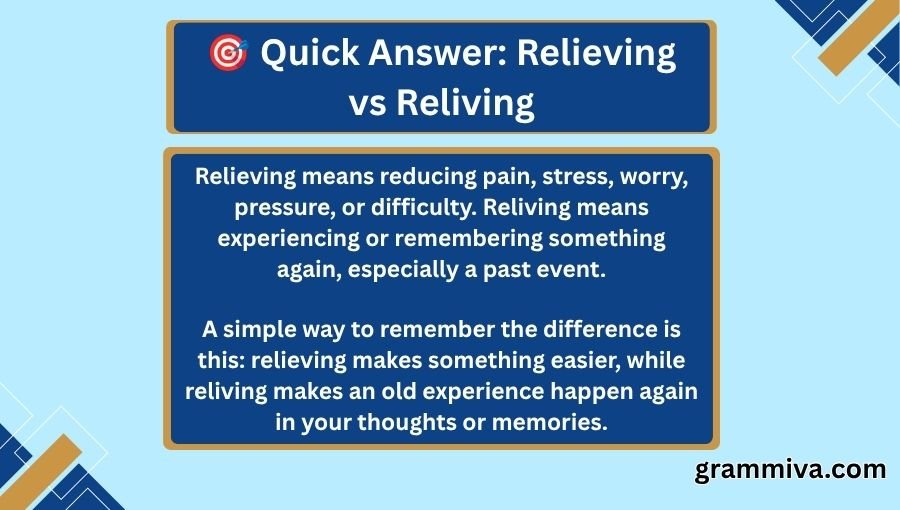
Relieving means reducing pain, stress, worry, pressure, or difficulty. Reliving means experiencing or remembering something again, especially a past event.
A simple way to remember the difference is this: relieving makes something easier, while reliving makes an old experience happen again in your thoughts or memories.
Related Word Forms
The two words come from different base verbs, so their related forms also have different meanings.
| Form | Type | Example |
|---|---|---|
| relieve | Base verb | A short break can relieve stress. |
| relieves | Third-person verb | This medicine relieves pain. |
| relieved | Past tense/past participle | I felt relieved after the test. |
| relieving | Present participle/gerund | Walking is relieving some of my stress. |
| relive | Base verb | She does not want to relive that moment. |
| relives | Third-person verb | He relives the memory often. |
| relived | Past tense/past participle | They relived the exciting final game. |
| reliving | Present participle/gerund | She is reliving the event in her mind. |
The spelling change becomes especially clear when you compare the base verbs. Relieve becomes relieving, while relive becomes reliving.
Understanding Relieving vs Reliving
The core difference is simple: relieving is connected to relieve, while reliving is connected to relive. The first concerns reducing something unpleasant. The second concerns experiencing something again.
| Form | Type | Meaning | Example | Correct/Incorrect |
|---|---|---|---|---|
| relieving | Present participle/gerund | Making pain, stress, or difficulty less severe | The treatment is relieving her pain. | ✅ Correct |
| reliving | Present participle/gerund | Experiencing a past event again | He is reliving his childhood memories. | ✅ Correct |
| relieving | Used for repeating a memory | Experiencing an event again | She is relieving the accident in her mind. | ❌ Incorrect |
| reliving | Used for reducing pain | Making pain less severe | The ice pack is reliving my headache. | ❌ Incorrect |
What Does “Relieving” Mean?
Relieving means reducing or removing something unpleasant. That unpleasant thing may be physical pain, emotional stress, pressure, worry, work, or another burden.
For example:
The cold towel is relieving my headache.
Here, relieving means the towel is making the headache less painful.
Another example:
Taking a short break is relieving some of the pressure.
The break does not repeat an earlier event. Instead, it makes the pressure easier to handle.
The word can also describe helping someone by taking away a task or burden.
I am relieving my coworker for the afternoon.
In this sentence, the speaker is taking over the coworker’s duties. The idea is still connected to removing or reducing a burden.
What Does “Reliving” Mean?
Reliving means experiencing something again. Usually, the experience is a memory, but the word can also describe repeating an enjoyable or meaningful past experience.
For example:
I am reliving my vacation by looking through old photos.
The speaker is mentally returning to the vacation.
Another example:
The team is reliving its championship season through a documentary.
The team is not reducing a problem. It is remembering and experiencing the past again through stories, images, or emotions.
Reliving can be positive, negative, or neutral. Someone might relive a wonderful wedding, a funny childhood moment, a major victory, or a painful event.
The Fastest Way to Tell Them Apart
Ask yourself one question:
Am I making something less painful or difficult, or am I experiencing something again?
If you are making something easier, choose relieving.
If you are experiencing something again, choose reliving.
| Meaning | Word Type | Example Sentence |
|---|---|---|
| Reducing pain | Verb form | The medicine is relieving my pain. |
| Reducing stress | Verb form | Exercise is relieving some of my stress. |
| Removing a burden | Verb form | She is relieving him of his duties. |
| Experiencing a memory again | Verb form | He is reliving the moment in his mind. |
| Experiencing a past event again | Verb form | We are reliving our college days. |
💡 Test Tip
Try replacing the word with “making easier” or “experiencing again.”
If “making easier” fits, use relieving.
If “experiencing again” fits, use reliving.
For example:
The massage is ___ my back pain.
“Making my back pain easier” works. So the answer is relieving.
She is ___ the day she won the award.
“Experiencing that day again” works. So the answer is reliving.
Is Relieving the Same as Reliving?
No. Relieving and reliving are different words with different meanings. Although they sound and look similar, they come from different verbs.
Think of them as two separate paths:
relieve → relieving → reduce or remove a burden
relive → reliving → experience again
The spelling also gives you a useful clue. Relieving keeps the “ie” from relieve. Reliving comes from relive and therefore has the shorter “i” pattern.
Relieving in Everyday Sentences
You will often see relieving with words such as:
- pain
- stress
- pressure
- tension
- worry
- discomfort
- symptoms
- responsibility
- a burden
Examples:
The medicine is relieving her pain. ✅
The new schedule is relieving some of the pressure on the staff. ✅
The warm shower was relieving his muscle tension. ✅
The medicine is reliving her pain. ❌
The new schedule is reliving some of the pressure. ❌
Reliving in Everyday Sentences
You will often see reliving with words connected to memories and experiences:
- memories
- moments
- childhood
- a trip
- a victory
- an experience
- an event
- a difficult time
- the past
Examples:
She is reliving her favorite childhood memories. ✅
We spent the evening reliving our road trip. ✅
He keeps reliving the final seconds of the game. ✅
She is relieving her favorite childhood memories. ❌
We spent the evening relieving our road trip. ❌
Why Do People Confuse Relieving and Reliving?
People confuse these words because they are visually and phonetically close. Both begin with “reliv-”, and both can appear after forms of be, such as “is,” “are,” and “was.”
Fast typing also causes trouble. Autocorrect may not catch a wrong word when both spellings are real English words.
I once edited a short workplace message that said, “Thanks for relieving those great memories with us.” The writer clearly meant reliving. The mistake was easy to understand because both words were valid spellings, but the sentence had the wrong meaning.
| Confusion | Why It Happens | Better Habit |
|---|---|---|
| relieving vs reliving | The words look very similar | Check the base verb |
| affect vs effect | Both are common in formal writing | Ask whether you mean action or result |
| advice vs advise | The final sound can be misleading | Check whether it is a noun or verb |
| your vs you’re | Apostrophe changes the meaning | Expand “you’re” to “you are” |
| its vs it’s | Both sound the same | Test “it is” |
| then vs than | Similar spelling and sound | Check whether you mean time or comparison |
The main lesson is that a spell-checker cannot always save you. Relieving and reliving are both legitimate words. A computer may see no spelling error even when your sentence says something completely different from what you intended.
Relieving vs Reliving at a Glance
The easiest comparison is to focus on what happens to the subject.
| Question | Relieving | Reliving |
|---|---|---|
| Does it reduce something unpleasant? | Yes | No |
| Does it involve a memory or past event? | Usually no | Usually yes |
| Base verb | relieve | relive |
| Common objects | pain, stress, pressure, burden | memories, moments, experiences |
| Basic idea | Make easier | Experience again |
| Example | The treatment is relieving pain. | She is reliving the moment. |
Correct Meanings and Uses
Relieving Pain or Discomfort
Use relieving when something makes physical discomfort less severe.
The medicine is relieving my toothache.
The medicine is not making the person experience the toothache again. It is reducing the discomfort.
The ice pack is relieving the swelling.
Again, the action is about making a problem less severe.
Relieving Stress or Pressure
The word also works for emotional or mental pressure.
Talking to a friend is relieving some of my stress.
The extra staff are relieving pressure on the busy team.
Here, relieving means reducing the amount of stress or pressure.
Relieving Someone of a Duty
A person can also be relieved of a responsibility.
The manager is relieving Maya of her evening shift.
This means Maya no longer has to handle that duty.
The phrase “relieve someone of something” often means taking a task, responsibility, or burden away from that person.
Reliving a Memory
Use reliving when someone mentally returns to a past experience.
Looking at old photographs had me reliving my childhood.
The speaker is remembering the experience in a vivid way.
Reliving a Positive Experience
Reliving does not always involve something painful.
The reunion felt like reliving our best college days.
The people are mentally returning to a happy period.
Reliving a Difficult Experience
The word can also describe an unwanted return to a painful memory.
Writing about the accident made him feel as if he were reliving it.
Here, the meaning is experiencing the event again through memory or emotion.
📝 Case Study: A Workplace Email
Imagine that an employee sends this message to a manager:
“Thank you for relieving the success of our product launch.”
That sentence does not express the intended idea. Relieving suggests reducing a burden or problem.
If the employee means that the team is remembering the successful launch, the better sentence is:
“Thank you for helping us relive the success of our product launch.” ✅
Now imagine a different message:
“The extra team members are reliving the pressure on customer support.” ❌
That sounds as if the team members are experiencing the pressure again. The intended meaning is probably:
“The extra team members are relieving the pressure on customer support.” ✅
The difference is only one letter, but the meaning changes sharply.
| Original Idea | Correct Word | Correct Sentence |
|---|---|---|
| Reduce pressure | relieving | The new staff are relieving the pressure. |
| Experience a memory | reliving | We are reliving the experience. |
| Reduce pain | relieving | The treatment is relieving the pain. |
| Experience the past again | reliving | She is reliving her childhood. |
Grammar Rules Explanation
The spelling difference follows the base verbs relieve and relive.
Relieving is the present participle of relieve. It means reducing, removing, or easing something such as pain, pressure, stress, or responsibility.
Reliving is the present participle of relive. It means experiencing something again, usually a past event or memory.
The spelling of relieving may look unusual because the base verb relieve ends in -ie. When -ing is added, the form becomes relieving.
The verb relive has a different structure. It ends in a simple -e, and the final e is dropped before -ing, producing reliving.
The grammar is therefore not a matter of personal style. Each form belongs to a different verb and carries a different meaning.
Standard English reference sources treat these as separate words. A general dictionary such as Merriam-Webster can also be useful when you want to check a word’s meaning or spelling.
Correct vs Incorrect at a Glance
| Sentence | Correct/Incorrect | Why |
|---|---|---|
| The cream is relieving my skin irritation. | ✅ Correct | It is reducing discomfort. |
| We are reliving our favorite vacation memories. | ✅ Correct | We are experiencing memories again. |
| The new policy is reliving pressure on employees. | ❌ Incorrect | The intended meaning is reducing pressure. |
| She is relieving the moment she won the race. | ❌ Incorrect | The intended meaning is experiencing the moment again. |
| The break is relieving some of my stress. | ✅ Correct | The break reduces stress. |
⚠️ Common Mistakes With Relieving and Reliving
These mistakes usually happen because the writer knows the meaning but types the wrong form. Sometimes the writer knows both words but forgets which one belongs in the sentence.
Common causes include:
- Fast typing: Your fingers may choose the familiar pattern before your brain checks the meaning.
- Autocorrect: Both words are real, so software may not flag the wrong choice.
- Lack of knowledge: Writers may not know that the two forms come from different verbs.
- Sound similarity: In quick speech, the difference may not feel important.
- Visual similarity: The words share most of their letters.
I once caught myself typing “relieving” when I meant “reliving” in a note about an old family trip. I had written the sentence quickly and noticed the error only when I read the whole sentence aloud. That small edit reminded me that real words can still be the wrong words.
| Common Confusion | Correct Choice | Quick Check |
|---|---|---|
| it’s / its | Depends on meaning | Can “it is” replace it? |
| your / you’re | Depends on meaning | Can “you are” replace it? |
| they’re / their / there | Depends on meaning | Person, possession, or place? |
| then / than | Depends on meaning | Time or comparison? |
| affect / effect | Depends on meaning | Action or result? |
| relieving / reliving | Depends on meaning | Reducing or experiencing again? |
Common Wrong Spellings and Uses
| Wrong Form | What’s Wrong | Correct Form |
|---|---|---|
| releiving | The letters are in the wrong order | relieving |
| relievng | The word is missing a letter | relieving |
| reliveing | The final e should be dropped before -ing | reliving |
| reliving pain | Usually uses the wrong meaning when “reducing pain” is intended | relieving pain |
| relieving memories | Usually uses the wrong meaning when “experiencing memories again” is intended | reliving memories |
| releaving | Incorrect spelling | relieving |
How To Remember the Difference
A simple memory trick can make this distinction almost automatic.
Think “Eases” for Relieving
Relieving = easing.
If something is making pain, stress, pressure, or a burden easier, choose relieving.
The massage is relieving my back pain.
Think:
relieving → relief → less trouble
Think “Again” for Reliving
Reliving = living again.
If someone is experiencing a memory or past event again, choose reliving.
She is reliving her favorite childhood memories.
Think:
reliving → living again → past experience returns
| Memory Trick | Word | Example |
|---|---|---|
| Easing something | relieving | The medicine is relieving pain. |
| Living something again | reliving | He is reliving the memory. |
| Reducing pressure | relieving | The assistant is relieving the workload. |
| Experiencing the past | reliving | They are reliving their school days. |
Usage in Different Contexts
The correct word does not change based on whether you are speaking, writing an email, or posting online. The meaning decides the word.
| Context | Which Term to Use | Example |
|---|---|---|
| Everyday conversation | relieving | This tea is relieving my sore throat. |
| Professional writing | relieving | The new system is relieving pressure on staff. |
| Creative writing | reliving | He sat quietly, reliving the summer of his youth. |
| Social media/texting | reliving | Reliving this amazing weekend! |
| Everyday conversation | reliving | We’re reliving old stories tonight. |
| Professional writing | relieving | The change is relieving some of the workload. |
Everyday Conversation
Both words are common in normal speech.
“This chair is really relieving my back pain.”
“We spent hours reliving old stories.”
Professional Writing
Precision matters more in workplace communication.
“The software is relieving employees of several repetitive tasks.”
“The presentation gave the team a chance to relive the project’s early success.”
Creative Writing
Writers often use reliving to show memories and emotions.
“She stood by the old house, reliving the summer she spent there.”
Relieving can create a different image:
“The rain was relieving the heat of the afternoon.”
Social Media and Texting
Short posts often use reliving when someone looks back on a good time.
“Reliving the best moments from last summer! 📸”
Meanwhile, relieving might appear in a post about comfort or recovery.
“Finally found a stretch that is relieving my shoulder pain.”
Common Phrases With Relieving and Reliving
Neither word has a huge list of fixed idioms, but both appear naturally in common expressions.
| Phrase | Meaning |
|---|---|
| relieving pain | Making pain less severe |
| relieving stress | Reducing stress |
| relieving pressure | Reducing pressure or strain |
| relieving someone of a duty | Taking a duty away from someone |
| reliving memories | Experiencing memories again |
| reliving the past | Mentally returning to past experiences |
The phrase “relieve someone of a duty” is especially useful in professional writing.
The phrase “reliving memories” is common in personal stories, captions, and reflective writing.
Synonyms and Alternatives
Sometimes you can replace these words with simpler phrases. This can help if you want to make your writing clearer.
| Alternative | Works When | Does Not Work When |
|---|---|---|
| easing | Something becomes less painful or difficult | You mean experiencing a memory |
| reducing | A problem, pain, or pressure becomes smaller | You mean remembering an event |
| lightening | A burden or load becomes easier | You mean returning to a past experience |
| remembering | You are thinking about a past event | You mean physically reducing pain |
| experiencing again | You want to explain reliving clearly | You mean removing a burden |
For example, instead of:
“The treatment is relieving the pain.”
You could write:
“The treatment is easing the pain.”
Instead of:
“She is reliving her childhood.”
You could write:
“She is experiencing her childhood memories again.”
The alternatives are not always perfect replacements. Context still matters.
Why Relieving vs Reliving Matters
Choosing the right word makes your writing easier to understand. A single letter can change the action in your sentence.
Clear writing also shows care. This matters in schoolwork, business emails, resumes, articles, social posts, and messages.
“A clear word saves the reader from having to guess.”
That principle is especially useful with words that look almost identical.
| Situation | Why Getting It Right Matters |
|---|---|
| Resume | Shows careful writing and attention to detail |
| Client email | Prevents confusing or awkward messages |
| Published content | Protects clarity and credibility |
| Social post | Helps readers understand your intended meaning |
Imagine writing that a new service is “reliving pressure from customers.” Readers may wonder whether the service is bringing old pressure back.
Change one letter:
“relieving pressure from customers.”
Now the intended meaning is clear.
Is “Relieving” Ever Used for Memories?
Normally, no. When you mean experiencing memories or past events again, reliving is the correct word.
You might see “relieving” near the word “memory” in a sentence, but that does not mean the two words are interchangeable.
For example:
The conversation was relieving her stress about the memory.
Here, relieving means reducing her stress.
Compare it with:
The conversation was causing her to relive the memory.
Here, relive means experience the memory again.
The surrounding words can therefore make the difference very clear.
Can Reliving Be Positive?
Yes. Reliving can describe happy, exciting, funny, or meaningful experiences as well as difficult ones.
You can relive:
- a great vacation
- a championship win
- a wedding
- a childhood memory
- a funny story
- a family tradition
- an important achievement
For example:
Watching the old game felt like reliving our team’s greatest victory.
There is nothing negative about the word itself.
The meaning simply involves experiencing something again.
Can Relieving Be Used for Emotional Problems?
Yes. Relieving can describe reducing emotional discomfort as well as physical discomfort.
For example:
Talking with a trusted friend was relieving some of her anxiety.
The good news was relieving his worry.
The basic idea stays the same: something unpleasant becomes less intense.
How To Choose the Right Word in Five Seconds
When you are unsure, use this five-step check:
- Find the action.
- Ask whether something is becoming less painful or difficult.
- If yes, choose relieving.
- If not, ask whether someone is experiencing something again.
- If yes, choose reliving.
Try these:
The medication is ___ my headache.
The medication is making the headache less severe.
Answer: relieving. ✅
They are ___ their first trip together.
They are experiencing the memory again.
Answer: reliving. ✅
The new employee is ___ some pressure from the team.
The employee is reducing pressure.
Answer: relieving. ✅
She is ___ the final moments of the concert.
She is experiencing those moments again in memory.
Answer: reliving. ✅
Quick Recap Checklist
Use this checklist whenever the spelling makes you pause.
| Question | If Yes → Use |
|---|---|
| Am I reducing pain? | relieving |
| Am I reducing stress? | relieving |
| Am I reducing pressure? | relieving |
| Am I taking away a responsibility? | relieving |
| Am I experiencing a past event again? | reliving |
| Am I thinking through an old memory again? | reliving |
| Am I returning to a happy past experience? | reliving |
Practice Examples
1. The warm bath is ___ my sore muscles.
Answer: relieving ✅
2. We are ___ our favorite family memories.
Answer: reliving ✅
3. The extra staff are ___ the workload.
Answer: relieving ✅
FAQs About Relieving vs Reliving
What is the difference between relieving and reliving?
Relieving means making pain, stress, pressure, or another burden less severe. Reliving means experiencing a past event or memory again.
Is it “relieving memories” or “reliving memories”?
The usual and correct phrase is “reliving memories.” It means experiencing or thinking through past memories again.
We spent the evening reliving memories from college. ✅
Is it “relieving pain” or “reliving pain”?
When you mean reducing pain, use “relieving pain.”
The medicine is relieving my pain. ✅
Reliving pain would suggest experiencing pain again rather than reducing it.
Why is relieving spelled with “ie”?
The word comes from the base verb relieve. When the -ing ending is added, the resulting form is relieving.
Why is reliving spelled without the final “e”?
The base verb is relive. Before adding -ing, the final e is dropped, giving reliving.
Is “relieving” a verb?
Yes. Relieving is the present participle of relieve, and it can also function as a gerund in a sentence.
For example:
The medicine is relieving the pain.
Is “reliving” a verb?
Yes. Reliving is the present participle of relive, and it can also function as a gerund.
For example:
She is reliving the moment in her mind.
Can you relive a happy memory?
Yes. Relive and reliving can describe positive memories and experiences. You can relive a vacation, celebration, victory, childhood event, or other meaningful moment.
Can relieving refer to emotional stress?
Yes. Relieving can refer to reducing emotional stress, worry, tension, or pressure.
The conversation was relieving some of my stress.
Which word should I use for “experience again”?
Use reliving.
A useful memory trick is:
reliving = living again
If the meaning is “making something less painful or difficult,” use relieving.
Final Comparison: Relieving vs Reliving
The difference between these words becomes easy once you focus on their base verbs.
Relieving comes from relieve and means reducing, easing, or removing something unpleasant or difficult. You can relieve pain, stress, pressure, worry, or responsibility.
Reliving comes from relive and means experiencing something again. You can relive memories, childhood moments, vacations, victories, conversations, or other past experiences.
The spelling follows the same split:
relieve → relieving
relive → reliving
When I teach this distinction, I tell writers not to memorize the spelling alone. Memorize the idea behind each word. If something is becoming easier, think relieving. If a past experience is coming back, think reliving.
That simple test works in emails, essays, conversations, captions, and professional writing.
So the next time you hesitate over relieving vs reliving, ask one quick question: Am I easing something, or am I experiencing something again? Once you answer that, the correct spelling is usually obvious.
Ease it with relieving. Experience it again with reliving. ✨

I am Ethan Brooks, an English grammar and vocabulary writer. I work at Grammiva, where I create simple and helpful content to make English learning easier for students and everyday learners.


[…] end, you should be able to choose the right word without stopping to second-guess yourself. ✍️ Relieving vs Reliving | Gray vs Grey | Ensure vs […]