Have you ever typed a sentence, stopped, and wondered whether anyway vs anyways is the better choice? You are not alone. I have seen this question come up in student papers, work emails, text messages, and even polished website copy. The two words look almost identical, and people often use them in the same kinds of sentences.
The good news is that the difference is much easier than it first appears. In standard US English, anyway is the safer and more widely accepted choice, especially in formal or professional writing. Anyways is also used in American English, but it is more informal and is often associated with casual speech.
That small difference matters. If you know when each form fits, you can sound natural in a text without making your writing look too casual in a report or business email. 😊
I will break down the rule, show real examples, explain common mistakes, and give you simple tests you can use whenever you are unsure. By the end, choosing between these two words should feel automatic. Drier vs Dryer | Labeler vs Labeller | Patient vs Patience
🎯 Quick Answer: Anyway vs Anyways
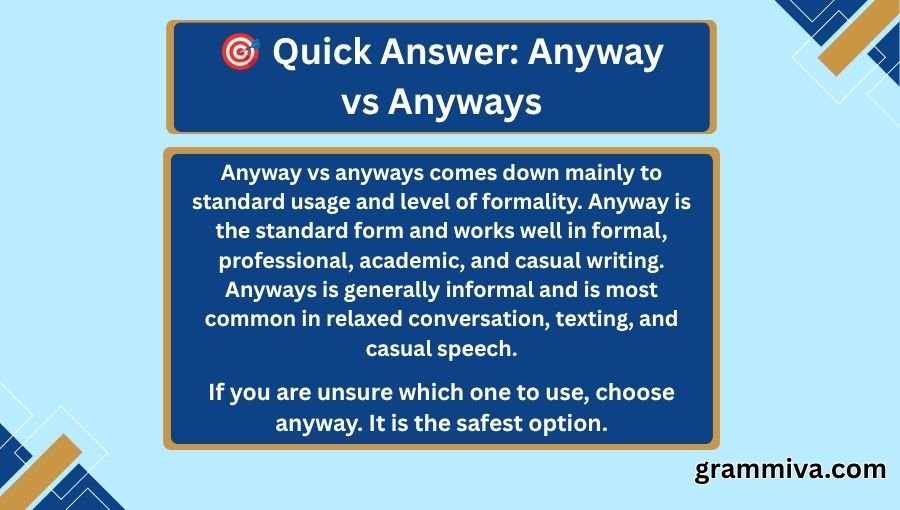
Anyway vs anyways comes down mainly to standard usage and level of formality. Anyway is the standard form and works well in formal, professional, academic, and casual writing. Anyways is generally informal and is most common in relaxed conversation, texting, and casual speech.
If you are unsure which one to use, choose anyway. It is the safest option.
| Word | General Use | Best Choice for Formal Writing? | Example |
|---|---|---|---|
| anyway | Standard adverb | Yes | “Anyway, let’s get back to the project.” |
| anyways | Informal adverb | Usually no | “Anyways, what are you doing tonight?” |
The key point is simple: anyway is the standard form, while anyways is mainly a casual variant.
🧩 Related Word Forms and Variants
Unlike words that have clear plural or possessive forms, this pair is not a case of changing a noun from singular to plural. Anyways is an informal variant of anyway, not a standard plural form.
That distinction helps explain why adding an -s does not create a different grammatical meaning.
| Form | Type | Example |
|---|---|---|
| anyway | Standard adverb | “Anyway, we need to leave soon.” |
| anyways | Informal adverb/variant | “Anyways, I should get going.” |
| any way | Phrase meaning “by any method” | “Is there any way to fix it?” |
The third form deserves special attention. Any way is two words and can have a completely different meaning.
For example:
- “Can we solve this anyway?” means “despite that” or “in some manner.”
- “Is there any way to solve this?” means “is there some method or possibility?”
That space can change the meaning of the sentence.
📚 Understanding Anyway vs Anyways
The core difference is that anyway belongs to standard English, while anyways is mainly an informal variant. Both can appear at the beginning or end of a sentence, but their tone is not always the same.
| Form | Type | Meaning | Example | Correct/Incorrect |
|---|---|---|---|---|
| anyway | Adverb | Despite that; in any case | “Anyway, we decided to stay.” | ✅ Correct |
| anyways | Informal adverb | Informal version of “anyway” | “Anyways, we decided to stay.” | ⚠️ Informal |
| any way | Phrase | By any method | “Is there any way to help?” | ✅ Correct |
| anyways in a formal report | Informal usage | Casual form of “anyway” | “Anyways, the results were clear.” | ❌ Avoid |
| anyway in a formal report | Standard adverb | In any case | “Anyway, the results were clear.” | ✅ Correct |
What Does Anyway Mean?
Anyway is an adverb commonly used to mean “in any case,” “despite that,” or “regardless of what was just said.” It can also help a speaker return to an earlier topic or move a conversation forward.
Consider this sentence:
“The weather was bad, but we went anyway.”
Here, anyway means that the bad weather did not stop the action.
Now consider:
“Anyway, let’s discuss the next step.”
Here, the word helps the speaker return to the main topic.
What Does Anyways Mean?
Anyways is an informal variant of anyway. It has the same basic conversational function, but it is less suitable for formal writing.
You may hear it often in casual American speech:
“Anyways, I’ll call you later.”
That sentence sounds relaxed and conversational. In a business email, however, I would normally change it to:
“Anyway, I’ll call you later.”
The meaning stays the same. The tone changes.
Is Anyway More Correct Than Anyways?
For standard US English, anyway is the better default. Anyways is not usually the best choice when you are writing for school, work, clients, publication, or a formal audience.
| Situation | Recommended Form | Example |
|---|---|---|
| Academic essay | anyway | “Anyway, the evidence supports this view.” |
| Business email | anyway | “Anyway, I will send the file today.” |
| Job application | anyway | “Anyway” is generally easy to avoid or replace. |
| Friendly text | anyway or anyways | “Anyways, see you tomorrow!” |
| Casual conversation | anyway or anyways | “Anyways, what happened next?” |
🎯 When Should You Use Anyway?
Use anyway when you want to show that something remains true despite another fact, return to a topic, or indicate that something will happen regardless.
Here are the most common uses.
1. Anyway Means “Despite That”
This is one of the most common uses.
“It was raining, but we went anyway.”
The speaker acknowledges the rain but says that it did not change the decision.
Another example:
“I was tired, but I finished the report anyway.”
The word shows that the result happened despite the condition.
2. Anyway Can Mean “In Any Case”
Anyway can introduce a statement that remains true regardless of another issue.
“The store is expensive, but we need the part anyway.”
The price does not change the need.
You can often replace anyway with “in any case” without changing the basic meaning.
3. Anyway Can Bring a Conversation Back to the Main Topic
People also use anyway as a transition.
“Anyway, let’s get back to the meeting.”
This tells the listener that the speaker wants to move on.
You might also hear:
“Anyway, where were we?”
or:
“Anyway, I wanted to ask you something.”
This use is extremely common in everyday speech.
4. Anyway Can Emphasize That Something Will Happen
For example:
“I’m going anyway.”
This means the speaker has already decided to go. Other circumstances do not change that decision.
| Meaning | Word Type | Example Sentence |
|---|---|---|
| Despite that | Adverb | “It was difficult, but I finished anyway.” |
| In any case | Adverb | “Anyway, we have enough time.” |
| Return to a topic | Adverb | “Anyway, let’s continue.” |
| Regardless | Adverb | “I was going anyway.” |
💡 Test Tip: Try “In Any Case”
When you are unsure about anyway, try replacing it with “in any case.”
If the sentence still makes sense, anyway is probably the right choice.
For example:
“Anyway, let’s begin.”
becomes:
“In any case, let’s begin.”
The meaning still works.
This test does not work perfectly in every sentence, but it is a useful quick check.
💬 How Anyway Works in Everyday Conversation
In casual speech, anyway is incredibly flexible. It can signal a change in topic, close a discussion, dismiss a side point, or show that an earlier problem did not matter.
For example:
“Anyway, what time are we leaving?”
Or:
“I forgot my umbrella, but I walked home anyway.”
Or:
“Anyway, that’s a story for another day.”
These sentences sound natural because anyway has a strong role in spoken English.
I once heard a student finish a long story with, “Anyways, back to my point.” The phrase made perfect sense in conversation. When I helped the same student edit a college essay later, we changed it to “Anyway” because the essay needed a more standard tone.
That small edit did not change the idea. It simply matched the audience.
💼 Anyway vs Anyways in Professional Writing
In professional writing, anyway is usually the better choice. Even better, in some sentences you can remove the word entirely and make the message more direct.
Compare these examples:
❌ “Anyways, I wanted to follow up about the meeting.”
✅ “Anyway, I wanted to follow up about the meeting.”
Even more direct:
✅ “I wanted to follow up about the meeting.”
The last version is often strongest in business writing because it gets straight to the point.
| Professional Situation | Best Choice | Example |
|---|---|---|
| Client email | anyway | “Anyway, I appreciate your time.” |
| Office message | anyway | “Anyway, let’s review the final draft.” |
| Formal report | anyway, when needed | “The plan proceeded anyway.” |
| Resume | Usually avoid it | Use direct wording instead. |
| Academic paper | anyway, when appropriate | “The study continued anyway.” |
Professional writing is not about avoiding every casual word. It is about choosing words that fit your audience and purpose.
📝 Case Study: A Small Change in a Work Email
Imagine that a manager sends this draft:
“Anyways, I wanted to check if you finished the sales report.”
The message is understandable. But if the manager is writing to a client or senior executive, the casual anyways may sound less polished.
A cleaner version is:
“Anyway, I wanted to check if you finished the sales report.”
An even more professional version is:
“I wanted to check whether you finished the sales report.”
The lesson is useful beyond this one word. Good editing often means removing words that do not add much meaning.
| Original | Revised | Why |
|---|---|---|
| “Anyways, I wanted to check…” | “Anyway, I wanted to check…” | More standard |
| “Anyway, I wanted to check…” | “I wanted to check…” | More direct |
| “Anyways, please let me know.” | “Please let me know.” | Removes unnecessary filler |
🧠 Anyway vs Anyways: Grammar Rules Explanation
Anyway is the standard adverb used in formal and informal standard English. Anyways is an informal variant that is common in speech and casual writing but is generally avoided in formal contexts.
The important point is that anyways is not needed to make the word plural. The ending -s does not represent a normal plural rule here.
Both forms can function similarly in casual conversation:
“Anyway, let’s go.”
“Anyways, let’s go.”
The first is standard. The second is informal.
Most major English dictionaries recognize the word anyways in some form, but its informal status is the key point for writers. A dictionary listing does not mean that two forms have exactly the same level of formality.
Correct vs Incorrect at a Glance
| Sentence | Correct/Incorrect | Why |
|---|---|---|
| “Anyway, let’s move on.” | ✅ Correct | Standard usage |
| “Anyways, let’s move on.” | ⚠️ Informal | Common in casual speech |
| “The plan failed, but we tried anyway.” | ✅ Correct | Standard adverb |
| “The plan failed, but we tried anyways.” | ⚠️ Informal | Casual variant |
| “Anyways, the report is attached.” | ❌ Avoid in formal writing | Too casual for the setting |
Calling anyways simply “wrong” can be misleading. It is better to say that it is informal and should usually be avoided in formal standard writing.
That distinction helps learners understand real English rather than memorizing an overly strict rule.
⚠️ Common Mistakes With Anyway and Anyways
People confuse these forms for several simple reasons.
First, fast typing can make people choose the version they hear most often. Second, autocorrect and predictive text may reinforce a form without explaining its tone. Third, lack of knowledge about formal and informal usage can make both forms seem equally appropriate everywhere.
There is also a fourth reason: people often hear anyways in conversation. When a form sounds natural in speech, it is easy to assume it belongs in every type of writing.
| Common Confusion | Correct Choice | Quick Reason |
|---|---|---|
| its / it’s | Depends on meaning | Possession vs. “it is” |
| your / you’re | Depends on meaning | Possession vs. “you are” |
| their / they’re | Depends on meaning | Possession vs. “they are” |
| then / than | Depends on meaning | Time/order vs. comparison |
| anyway / anyways | Usually anyway | Standard vs. informal |
I once caught myself typing “anyways” in a draft email to a new client. I noticed it during my final read-through and changed it to “anyway.” The change took one second, but it reminded me that even experienced writers can type what they normally say.
Common Wrong Forms and Uses
| Wrong Form or Use | What’s Wrong | Correct Form |
|---|---|---|
| “Anyways” in a formal report | Too informal | “Anyway” |
| “Any ways” when meaning “in any case” | Incorrect spacing | “Anyway” |
| “Anyway’s” | Incorrect apostrophe | “Anyway” |
| “Anyways,” in a formal letter | Casual tone | “Anyway,” or remove it |
| “Any way” when meaning “despite that” | Wrong phrase | “Anyway” |
| “Anyway’s” | Unnecessary possessive form | “Anyway” |
The biggest trap is any way versus anyway. If you mean “by any method,” keep the words separate.
For example:
“Is there any way to repair the computer?”
But:
“I was tired, but I finished it anyway.”
🕰️ Word History and Spelling
The history of anyway is closely tied to the ordinary English combination of any and way. Over time, the word became established as a single adverb meaning something like “in any case” or “regardless.”
The informal form anyways developed as a variant with an added -s. The important point for modern writers is not the exact historical path but the difference in present-day style.
| Period | Form | General Note |
|---|---|---|
| Earlier English | any + way | Related words could appear as separate elements |
| Later established usage | anyway | Became a standard adverb |
| Modern English | anyway | Standard form |
| Modern informal English | anyways | Informal variant, especially in speech |
| Modern digital writing | anyway / anyways | Choice often depends on audience and tone |
You do not need to memorize the history to use the word correctly. The modern rule is much more useful: anyway is the standard choice, while anyways is mainly informal.
🌎 Usage in Different Contexts
The best choice depends heavily on where the word appears. Anyway works across nearly every setting. Anyways is most comfortable in relaxed conversation and casual digital messages.
| Context | Which Term to Use | Example |
|---|---|---|
| Everyday conversation | anyway or anyways | “Anyways, what happened next?” |
| Professional writing | anyway | “Anyway, I will send the file today.” |
| Creative writing | Depends on character and voice | “Anyways, I don’t care.” |
| Social media/texting | anyway or anyways | “Anyways, I’m heading home.” |
Everyday Conversation
In relaxed speech, either form may appear.
“Anyways, what are we doing later?”
The informal form can help a character or speaker sound relaxed and natural.
Professional Writing
Use anyway if you need the word at all.
“Anyway, I will follow up tomorrow.”
However, professional writing often improves when unnecessary transition words are removed.
“I will follow up tomorrow.”
Creative Writing
Authors can use anyways to show personality.
A character who says “Anyways” may sound casual, youthful, humorous, or simply conversational. That does not make the dialogue grammatically “bad.” It means the writer is showing a particular voice.
Social Media and Texting
Digital writing is flexible. You can use anyways when you want a casual tone:
“Anyways 😂 I’m going to bed.”
For a cleaner or more neutral tone, use anyway:
“Anyway, I’m going to bed.”
✍️ Common Phrases With Anyway
There are several common sentence patterns in which anyway appears naturally. These are useful because learning a phrase can be easier than learning a rule in isolation.
| Phrase | Meaning |
|---|---|
| Anyway, let’s move on. | Return to the main topic |
| I did it anyway. | I did it despite the problem |
| Thanks anyway. | Thanks despite the result |
| I’ll go anyway. | The decision will not change |
| Anyway, as I was saying… | Return to an earlier point |
| It doesn’t matter anyway. | The issue has no effect on the result |
One especially common phrase is “Thanks anyway.”
For example:
“You couldn’t find the book? Thanks anyway.”
The speaker is still expressing thanks even though the other person could not help.
🔄 Synonyms and Alternatives to Anyway
Sometimes the best way to improve a sentence is to replace anyway with a more exact phrase. The right choice depends on what you mean.
| Alternative | Works When | Does Not Work When |
|---|---|---|
| in any case | You mean “regardless” | The sentence is very casual |
| regardless | You want strong emphasis | You are simply changing topics |
| still | You mean something happened despite a problem | You are closing a topic |
| either way | There are two possible outcomes | There is no choice or contrast |
| at any rate | You want a formal transition | You want very casual speech |
For example:
“It was expensive, but I bought it anyway.”
could become:
“It was expensive, but I bought it regardless.”
Both work.
But:
“Anyway, what time is dinner?”
does not naturally become:
“Regardless, what time is dinner?”
That would sound strange because the original anyway is acting as a conversational transition.
🎯 Why Anyway Matters in Clear Writing
Choosing between these forms may seem like a tiny issue. In practice, small word choices can shape how readers hear your voice.
Clarity in Communication
A standard form helps readers understand your intended tone without distraction.
Professionalism
In a formal email or report, informal wording can make the message sound less polished. Anyways is not automatically wrong, but anyway is the safer professional choice.
Digital Communication
Text messages allow more freedom. Still, different audiences expect different levels of care.
A message to a close friend can sound casual:
“Anyways, see you later!”
A message to a customer should usually be:
“Anyway, I appreciate your time.”
Or, better:
“I appreciate your time.”
A useful writing principle is:
“The best word is the one that fits both the meaning and the audience.”
| Situation | Why Getting It Right Matters |
|---|---|
| Resume | Your language should look polished and controlled. |
| Client email | Tone can affect how professional you sound. |
| Published content | Readers expect standard grammar and style. |
| Social post | You have more freedom to sound casual. |
🧭 How to Remember the Difference
The easiest memory trick is this:
When in doubt, use “anyway.”
You can also remember:
- Anyway = standard
- Anyways = informal
- Any way = two-word phrase with a different meaning
Try this three-step check:
- Am I writing something formal?
- If yes, choose anyway.
- If I mean “by any method,” use any way.
Here is a quick memory table:
| If You Mean… | Use |
|---|---|
| In any case | anyway |
| Despite that | anyway |
| Regardless | anyway |
| Casual version of “anyway” | anyways |
| Any possible method | any way |
🧪 Practice Examples
Let’s test the rule with a few short examples.
Example 1
❌ “Anyways, I need to finish my homework.”
✅ “Anyway, I need to finish my homework.”
The second version is the standard form.
Example 2
❌ “Is there anyway to contact her?”
✅ “Is there any way to contact her?”
Here, the problem is not anyways. The writer needs any way because the meaning is “is there some method?”
Example 3
❌ “The trip was expensive, but we went anyways.”
✅ “The trip was expensive, but we went anyway.”
The first sentence is understandable and informal. The second is the standard choice.
Example 4
❌ “Anyway’s, I think we’re done.”
✅ “Anyway, I think we’re done.”
There is no reason for an apostrophe.
Example 5
❌ “Any ways, let’s start the meeting.”
✅ “Anyway, let’s start the meeting.”
When the word means “in any case” or introduces a transition, it is written as one word.
| Example | Best Form | Main Lesson |
|---|---|---|
| “I went ___ despite the rain.” | anyway | Despite that |
| “___, let’s continue.” | anyway | Topic transition |
| “Is there ___ to fix this?” | any way | Any method |
| “___, I’m leaving.” | anyway | Standard transition |
| “___, see you later!” | anyways can work casually | Informal speech |
🧠 Quick Recap Checklist
Use this checklist whenever you pause over the spelling.
| Question | If Yes → Use |
|---|---|
| Do I mean “in any case”? | anyway |
| Do I mean “despite that”? | anyway |
| Am I writing professionally? | anyway |
| Am I writing a formal paper? | anyway |
| Am I using a casual speaking style? | anyways can work |
| Do I mean “by any method”? | any way |
Three Final Practice Examples
- “It was late, but I finished the project anyway.”
✅ Standard - “Anyways, what do you want for dinner?”
✅ Acceptable in casual conversation; anyway is more standard. - “Is there any way we can move the meeting?”
✅ Correct because “any way” means some possible method.
❓ FAQs About Anyway vs Anyways
Is anyway or anyways correct?
Anyway is the standard form and is the safest choice in all types of writing. Anyways is an informal variant that is common in casual speech and relaxed writing.
Is anyways grammatically correct?
Anyways is used in real English, especially informal American speech and writing. However, it is generally considered less standard and less formal than anyway.
Should I use anyway or anyways in a professional email?
Use anyway. In many professional emails, you can also remove the word if it does not add meaning.
For example:
“Anyway, I wanted to follow up.”
can become:
“I wanted to follow up.”
Is anyways a word?
Yes. Anyways is an established informal form of anyway. Its existence does not mean that it is equally suitable for every writing situation.
Why do people say anyways instead of anyway?
People use anyways because it is a familiar informal form in speech and casual writing. Some speakers naturally include the final -s as part of their everyday style.
Is “any way” different from “anyway”?
Yes. Any way is written as two words when it means “any possible method” or “some method.”
Example:
“Is there any way to solve this?”
Anyway is one word when it means “in any case,” “despite that,” or “regardless.”
Example:
“I was tired, but I finished it anyway.”
Can I use anyways in an essay?
You generally should not. Use anyway instead, or remove the word if it is unnecessary. Academic writing usually benefits from standard, neutral wording.
Is anyway formal or informal?
Anyway works in both formal and informal English. Its flexibility makes it the best default choice.
What is the easiest way to remember anyway vs anyways?
Remember this rule: When you are unsure, use “anyway.” Use anyways mainly when you deliberately want a casual, conversational tone.
Is “thanks anyway” correct?
Yes. “Thanks anyway” is a common and standard expression. It means that you appreciate someone’s effort even though the result may not have been what you wanted.
🏁 Conclusion
Anyway vs anyways is mainly a question of standard usage and tone. Anyway is the standard form and works in professional, academic, published, and everyday writing. Anyways is an informal variant that can sound natural in relaxed conversation, texting, or dialogue.
The third form, any way, should also stay on your radar. When you mean “by any method,” use two words: “Is there any way to fix this?” When you mean “despite that” or “in any case,” use one word: “I decided to go anyway.”
My simplest advice is to make anyway your default. It will almost never put you in the wrong style group. Save anyways for moments when a casual voice is part of what you want.
Small grammar choices can make a big difference in how your writing sounds. Choose the form that fits the meaning, match it to your audience, and when you’re unsure, anyway is the safe choice. ✨
Remember: standard writing says “anyway”; casual speech may say “anyways.”

I am Ethan Brooks, an English grammar and vocabulary writer. I work at Grammiva, where I create simple and helpful content to make English learning easier for students and everyday learners.

[…] you simple tests you can use when you are writing an email, school paper, story, or social post. Anyway vs Anyways | Drier vs Dryer | Labeler vs […]
[…] This guide explains the difference in plain US English. By the end, you will know what each word means, when to use it, how to spell it, and which form works best in formal and casual writing. onto vs on to | dreamed vs dreamt | Anyway vs Anyways […]