Have you ever typed a sentence and paused because you could not tell whether to write your or you’re? You are not alone. This guide to your vs youre explains the difference clearly, so you can choose the correct form with confidence. The two forms sound almost exactly the same when spoken, but they do very different jobs in a sentence. That small apostrophe can change the meaning of your entire message. ✍️
If you are learning English, editing a website, writing an email, or simply trying to avoid grammar mistakes, understanding your vs youre is a useful skill. The good news is that the rule is simple once you know what each word does.
I teach grammar by looking at the job a word performs, rather than asking students to memorize long rules. That approach works especially well here. Once you learn one quick test, you can usually choose the correct form in seconds. 😊
This guide explains the difference between your and you’re, shows common examples, covers mistakes, and gives you practical ways to remember the rule. Accept vs Except | Principal vs Principle | Who vs Whom
🎯 Quick Answer: your vs youre
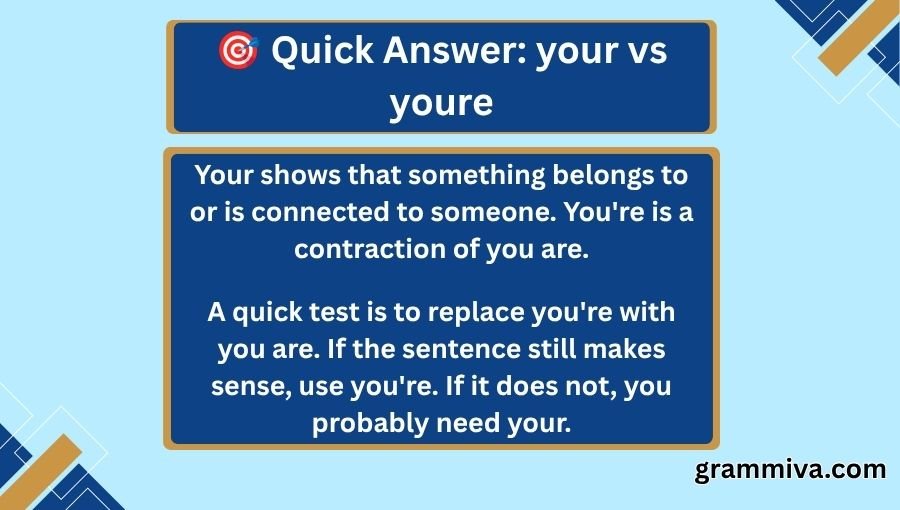
Your shows that something belongs to or is connected to someone. You’re is a contraction of you are.
A quick test is to replace you’re with you are. If the sentence still makes sense, use you’re. If it does not, you probably need your.
| Form | Type | Basic Meaning | Example |
|---|---|---|---|
| your | Possessive determiner | Belonging to or connected with you | Your jacket is on the chair. |
| you’re | Contraction | You are | You’re very kind. |
| you are | Two-word phrase | The full form of you’re | You are ready. |
Related Word Forms and Their Uses
The main forms that cause confusion are your, you’re, and you are. They are related in everyday use, but they are not interchangeable. Understanding your vs youre also helps you avoid mistakes with related forms such as yours and you are.
| Form | Type | Example |
|---|---|---|
| your | Possessive determiner | Your phone is ringing. |
| you’re | Contraction | You’re late. |
| you are | Full phrase | You are late. |
| yours | Possessive pronoun | The blue bag is yours. |
Notice that yours is also related to this group, but it works differently. We say “your book,” but we say “The book is yours.” We do not normally say “the book is your.”
🧩 Understanding Your vs youre
The easiest way to understand your vs youre is to focus on meaning. Your connects a person to a noun. You’re tells us something about the person because it means you are.
Think of your as a word that points to ownership or connection. Think of you’re as two words wearing a shorter form.
| Form | Type | Meaning | Example | Correct/Incorrect |
|---|---|---|---|---|
| your | Possessive determiner | Belonging to you | Your keys are here. | ✅ Correct |
| you’re | Contraction | You are | You’re early. | ✅ Correct |
| your | Possessive determiner | You are | Your early. | ❌ Incorrect |
| you’re | Contraction | Belonging to you | You’re keys are here. | ❌ Incorrect |
| you are | Full phrase | You are | You are early. | ✅ Correct |
Your Shows Possession or Connection
Use your before a noun when you mean that something belongs to, relates to, or is connected with the person you are speaking to.
Examples include:
- Your house
- Your name
- Your brother
- Your idea
- Your answer
- Your computer
- Your favorite song
The item does not always have to be physically owned. Your idea means an idea connected to you. Your teacher can mean the teacher assigned to you.
Consider this sentence:
Your new shoes look great.
The word your tells us whose shoes we are talking about. The noun is shoes, and your describes the relationship between the shoes and the person being addressed.
Here are more examples:
| Sentence | Why “your” works |
|---|---|
| Your dog is sleeping. | The dog belongs to or is connected with you. |
| I like your painting. | The painting was made by or belongs to you. |
| Please check your email. | The email account is yours. |
| Your answer is correct. | The answer belongs to you. |
You’re Means You Are
Use you’re when you mean you are.
For example:
You’re ready.
This means:
You are ready.
Another example:
You’re my best friend.
This means:
You are my best friend.
The apostrophe is important because it signals that letters have been left out. In you’re, the apostrophe marks the shortened form of you are.
| You’re | Full Form | Meaning |
|---|---|---|
| You’re happy. | You are happy. | You are happy. |
| You’re tired. | You are tired. | You are tired. |
| You’re funny. | You are funny. | You are funny. |
| You’re right. | You are right. | You are right. |
A Simple Sentence Breakdown
Take this sentence:
You’re very patient.
Replace you’re with you are:
You are very patient.
The sentence still works. Therefore, you’re is correct.
Now try:
Your very patient.
Replace your with you are:
You are very patient.
That changes the original structure because your was supposed to describe a noun. The correct sentence is:
Your patient is waiting.
Here, patient is a noun. In this sentence, your means the patient connected with you.
Test Tip 💡
When you are unsure, use the you are test:
- Find your or you’re.
- Replace you’re with you are.
- Read the sentence again.
- If it works, choose you’re.
- If it does not work, ask whether your is describing a noun.
For example:
___ going to love this movie.
Try you are:
You are going to love this movie.
It works, so the answer is you’re.
Now try:
I love ___ new car.
“Your” works because it describes car.
| Meaning | Word Type | Example Sentence |
|---|---|---|
| Belonging to you | Possessive determiner | Your coat is wet. |
| Connected with you | Possessive determiner | Your team won. |
| You are | Contraction | You’re very helpful. |
| You are | Contraction | You’re going home. |
Why Do People Confuse Your and You’re? 🤔
People confuse these words mainly because they sound alike. When we speak, the difference between them may not be clear. When we write, however, the difference becomes visible.
I once read a student’s short story that contained the sentence, “Your going to love the ending.” The student knew the words but had learned them mostly through speech. We changed the sentence to “You’re going to love the ending” and then used the you are test on several more examples. After a few minutes, the pattern became much easier.
Other reasons include:
- Fast typing
- Autocorrect
- Texting habits
- Writing exactly as words sound
- Forgetting the apostrophe
- Not knowing that you’re means you are
- Focusing on the sentence’s meaning instead of each word’s job
The mistake is common because the words are pronounced similarly. It does not mean someone is careless or bad at English. It simply means the writer needs a reliable checking method.
Your vs youre at a Glance
The key difference is simple: your comes before a noun to show a connection, while you’re means you are.
| Sentence | Correct/Incorrect | Reason |
|---|---|---|
| Your car is outside. | ✅ Correct | “Your” describes car. |
| You’re waiting outside. | ✅ Correct | “You’re” means you are. |
| Your waiting outside. | ❌ Incorrect | “Your” cannot mean you are. |
| You’re car is outside. | ❌ Incorrect | “You’re” cannot show possession. |
| You are waiting outside. | ✅ Correct | “You are” is the full form of you’re. |
Correct Uses of Your
The word your is used before nouns to show that something belongs to, relates to, or is associated with the person being addressed.
Your With Things You Own
Did you bring your wallet?
The wallet is connected with the person being addressed.
Where are your shoes?
Again, your tells us whose shoes we mean.
Your With People and Relationships
We also use your with people.
Your sister called.
The sister is related to or connected with the person being addressed.
I met your manager yesterday.
The manager is associated with the person being addressed.
Your With Ideas and Actions
Ownership can be abstract.
I understand your concern.
A concern does not need to be a physical object. Your shows that the concern belongs to or comes from the person.
I respect your decision.
The decision is connected with the person being addressed.
Correct Uses of You’re
Understanding your vs youre becomes easier when you remember that you’re always means you are. Use it wherever the full phrase you are would make sense.
You’re Before an Adjective
You’re kind.
This means:
You are kind.
Other examples include:
- You’re smart.
- You’re funny.
- You’re ready.
- You’re lucky.
- You’re careful.
You’re Before a Verb Form
You’re learning quickly.
This means:
You are learning quickly.
Here, you’re is followed by learning, which is a verb form.
You’re making good progress.
Again, expand it:
You are making good progress.
The sentence still makes sense.
You’re Before a Place or Situation
You’re at the right address.
Expand it:
You are at the right address.
The meaning remains clear.
| Original | Expanded Form | Correct? |
|---|---|---|
| You’re ready. | You are ready. | ✅ |
| You’re my neighbor. | You are my neighbor. | ✅ |
| You’re at home. | You are at home. | ✅ |
| You’re learning. | You are learning. | ✅ |
📝 Case Study: Your and You’re at Work
Imagine that a manager sends this message to an employee:
Please bring you’re updated report to the meeting.
The intended meaning is that the report belongs to the employee. The correct version is:
Please bring your updated report to the meeting.
Now imagine a different message:
You’re responsible for presenting the report.
This means:
You are responsible for presenting the report.
I once edited a workplace email where an employee had written “Please review you’re file before the meeting.” The writer immediately saw the problem when I asked one question: “Can you replace it with ‘you are’?” The result was “Please review you are file,” which clearly failed. That made the correct choice, your, obvious.
This is why a quick substitution test is often more useful than memorizing a complicated rule.
| Workplace Sentence | Correct Form | Explanation |
|---|---|---|
| Please send your report. | your | The report belongs to you. |
| You’re presenting the report. | you’re | You are presenting it. |
| Check your schedule. | your | The schedule is connected with you. |
| You’re ready for the meeting. | you’re | You are ready. |
Grammar Rules Explanation
The grammatical difference between your and you’re is based on their different functions. The basic rule behind your vs youre is simple once you understand the different jobs these two forms perform.
Your is a possessive determiner. It appears before a noun or noun phrase and shows a relationship between the noun and the person being addressed.
Examples:
Your book is on the table.
I like your new design.
In both sentences, your modifies a noun.
You’re is a contraction of you are. It contains the pronoun you and the verb are in shortened form.
Examples:
You’re ready.
You’re doing well.
In both sentences, you’re can be expanded to you are without changing the basic meaning.
Most standard English reference sources agree on this basic distinction. The rule is not based on style or personal preference. The two forms have different grammatical roles.
A useful way to remember the rule is:
your + noun
you’re = you are
This pattern covers most everyday cases.
Correct vs Incorrect at a Glance
| Sentence | Correct/Incorrect | Why |
|---|---|---|
| I like your new shoes. | ✅ Correct | “Your” describes shoes. |
| You’re very helpful. | ✅ Correct | “You’re” means you are. |
| You’re new shoes look great. | ❌ Incorrect | “You’re” cannot show possession. |
| Your very helpful. | ❌ Incorrect | “Your” cannot mean you are. |
| I think you’re right. | ✅ Correct | “You’re” means you are. |
⚠️ Common Mistakes With Your and You’re
The most common mistake is using your when the writer means you are.
Another common mistake is adding an apostrophe to your because the writer thinks possession always needs an apostrophe. That is not true. Your is already the possessive form.
Compare these pairs:
| Confusion | Correct Choice | Main Rule |
|---|---|---|
| your / you’re | Depends on meaning | your = belonging to you; you’re = you are |
| its / it’s | Depends on meaning | its = belonging to it; it’s = it is |
| their / they’re | Depends on meaning | their = belonging to them; they’re = they are |
| there / their | Depends on meaning | there = place; their = belonging to them |
| whose / who’s | Depends on meaning | whose = possession; who’s = who is |
Why Fast Typing Causes Problems
When people type quickly, they often choose the form that sounds right instead of the form that is grammatically right.
I once caught myself typing “your welcome” in a quick message. I knew the rule, but my fingers had followed the sound rather than the meaning. I corrected it to “you’re welcome.” That small mistake is a good reminder that even experienced writers can make these errors when they type on autopilot.
Why Autocorrect Can Add Confusion
Autocorrect can fix spelling, but it does not always understand what you mean. A sentence can contain a correctly spelled word that is still the wrong word.
For example, both your and you’re are correctly spelled. A spell checker may not flag the wrong choice.
| Wrong Form | What’s Wrong | Correct Form |
|---|---|---|
| Your going home. | “Your” does not mean you are. | You’re going home. |
| You’re shoes are wet. | “You’re” does not show possession. | Your shoes are wet. |
| Your very funny. | “Your” cannot mean you are. | You’re very funny. |
| You’re phone is ringing. | “You’re” cannot describe phone. | Your phone is ringing. |
| I like you’re idea. | “You’re” cannot show ownership or connection. | I like your idea. |
| Your the winner. | “Your” cannot mean you are. | You’re the winner. |
How to Remember the Difference
The easiest way to remember your vs youre is to use the you are test. If you can replace the word with you are and the sentence still makes sense, choose you’re. Otherwise, your is usually the correct choice.
YOUR has no apostrophe because it shows possession. YOU’RE has an apostrophe because it is short for YOU ARE.
Try saying the expanded form aloud.
If you write:
You’re amazing.
Say:
You are amazing.
If that sounds right, use you’re.
If you write:
Your amazing idea helped me.
You cannot replace your with you are:
You are amazing idea helped me.
That does not work. So your is correct.
Another useful trick is to look at the word immediately after your.
If the next word is a noun, your may be correct:
your house
your answer
your friend
your computer
This is not an absolute rule because sentence structures can vary, but it is a useful clue.
| Question | What to Do |
|---|---|
| Does it mean “you are”? | Use you’re. |
| Does it show something connected to you? | Use your. |
| Can you replace it with “you are”? | If yes, use you’re. |
| Is it describing a noun? | Your may be correct. |
Your vs youre in Different Contexts
The basic rule does not change between casual and formal writing. However, the need for accuracy can change with the setting.
| Context | Which Term to Use | Example |
|---|---|---|
| Everyday conversation | Either, depending on meaning | You’re coming with us. |
| Professional writing | Either, depending on meaning | Please review your document. |
| Creative writing | Either, depending on meaning | You’re the hero of this story. |
| Social media/texting | Either, depending on meaning | Your photo looks great! |
Everyday Conversation
Speech can hide the difference because your and you’re often sound alike.
That means context does much of the work when people talk.
Professional Writing
Accuracy matters more in emails, reports, applications, and business messages.
A sentence such as:
You’re application has been received.
should be:
Your application has been received.
The application is connected with the reader, so your is correct.
Creative Writing
Writers can use both forms naturally.
You’re standing at the edge of the road.
But:
Your hands are shaking.
The first means you are. The second shows a connection between the hands and the person.
Social Media and Texting
Casual writing often contains shortcuts and errors. Still, the correct forms are easy to use once the rule becomes automatic.
For example:
You’re going to love this!
But:
I love your new post!
Common Phrases With Your and You’re
There are many everyday phrases that make the distinction easy to practice.
| Phrase | Meaning |
|---|---|
| your best friend | The friend connected with you |
| your own way | The way belonging to or chosen by you |
| your first step | The first step connected with you |
| you’re welcome | You are welcome |
| you’re right | You are right |
| you’re the best | You are the best |
The phrase you’re welcome is especially useful as a memory example. It never means that something belongs to you. It means you are welcome.
Likewise, your own usually points to something associated with the person:
Do what is best for your own health.
The word your modifies own health.
Synonyms and Alternatives
There is no perfect synonym for either form in every sentence. Understanding your vs youre first is more useful because the two forms perform different grammatical jobs.
| Alternative | Works When | Does Not Work When |
|---|---|---|
| belonging to you | You want to explain possession | A shorter grammatical form is needed |
| owned by you | You mean actual ownership | The relationship is not ownership |
| connected to you | The relationship is broader than ownership | The sentence needs a direct possessive |
| you are | You’re is being expanded | You need to show possession |
| yours | The noun has already been named | It comes directly before a noun |
For example:
Your car is fast.
can sometimes become:
The car belonging to you is fast.
But that version is longer and less natural. Your is the normal choice.
Likewise:
You’re ready.
can become:
You are ready.
The two versions have the same basic meaning.
💼 Why Getting Your and You’re Right Matters
Grammar is not just about following rules. It is also about making your meaning clear.
A reader usually understands what you mean even when you make a your/you’re mistake. Still, repeated mistakes can distract readers and make writing look less polished.
| Situation | Why Getting It Right Matters |
|---|---|
| Resume | Shows attention to detail |
| Client email | Creates a professional impression |
| Published content | Keeps the writing clean and credible |
| Social post | Makes your message easier to read |
A useful writing principle is:
Clear writing helps the reader focus on your message instead of your mistakes.
That does not mean one typo ruins a piece of writing. Everyone makes mistakes. The goal is to build habits that prevent common errors from appearing again and again.
Is Your the Same as You’re?
No. Your and you’re are different words with different grammatical jobs.
Your shows possession or connection:
Your desk is clean.
You’re means you are:
You’re sitting at your desk.
The difference is easy to check by expanding you’re.
| Word | Can Be Expanded to “You Are”? | Shows Possession? |
|---|---|---|
| your | ❌ No | ✅ Yes |
| you’re | ✅ Yes | ❌ No |
| yours | ❌ No | ✅ Yes |
When Should You Use Your Instead of You’re?
Use your when the word describes a noun and means something like “belonging to you” or “connected with you.”
Examples:
- Your house
- Your job
- Your opinion
- Your family
- Your question
- Your name
A simple sentence test is:
I like your idea.
Ask what your describes. It describes idea.
Now compare:
You’re excited.
Ask whether you’re can become you are.
You are excited.
Yes. Therefore, you’re is correct.
When Should You Use You’re Instead of Your?
Use you’re when you mean you are.
It commonly appears before:
- An adjective: You’re happy.
- A noun phrase: You’re a good friend.
- A verb form: You’re working hard.
- A place phrase: You’re at home.
- A description: You’re the person I need.
| Pattern | Example |
|---|---|
| You’re + adjective | You’re kind. |
| You’re + noun phrase | You’re a great teacher. |
| You’re + verb form | You’re improving. |
| You’re + place phrase | You’re at the station. |
| You’re + description | You’re the right person for this job. |
What Happens If You Leave Out the Apostrophe?
Leaving out the apostrophe in you’re changes the word into your, which changes the grammar.
Compare:
You’re funny.
and:
Your funny…
The second sentence is incomplete if your is intended to mean you are.
The apostrophe is not decoration. It helps identify the contraction. If you still hesitate when choosing between the two, remember that your vs youre can almost always be solved with the you are test.
| With Apostrophe | Without Apostrophe | Meaning |
|---|---|---|
| you’re | your | Different words |
| you’re ready | your ready | Incorrect if intended to mean “you are ready” |
| your book | you’re book | Incorrect if intended to show possession |
Quick Recap Checklist ✅
Use these questions whenever you are unsure.
| Question | If Yes → Use |
|---|---|
| Does the word mean “you are”? | you’re |
| Can you replace it with “you are”? | you’re |
| Does it show something belonging to or connected with you? | your |
| Does it describe a noun? | Usually your |
| Are you writing “you’re welcome”? | you’re |
Practice Examples
- ___ going to enjoy this book.
Answer: You’re → You are going to enjoy this book. - I like ___ new jacket.
Answer: your → The jacket is connected with you. - ___ one of the best players on the team.
Answer: You’re → You are one of the best players.
FAQs About Your vs You’re
What is the difference between your and you’re?
Your shows possession or connection. You’re is a contraction of you are.
Example: “Your bag is here.”
Example: “You’re early.”
Is “your” a possessive word?
Yes. Your is a possessive determiner. It comes before a noun and shows that the noun belongs to, relates to, or is connected with the person being addressed.
Example: “Your answer is correct.”
Is “you’re” short for “you are”?
Yes. You’re is the contracted form of you are.
Example:
You’re ready.
means:
You are ready.
How can I remember your vs you’re?
Use the you are test. Replace you’re with you are. If the sentence still makes sense, you’re is correct. If it does not, check whether your is showing possession or connection.
Which is correct: “your welcome” or “you’re welcome”?
The correct phrase is “you’re welcome.” It means “you are welcome.”
Which is correct: “your right” or “you’re right”?
If you mean that someone is correct, use “you’re right.” It means “you are right.”
However, “your right” can be correct in a different sentence, such as “Raise your right hand.” Here, your describes the person’s hand.
Which is correct: “your going” or “you’re going”?
Use “you’re going” when you mean “you are going.”
Example:
You’re going to enjoy the trip.
Use “your” only when it describes a noun.
Example:
Your going surprised me.
This sentence is possible in a different grammatical structure, where going acts as a noun-like activity. However, that structure is much less common in everyday writing.
Why do your and you’re sound the same?
In common American English speech, the two forms can sound very similar. That is why writers often confuse them. Writing makes the difference visible through spelling and the apostrophe.
Can autocorrect tell the difference between your and you’re?
Not reliably. Both forms are correctly spelled words, so a spell checker may not recognize that you selected the wrong one for the sentence. A meaning-based check, such as the you are test, is more useful.
Is “your’s” correct?
No. The standard possessive form is yours, without an apostrophe.
Correct:
The blue notebook is yours.
Incorrect:
The blue notebook is your’s.
This is a separate mistake from confusing your and you’re, but it is worth remembering.
Conclusion
Your vs youre becomes much easier once you remember one simple rule: your shows possession or connection, while you’re means you are. If you can replace the word with “you are,” choose you’re. If the word describes something belonging to or connected with the person you are addressing, choose your.
The apostrophe in you’re has a real job. It tells the reader that the word is a shortened form of you are. Meanwhile, your needs no apostrophe because it is already the possessive form.
When I edit writing, I do not tell people to memorize dozens of grammar rules for this pair. I tell them to stop for one second and ask: “Do I mean you are?” That question catches most mistakes immediately. ✨
Practice the test a few times, and the choice will soon feel natural.
Remember: if you mean “you are,” write “you’re.” If you mean something connected with you, write “your.” Once that rule sticks, this common grammar trap loses its power.

I am Ethan Brooks, an English grammar and vocabulary writer. I work at Grammiva, where I create simple and helpful content to make English learning easier for students and everyday learners.
[…] end, you should be able to choose the right word without stopping to second-guess yourself. ✍️ Your vs youre | Accept vs Except | Principal vs […]