Have you ever stopped in the middle of a sentence and wondered whether whether vs whether or not is the better choice? 🤔 You are not alone.
These two forms look almost the same, and in many sentences, both can seem correct.
The good news is that the basic rule is simple.
Whether is usually enough when you are talking about two possible choices or outcomes.
Whether or not is useful when you want to stress that something can happen regardless of the result, or when the words or not add useful emphasis.
As an editor and grammar teacher, I see this question often.
Writers sometimes add or not because they think the sentence sounds more complete.
Other writers leave it out because they believe whether can never be followed by or not.
Neither idea is right.
In this guide, I’ll explain the difference in plain US English.
I’ll show you when each form works, where writers make mistakes, and how to make the right choice quickly. ✨ Therefore vs Therefor | Labor vs Labour | Resume vs CV
🎯 Quick Answer: Whether vs Whether or Not
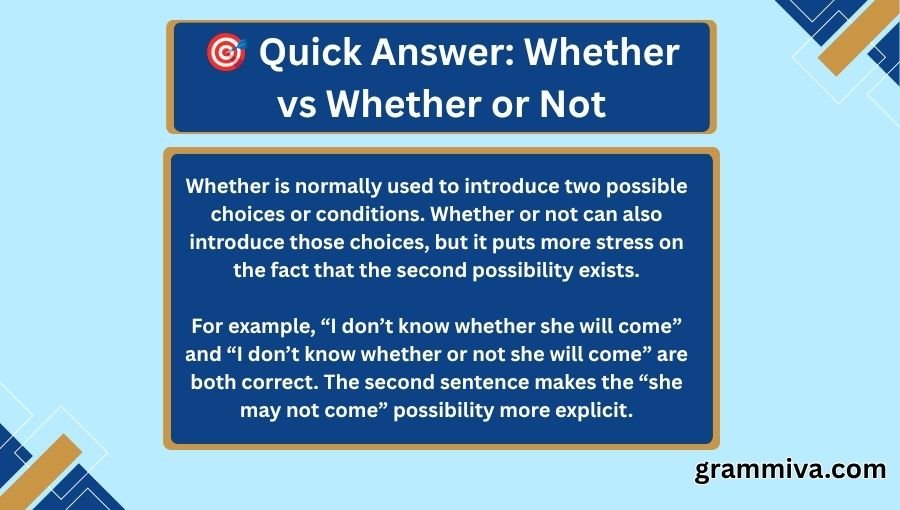
Whether is normally used to introduce two possible choices or conditions. Whether or not can also introduce those choices, but it puts more stress on the fact that the second possibility exists.
For example, “I don’t know whether she will come” and “I don’t know whether or not she will come” are both correct. The second sentence makes the “she may not come” possibility more explicit.
| Form | Basic use | Example |
|---|---|---|
| whether | Presents a choice or uncertainty | I don’t know whether he is ready. |
| whether or not | Presents a choice with extra emphasis on either outcome | I don’t know whether or not he is ready. |
| whether … or … | Presents two clear alternatives | Tell me whether you want tea or coffee. |
| whether … or not | Shows that either outcome is possible | Whether you agree or not, the rule applies. |
🔍 Is Whether the Same as Whether or Not?
Whether and whether or not are closely related, but they are not always interchangeable in meaning or style. The difference is mainly about emphasis and sentence structure.
Consider these examples:
- “She asked whether I wanted to stay.”
- “She asked whether or not I wanted to stay.”
Both are grammatically correct. The first is shorter and often sounds more natural. The second makes the two possible answers—yes and no—more visible.
Here is another example:
- “I need to decide whether to go.”
- “I need to decide whether or not to go.”
Again, both can work. The second version highlights the possibility of not going.
Whether as a choice word
Use whether when you are considering alternatives.
Common patterns include:
- whether + clause
- whether + to + verb
- whether + one option + or + another option
For example:
I can’t decide whether to call her.
The writer is choosing between calling and not calling. The negative choice is understood.
Whether or not for added emphasis
Use whether or not when you want to make the negative possibility clear.
I can’t decide whether or not to call her.
This sentence leaves no doubt that both calling and not calling are being considered.
The difference is small, but it can matter when you want your meaning to be especially clear.
📚 Whether vs Whether or Not at a Glance
The easiest way to understand the difference is to compare the patterns side by side.
| Form | Type | Meaning | Example | Correct/Incorrect |
|---|---|---|---|---|
| whether | Conjunction | Introduces uncertainty or alternatives | I wonder whether he knows. | ✅ Correct |
| whether or not | Conjunction phrase | Emphasizes either possible result | I wonder whether or not he knows. | ✅ Correct |
| whether to | Conjunction + infinitive | Shows a choice about an action | She is deciding whether to leave. | ✅ Correct |
| whether or | Alternative structure | Compares two options | Decide whether to stay or leave. | ✅ Correct |
| if or not | Informal alternative in some structures | May sound awkward or change the grammar | I don’t know if or not he came. | ❌ Incorrect/Awkward |
The last example is especially useful. English speakers do use if in many situations where whether works, but if or not does not simply replace whether or not in every sentence.
💡 How Do You Use Whether Correctly?
Whether is used when a person is thinking about, asking about, or deciding between possible outcomes.
I use it often in editing because it lets writers express uncertainty without unnecessary words.
1. Use whether with questions inside sentences
A sentence can contain an indirect question introduced by whether.
I don’t know whether the store is open.
This does not mean the writer is directly asking, “Is the store open?” Instead, the question has become part of a larger sentence.
Another example:
She asked whether I had finished the report.
The structure is simple:
- She asked = main idea
- whether I had finished the report = indirect question
2. Use whether before an infinitive
You can use whether + to + verb when someone must decide what action to take.
I don’t know whether to accept the offer.
The possible choices are clear:
- accept the offer
- do not accept the offer
You can also name two actions:
He must decide whether to stay or leave.
This pattern is common in professional and academic writing.
3. Use whether with “or”
When two choices are stated, whether … or … is especially clear.
We need to decide whether to drive or take the train.
The two alternatives are directly named.
| Meaning | Word Type | Example Sentence |
|---|---|---|
| Uncertainty | Conjunction | I don’t know whether she called. |
| Choice about an action | Conjunction + infinitive | He is deciding whether to apply. |
| Two alternatives | Conjunction structure | We must choose whether to stay or leave. |
| Indirect yes/no question | Conjunction | Ask whether the door is locked. |
💡 Test Tip
Try replacing whether with the question “Which of these possibilities is true?”
If the sentence is about uncertainty between alternatives, whether is probably a good choice.
For example:
I don’t know whether he will come.
Think:
Will he come, or will he not come?
That mental test can help you recognize the structure quickly.
❓ When Should You Use Whether or Not?
Use whether or not when you want to clearly include both possible outcomes.
For example:
We will go ahead whether or not they approve the plan.
The meaning is stronger than simple uncertainty. The action will happen in either case.
This is an important distinction.
Compare:
I don’t know whether they will approve the plan.
This tells us that the writer does not know the answer.
Now compare:
We will go ahead whether or not they approve the plan.
This tells us that the result does not change the planned action.
Whether or not can stress “regardless”
This is one of the most useful meanings.
Whether or not it rains, the game will start at noon.
The game will start in either situation.
Whether or not you agree, we need to make a decision.
Agreement does not change what happens next.
Here, or not is doing useful work. It tells readers that the outcome does not matter.
| Sentence | Main idea | Effect |
|---|---|---|
| I don’t know whether she will come. | Uncertainty | Neutral |
| I don’t know whether or not she will come. | Uncertainty | More explicit |
| We will leave whether she comes or not. | Either outcome | Clear contrast |
| We will leave whether or not she comes. | Either outcome | Strong emphasis |
| Whether or not he agrees, we will proceed. | Outcome does not matter | Strong and direct |
⚖️ Whether vs Whether or Not: When Both Are Correct
There are many sentences where either form is grammatically correct.
For example:
I can’t tell whether he is serious.
I can’t tell whether or not he is serious.
The first is more concise. The second makes the two possibilities more explicit.
Another pair:
She wondered whether the meeting was canceled.
She wondered whether or not the meeting was canceled.
Both work.
The best choice depends on what you want to emphasize.
A useful style rule
When or not adds no useful meaning, whether is often the cleaner choice.
When the negative possibility matters, keep or not.
That gives you a practical editing rule:
Use whether for a simple choice or uncertainty. Use whether or not when you want to stress either outcome.
📝 Case Study: A Workplace Email
Imagine that I am editing an email from a project manager.
The original sentence says:
Please let me know whether or not you can attend the meeting.
There is nothing grammatically wrong with it. However, if the manager simply needs to know the answer, a shorter version may be cleaner:
Please let me know whether you can attend the meeting.
Now imagine a different message:
The meeting will take place whether or not you can attend.
Here, or not is important. It tells the reader that the meeting will happen either way.
That small difference can change the tone.
| Workplace sentence | Best choice | Reason |
|---|---|---|
| Let me know whether you can attend. | whether | Simple request for information |
| The meeting will happen whether or not you attend. | whether or not | Attendance does not change the result |
| We need to decide whether to postpone the meeting. | whether | Decision about an action |
| Tell me whether you prefer Monday or Tuesday. | whether | Two named options |
| Whether or not you finish today, send me an update. | whether or not | Either outcome is covered |
A student once showed me a draft email that used whether or not four times in three sentences. I asked her to remove two of them. The meaning stayed the same, but the email became much cleaner.
📐 Grammar Rules Explanation
The key grammar point is that whether can introduce an indirect question or a choice between alternatives. Or not can be added when the writer wants to state the negative possibility explicitly.
Standard English grammar references treat whether as a conjunction used in structures involving alternatives or uncertainty. The phrase whether or not is also standard English.
There is no rule saying that whether or not is always wrong. There is also no rule saying that or not must always be included.
The structure determines the best choice.
Whether before “to”
One especially common pattern is:
whether + to + verb
Examples include:
- whether to stay
- whether to apply
- whether to wait
- whether to call
- whether to accept
For example:
She is unsure whether to accept the job.
You can also say:
She is unsure whether or not to accept the job.
Both are possible.
Whether or not at the start of a sentence
When whether or not begins a sentence, it often means “regardless of whether.”
Whether or not you are ready, we need to leave.
The sentence means that readiness does not change the need to leave.
This is different from:
I don’t know whether you are ready.
The first sentence concerns an action that will happen either way. The second simply expresses uncertainty.
Correct vs Incorrect at a Glance
| Sentence | Correct/Incorrect | Why |
|---|---|---|
| I don’t know whether he called. | ✅ Correct | Whether introduces an indirect question. |
| I don’t know whether or not he called. | ✅ Correct | Or not emphasizes both possibilities. |
| We will leave whether or not she arrives. | ✅ Correct | Either outcome is covered. |
| I wonder whether to go or stay. | ✅ Correct | Whether introduces two actions. |
| I don’t know whether or not if he came. | ❌ Incorrect | The structure unnecessarily combines two conjunction patterns. |
⚠️ Common Mistakes With Whether and Whether or Not
Most mistakes come from trying to make the sentence sound complete instead of checking what the sentence actually means.
Three common causes are:
- Fast typing: Writers type familiar phrases without checking the structure.
- Autocorrect: Software may change a phrase into something that looks familiar but does not fit the sentence.
- Lack of knowledge: Writers may know that both forms exist but not know when each one is most useful.
I once caught myself typing whether or not in a sentence where I had already named two choices. I deleted or not because the sentence was clearer without it. Even experienced writers can overuse familiar phrases.
Similar Grammar Confusions
| Confusion | Correct Form | Main Difference |
|---|---|---|
| it’s / its | it’s = it is; its = possessive | One is a contraction; one shows ownership |
| your / you’re | your = possessive; you’re = you are | Different grammar roles |
| their / there / they’re | their = possessive; there = place; they’re = they are | Different meanings |
| then / than | then = time/order; than = comparison | Different functions |
| whether / if | Depends on sentence structure | Both can introduce conditions or questions in some contexts |
Common Wrong Forms and Uses
| Wrong Form | What’s Wrong | Correct Form |
|---|---|---|
| weather or not | “Weather” refers to conditions such as rain or snow. | whether or not |
| wether or not | “Wether” is a different word. | whether or not |
| whether or no | Missing the standard word not in the phrase. | whether or not |
| whether or not if | Two structures are incorrectly combined. | whether or not / whether |
| if or not | Often awkward where a direct alternative structure is needed. | whether or not |
| whether to or not to | Not always wrong, but often unnecessarily wordy. | whether to / whether or not to |
The spelling mistake weather or not is especially common because weather is a familiar English word.
Remember:
Weather = rain, wind, heat, snow, and other outdoor conditions.
Whether = a choice or uncertainty.
🧠 Why Do People Confuse Whether and Whether or Not?
People confuse the two because they often appear in nearly identical sentences.
For example:
I don’t know whether he will come.
and
I don’t know whether or not he will come.
The words around the phrase are the same. Only two small words change.
Another reason is that speakers often add or not for emphasis in conversation. That habit can move into formal writing, even when the extra words are not needed.
A simple editing question helps:
Does “or not” change the meaning or add useful emphasis?
If the answer is no, whether is usually enough.
If the answer is yes, keep whether or not.
💬 Usage in Different Contexts
The choice can also depend on the setting. Both forms are standard, but concise writing often favors whether when or not does not add meaning.
| Context | Which Term to Use | Example |
|---|---|---|
| Everyday conversation | Either | I don’t know whether or not he’ll come. |
| Professional writing | Usually whether unless emphasis is needed | Please confirm whether you can attend. |
| Creative writing | Either, depending on voice | She wondered whether he would return. |
| Social media/texting | Either | Let me know whether you’re coming. |
Everyday conversation
In speech, whether or not is very natural.
I don’t know whether or not she’s coming.
The extra words can make the two possible answers feel more obvious.
Professional writing
In work emails and reports, shorter wording often reads better.
Instead of:
Please tell us whether or not you are available.
You can often write:
Please tell us whether you are available.
But when the outcome does not matter, whether or not is useful:
The deadline remains Friday whether or not the client responds.
Creative writing
Writers can use either form to control rhythm and emphasis.
He could not decide whether to knock.
This is quiet and simple.
He could not decide whether or not to knock.
This gives slightly more weight to the choice.
Social media and texting
Either form can work. Informal writing often favors shorter expressions.
Are you coming or not?
is very direct, while
I don’t know whether you’re coming.
is softer.
🔄 Common Phrases With Whether
There are several useful patterns worth remembering.
| Phrase | Meaning |
|---|---|
| whether or not | Either possible outcome |
| whether … or … | One of two alternatives |
| whether to | A choice about an action |
| whether or not to | A choice that clearly includes doing or not doing something |
| regardless of whether | The result does not depend on the condition |
Examples:
We need to decide whether to wait.
I will go whether or not you come.
Tell me whether you want pizza or pasta.
These patterns are more useful to memorize than one isolated rule.
🛠️ Alternatives to Whether
Sometimes you can replace whether with another expression. However, the alternatives do not always work in the same sentence.
| Alternative | Works When | Does Not Work When |
|---|---|---|
| if | An indirect yes/no question or condition fits the sentence | The sentence needs a clear two-way alternative |
| regardless of whether | You mean the outcome does not matter | You are simply asking about an unknown fact |
| either … or … | Two specific options are named | The alternatives are not clearly stated |
| no matter whether | You want strong “either way” meaning | You need a simple indirect question |
| whether … or … | Two alternatives need to be shown | There are no meaningful alternatives |
For example:
I don’t know if he is coming.
This can work in ordinary English.
But:
Whether to stay or leave is the question.
does not naturally become:
If to stay or leave is the question.
The grammar pattern matters.
🎯 How to Remember the Difference
Use this three-step test.
Step 1: Find the choice
Ask yourself whether the sentence involves two possible outcomes.
I don’t know whether she is coming.
Possible outcomes:
- she is coming
- she is not coming
Step 2: Ask whether “or not” adds meaning
If the sentence works perfectly without or not, you may not need it.
I don’t know whether she is coming.
If you want to stress the negative possibility, add it:
I don’t know whether or not she is coming.
Step 3: Look for “regardless”
If you can replace the idea with regardless of the outcome, whether or not is often the better choice.
Whether or not it rains, we will play.
Means:
Regardless of whether it rains, we will play.
This is a powerful shortcut.
❓ Can You Use Whether Without Or Not?
Yes. Whether can stand alone in many standard English sentences.
I don’t know whether he is home.
She asked whether I was ready.
We need to decide whether to leave.
You do not have to add or not.
In fact, adding extra words can sometimes make a sentence less direct.
| Sentence | Evaluation | Comment |
|---|---|---|
| I don’t know whether he is home. | ✅ Natural | Concise and clear |
| I don’t know whether or not he is home. | ✅ Natural | More explicit |
| She asked whether I was ready. | ✅ Natural | No extra emphasis needed |
| She asked whether or not I was ready. | ✅ Natural | Explicitly includes both answers |
| We will leave whether or not he arrives. | ✅ Strong choice | Means the outcome does not matter |
❓ Can Whether Or Not Begin a Sentence?
Yes. Whether or not can begin a sentence when it means that either outcome will not change the result.
Whether or not you agree, the decision has been made.
Whether or not we finish today, we will meet again tomorrow.
The structure is especially useful for showing that an action or result is independent of a condition.
❓ Is Whether or Not More Formal Than Whether?
Not necessarily. Both are standard forms. Whether is simply shorter in many situations.
In professional writing, the best choice depends on meaning rather than formality.
Please tell me whether you are available.
is concise and professional.
Please tell me whether or not you are available.
is also professional. It puts more attention on the possibility that the person may not be available.
❓ Is Whether or Not Always Necessary?
No. Or not is often optional.
If the negative possibility is already understood, whether may be enough.
I am not sure whether I should call.
If you want to make the choice explicit:
I am not sure whether or not I should call.
The second version is not automatically “better.” It simply gives the negative option more attention.
❓ Can Whether and If Be Used the Same Way?
Sometimes, but not always. If and whether overlap in indirect questions, especially in everyday English.
For example:
I don’t know if he is coming.
and
I don’t know whether he is coming.
Both are common.
However, whether is the safer choice when the sentence clearly presents alternatives or uses structures such as whether … or ….
I need to decide whether to stay or leave.
This is much more natural than trying to force if into the same pattern.
❓ Which Is Better for Formal Writing, Whether or Whether or Not?
Usually, choose whether when or not adds no important meaning. Choose whether or not when you need to stress that either outcome is possible.
For example:
Please confirm whether you received the file.
is concise.
But:
The offer remains available whether or not you accept it today.
needs the stronger either-way meaning.
❓ Is “Whether or Not If” Correct?
No. Avoid combining the two structures in this way.
Incorrect:
I don’t know whether or not if he is coming.
Better:
I don’t know whether he is coming.
or:
I don’t know whether or not he is coming.
Choose one structure instead of stacking them together.
❓ What Is the Difference Between Whether and Whether or Not?
The core difference is emphasis. Whether introduces uncertainty or alternatives, while whether or not can explicitly include the negative possibility or show that either outcome will have the same result.
A quick comparison:
| Question | Best answer |
|---|---|
| Am I presenting uncertainty? | Use whether. |
| Am I naming two options? | Use whether … or …. |
| Do I need to stress both outcomes? | Use whether or not. |
| Does the result stay the same either way? | Use whether or not. |
| Is or not just extra wording? | Use whether. |
🌟 Why Getting This Right Matters
Grammar is not just about following rules. Good grammar helps readers understand your meaning without stopping to decode your sentence.
Clear choices matter in many settings.
“Good writing makes the intended meaning easy to see.”
That principle is especially useful with small grammar choices. A tiny phrase can change the focus of a sentence.
| Situation | Why Getting It Right Matters |
|---|---|
| Resume | Shows careful control of professional English |
| Client email | Reduces confusion about choices and conditions |
| Published content | Makes sentences easier to read and trust |
| Social post | Keeps short messages clear and natural |
Clarity in communication
When you choose between whether and whether or not based on meaning, readers can see the relationship between the choices more quickly.
Professionalism
Professional writing benefits from concise sentences. Removing words that add no meaning can make an email or report stronger.
Digital communication
Readers often scan emails, messages, and web content. Clear sentence structure helps important information stand out.
🧩 Special Exception: Whether … or Not vs Whether or Not
There is a useful structural distinction to remember.
Compare:
I don’t know whether or not he is coming.
and:
Whether he comes or not, we will begin.
Both express two possibilities, but the structure is different.
In the first sentence, whether or not directly introduces the uncertainty.
In the second, whether … or not connects the positive and negative possibilities around the verb.
Another example:
Whether you like it or not, the rule applies.
This is a common and natural construction.
The key is not to treat every sentence as if whether or not must appear as one fixed chunk. English allows several related structures.
🔎 Quick Recap Checklist
Use this checklist whenever you are unsure.
| Question | If Yes → Use |
|---|---|
| Am I simply expressing uncertainty? | whether |
| Am I presenting two named choices? | whether … or … |
| Do I want to emphasize the negative possibility? | whether or not |
| Will the same thing happen either way? | whether or not |
| Does “or not” add no useful meaning? | whether |
| Am I choosing between two actions? | whether to … |
Practice Examples
- I can’t decide whether to stay. ✅
The sentence describes a choice about an action. - Whether or not you agree, we need to move forward. ✅
The decision does not depend on agreement. - I don’t know whether she received the message. ✅
This simply expresses uncertainty.
📌 Final Practice: Correct or Incorrect?
| Example | Answer | Reason |
|---|---|---|
| I wonder whether he knows. | ✅ Correct | Standard indirect-question structure |
| I wonder whether or not he knows. | ✅ Correct | Adds explicit emphasis |
| Whether or not it snows, school will open. | ✅ Correct | Either result is covered |
| Decide whether you want tea or coffee. | ✅ Correct | Two choices are named |
| I wonder whether or not if she knows. | ❌ Incorrect | Do not combine the structures |
| I don’t know weather he is coming. | ❌ Incorrect | The intended word is whether |
❓ FAQs About Whether vs Whether or Not
Is whether or not grammatically correct?
Yes. Whether or not is a standard English construction. It is useful when you want to emphasize that either outcome is possible.
Is whether better than whether or not?
Neither is always better. Whether is often better for concise writing, while whether or not is better when the negative possibility or either-way meaning needs emphasis.
Can I say “whether or not” in formal writing?
Yes. The phrase is appropriate in formal writing when it accurately expresses the intended meaning.
Can whether be used without or not?
Yes. This is very common.
I don’t know whether she is available.
The sentence is complete and grammatically correct.
Should I use whether or not before an infinitive?
You can use both forms.
I don’t know whether to go.
and:
I don’t know whether or not to go.
The second version makes the choice between going and not going more explicit.
What does whether or not mean?
It can mean that either of two outcomes is possible. In sentences such as “Whether or not it rains, we will go,” it also means that the result will happen regardless of the condition.
Is “whether or not if” correct?
No. Avoid combining whether or not with if in the same indirect-question structure.
Use:
I don’t know whether or not he is coming.
or:
I don’t know if he is coming.
Is whether the same as if?
They can overlap in some indirect questions, but they are not identical in every grammatical structure. Whether is especially useful when alternatives are being presented.
Which is more concise, whether or whether or not?
Whether is more concise. If or not does not add useful meaning, removing it can make the sentence cleaner.
🎯 Conclusion
Whether vs whether or not becomes much easier once you focus on meaning rather than memorizing a long list of rules. Use whether for uncertainty, indirect questions, and choices. Use whether or not when you want to stress both possible outcomes or show that something will happen regardless of the result. 💡
Remember the simplest test: ask whether or not is doing real work in the sentence. If it adds emphasis or shows that either outcome leads to the same result, keep it. If it adds nothing important, whether is usually the cleaner choice.
Also remember that both forms can be correct in many sentences. The goal is not to treat one as “good” and the other as “bad.” The goal is to choose the form that gives readers the clearest meaning with the fewest unnecessary words. ✨
When in doubt, read the sentence aloud. If whether gives you everything you need, use it. If the sentence needs to highlight “this way or the other way,” whether or not is often the right choice.
Choose the words that make your meaning easiest to see—that is the real rule behind good grammar.

I am Adam Wilson, an English language content writer with an interest in grammar and vocabulary. I work at Grammiva and focus on creating clear explanations and practical examples for English learners.

[…] key is knowing which form fits your audience, style, and setting. Whether vs Whether or Not | Therefore vs Therefor | Labor vs […]