Have you ever followed a set of instructions and stopped because you were not sure which way to turn something? 🔄 The words anticlockwise vs counterclockwise can cause that exact problem, especially when you read British and American English side by side.
The good news is that the two words have the same basic meaning.
Both describe movement in the direction opposite to the movement of clock hands.
The main difference is regional usage. In American English, counterclockwise is the usual word.
In British English and several other varieties of English, anticlockwise is common.
I teach writers to think about audience before choosing between the two.
If you are writing for a US audience, counterclockwise is normally the better choice.
If your readers use British English, anticlockwise may sound more natural.
Neither word is automatically wrong.
The key is knowing which form fits your audience, style, and setting. Whether vs Whether or Not | Therefore vs Therefor | Labor vs Labour
🎯 Quick Answer: Anticlockwise vs Counterclockwise
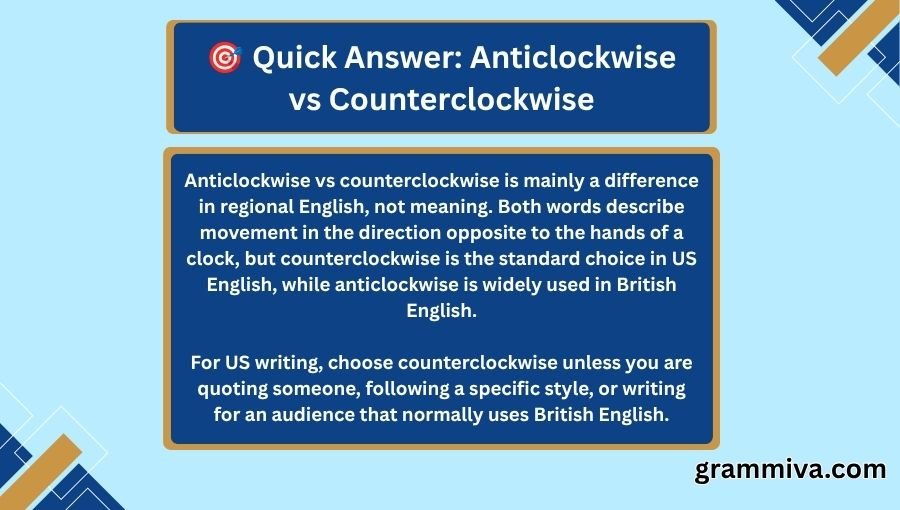
Anticlockwise vs counterclockwise is mainly a difference in regional English, not meaning. Both words describe movement in the direction opposite to the hands of a clock, but counterclockwise is the standard choice in US English, while anticlockwise is widely used in British English.
For US writing, choose counterclockwise unless you are quoting someone, following a specific style, or writing for an audience that normally uses British English.
| Word | Main Usage | Basic Meaning | US English? |
|---|---|---|---|
| Counterclockwise | American English | Moving opposite to clock-hand movement | Yes |
| Anticlockwise | British English and other varieties | Moving opposite to clock-hand movement | Less common |
| Clockwise | Broadly used | Moving in the same direction as clock hands | Yes |
| Counterclockwise direction | American English | The direction opposite clock hands | Yes |
Is Anticlockwise the Same as Counterclockwise?
Yes. Anticlockwise and counterclockwise have the same basic meaning. They both describe a circular movement that goes against the direction in which the hands of a traditional clock move.
Imagine looking directly at a clock. The hands move from 12 to 1, then 2, 3, and so on. That is clockwise movement. Going from 12 to 11, then 10, 9, and so on is counterclockwise or anticlockwise movement.
| Direction | Movement on a Clock Face | Common US Term | Common British Term |
|---|---|---|---|
| Same as clock hands | 12 → 1 → 2 → 3 | Clockwise | Clockwise |
| Opposite clock hands | 12 → 11 → 10 → 9 | Counterclockwise | Anticlockwise |
| Half turn | 12 → 6 | Neither direction alone | Neither direction alone |
| Quarter turn left from 12 | 12 → 9 | Counterclockwise | Anticlockwise |
The important point is that the direction does not change between the two words. Only the preferred word changes by variety of English.
🔄 Anticlockwise vs Counterclockwise at a Glance
The simplest way to remember the difference is this: counterclockwise is preferred in US English, while anticlockwise is common in British English.
| Form | Type | Meaning | Example | Correct/Incorrect |
|---|---|---|---|---|
| Counterclockwise | Adverb/adjective | Opposite the direction of clock hands | Turn the knob counterclockwise. | ✅ Correct in US English |
| Anticlockwise | Adverb/adjective | Opposite the direction of clock hands | Turn the knob anticlockwise. | ✅ Correct in British English |
| Clockwise | Adverb/adjective | In the direction of clock hands | Turn the knob clockwise. | ✅ Correct |
| Counter clockwise | Two-word form | Intended to mean counterclockwise | Turn it counter clockwise. | ❌ Usually incorrect in standard US writing |
| Anti-clockwise | Hyphenated form | Intended to mean anticlockwise | Turn it anti-clockwise. | ⚠️ Style-dependent; usually write “anticlockwise” |
Why Do People Confuse Anticlockwise and Counterclockwise?
People confuse these words because they describe exactly the same direction. The difference is mostly about regional English, so a reader may see one form in a US book and another form in a British book.
There is also a simple logic problem. The word counter can mean “against,” so American readers may find counterclockwise easy to understand. The prefix anti- also suggests opposition, which makes anticlockwise equally clear.
I once edited a training guide that had been written by two teams. One team used “anticlockwise,” and the other used “counterclockwise.” Both teams were correct, but the guide looked inconsistent. We chose one form based on the intended US audience and changed it throughout.
That experience taught me a useful editing rule: consistency matters almost as much as correctness.
A Simple Direction Test
When you are unsure, picture a clock face.
- If the movement follows 12 → 1 → 2 → 3, it is clockwise.
- If the movement follows 12 → 11 → 10 → 9, it is counterclockwise in US English.
- The same second direction can be called anticlockwise in British English.
💡 Test Tip: If you are writing for Americans, choose counterclockwise. If you are writing for a British audience, anticlockwise is usually the natural choice.
What Does Counterclockwise Mean in US English?
In US English, counterclockwise means moving in the direction opposite to the movement of clock hands. It can describe physical movement, rotation, turning, or the direction of an object.
For example:
Turn the dial counterclockwise to lower the setting.
Here, counterclockwise tells the reader which direction to turn the dial.
Another example:
The wheel rotated counterclockwise.
In this sentence, the word describes the direction of rotation.
| Meaning | Word Type | Example Sentence |
|---|---|---|
| Opposite the clock-hand direction | Adverb | Turn the handle counterclockwise. |
| Moving in the opposite direction | Adjective | The counterclockwise motion continued. |
| Direction of rotation | Adjective | The machine uses counterclockwise rotation. |
The word is especially common in American instructions, manuals, mathematics, engineering, science, and everyday speech.
When Should You Use Anticlockwise?
Use anticlockwise when writing in British English or when your audience normally uses that form. It is not a meaningless or broken version of counterclockwise. It is a legitimate English word with the same basic directional meaning.
For example:
Turn the dial anticlockwise.
That sentence is natural in British English.
If you are writing a US instruction manual, however, counterclockwise will usually be the better choice:
Turn the dial counterclockwise.
The difference is similar to other regional choices in English. Writers may choose color or colour, center or centre, and favorite or favourite depending on their audience.
| Audience | Preferred Form | Example |
|---|---|---|
| United States | Counterclockwise | Turn the knob counterclockwise. |
| United Kingdom | Anticlockwise | Turn the knob anticlockwise. |
| Mixed international audience | Choose one style and stay consistent | Turn the knob counterclockwise. |
| Quoting British text | Preserve original wording | “Turn the knob anticlockwise.” |
How Do You Use Counterclockwise in a Sentence?
You can use counterclockwise as an adverb or adjective. Its exact role depends on how it appears in the sentence.
As an adverb:
Turn the screw counterclockwise.
Here, counterclockwise tells us how the action should be performed.
As an adjective:
The counterclockwise rotation stopped suddenly.
Here, counterclockwise describes the type of rotation.
As part of a longer phrase:
Move the pointer in a counterclockwise direction.
The same basic meaning remains in each example.
Correct and Incorrect Examples
| Example Pair | Correct | Incorrect |
|---|---|---|
| Direction | ✅ Turn the dial counterclockwise. | ❌ Turn the dial counter clockwise. |
| Spelling | ✅ The wheel moved counterclockwise. | ❌ The wheel moved counter-clockwise. |
| Usage | ✅ Rotate the knob counterclockwise. | ❌ Rotate the knob counterclockwise direction. |
| British form | ✅ Turn it anticlockwise. | ❌ Assume anticlockwise is never valid English. |
The last example is important. Calling anticlockwise “wrong” in every situation is itself an error. The word is standard in varieties of English outside the US.
📝 Case Study: A Workplace Instruction
Consider a US workplace email about operating a machine.
A supervisor might write:
“Before starting the machine, turn the adjustment knob counterclockwise until the marker reaches zero.”
The word counterclockwise gives the worker a clear direction. There is little room for confusion.
Now imagine the same instruction in a British workplace:
“Before starting the machine, turn the adjustment knob anticlockwise until the marker reaches zero.”
The direction is exactly the same. The regional word choice has changed.
I once caught a similar issue while reviewing instructions for a piece of equipment. The original document used British spelling and American directional terms. Nothing was dangerous or grammatically broken, but the mixed style made the document look poorly edited. We standardized the language for the target market.
This is why professional writing should consider audience and consistency, not just whether a word appears in a dictionary.
📚 Grammar Rules Explanation
The grammar rule is simple: both counterclockwise and anticlockwise can function as directional words, but US English normally favors counterclockwise. The key rule in anticlockwise vs counterclockwise is that both forms describe the same direction.
Neither form is an opposite of the other. They are different regional labels for the same direction.
The words can appear in similar grammatical positions:
- Turn the handle counterclockwise.
- Turn the handle anticlockwise.
- The wheel rotates counterclockwise.
- The wheel rotates anticlockwise.
- The machine has a counterclockwise rotation.
- The machine has an anticlockwise rotation.
The main question is not, “Which word has the right meaning?” Both do. The better question is, “Which form fits my variety of English?”
Standard reference works, including well-known English dictionaries, recognize the distinction between these regional forms. For US-focused writing, major style practices generally favor the American form counterclockwise.
Correct vs Incorrect at a Glance
| Sentence | Correct/Incorrect | Why |
|---|---|---|
| Turn the knob counterclockwise. | ✅ Correct | Standard US English usage |
| Turn the knob anticlockwise. | ⚠️ Regionally correct | Common in British English |
| Turn the knob counter clockwise. | ❌ Incorrect in standard US style | The usual form is one word |
| The fan spins counterclockwise. | ✅ Correct | Correct directional use |
| The fan spins counter-clockwise. | ⚠️ Usually avoid | Standard US spelling is “counterclockwise” |
The important distinction is between regional variation and grammar error. A British writer using “anticlockwise” has not made the same kind of mistake as a writer who invents a spelling such as “counter clock wise.”
⚠️ Common Mistakes With These Direction Words
Most mistakes happen for three reasons: fast typing, autocorrect, and lack of knowledge about regional English.
Fast typing can produce spaces or missing letters. Autocorrect can sometimes change a word into a form that looks familiar but does not fit the chosen style. Lack of knowledge can lead writers to assume that one regional form must be wrong.
| Common Confusion | Problem | Better Choice |
|---|---|---|
| Its / It’s | Possession vs contraction | Check the sentence meaning |
| Your / You’re | Possession vs contraction | Check whether “you are” fits |
| Then / Than | Time/order vs comparison | Check the relationship |
| Affect / Effect | Different grammatical roles and meanings | Check the sentence function |
| Anticlockwise / Counterclockwise | Regional English choice | Match the audience |
The mistake is often not about the direction itself. It is about assuming that English has only one accepted form.
Specific Spelling and Usage Mistakes
| Wrong Form | What’s Wrong | Correct Form |
|---|---|---|
| Counter clockwise | Unnecessary space | Counterclockwise |
| Counter-clockwise | Unnecessary hyphen in standard US usage | Counterclockwise |
| Counterclock wise | Incorrect word division | Counterclockwise |
| Anticlock-wise | Incorrect hyphenation | Anticlockwise |
| Anti clockwise | Usually not the standard closed form | Anticlockwise |
| Counterclockwize | Incorrect spelling | Counterclockwise |
I once caught myself typing “counter clockwise” in a quick note because I was writing faster than I was thinking. I fixed it before sending the message. Small mistakes like that are easy to make when the word is not one you type every day.
Is Counterclockwise One Word?
Yes. In standard US English, counterclockwise is normally written as one word.
That means you should write:
Turn the dial counterclockwise.
Not:
Turn the dial counter clockwise.
The same principle applies when counterclockwise is used as an adjective:
The device has a counterclockwise rotation.
For ordinary US writing, keeping the word closed is the safest choice.
| Form | Standard US Choice? | Example |
|---|---|---|
| Counterclockwise | ✅ Yes | Rotate counterclockwise. |
| Counter clockwise | ❌ No | Avoid this spelling. |
| Counter-clockwise | ⚠️ Usually avoid | Use the closed form in US English. |
| Anticlockwise | ⚠️ Regional | Common in British English. |
| Anti-clockwise | ⚠️ Regional/style-dependent | The closed British form is usually safer. |
Does Counterclockwise Mean Turn Left?
Not always. Counterclockwise describes a direction of rotation, not simply “left.”
If you look at a clock face, counterclockwise movement goes from 12 toward 11, 10, and 9. But whether a person should move an object left or right depends on the object’s position and how it is being viewed.
For example, a knob may require a counterclockwise turn, but telling someone simply to “turn left” may not provide enough information.
| Instruction | Meaning | Best Use |
|---|---|---|
| Turn counterclockwise | Rotate opposite clock-hand movement | Precise circular motion |
| Turn clockwise | Rotate with clock-hand movement | Precise circular motion |
| Turn left | Move or rotate toward the left | Less precise |
| Rotate 90 degrees counterclockwise | Make a quarter turn in that direction | Very precise |
For instructions, counterclockwise is often clearer than “left” because it describes rotation rather than a general side.
Anticlockwise vs Counterclockwise in Different Contexts
Both forms can work in everyday speech, professional writing, creative writing, and online communication. The main factor is your audience. Knowing anticlockwise vs counterclockwise helps you choose wording that fits your audience.
| Context | Which Term to Use | Example |
|---|---|---|
| Everyday US conversation | Counterclockwise | Turn it counterclockwise. |
| Professional US writing | Counterclockwise | Rotate the control counterclockwise. |
| Creative writing for US readers | Counterclockwise | She twisted the handle counterclockwise. |
| Social media for US readers | Counterclockwise | Turn the cap counterclockwise to open it. |
| British professional writing | Anticlockwise | Rotate the control anticlockwise. |
| British everyday conversation | Anticlockwise | Turn it anticlockwise. |
Everyday Conversation
Americans are likely to say:
“Turn it counterclockwise.”
A British speaker may naturally say:
“Turn it anticlockwise.”
Both instructions communicate the same direction.
Professional Writing
In a US manual, report, technical guide, or work email, counterclockwise is usually the better choice.
Consistency is especially important when the word appears many times.
Creative Writing
Creative writers can use either form based on the setting and audience. A US novel would normally favor counterclockwise. A British novel may naturally use anticlockwise.
Social Media and Texting
Informal writing is flexible, but the regional pattern still applies. US readers will generally find counterclockwise more familiar.
How Does Anticlockwise vs Counterclockwise Work in Math?
In mathematics, both terms can describe rotation, but counterclockwise is especially common in US educational materials.
For example:
Rotate the shape 90 degrees counterclockwise.
This tells the reader to make a quarter turn opposite to the movement of clock hands.
| Math Instruction | Meaning |
|---|---|
| Rotate 90° clockwise | Quarter turn in the clock-hand direction |
| Rotate 90° counterclockwise | Quarter turn opposite the clock-hand direction |
| Rotate 180° | Half turn |
| Rotate 270° counterclockwise | Three-quarter turn in the counterclockwise direction |
This language is useful when working with geometry, graphs, coordinates, transformations, and angles.
What Are Common Phrases With Counterclockwise?
There are no major idioms built around counterclockwise, but several practical phrases are common in instructions and technical writing.
| Phrase | Meaning |
|---|---|
| Turn counterclockwise | Rotate in the opposite direction from clock hands |
| Rotate counterclockwise | Move around a center in that direction |
| Move counterclockwise | Travel around a circle in that direction |
| Counterclockwise direction | The direction opposite clock-hand movement |
| Counterclockwise rotation | Rotation in that direction |
| Turn slightly counterclockwise | Make a small rotation in that direction |
These phrases are useful because they make physical instructions more exact.
How Can You Remember the Difference?
A simple memory trick is to connect counter with “against.”
Counterclockwise = against the clock.
Then remember the regional rule:
US English → counterclockwise
British English → anticlockwise
That gives you two separate questions:
- Which direction do I mean?
- Which English variety am I writing?
If the answer to the first question is “opposite the clock,” and the answer to the second is “US English,” then counterclockwise is your safest choice.
| Question | Best Answer |
|---|---|
| Am I describing the opposite clock direction? | Use a counterclockwise/anticlockwise word |
| Am I writing for US readers? | Prefer counterclockwise |
| Am I writing for British readers? | Prefer anticlockwise |
| Am I mixing both forms? | Pick one style and stay consistent |
| Am I writing a technical instruction? | Use the clearest regional standard |
Synonyms and Alternatives
Sometimes you can replace the directional word with a phrase. This can help when you want to explain the movement to someone who may not know the term. When explaining anticlockwise vs counterclockwise, you can sometimes replace either term with a longer descriptive phrase.
| Alternative | Works When | Does Not Work When |
|---|---|---|
| Opposite the direction of the clock hands | You want maximum clarity | The sentence needs to be short |
| Against the clock | Informal explanation | Formal technical instructions |
| Rotate to the left | The physical setup makes left clear | The viewer’s position may change |
| Turn in the opposite direction | The context already explains the clock direction | Precise technical directions are needed |
| Move around the circle counterclockwise | You need a clear math or movement instruction | A simple “counterclockwise” is enough |
“Opposite the direction of the clock hands” is the clearest full explanation. Counterclockwise is much shorter.
Why Does Getting the Word Right Matter?
Choosing the right regional form helps your writing feel natural and consistent. It also prevents readers from wondering whether you have made a spelling mistake. The distinction between anticlockwise vs counterclockwise can affect consistency in professional US English.
This matters most when the word appears in instructions, educational content, product manuals, or professional documents.
Clear writing gives the reader fewer things to stop and question.
That principle is especially useful for directional words. A reader should spend time understanding the task, not wondering whether the writer knows which spelling to use.
| Situation | Why Getting It Right Matters |
|---|---|
| Resume or application | Shows careful control of written English |
| Client email | Makes instructions look polished |
| Published content | Keeps regional language consistent |
| Social post | Makes the wording natural for the target audience |
For US-focused content, using counterclockwise also supports consistent American spelling across the rest of the document.
Is There a Special Exception?
There is no major grammatical exception that changes the basic rule. The main special case is audience.
If you are quoting a British speaker or reproducing a British document, keeping anticlockwise may be the right editorial choice. Likewise, a US publication may use counterclockwise even when discussing a British source.
The goal is not to erase regional English. The goal is to use the form that fits the situation.
| Situation | Recommended Approach |
|---|---|
| US website | Use counterclockwise |
| UK website | Use anticlockwise |
| International website | Choose a consistent style |
| Direct quotation | Keep the original form |
| Mixed-language document | Follow the document’s main English variety |
Which Form Should US Writers Choose?
US writers should normally choose counterclockwise. It is the natural American form for describing movement opposite to clock-hand movement.
If your target audience is American, there is little reason to switch to anticlockwise unless you are preserving a quotation or intentionally using another variety of English.
A useful editorial rule is:
Match the word to the reader, then keep the choice consistent.
This rule works beyond directional words. The same idea helps with spelling differences such as color/colour and center/centre. The easiest rule for anticlockwise vs counterclockwise is to use counterclockwise for US readers.
Quick Recap Checklist
Use this checklist whenever you are unsure which word to choose.
| Question | If Yes → Use |
|---|---|
| Are you writing standard US English? | Counterclockwise |
| Are you writing standard British English? | Anticlockwise |
| Do you mean movement opposite clock hands? | Counterclockwise or anticlockwise |
| Are you writing a US technical guide? | Counterclockwise |
| Are you quoting British English? | Keep anticlockwise |
| Are both forms appearing in one document? | Choose one based on the audience |
Practice Examples
- The mechanic told me to turn the screw counterclockwise.
- The British instruction said to turn the dial anticlockwise.
- The wheel began moving counterclockwise after the motor started.
In all three examples, the direction is the same. The word changes because the English variety or context changes.
FAQs About Anticlockwise vs Counterclockwise
Is anticlockwise correct in English?
Yes. Anticlockwise is a correct English word and is widely used in British English and other varieties. It means the same basic direction as counterclockwise.
Is counterclockwise the correct US spelling?
Yes. Counterclockwise is the standard choice in US English. It is normally written as one word.
Are anticlockwise and counterclockwise synonyms?
Yes. They are regional synonyms for the direction opposite to the movement of clock hands.
Should Americans say anticlockwise or counterclockwise?
Americans should normally say counterclockwise. That form is more natural in standard US English.
Should British people say anticlockwise or counterclockwise?
British speakers commonly use anticlockwise. Both forms can be understood, but anticlockwise fits British English better.
Is counter clockwise two words?
No. In standard US English, the usual spelling is counterclockwise, as one word.
Is counter-clockwise correct?
The hyphenated form can appear in some styles or older writing, but counterclockwise is the preferred closed form for standard US English.
Does counterclockwise mean left?
Not exactly. Counterclockwise describes rotation opposite to the movement of clock hands. “Left” can describe a different kind of movement and may not be precise enough for a circular action.
Which word should I use in a US grammar article?
Use counterclockwise when the article is written in US English. You can mention anticlockwise when explaining the British English equivalent.
How do I remember counterclockwise vs anticlockwise?
Remember counterclockwise = against the clock. Then connect the regional choice to your audience: US English generally uses counterclockwise, while British English commonly uses anticlockwise.
Final Takeaway
Anticlockwise vs counterclockwise is not really a fight between a correct word and an incorrect word. It is mainly a question of regional English. Both words describe movement opposite to the hands of a clock.
For American readers, counterclockwise is the clear default. For British readers, anticlockwise is often the more natural choice. Neither should be treated as universally wrong.
When you edit your writing, check three things: the direction you mean, the audience you are addressing, and the spelling style used in the rest of the document. That small check can prevent an otherwise simple word choice from looking inconsistent.
If you are writing for a US audience, remember the easiest rule: counterclockwise is your go-to form. 🔄 Once that habit is fixed, this particular English confusion becomes easy to handle.
Know your audience, choose your direction, and keep your wording consistent. ✨

I am Alex Morgan, an English grammar and vocabulary writer passionate about making language learning simple and useful. I work at Grammiva, where I create clear educational content and practical English examples for learners.

[…] what steer means and why stear does not normally work, the choice becomes much easier. 🎯 Anticlockwise vs Counterclockwise | Whether vs Whether or Not | Therefore vs […]