Have you ever typed a word, looked at it twice, and suddenly wondered if it looks right? Truly vs truely is one of those spelling questions that can stop a sentence in its tracks. Both forms look believable, especially because many English words keep the letter combination “-ue” after a vowel. But only one spelling is correct in standard US English.
If you have ever written “truely” in a text, email, school paper, or social post, you are not alone. The mistake is easy to make because the word truly does not follow the spelling pattern that many people expect. The good news is that the rule is simple once you see it.
I have taught and edited English for years, and I often find that small spelling rules are easier to remember when they are tied to a clear pattern. So let’s break this one down step by step. By the end, you will know exactly when to use truly, why truely is wrong, and how to remember the correct form. 😊 Trek vs Treck | High school vs highschool | Aide vs Aid
🎯 Quick Answer: Truly vs Truely
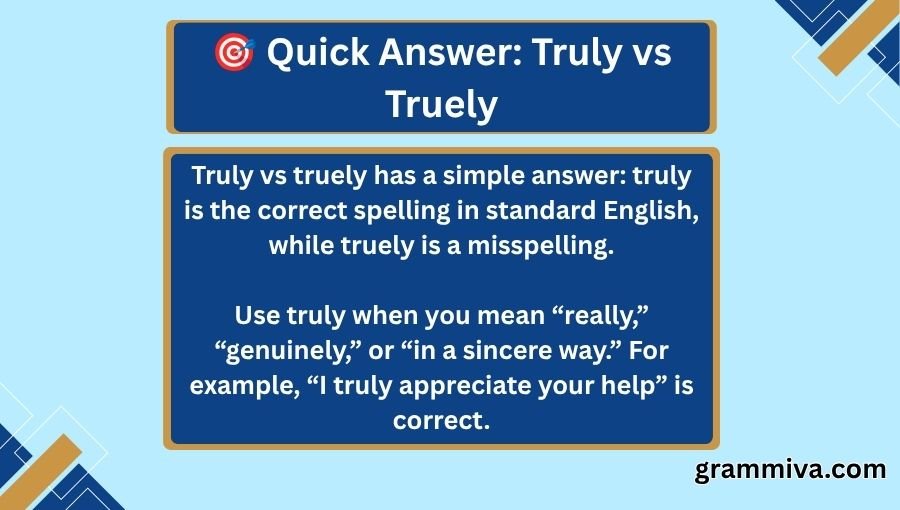
Truly vs truely has a simple answer: truly is the correct spelling in standard English, while truely is a misspelling.
Use truly when you mean “really,” “genuinely,” or “in a sincere way.” For example, “I truly appreciate your help” is correct.
Related Word Forms of Truly
The word truly is an adverb. It comes from the adjective true, but its spelling changes when the suffix -ly is added.
Here are the most useful related forms:
| Form | Type | Example |
|---|---|---|
| true | Adjective | That story is true. |
| truly | Adverb | I truly believe you. |
| truth | Noun | She told the truth. |
| truthful | Adjective | He gave a truthful answer. |
| truthfully | Adverb | She answered truthfully. |
The key point is that true becomes truly, not truely, when it takes the adverb ending.
🔎 Understanding Truly vs Truely
The basic difference between truly vs truely is spelling. Truly is the standard English spelling. Truely is not the standard spelling of the adverb.
The confusion comes from the word true. Since “true” ends in e, it may seem natural to write “true + ly” as “truely.” English spelling does not always work that way.
When -ly is added to true, the final e is dropped:
true → truly
This gives us a useful pattern to remember.
| Form | Type | Meaning | Example | Correct/Incorrect |
|---|---|---|---|---|
| truly | Adverb | Really; genuinely | I truly enjoyed the show. | ✅ Correct |
| truely | Intended adverb | Intended to mean “really” | I truely enjoyed the show. | ❌ Incorrect |
| true | Adjective | Factually correct or genuine | The statement is true. | ✅ Correct |
| truth | Noun | What is real or factual | He told the truth. | ✅ Correct |
| truthful | Adjective | Honest or accurate | She gave a truthful answer. | ✅ Correct |
Why Is Truly Spelled Without the E?
Truly is spelled without the e because the final e in true is removed before the -ly ending is added.
Think of it this way:
true + ly → truly
Not:
true + ly → truely
This is a spelling change, not a change in meaning.
What Does Truly Mean?
Truly means “really,” “genuinely,” or “sincerely.” It tells the reader that something is real, sincere, or strongly felt.
For example:
- “I truly enjoyed the book.”
- “She truly cares about her students.”
- “That was truly amazing.”
In each sentence, truly adds emphasis or shows sincerity.
Is Truely Ever Correct?
No. In standard English, truely is not the correct spelling of the adverb formed from true.
If you mean “really” or “genuinely,” write truly.
| Intended Meaning | Correct Form | Example |
|---|---|---|
| Really | truly | I truly understand. |
| Genuinely | truly | She truly cares. |
| Sincerely | truly | I am truly sorry. |
| Very much | truly | We truly enjoyed it. |
🎯 Correct Meanings and Uses of Truly
Truly has several closely related uses. They all center on the ideas of truth, reality, genuineness, or strong feeling.
Truly as “Really”
One common use of truly is to emphasize that something is real or actually the case.
For example:
“I truly enjoyed the concert.”
Here, truly means that the speaker really enjoyed it. It adds emphasis.
Compare these sentences:
- “I enjoyed the concert.”
- “I truly enjoyed the concert.”
The second sentence sounds stronger and more sincere.
Truly as “Genuinely”
Truly can also describe something that is genuine.
“She is truly kind.”
This means her kindness is real. The speaker is not merely being polite.
Truly as “Sincerely”
The word can also show honest feeling.
“I am truly sorry.”
Here, truly tells the reader that the apology is sincere.
Truly for Strong Emphasis
Writers sometimes use truly to give extra force to a statement.
“It was a truly remarkable performance.”
The word strengthens the adjective remarkable.
| Meaning | Word Type | Example Sentence |
|---|---|---|
| Really | Adverb | I truly understand your concern. |
| Genuinely | Adverb | He truly wants to help. |
| Sincerely | Adverb | I am truly grateful. |
| Strongly emphasizing a quality | Adverb | It was a truly beautiful place. |
💡 Test Tip: Try “Really”
One easy test is to replace truly with really.
If the sentence still makes sense, truly is often a good choice.
For example:
“I truly appreciate your help.”
Try:
“I really appreciate your help.”
Both sentences work. That tells you truly is being used as an adverb meaning “really.”
But remember: this test helps with meaning. It does not determine the spelling. The spelling is always truly.
📝 Truly vs Truely in a Real-Life Case Study
Imagine that a manager is writing an email to an employee who has completed a difficult project.
The manager writes:
“I truely appreciate all the work you put into this project.”
The meaning is clear, but the spelling is wrong.
A corrected version would be:
“I truly appreciate all the work you put into this project.”
That tiny correction makes the sentence look more polished.
I once edited a short workplace message where the writer had used “truely” several times. The writer knew exactly what the word meant. The problem was simply that the spelling looked logical to them. Once I showed them true → truly, they stopped making the mistake.
| Situation | Incorrect Version | Correct Version |
|---|---|---|
| Thank-you email | I truely appreciate it. ❌ | I truly appreciate it. ✅ |
| School assignment | This is truely important. ❌ | This is truly important. ✅ |
| Customer message | We are truely sorry. ❌ | We are truly sorry. ✅ |
| Personal note | I truely mean it. ❌ | I truly mean it. ✅ |
Grammar Rules Explanation
The spelling truly follows a common English spelling pattern involving the adjective true and the adverb-forming suffix -ly.
When -ly is added to true, the final e is removed:
true + -ly = truly
The resulting word is an adverb.
The form truely incorrectly keeps the final e from true. Standard English does not use that spelling for the adverb.
This is why truly is correct:
“She truly understands the problem.”
And this is why truely is incorrect:
“She truely understands the problem.”
Most standard English dictionaries and spelling references agree on the spelling truly.
Correct vs Incorrect at a Glance
| Sentence | Correct/Incorrect | Why |
|---|---|---|
| I truly believe you. | ✅ Correct | Truly is the standard adverb. |
| I truely believe you. | ❌ Incorrect | Truely is a misspelling. |
| She is truly happy. | ✅ Correct | The adverb modifies “happy.” |
| She is truely happy. | ❌ Incorrect | The final e should not remain. |
| We truly appreciate your support. | ✅ Correct | Truly means genuinely or sincerely. |
⚠️ Common Mistakes With Truly
People usually write truely for a simple reason: they apply a spelling pattern that feels logical.
They see:
true + ly
and naturally write:
truely
But English spelling has many small changes like this.
Why Do People Write Truely?
There are three common causes:
- Fast typing
When people type quickly, they may spell the word the way it sounds or the way it looks. - Autocorrect and typing habits
A person who has repeatedly typed a misspelling may stop noticing it. - Lack of knowledge of the spelling rule
If someone has never learned that true changes to truly, the incorrect form can look perfectly reasonable.
I once caught myself typing “truely” while drafting a casual message. I knew the correct spelling, but my brain had followed the visual pattern of “true” plus “ly.” That was a good reminder that even familiar words can cause quick typing errors.
Similar English Spelling Confusions
The same kind of problem appears in other common word pairs.
| Confusion | Correct Form | What Causes the Mistake |
|---|---|---|
| its / it’s | Depends on meaning | Apostrophe confusion |
| your / you’re | Depends on meaning | Sound-alike words |
| their / there / they’re | Depends on meaning | Similar pronunciation |
| then / than | Depends on meaning | Similar spelling and sound |
| truly / truely | truly | Incorrectly keeping the e |
Common Wrong Spellings of Truly
| Wrong Form | What’s Wrong | Correct Form |
|---|---|---|
| truely | Keeps the final e | truly |
| truelyy | Adds an extra y | truly |
| truley | Changes the letter order | truly |
| trully | Drops the wrong letter and doubles l | truly |
| truely appreciated | Uses the wrong spelling | truly appreciated |
| truely sorry | Uses the wrong spelling | truly sorry |
The safest choice is simple: whenever you mean “really,” “genuinely,” or “sincerely,” use truly.
🧠 Why the Truly Spelling Feels Strange
The word true creates the trap.
Many learners know that words can keep an e before certain endings. That makes “truely” look reasonable at first glance.
But truly is a familiar example of a spelling change that has to be learned as a whole.
A useful memory pattern is:
TRUE loses E before LY.
So:
true → truly
You can also connect it with a few related words:
- true
- truth
- truthful
- truly
The forms are related in meaning, but they do not all follow exactly the same spelling pattern.
Is Truly the Same as Really?
Truly and really can have the same basic meaning in many sentences, but they do not always sound exactly the same.
For example:
“I really like this song.”
This sounds natural and conversational.
“I truly like this song.”
This can sound more sincere or emphatic.
In formal or emotional writing, truly may sound warmer or more serious.
| Word | Common Meaning | Example |
|---|---|---|
| truly | Really; genuinely | I truly appreciate it. |
| really | Actually; very much | I really like it. |
| genuinely | In a sincere or real way | She genuinely cares. |
| sincerely | Honestly; with real feeling | I sincerely apologize. |
How To Use Truly in Different Contexts
The truly vs truely rule stays the same in emails, conversations, creative writing, and social media. The correct spelling stays the same across different types of writing. What changes is how often the word appears and what tone it creates.
| Context | Which Term to Use | Example |
|---|---|---|
| Everyday conversation | truly | I truly mean that. |
| Professional writing | truly | We truly appreciate your support. |
| Creative writing | truly | She was truly alone. |
| Social media/texting | truly | This is truly amazing! |
Everyday Conversation
In casual speech, truly can show strong feeling.
“I truly hope everything works out.”
It may sound a little more heartfelt than “I really hope everything works out.”
Professional Writing
Truly works well in professional messages when you want to express genuine appreciation.
“We truly appreciate your patience.”
It can also appear in formal closings such as “Yours truly,” although the phrase has a particular letter-writing style and is less common in casual email.
Creative Writing
Authors may use truly to add emotional weight.
“For the first time, he felt truly free.”
Here, truly helps stress the depth of the feeling.
Social Media and Texting
Informal writing often uses truly for emphasis.
“That was truly one of the best meals I’ve had.”
The spelling does not change just because the setting is casual.
Common Phrases With Truly
There are several natural phrases that use truly.
| Phrase | Meaning |
|---|---|
| truly appreciate | Feel genuine gratitude |
| truly sorry | Sincerely sorry |
| truly believe | Have a strong, sincere belief |
| truly amazing | Extremely or genuinely amazing |
| truly grateful | Deeply thankful |
| yours truly | A traditional letter closing or a reference to oneself |
These phrases are useful because they make the correct spelling easier to remember. If you have seen “truly appreciate” many times, that pattern becomes familiar.
Can You Say “Truly Sorry”?
Yes. Truly sorry is correct.
It means sincerely sorry or genuinely sorry.
For example:
“I am truly sorry for the mistake.”
The word truly modifies the adjective phrase “sorry” by showing that the feeling is sincere.
By contrast:
“I am truely sorry for the mistake.”
❌ This sentence contains a spelling error.
The intended meaning is still clear, but the written form should be corrected.
Can You Say “Truly Appreciate”?
Yes. Truly appreciate is both grammatical and natural.
For example:
“I truly appreciate your time.”
This is common in professional emails, thank-you notes, and personal messages.
You could also say:
“I really appreciate your time.”
Both work. Truly can give the sentence a slightly more sincere or formal tone.
How To Remember Truly vs Truely
The easiest memory trick is short:
TRUE loses E before LY.
Write these two forms side by side:
TRUE → TRULY
Notice what disappears: the E.
Then practice with a few common phrases:
- truly grateful
- truly sorry
- truly appreciate
- truly amazing
- truly understand
A second trick is to remember that truely looks unusual once you have trained your eyes to spot it. When proofreading, the sequence ue + ly should make you pause.
| Memory Step | What to Remember |
|---|---|
| 1 | Start with true |
| 2 | Add -ly |
| 3 | Drop the final e |
| 4 | Write truly |
| 5 | Never write truely for this meaning |
Synonyms and Alternatives for Truly
You can replace truly with other words in some situations. However, the replacement may change the tone.
| Alternative | Works When | Does Not Work When |
|---|---|---|
| really | You want a common, casual word | You want a more heartfelt tone |
| genuinely | You want to stress sincerity | The sentence needs a simple conversational style |
| sincerely | You mean honest feeling | The meaning is simply “actually” |
| honestly | You want to stress truthfulness | The sentence is about strong emphasis rather than honesty |
| actually | You want to stress fact or reality | You mean emotional sincerity |
For example:
“I truly appreciate your help.”
can become:
“I really appreciate your help.”
But “I sincerely appreciate your help” has a somewhat different tone. It sounds more formal and focused on sincerity.
Why Truly vs Truely Matters
Knowing the truly vs truely difference helps you avoid a common spelling mistake in professional and everyday writing. A single spelling mistake rarely ruins communication. Most readers will understand what truely means. Still, correct spelling matters because writing sends signals about care and attention.
Clarity in Communication
Correct spelling helps readers move through your sentence without stopping.
When a reader sees an unfamiliar or incorrect spelling, they may briefly wonder whether the word is intentional.
Professionalism
A spelling error in a resume, cover letter, client email, or report can make your writing look less polished.
That does not mean one mistake defines your writing. It simply means proofreading is worth the effort.
Accuracy in Digital Communication
Text messages are casual, but public posts, websites, business emails, and online profiles can reach many people.
A small spelling check can prevent the same error from being repeated.
“Good writing makes the reader’s job easier.”
That simple idea explains why spelling matters.
| Situation | Why Getting It Right Matters |
|---|---|
| Resume | Shows care and attention |
| Client email | Supports a professional tone |
| Published content | Builds reader trust |
| Social post | Makes the message look polished |
What About “Yours Truly”?
Yours truly is a correct fixed phrase.
It is traditionally used as a closing in letters and can also refer to the speaker or writer in a playful way.
For example:
“Yours truly,
Alex”
The word is still spelled truly, not truely.
This phrase is worth remembering because it gives you another familiar example of the correct spelling.
Truly vs Truely in Formal and Informal Writing
The spelling does not change based on formality. Always write truly.
What can change is the tone.
In casual writing:
“I truly love this!”
In professional writing:
“We truly appreciate your continued support.”
In academic writing:
“The results are truly significant.”
In creative writing:
“She truly believed she could change things.”
The word remains exactly the same in every case.
How Searchers Commonly Ask About Truly and Truely
People who search this spelling question often want a very short answer. The clearest answer is:
Truly is correct. Truely is incorrect.
If you are unsure, remember:
true → truly
Do not add the e before -ly.
That rule covers the most common use of the word.
💡 A Simple Proofreading Method
When I proofread, I like to check questionable words in context instead of looking at them alone.
If you see:
“I truely appreciate your help.”
Stop at the word.
Ask:
Am I trying to say “really” or “genuinely”?
If yes, replace it with:
“I truly appreciate your help.”
Then read the whole sentence again.
This two-step method is useful because it checks both meaning and spelling.
| Step | Question | Action |
|---|---|---|
| 1 | What do I mean? | Identify the intended meaning |
| 2 | Is the word an adverb? | Check whether truly fits |
| 3 | How is it spelled? | Use truly |
| 4 | Does the sentence sound natural? | Read it again |
| 5 | Is the tone right? | Change to “really,” “genuinely,” or another option if needed |
Quick Recap Checklist
Use this checklist whenever you are unsure.
| Question | If Yes → Use |
|---|---|
| Do you mean “really”? | truly |
| Do you mean “genuinely”? | truly |
| Do you mean “sincerely”? | truly |
| Are you describing a sincere feeling? | truly |
| Are you tempted to write “truely”? | Stop and write truly |
Practice Examples
- I truly enjoyed meeting you.
- We truly appreciate your support.
- She was truly surprised by the news.
Try covering the bold word and spelling it yourself. The goal is to make truly feel automatic.
FAQs About Truly vs Truely
Is truly the correct spelling?
Yes. Truly is the correct standard spelling. Truely is a misspelling.
Is truely a word?
Truely is not the standard spelling of the English adverb meaning “really” or “genuinely.” Use truly instead.
Why is truly spelled without the e?
The final e in true is dropped when the adverb ending -ly is added. The result is truly, not truely.
Is “truly” an adverb?
Yes. Truly is an adverb. It can modify a verb, adjective, or other expression by adding the idea of sincerity, reality, or emphasis.
What is the difference between truly and really?
Both can mean “really,” but truly can sound more sincere or emphatic. For example, “I truly appreciate it” often sounds more heartfelt than “I really appreciate it.”
Is “I truly appreciate it” correct?
Yes. I truly appreciate it is grammatically correct and natural. It means that you genuinely feel grateful.
Is “I truely appreciate it” correct?
No. The sentence should be written as “I truly appreciate it.” The problem is the spelling of the adverb.
Is “truly sorry” correct?
Yes. Truly sorry is correct and means sincerely sorry or genuinely sorry.
How can I remember the spelling of truly?
Remember this simple pattern: true → truly. The final e disappears before -ly.
Which is correct: “truly grateful” or “truely grateful”?
Truly grateful is correct. Truely grateful contains a spelling error.
Final Thoughts on Truly vs Truely
Truly vs truely becomes easy once you remember one rule: true loses its final e before -ly, giving us truly. Use truly when you mean “really,” “genuinely,” or “sincerely.” Do not use truely in standard English.
The mistake is understandable because “true” naturally makes us want to keep the e. But the correct spelling is worth learning as a fixed pattern. Once you have seen phrases such as “truly appreciate,” “truly sorry,” and “truly grateful” often enough, the correct form becomes much easier to recognize. 😊
When proofreading, pause whenever you see “truely.” Ask yourself whether you mean “really” or “genuinely.” If you do, change it to truly.
One tiny spelling change can make a sentence cleaner, more polished, and easier to trust. Remember the shortcut: TRUE → TRULY. Keep the meaning, drop the e, and you will have the right spelling every time.

I am Ryan Mitchell, a writer focused on English grammar, vocabulary, and everyday language. I work at Grammiva, creating easy-to-understand articles that help readers improve their English with confidence.


[…] will also see examples from everyday speech, work emails, social media, and formal writing. Truly vs Truely | Trek vs Treck | High school vs […]
[…] uses, memory tricks, and answers to the questions writers ask most often. Elses vs Elses | Truly vs Truely | Trek vs […]