
Have you ever typed a sentence about a long hike and stopped because you could not remember whether it should be trek vs treck? You are not alone. The two spellings look almost identical, and the extra c in “treck” can feel natural when you type quickly. 🥾
The good news is simple: trek is the standard English spelling. It can be a noun or a verb, and it is commonly used for a long or difficult journey, especially on foot. Treck is generally a misspelling when you mean the English word trek.
I teach and edit English writing, and I often see this kind of mistake. It is easy to make because English has many words where adding a letter seems to make sense. Here, however, that extra c does not belong.
In this guide, I will explain the difference, show you how to use trek correctly, examine common mistakes, and give you simple ways to remember the right spelling. By the end, the trek vs treck question should be easy to answer. 🌄 High school vs highschool | Aide vs Aid | Wiener vs Weiner
🎯 Quick Answer: Trek vs Treck
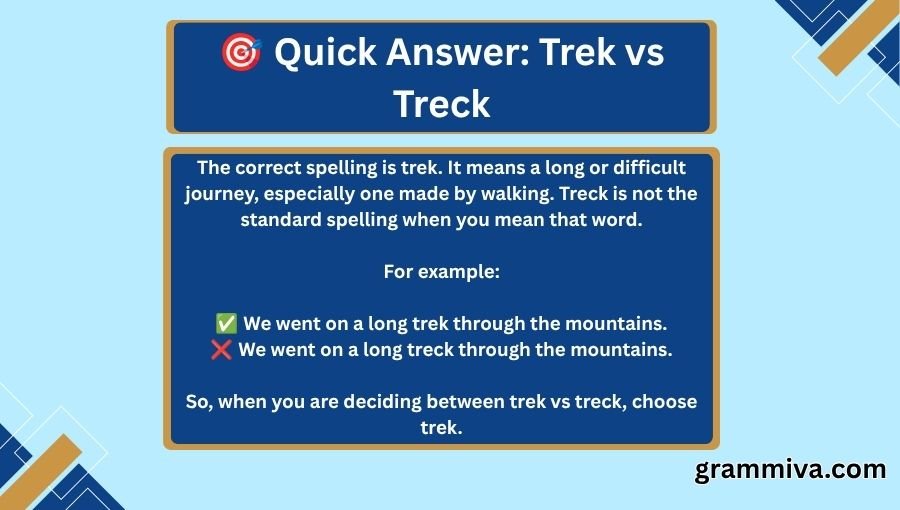
The correct spelling is trek. It means a long or difficult journey, especially one made by walking. Treck is not the standard spelling when you mean that word.
For example:
- ✅ We went on a long trek through the mountains.
- ❌ We went on a long treck through the mountains.
So, when you are deciding between trek vs treck, choose trek.
What Is the Difference Between Trek and Treck?
The main difference is spelling and standard usage. Trek is a real English word, while treck is normally an incorrect spelling of trek.
| Form | Type | Meaning | Example | Correct/Incorrect |
|---|---|---|---|---|
| trek | Noun | A long or difficult journey | We planned a mountain trek. | ✅ Correct |
| trek | Verb | To travel on a long or difficult journey | They will trek across the valley. | ✅ Correct |
| treck | — | Usually an incorrect spelling of trek | We went on a treck. | ❌ Incorrect |
| trekking | Verb form/noun use | Traveling or walking on a trek | She enjoys trekking. | ✅ Correct |
| trekked | Past-tense verb | Traveled on a trek | We trekked for six hours. | ✅ Correct |
The easiest rule is this: trek has no c after the k.
That rule also helps when you form related words. You write trekking and trekked, not forms based on treck.
Why Does “Treck” Look Correct?
The spelling treck feels believable because English contains many words with similar letter patterns. When people hear the final /k/ sound, they may instinctively add a c.
I once edited a travel article where the writer used treck several times. The writer knew exactly what the word meant. The problem was simply spelling. After I pointed out the pattern, the writer changed every instance to trek in less than a minute.
That is why the trek vs treck problem is usually a spelling issue rather than a vocabulary issue.
Is Trek the Correct Spelling?
Yes. Trek is the standard spelling when you mean a long, often challenging journey or a long walk.
You can use trek as both a noun and a verb.
As a noun:
We went on a three-day trek.
Here, trek names the journey.
As a verb:
We trekked through the forest.
Here, trekked describes the action of traveling.
Compare the two:
- ✅ The trek took three days.
- ❌ The treck took three days.
- ✅ They trekked across the hills.
- ❌ They trecked across the hills.
The difference is not one of meaning. The problem is the spelling.
Trek as a Noun
As a noun, trek refers to a journey, especially one that is long, difficult, or made on foot.
Examples include:
- a mountain trek
- a desert trek
- a long trek through the woods
- a winter trek
- a five-day trek
For example:
The hikers prepared carefully for their mountain trek.
The word describes the journey itself.
Trek as a Verb
As a verb, trek means to travel or walk for a long distance, often under difficult conditions.
For example:
We trekked through the snow for several hours.
The related forms are also important:
- Present: trek
- Third-person singular: treks
- Present participle: trekking
- Past tense: trekked
Notice that trek doubles its final k before -ing and -ed.
| Meaning | Word Type | Example Sentence |
|---|---|---|
| A long journey | Noun | The trek was exhausting. |
| A difficult walk | Noun | We planned a trek through the hills. |
| To travel a long distance | Verb | They trek across the region every year. |
| To travel in the past | Verb | We trekked through the forest yesterday. |
| Traveling or walking | Verb form | They are trekking in the mountains. |
💡 Test Tip: Try the “Remove the C” Test
If you are unsure about trek vs treck, remove the c.
Ask yourself:
Does trek look like the normal English word for a long journey or difficult walk?
Yes.
Now try treck. It will usually look unfamiliar once you compare the two side by side.
This is a quick test you can use while writing an email, article, school assignment, or social post.
🥾 Trek vs Treck at a Glance
The short answer is that trek is correct and treck is generally incorrect in standard English.
| Spelling | Standard English? | Meaning | Example |
|---|---|---|---|
| trek | Yes | Long or difficult journey | We began our trek early. |
| treck | No, when intended as trek | Usually a misspelling | We began our treck early. |
| trekking | Yes | Going on a trek | They are trekking today. |
| trekked | Yes | Went on a trek | She trekked across the valley. |
The key point in trek vs treck is that the standard base word contains only one k and no c.
Why Do People Confuse Trek and Treck?
People confuse these spellings because they sound the same and differ by only one letter. The eye may also expect a c because English uses c in many words that contain a similar sound.
Fast typing makes the problem worse.
Autocorrect can also play a role. A writer may type quickly, accept a suggested spelling, and move on without checking the word.
I once caught myself typing treck while making notes for a hiking piece. I knew the correct word, but my fingers followed a familiar letter pattern. That small mistake reminded me that knowing a word and spelling it correctly are two different skills.
Here are some other common spelling pairs that create similar confusion:
| Confusion | Correct Form | Common Wrong Form | Why It Happens |
|---|---|---|---|
| its/it’s | its or it’s | Mixed forms | Both sound alike |
| your/you’re | your or you’re | Mixed forms | Fast writing |
| their/there/they’re | their, there, they’re | Mixed forms | Similar sounds |
| definitely | definitely | definately | Pronunciation can mislead spelling |
| separate | separate | seperate | Vowel order is easy to forget |
| trek | trek | treck | Extra letter feels natural |
The trek vs treck error can therefore be part of a larger pattern: writers often add letters that seem logical even when the standard spelling does not use them.
⚠️ Common Mistakes With Trek and Treck
Most mistakes come from three simple causes: fast typing, autocorrect, and lack of knowledge.
1. Fast typing
When you type quickly, your brain often focuses on meaning rather than every letter.
You may know the correct spelling but still type treck.
2. Autocorrect
Spell-check tools are helpful, but they are not perfect. A writer may accept a suggestion without checking the sentence.
3. Lack of knowledge
Someone who has rarely seen the word in writing may not know which spelling is standard.
The best solution is to learn the base form once and connect it to its related forms.
Specific Wrong Spellings and Uses
| Wrong Form | What’s Wrong | Correct Form |
|---|---|---|
| treck | Extra c | trek |
| trecking | Built from the wrong base spelling | trekking |
| trecked | Built from the wrong base spelling | trekked |
| trecks | Built from the wrong base spelling | treks |
| long treck | Misspelled noun | long trek |
| we trecked | Misspelled verb | we trekked |
A useful pattern emerges: if the base word is trek, all of its standard forms are built from trek, not treck.
How Should You Use Trek in a Sentence?
Use trek when you want to describe a long journey or a demanding trip, especially when walking is involved.
Here are several examples:
- ✅ Our trek lasted six hours.
- ❌ Our treck lasted six hours.
- ✅ They trekked through the hills.
- ❌ They trecked through the hills.
- ✅ The group is trekking toward the campsite.
- ❌ The group is trecking toward the campsite.
- ✅ She enjoys long treks in the summer.
- ❌ She enjoys long trecks in the summer.
These examples show why trek vs treck is easy to solve once you remember the base spelling.
📝 Case Study: A Travel Email
Imagine that a tour company sends this email:
We are excited to announce a new mountain trek for experienced hikers. The trip includes two nights at a campsite and several hours of walking each day.
That use is correct because trek describes the long journey.
Now imagine a customer replies:
I have never been on a trek this long before. What equipment should I bring?
Again, trek is correct.
The word works naturally in professional communication because it clearly describes the type of trip.
A few days ago, I reviewed a sample travel message that used treck repeatedly. The writer had strong information about the trip but had never checked the spelling. Correcting the word made the entire message look more polished.
| Writing Situation | Better Sentence | Why |
|---|---|---|
| Travel email | We are planning a mountain trek. | Standard spelling |
| Trip description | The trek will take two days. | Clear noun use |
| Personal message | I went on a trek last summer. | Natural everyday use |
| Travel blog | We trekked through the valley. | Correct verb form |
| Tour advertisement | Join our weekend trek. | Clear and professional |
What Are the Grammar Rules for Trek?
The basic grammar rule is simple: trek is the standard English word, and treck is normally not the correct spelling when referring to a long journey or difficult walk.
As a noun, trek can follow words such as a, the, long, mountain, or difficult.
Examples include:
a long trek
the mountain trek
an exhausting trek
As a verb, trek can be changed to match tense and subject.
For example:
We trek through the area each summer.
We trekked through the area last summer.
We are trekking through the area now.
The spelling of trek also changes when suffixes are added. The final k is doubled in trekked and trekking.
The standard spelling does not insert a c.
Most standard English reference sources and dictionaries recognize trek as the established spelling. For everyday writing, that is the form you should use.
Correct vs Incorrect at a Glance
| Sentence | Correct/Incorrect | Why |
|---|---|---|
| We went on a long trek. | ✅ Correct | Trek is the standard noun. |
| We went on a long treck. | ❌ Incorrect | Treck is a misspelling here. |
| They trekked through the valley. | ✅ Correct | Trekked is the correct past form. |
| They trecked through the valley. | ❌ Incorrect | The spelling incorrectly adds c. |
| She enjoys trekking in the mountains. | ✅ Correct | Trekking uses the correct base word. |
The rule behind trek vs treck does not require a complicated grammar formula. It is mainly a matter of using the standard spelling.
Is Treck Ever Correct?
In ordinary English writing, treck should not be used as a spelling of trek. If you mean a long journey or difficult walk, use trek.
There may be unusual cases where a similar-looking string of letters appears as part of a name, username, product name, fictional term, or other proper name. Those cases do not change the normal English spelling rule.
For regular writing, the choice is straightforward:
trek = standard English word
treck = generally a misspelling
So if you are writing an essay, resume, blog post, email, report, or travel description, choose trek.
Where Does Trek Fit in Everyday English?
Trek is common in travel and outdoor writing, but it can also be used more broadly.
A person can describe a difficult trip to a place as a trek even when the trip is not a formal hiking expedition.
For example:
The walk to the remote village was a real trek.
Here, the word emphasizes that the journey was long or difficult.
It can also be used in a casual way:
Getting across town during rush hour was a trek.
The speaker is not necessarily talking about hiking. The word simply makes the journey sound long or tiring.
This flexible use is one reason trek vs treck matters. You may encounter trek in many kinds of writing.
Trek Usage in Different Contexts
The correct form remains trek across normal writing contexts. What changes is the style and tone of the sentence.
| Context | Which Term to Use | Example |
|---|---|---|
| Everyday conversation | trek | That was quite a trek! |
| Professional writing | trek | The project team completed a difficult trek. |
| Creative writing | trek | Their trek through the silent valley seemed endless. |
| Social media/texting | trek | Just finished an amazing trek! |
| Travel writing | trek | The trek offered views of the surrounding peaks. |
In casual texting, people may make spelling mistakes because they type quickly. That does not make treck the correct form.
What Are Common Phrases With Trek?
Trek appears in several natural phrases. These expressions can help you remember the correct spelling.
| Phrase | Meaning |
|---|---|
| go on a trek | Take a long or difficult journey |
| mountain trek | A long journey through mountainous areas |
| long trek | A journey that covers a lot of distance |
| difficult trek | A journey that requires effort |
| trekking trail | A path used for trekking |
| trek through the forest | Travel through a forest on a long journey |
When you see these phrases often, the spelling trek becomes easier to remember.
For example:
We went on a mountain trek.
It would look unusual to most experienced English readers to see mountain treck in that sentence.
How Can You Remember the Difference?
The simplest memory trick is:
Trek has no C.
You can also connect the word to its common forms:
- trek
- treks
- trekked
- trekking
None of these standard forms needs a c.
Another useful trick is to picture the word TREK printed on a hiking sign:
TREK → TRAIL → TRAVEL
The visual link can make the spelling easier to recall.
If you are writing quickly, stop for one second when you see treck. Ask:
“Do I mean a long journey?”
If yes, change it to trek.
That tiny pause can prevent the mistake.
Are There Good Alternatives to Trek?
Yes. Depending on the sentence, you can sometimes replace trek with words such as journey, hike, trip, or walk. However, these words are not always exact replacements.
| Alternative | Works When | Does Not Work When |
|---|---|---|
| journey | You mean travel from one place to another | You specifically mean a long hike |
| hike | You mean walking outdoors, especially on a trail | The journey is broader than walking |
| trip | You mean travel in a general sense | You want to stress difficulty or distance |
| walk | You simply mean traveling on foot | You want the stronger sense of a demanding journey |
| expedition | You mean an organized or purposeful journey | The situation is just an ordinary walk |
For example, hike may work in:
We went on a mountain hike.
But trek can give the sentence a stronger sense of distance or challenge:
We went on a difficult mountain trek.
So trek and these alternatives overlap, but they are not always interchangeable.
Why Does Getting Trek Right Matter? 🎯
Correct spelling helps readers understand your writing without distraction. A small spelling error can make an otherwise strong piece look careless.
This matters especially when you write for work, school, customers, or a public audience.
Consider this short principle:
Clear words make clear writing.
The rule is simple, but its effect is useful.
| Situation | Why Getting It Right Matters |
|---|---|
| Resume | Shows attention to detail |
| Client email | Creates a professional impression |
| Published content | Builds reader trust |
| Social post | Makes the message easier to read |
A single spelling error usually does not ruin communication. Still, repeated errors can reduce confidence in the writer.
The trek vs treck question is therefore more than a tiny spelling puzzle. It is a good example of why checking familiar words matters.
Why Is Trek Better Than Treck in Professional Writing?
Trek is the form professional writers should use when they mean a long or difficult journey.
Professional readers expect standard spelling. A misspelled word can interrupt the flow of a report or email.
Compare:
- ✅ The team completed a challenging trek across the region.
- ❌ The team completed a challenging treck across the region.
The first sentence looks polished. The second makes the reader stop and wonder whether treck is a special term.
In most cases, it is not.
This is especially important for:
- travel companies
- outdoor businesses
- tourism websites
- school assignments
- news articles
- blogs
- marketing pages
- workplace documents
Using the standard form keeps your writing clear and familiar.
Does Trek Have Different Word Forms?
Yes. Trek can take several common forms depending on how it is used in a sentence.
| Word Form | Grammar Role | Example |
|---|---|---|
| trek | Base noun or verb | We planned a trek. |
| treks | Plural noun or third-person verb | She goes on long treks. |
| trekked | Past-tense verb | We trekked for hours. |
| trekking | Present participle/gerund | They are trekking today. |
One detail is especially worth remembering: trekking and trekked have two k letters.
That is because the final consonant is doubled before these endings in the standard spelling of the word.
Do not turn the word into trecking or trecked.
How Does Trek Compare With Other Travel Words?
Trek has a more specific feel than some general travel words.
A trip can be short or long.
A journey focuses on travel from one place to another.
A hike usually suggests walking outdoors.
A trek often suggests a long, challenging, or demanding journey, particularly on foot.
| Word | Main Idea | Example |
|---|---|---|
| trip | General travel | We took a trip to Denver. |
| journey | Travel from one place to another | The journey took two days. |
| hike | Outdoor walking | We went on a short hike. |
| trek | Long or difficult journey | They completed a mountain trek. |
| expedition | Organized journey with a purpose | The team joined an Arctic expedition. |
These differences can help you choose the best word instead of simply correcting the spelling.
Can You Use Trek as a Verb?
Yes. Trek works as both a noun and a verb.
As a noun:
The trek was harder than expected.
As a verb:
We trekked through the valley.
This is useful because the same word can describe both the journey and the action.
Here are more examples:
- ✅ They trek across the desert each year.
- ❌ They treck across the desert each year.
- ✅ We trekked through the forest.
- ❌ We trecked through the forest.
- ✅ The hikers are trekking toward the campsite.
- ❌ The hikers are trecking toward the campsite.
Remember that the trek vs treck choice does not change just because the word changes grammatical form.
How Do You Avoid the Trek vs Treck Mistake?
Use three simple habits.
Habit 1: Learn the base spelling
Memorize:
T-R-E-K
Not:
T-R-E-C-K
Habit 2: Learn the family
Think:
trek → trekking → trekked
This helps reinforce the correct spelling.
Habit 3: Read the word often
Seeing trek in books, travel articles, and other writing makes the standard form familiar.
You do not need a complicated memory system. Repeated exposure plus one simple rule is enough for most writers.
What Should You Choose in a Grammar Test?
If a test asks you to choose between trek and treck, select trek when the sentence refers to a long journey or difficult walk.
For example:
We went on a long ___ through the mountains.
The answer is:
trek
Another example:
They ___ through the valley for five hours.
The answer is:
trekked
The key is to recognize both the meaning and the spelling.
Quick Test
| Sentence | Answer |
|---|---|
| We planned a mountain ___. | trek |
| They ___ across the hills. | trekked |
| She loves ___. | trekking |
| The hikers completed several ___. | treks |
If you can complete these without hesitation, you have mastered the basic trek vs treck rule.
FAQs About Trek vs Treck
Is trek or treck correct?
Trek is correct when you mean a long or difficult journey, especially one involving walking. Treck is generally a misspelling of trek.
What does trek mean?
Trek means a long or difficult journey or walk. It can be a noun or a verb.
Is treck a real English word?
Treck is not the standard spelling of the English word meaning a long journey or difficult walk. In ordinary writing, use trek.
How do you spell the past tense of trek?
The past tense is trekked. The final k is doubled before -ed.
How do you spell trekking?
The correct spelling is trekking, with two k letters and no c.
Is trek a noun or a verb?
It can be both. As a noun, it names a long journey. As a verb, it describes traveling on such a journey.
Can trek mean a long walk?
Yes. Trek can describe a long or difficult walk, especially when the walk is part of a journey.
What is the difference between trek and hike?
Both can describe outdoor walking. Hike often means walking for pleasure or exercise, while trek can suggest a longer or more demanding journey.
Why do people spell trek as treck?
The error usually happens because treck looks and sounds plausible. Fast typing, unfamiliarity with the word, and similar spelling patterns can also cause the mistake.
How can I remember trek vs treck?
Remember the simple rule: trek has no c. Think of the word family trek, trekking, trekked, and treks.
✅ Quick Recap Checklist
Use this checklist whenever you are unsure.
| Question | If Yes → Use |
|---|---|
| Do you mean a long journey? | trek |
| Do you mean a difficult walk? | trek |
| Do you mean the past form? | trekked |
| Do you mean the -ing form? | trekking |
| Did you write “treck”? | Change it to trek |
Practice Examples
- We went on a long trek through the hills.
Correct: trek - They trekked for six hours before reaching camp.
Correct: trekked - She enjoys trekking on weekends.
Correct: trekking
The pattern is easy once you see it: trek → trekked → trekking.
Trek vs Treck: The Simple Rule to Remember
The answer to trek vs treck is clear: use trek when you mean a long or difficult journey or walk.
Use trek as a noun:
We planned a difficult trek.
Use it as a verb:
We trek through the hills every summer.
Use its past form:
We trekked through the valley.
Use its -ing form:
We are trekking toward the campsite.
Do not add a c.
The incorrect spelling can appear tempting because the words sound the same. However, standard English uses trek, not treck, for this meaning.
The best way to remember the rule is to learn the whole word family:
trek, treks, trekked, trekking.
Once that pattern becomes familiar, the spelling choice becomes almost automatic.
Whether you are writing a travel blog, school assignment, work email, social post, or casual message, choosing the standard spelling makes your writing cleaner and easier to trust.
So the next time you pause over these two forms, do not overthink it. 🥾
Trek has no C. Remember the trail, choose the right spelling, and keep your writing moving forward.

I am Ethan Brooks, an English grammar and vocabulary writer. I work at Grammiva, where I create simple and helpful content to make English learning easier for students and everyday learners.


[…] know exactly when to use truly, why truely is wrong, and how to remember the correct form. 😊 Trek vs Treck | High school vs highschool | Aide vs […]
[…] see examples from everyday speech, work emails, social media, and formal writing. Truly vs Truely | Trek vs Treck | High school vs […]