Have you ever typed a word that looks right, then paused because one letter suddenly feels wrong? 🤔 seamless vs seemless is a classic example. The two forms look almost identical, and they sound alike in many varieties of English, so it is easy to see why writers mix them up.
I see this mistake most often when people are writing about smooth processes, technology, customer service, design, or transitions. The good news is that the rule is simple once you connect the spelling to the word seam.
In this guide, I will explain the difference, show you how to use the correct form, cover common mistakes, and give you practical examples you can use in school, work, email, and everyday writing. By the end, you should be able to choose the right spelling without stopping to think twice. ✨
🎯 Quick Answer: Seamless vs Seemless
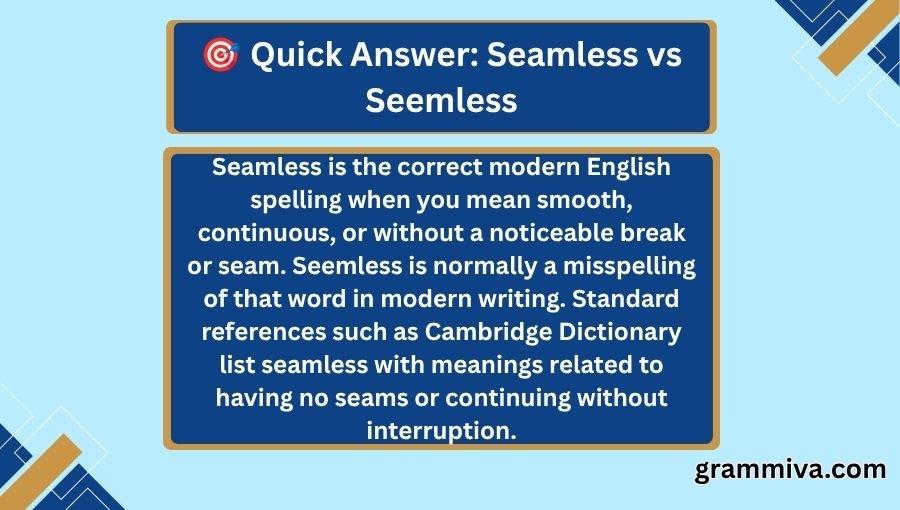
Seamless is the correct modern English spelling when you mean smooth, continuous, or without a noticeable break or seam. Seemless is normally a misspelling of that word in modern writing. Standard references such as Cambridge Dictionary list seamless with meanings related to having no seams or continuing without interruption.
So, if you are describing a smooth transition, easy process, connected experience, or garment without visible seams, use seamless.
Quick rule: seam + less = seamless
Is Seamless the Same as Seemless?
No. In modern standard English, seamless is the form you should use when you mean “without seams” or “smooth and uninterrupted.” Seemless is generally treated as a spelling error in that context.
The confusion comes from sound. Seam and seem sound alike, but they have different meanings.
| Form | Type | Meaning | Example | Correct/Incorrect |
|---|---|---|---|---|
| seamless | adjective | Smooth, continuous, or without seams | The transition was seamless. | ✅ Correct |
| seemless | spelling variant used in error | Usually intended to mean “seamless” | The transition was seemless. | ❌ Incorrect |
| seam | noun | A line where materials are joined | The seam on the shirt is loose. | ✅ Correct |
| seem | verb | To appear or give an impression | You seem tired. | ✅ Correct |
The key is to look at the meaning behind the word. If you mean a smooth connection or a lack of a visible join, think seam, not seem.
💡 Why Do People Confuse Seamless and Seemless?
People confuse these spellings mainly because seam and seem sound the same in ordinary speech. The eye then has to remember which spelling belongs to which meaning.
There is also a strong visual reason for the error. The word seem is familiar to English speakers:
- You seem happy.
- That seems strange.
- It seems easy.
Because seem is so common, seemless can look believable when someone hears the word rather than sees it.
I once edited a short workplace guide in which the writer had typed seemless several times. The writer knew exactly what the word meant and understood the topic well. The problem was simply that the sound of seamless had been connected to the more familiar spelling seem.
Here is the basic distinction:
| Word | What It Means | Example |
|---|---|---|
| seam | A join in material | The seam split on the sleeve. |
| seem | To appear | You seem ready. |
| seamless | Without a seam or noticeable break | The transition was seamless. |
| seemless | Usually an incorrect spelling of seamless | ❌ Avoid this spelling in modern standard writing. |
The safest habit is to connect seamless with seam.
Seamless vs Seemless at a Glance
The difference can be reduced to one simple spelling rule: the modern word meaning “smooth” or “without a seam” is spelled seamless.
| Feature | Seamless | Seemless |
|---|---|---|
| Standard modern spelling | Yes | No, for the usual intended meaning |
| Word class | Adjective | Usually an accidental spelling |
| Related base word | seam | seem |
| Common meaning | Smooth or without seams | Usually intended as “seamless” |
| Professional writing | Use it | Avoid it |
| Academic writing | Use it | Avoid it |
| Use it | Avoid it | |
| Technology | Use it | Avoid it |
One small historical exception is worth knowing: older English sources can contain seemless with an obsolete sense related to being unseemly or improper. That is not the modern meaning people normally intend when they type seemless.
For normal modern writing, the choice is straightforward: seamless.
What Does Seamless Mean?
Seamless is an adjective. It can describe something that literally has no seams, or something that works smoothly without a noticeable break.
Cambridge describes the word in both a physical sense and a broader sense involving something that happens without sudden changes, interruption, or difficulty.
Physical meaning
The original idea is easy to understand.
A seam is a place where pieces of material are joined. Something seamless has no visible seam or is made without such a join.
For example:
The designer created a seamless garment.
Here, seamless describes the physical construction of the garment.
Figurative meaning
The word is also widely used for things that are not physical.
A process can be seamless.
A transition can be seamless.
An experience can be seamless.
A connection can be seamless.
In these cases, seamless means that the parts work together smoothly and without an obvious problem.
| Meaning | Word Type | Example Sentence |
|---|---|---|
| Without a physical seam | Adjective | The shirt has a seamless design. |
| Smooth and continuous | Adjective | The presentation had a seamless flow. |
| Without an awkward break | Adjective | We planned a seamless transition. |
| Working smoothly together | Adjective | The two systems provide seamless integration. |
How Is Seamless Used in Real Sentences?
The most common modern uses fall into a few clear groups.
1. Seamless for physical objects
Use seamless when an object has no visible seam or join.
Examples:
- The company makes seamless socks.
- The dress has a seamless finish.
- The tube has a seamless construction.
In each sentence, the word relates to the physical idea of a seam.
2. Seamless for transitions
This is one of the most common uses in professional English.
The team made the transition seamless.
The sentence means the change happened smoothly. People did not experience an obvious disruption.
You might describe:
- a seamless transition
- a seamless change
- a seamless handoff
- a seamless move
- a seamless shift
3. Seamless for technology
Technology writers often use seamless to describe systems that work together smoothly.
For example:
The new software provides seamless integration with existing tools.
Here, no one is talking about clothing. The word describes how smoothly the systems connect.
4. Seamless for experiences
Businesses often use the word to describe a smooth customer or user experience.
Examples include:
The website offers a seamless shopping experience.
The app creates a seamless checkout process.
The service gives customers a seamless way to manage their accounts.
The common idea is that the user does not face unnecessary breaks or obstacles.
🧠 Test Tip: How Can You Remember the Correct Spelling?
Use the seam test.
Ask yourself:
“Am I talking about something that has no seam or feels as if there is no break between parts?”
If yes, write seamless.
A second memory trick is even shorter:
No seam → seamless.
Do not build the word from seem. The correct modern spelling comes from seam + -less.
| Question to Ask | If Yes | Spelling |
|---|---|---|
| Am I describing a smooth transition? | Yes | seamless |
| Am I describing something without a visible join? | Yes | seamless |
| Am I describing smooth cooperation? | Yes | seamless |
| Am I describing something that appears to be a certain way? | Yes | seem |
| Am I trying to write “without seams”? | Yes | seamless |
If you remember only one thing, remember seamless = no seam.
📝 Case Study: Seamless in a Workplace Email
Imagine that a company is moving from one software system to another. An employee needs to send an update to the team.
A natural sentence would be:
“Our goal is to make the switch as seamless as possible for everyone.”
That sentence works because seamless describes a change that should happen smoothly.
Now compare the incorrect spelling:
❌ “Our goal is to make the switch as seemless as possible.”
The meaning is still understandable, but the spelling is wrong for standard modern English.
A better email might say:
“The training sessions are designed to make the transition seamless for all employees.”
This sounds clear and professional.
I once caught myself typing seemless in a draft after writing quickly. I knew the correct word, but my fingers followed the sound rather than the spelling. I stopped, remembered seam + less, and fixed it immediately. That small trick is useful because spelling mistakes often happen even when the writer knows the word.
| Workplace Situation | Recommended Example |
|---|---|
| Software change | We want a seamless transition. |
| Employee handoff | The handoff should be seamless. |
| Customer service | We aim to provide a seamless experience. |
| Team collaboration | The groups worked together seamlessly. |
| Process improvement | The new process creates a seamless workflow. |
Grammar Rules Explanation
The grammar rule is simple because seamless is a standard adjective.
The word is built from seam and the suffix -less. The suffix -less often carries the idea of “without.” Therefore, seamless carries the basic idea of “without a seam.” That physical meaning also supports its modern figurative uses, such as a transition without a noticeable break.
The verb seem is different. It means to appear or give a certain impression.
Compare:
The fabric has no seam.
and:
The fabric seems soft.
The first sentence uses seam because it refers to a join in material. The second uses seems because it refers to appearance.
Most standard English references agree on the modern spelling seamless for the meaning discussed in this article. Cambridge, for example, lists seamless as an adjective with physical and figurative uses.
Correct vs Incorrect at a Glance
| Sentence | Correct/Incorrect | Why |
|---|---|---|
| The transition was seamless. | ✅ Correct | “Seamless” means smooth and without a noticeable break. |
| The transition was seemless. | ❌ Incorrect | “Seemless” is not the standard spelling for this meaning. |
| We need a seamless process. | ✅ Correct | The adjective describes a smooth process. |
| The software provides seamless integration. | ✅ Correct | The systems connect smoothly. |
| The software provides seemless integration. | ❌ Incorrect | The intended word is “seamless.” |
The grammar itself is not complicated. The main challenge is spelling.
⚠️ Common Mistakes With Seamless and Seemless
Why does this error happen so often?
Fast typing
When people type quickly, they often write the spelling that comes to mind first. Since seam and seem sound alike, the wrong spelling can slip through.
Autocorrect
Spell-check tools can help, but they should not replace knowledge. Different software may flag a word, ignore it, or behave differently depending on the language settings.
Lack of knowledge
A learner may hear seamless before seeing it written. Without knowing the word seam, the spelling seemless can appear logical.
Similar spelling patterns
English has many pairs that create confusion:
| Common Confusion | Correct Form | Meaning |
|---|---|---|
| it’s / its | it’s, its | contraction / possessive |
| your / you’re | your, you’re | possessive / you are |
| their / they’re | their, they’re | possessive / they are |
| affect / effect | affect, effect | commonly verb / commonly noun |
| then / than | then, than | time or sequence / comparison |
The same lesson applies: sound alone does not always tell you the spelling.
Common Wrong Spellings and Uses for This Term
| Wrong Form | What’s Wrong | Correct Form |
|---|---|---|
| seemless | Uses “seem” instead of “seam” | seamless |
| seam-less | Unnecessary hyphen | seamless |
| seam less | Incorrectly separates one word | seamless |
| seem-less | Incorrect base spelling and unnecessary hyphen | seamless |
| seamlesss | Extra “s” | seamless |
| seemles | Missing letters and wrong base | seamless |
The most important correction is simple: seemless → seamless.
Is Seamless Always an Adjective?
In normal modern usage, seamless functions as an adjective.
It can describe a noun:
We had a seamless transition.
It can also appear after a linking verb:
The transition was seamless.
The word also has related forms, including seamlessly and seamlessness. The adverb seamlessly describes how an action happens, while seamlessness names the quality of being seamless. Standard reference material lists these related forms.
| Form | Type | Example |
|---|---|---|
| seamless | adjective | The transition was seamless. |
| seamlessly | adverb | The teams worked seamlessly together. |
| seamlessness | noun | The seamlessness of the process impressed us. |
| seam | noun | The seam needs repair. |
| seem | verb | You seem confident. |
Notice that none of these forms changes seamless into seemless.
Why Is Seamless Spelled With “A”?
The spelling becomes easier when you look at its base.
Seamless is connected to seam, not seem.
A seam is a line or join where parts of something are connected. Add -less, and you get the idea of something without a seam.
That also explains the figurative meaning.
A physical object without an obvious seam looks continuous. From that idea, seamless can describe something that moves from one part to another without an obvious break.
| Base | Meaning | Related Form |
|---|---|---|
| seam | A join or line between parts | seamless |
| -less | Without | seamless |
| seamless | Without a seam; smooth or continuous | seamlessly |
| seem | Appear or give an impression | seems, seeming |
This is why replacing the a with ee changes the word into a spelling error for the meaning most writers intend.
Word Origin and History
The history of seamless is clear enough to explain the spelling without making complicated claims. The word is formed from seam plus -less, giving the basic sense “without a seam.” Reference sources record the word in English for centuries, and its meaning now covers both physical objects and smooth, uninterrupted processes.
The modern figurative use is especially common in descriptions of transitions, systems, services, design, and experiences.
| Period | Form | General Note |
|---|---|---|
| Earlier English use | seamless | Connected to the literal idea of having no seam |
| Later use | seamless | Continued physical use for clothing and materials |
| Modern English | seamless | Expanded strongly into figurative uses |
| Current usage | seamless | Common for transitions, technology, services, and experiences |
There is also a historical wrinkle: seemless has appeared in older English with an obsolete meaning related to being unseemly. That historical use is not the spelling you want when writing about a smooth transition or experience.
How Is Seamless Used in Different Contexts?
The word works naturally across many kinds of writing. The meaning stays similar, but the noun it describes changes.
| Context | Which Term to Use | Example |
|---|---|---|
| Everyday conversation | seamless | The move was surprisingly seamless. |
| Professional writing | seamless | We need a seamless transition. |
| Creative writing | seamless | The scene change felt seamless. |
| Social media/texting | seamless | The whole process was seamless! |
| Technology | seamless | The app offers seamless integration. |
| Customer service | seamless | We want a seamless customer experience. |
In casual writing, people may use seamless less often than simpler words such as smooth or easy. In professional and technology writing, however, it is very common.
What Are Common Phrases With Seamless?
There are several common combinations that sound natural in modern English.
| Phrase | Meaning |
|---|---|
| seamless transition | A change with little or no noticeable disruption |
| seamless integration | Systems or parts working together smoothly |
| seamless experience | An experience with few noticeable obstacles |
| seamless process | A process that flows smoothly |
| seamless connection | A connection without an obvious break |
| seamless workflow | A work process that moves smoothly from step to step |
These phrases are especially common in business, technology, design, customer service, and project management.
For example:
The new platform offers seamless integration with our existing system.
The teacher planned a seamless transition between activities.
Customers expect a seamless online experience.
Seamless vs Seemless in Professional Writing
Professional writing requires extra care because small spelling errors can distract readers from your main point.
Imagine these two sentences in a client email:
❌ We want to create a seemless onboarding process.
✅ We want to create a seamless onboarding process.
The second version uses the standard spelling.
This does not mean one spelling error ruins an entire document. It means that accurate spelling helps readers focus on your message instead of stopping at an avoidable error.
| Situation | Why Getting It Right Matters |
|---|---|
| Resume | Shows attention to written detail |
| Client email | Keeps communication clear and polished |
| Published content | Protects readability and credibility |
| Social post | Prevents an easily avoidable spelling mistake |
A useful editing habit is to search your document for seemless before publishing. If you find it and you mean “smooth” or “without seams,” change it to seamless.
What Alternatives Can You Use Instead of Seamless?
Sometimes seamless is not the best word, even when it is spelled correctly. Good writing depends on choosing a word that matches the exact meaning.
Possible alternatives include:
| Alternative | Works When | Does Not Work When |
|---|---|---|
| smooth | You mean easy or free of trouble | You specifically mean “without seams” |
| continuous | You mean something does not stop | You mean a process was simply easy |
| uninterrupted | You mean there were no breaks | The situation involved small changes |
| connected | You mean parts work or relate together | You need to stress ease or flow |
| effortless | You mean something required little visible effort | You mean a physical object has no seam |
For example, smooth transition and seamless transition can often communicate similar ideas. But seamless garment has a more specific physical meaning, so smooth garment is not always an exact replacement.
Good writers do not just ask, “Is the spelling correct?” They also ask, “Is this the best word for what I mean?”
How Can You Avoid the Mistake?
The easiest method is to build a mental link between the spelling and the meaning.
Remember the word pair
seam → seamless
A seam is a join. Something without a seam is seamless.
Do not build it from seem
Seem means “appear.”
You seem tired.
It does not provide the base for the modern word describing a smooth transition.
Use a quick replacement test
If you can replace the word with smooth, continuous, or without a visible break, seamless is probably what you want.
| Your Intended Meaning | Try This Test | Likely Word |
|---|---|---|
| Smooth change | “Was the change smooth?” | seamless |
| Easy connection | “Did the parts connect smoothly?” | seamless |
| No physical join | “Is there no visible seam?” | seamless |
| Appearance | “Does it appear to be something?” | seem |
| Historical or literary use | Check the exact source and context | Possibly seemless |
That final row matters because rare historical words can appear in old texts. For ordinary modern English, though, seamless is the practical choice.
🔍 Is “Seemless” Ever Correct?
In ordinary modern English, do not use seemless when you mean smooth, continuous, or without a seam. That use is generally a misspelling of seamless.
There is a narrow historical exception. Some historical references record seemless as an obsolete word related to “unseemly.” Wiktionary, for example, records that older sense while also identifying modern uses of seemless as a misspelling of seamless.
This exception rarely affects everyday writing.
If you are writing:
- an email,
- a resume,
- a blog post,
- a school assignment,
- a business report,
- website copy,
- product information, or
- a social media post,
and you mean “smooth” or “without interruption,” choose seamless.
Why Does Getting the Spelling Right Matter?
Correct spelling helps readers understand your meaning without distraction.
A spelling error may be small, but repeated errors can make a document harder to trust or edit. This matters even more in professional communication, where clarity and polish are part of the message.
Consider the simple quote:
“Clear writing makes the message easier to see.”
The goal is not to make every sentence sound fancy. The goal is to make the intended meaning easy to understand.
| Situation | Why Accuracy Matters |
|---|---|
| Job application | Your writing represents you before you speak |
| Client communication | Clear wording reduces avoidable confusion |
| Website content | Readers need clean, easy-to-follow text |
| School work | Correct spelling supports clear written expression |
Using seamless instead of seemless is a small step, but it is an easy one to get right.
Is Seamless a Positive Word?
Usually, yes. Seamless generally suggests that something works smoothly, continuously, or without noticeable problems.
For example:
We had a seamless experience.
This normally suggests that the experience went well.
However, the word itself does not guarantee that something was actually perfect. It simply describes something as smooth or without noticeable breaks. Context still matters.
| Phrase | General Idea |
|---|---|
| seamless transition | A smooth change |
| seamless service | Service that feels smooth and connected |
| seamless design | Design with no obvious breaks or joins |
| seamless workflow | Work that moves smoothly |
| seamless experience | An experience without noticeable obstacles |
How Does Seamless Work in Digital Communication?
Digital communication is one place where this word appears often.
You may see it in:
- product descriptions,
- app interfaces,
- customer support pages,
- software documentation,
- marketing copy,
- email campaigns,
- social media posts.
For example:
Our app creates a seamless way to share files.
Or:
The update provides seamless access across devices.
The word is useful because it quickly tells the reader that different steps, tools, or systems are intended to feel connected.
But avoid repeating it in every paragraph. If you use seamless too often, the writing can sound repetitive. Sometimes smooth, easy, connected, or continuous is clearer.
FAQs About Seamless vs Seemless
Is seamless or seemless correct?
Seamless is the standard modern spelling when you mean smooth, continuous, or without a visible seam. Seemless is generally a misspelling in that context.
What does seamless mean?
Seamless means having no seam or, more broadly, happening smoothly without a noticeable break, interruption, or awkward change.
Why is seamless spelled with an “a”?
It is built from seam plus -less. The spelling connects the word to the noun seam, not the verb seem.
Is seemless a real English word?
There is a rare historical use of seemless, but it is not the modern spelling to use when you mean “smooth” or “without seams.” Historical sources may record it with an obsolete meaning.
Is seamless an adjective?
Yes. Seamless is an adjective.
The transition was seamless.
It describes the transition.
What is the adverb form of seamless?
The adverb is seamlessly.
The two systems worked seamlessly together.
It tells you how something happened.
What is the noun form of seamless?
The noun is seamlessness.
The seamlessness of the transition impressed the team.
It names the quality of being seamless.
Can I use seamless for technology?
Yes. Seamless is commonly used to describe technology that connects or operates smoothly.
The software provides seamless integration.
Is seamless used in both American and British English?
Yes. Seamless is used in both American and British English. The spelling does not change between the two varieties.
What is the easiest way to remember seamless?
Think:
seam + less = seamless
If you mean “without a seam” or “without a noticeable break,” choose seamless.
✅ Quick Recap Checklist
Use this checklist whenever you are unsure.
| Question | If Yes → Use |
|---|---|
| Do you mean “without a seam”? | seamless |
| Do you mean smooth or continuous? | seamless |
| Do you mean a transition without a noticeable break? | seamless |
| Do you mean that someone appears to be something? | seem |
| Are you writing modern standard English and mean “smooth”? | seamless |
| Did you write “seemless” by mistake? | Change it to seamless |
Practice Examples
- The handoff between the two teams was seamless. ✅
- The new software offers seamless integration. ✅
- The designer created a seamless finish. ✅
Try to explain the spelling using the base word seam. If you can do that, you are much less likely to write seemless by accident.
Final Thoughts on Seamless vs Seemless
Seamless vs seemless becomes much easier once you connect the correct spelling to the word seam. Use seamless when you mean something without a seam, without a noticeable break, or smooth and continuous. In normal modern writing, seemless is the spelling to avoid.
The most useful memory trick is also the simplest: seam + less = seamless. A seam is a join, and something seamless has no noticeable join. The word can describe clothing and other physical objects, but it can also describe transitions, technology, services, workflows, and experiences.
If you are proofreading an email, article, report, resume, or website, search for seemless and check what you intended to say. If the meaning is “smooth” or “without interruption,” replace it with seamless.
One small spelling choice can make your writing cleaner, clearer, and easier to trust. ✨ Remember the seam, choose seamless, and let your writing flow.

I am Alex Morgan, an English grammar and vocabulary writer passionate about making language learning simple and useful. I work at Grammiva, where I create clear educational content and practical English examples for learners.

[…] the end, you should be able to spot the correct form at a glance. ✍️ Seamless vs Seemless | Shiny vs Shiney | Capital vs […]
[…] covers exceptions, and gives you quick ways to check your writing. 🍂 Desperate vs Desparate | Seamless vs Seemless | Shiny vs […]