Have you ever typed a word, looked at it twice, and suddenly wondered whether it looks right? 😅 Steer vs stear is one of those spelling pairs that can cause a quick pause.
The two forms look almost identical, but they do not have the same status in standard US English.
The good news is that the rule is simple.
Steer is the standard English word.
It can mean to guide or control the direction of something, especially a vehicle, animal, or course of action.
Stear is not the standard spelling for those meanings.
I have seen this kind of mistake often in editing.
A writer knows exactly what they want to say, but a fast keyboard slip creates a spelling that looks believable.
That is why learning the difference is more useful than simply memorizing one spelling.
Once you understand what steer means and why stear does not normally work, the choice becomes much easier. 🎯 Anticlockwise vs Counterclockwise | Whether vs Whether or Not | Therefore vs Therefor
🎯 Quick Answer: Steer vs Stear
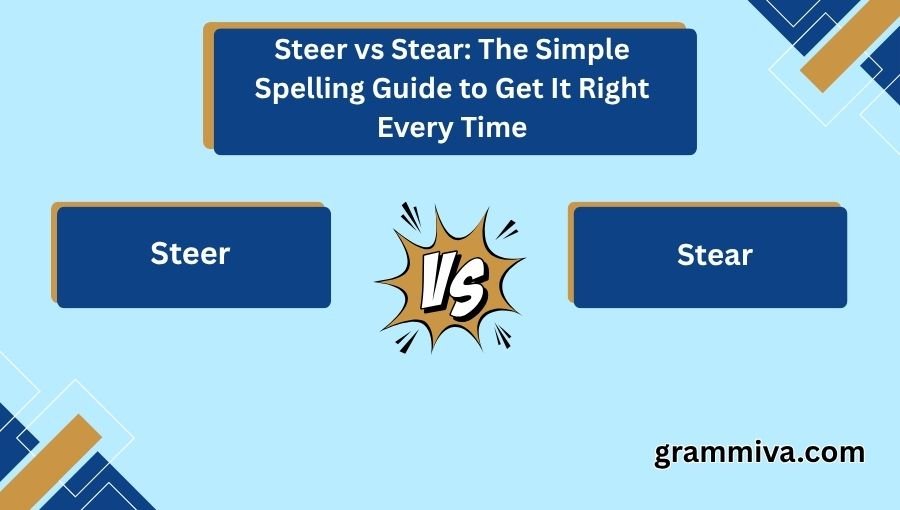
The correct spelling is steer. Stear is generally an incorrect spelling when you mean to guide, direct, or control the movement or course of something.
For example, you can steer a car, steer a boat, or steer a conversation. In standard US English, use steer for these meanings.
| Word | Standard English? | Main use | Example |
|---|---|---|---|
| steer | Yes | Guide, direct, or control | Please steer the car carefully. |
| stear | No, in standard usage | Usually a misspelling of steer | ❌ Please stear the car. |
Is Steer the Correct Spelling?
Yes. Steer is the correct standard spelling when you mean to guide or direct something.
The word works as both a verb and a noun. As a verb, it describes the act of controlling direction. As a noun, it can refer to a male cattle animal, especially a castrated male bovine.
The spelling stays steer in both cases.
| Form | Type | Meaning | Example | Correct/Incorrect |
|---|---|---|---|---|
| steer | Verb | Guide or direct | She learned to steer the boat. | ✅ Correct |
| steer | Noun | A male bovine animal | The farmer moved the steer. | ✅ Correct |
| stear | Verb | Not the standard spelling for steer | He tried to stear the bike. | ❌ Incorrect |
| stear | Noun | Not the standard spelling for the common noun steer | The stear stood near the fence. | ❌ Incorrect |
Why Do People Confuse Steer and Stear?
People confuse these spellings because they look and sound close, especially when typing quickly. The letters ea and ea are not the problem by themselves. The trouble comes from remembering which vowel pattern belongs to this particular word.
I once reviewed a short work email that said, “We need to stear the project in a new direction.” The writer had a clear idea and had used the word correctly in meaning. Only the spelling was wrong. A quick correction changed stear to steer, and the sentence was ready to send.
Here are some common reasons the error happens:
- Fast typing: Your fingers may produce a familiar-looking spelling before your brain checks it.
- Autocorrect: Spell-check tools do not always catch every error, especially in unusual contexts.
- Lack of knowledge: If you have never had to think about the spelling, stear can look reasonable.
- Sound-based spelling: English spelling does not always make the correct form obvious from pronunciation alone.
- Visual similarity: The two forms differ by only one letter.
| Cause | What happens | Helpful solution |
|---|---|---|
| Fast typing | Letters are entered from memory | Slow down when unsure |
| Autocorrect | A device may miss the error | Read the whole sentence |
| Lack of knowledge | Both forms may look familiar | Memorize steer |
| Sound-based spelling | You spell from what you hear | Check the written form |
| Similar appearance | The wrong form looks believable | Use a memory trick |
🧭 Steer vs Stear at a Glance
The core rule is straightforward: steer is the standard spelling; stear is normally a misspelling when the intended word is steer.
| Feature | Steer | Stear |
|---|---|---|
| Standard US English word | Yes | No, for the usual meanings |
| Means “guide” | Yes | No |
| Means “direct” | Yes | No |
| Can describe vehicle control | Yes | No |
| Can describe guiding a discussion | Yes | No |
| Common spelling error | No | Yes |
This is not a case where both spellings are interchangeable. You should not choose between them based on sentence style. If your sentence needs the word meaning guide or direct, write steer.
What Does Steer Mean?
Steer means to guide, direct, or control the direction of something. It is often used with vehicles, boats, animals, people, conversations, and plans. Understanding steer vs stear starts with knowing what the word steer actually means.
Steer as a Verb
As a verb, steer means to control where something goes.
Consider these examples:
- I steered the car into the driveway.
- She steered the boat toward the dock.
- He steered the bicycle around the puddle.
- The manager steered the meeting back to the main topic.
The meaning can be physical or figurative.
When you physically steer something, you control its direction. When you steer a discussion or project, you guide its course.
Steer as a Noun
Steer can also be a noun referring to a male cattle animal.
For example:
- The rancher checked the steer.
- The young steer stayed near the herd.
This noun has the same spelling: steer.
| Meaning | Word Type | Example Sentence |
|---|---|---|
| Guide a vehicle | Verb | I steer the truck carefully. |
| Guide a boat | Verb | They steered toward shore. |
| Guide a conversation | Verb | She steered the talk toward the main issue. |
| Guide a project | Verb | He helped steer the team toward its goal. |
| Male cattle animal | Noun | The steer stood beside the fence. |
💡 Test Tip: Try the “Guide” Test
When you are unsure whether to write steer or stear, replace the word with guide or direct.
If the sentence still makes sense, steer is almost certainly the word you need.
We need to ___ the discussion toward the budget.
Replace the blank:
We need to guide the discussion toward the budget.
That works. So:
We need to steer the discussion toward the budget. ✅
This quick test is especially useful when proofreading your own work.
Can Steer Be Used in a Figurative Sense?
Yes. Steer is commonly used beyond physical movement. It can describe guiding a person, discussion, plan, team, or situation.
For example:
- The teacher steered the class toward the right answer.
- We need to steer the project in a different direction.
- She steered the conversation away from politics.
- The coach helped steer the team through a difficult season.
| Physical Use | Figurative Use |
|---|---|
| Steer a car | Steer a discussion |
| Steer a boat | Steer a project |
| Steer a bicycle | Steer a team |
| Steer an animal | Steer a decision |
| Steer toward a dock | Steer away from a problem |
This flexible use explains why steer appears in many kinds of writing, from casual conversation to business documents.
Is Stear Ever Correct?
For ordinary modern US English, stear should not be used as the spelling of the common word steer.
If you intend to say that someone guides a car, controls a boat, or directs a conversation, write steer.
There can be unusual cases where a spelling appears as part of a proper name, historical material, or another specialized context. Such a use does not make stear the standard spelling of the ordinary English word.
| Intended Meaning | Use | Avoid |
|---|---|---|
| Guide a car | steer | stear |
| Direct a boat | steer | stear |
| Guide a discussion | steer | stear |
| Direct a project | steer | stear |
| Male cattle animal | steer | stear |
📝 Case Study: A Small Email Error With a Big Impact
Imagine a team leader writing this email:
❌ “We should stear the project toward a simpler design.”
The meaning is clear, but the spelling is wrong.
The corrected version is:
✅ “We should steer the project toward a simpler design.”
The change is tiny. The improvement is immediate.
I once caught myself typing a similar spelling error in a draft after writing several pages without stopping. I knew the correct word, but my fingers had moved faster than my proofreading. That was a useful reminder: knowing a word and checking a word are two different skills.
In a professional setting, these small errors can distract readers. A client may not care about one misspelled word, but repeated errors can make a document look less polished.
| Original Sentence | Corrected Sentence | Result |
|---|---|---|
| ❌ We need to stear the team. | ✅ We need to steer the team. | Correct spelling |
| ❌ She will stear the boat. | ✅ She will steer the boat. | Correct spelling |
| ❌ Let’s stear the discussion back. | ✅ Let’s steer the discussion back. | Correct spelling |
| ❌ He learned to stear the car. | ✅ He learned to steer the car. | Correct spelling |
Grammar Rules Explanation
The spelling steer is correct when the word functions as the verb meaning “to guide,” “direct,” or “control.” It can also function as a noun for a male cattle animal.
The form stear does not normally serve as the standard spelling for these meanings in modern US English. Therefore, replacing steer with stear creates a spelling error rather than a meaningful grammatical distinction.
The issue is mainly spelling, not a difference in verb tense or grammar.
For example:
- Present: I steer the car.
- Past: I steered the car.
- Present participle: I am steering the car.
- Third-person singular: She steers the car.
Notice that the base form remains steer.
Most standard English reference sources agree on the ordinary spelling steer for these uses.
Correct vs Incorrect at a Glance
| Sentence | Correct/Incorrect | Why |
|---|---|---|
| I need to steer the car. | ✅ Correct | Steer means guide or control. |
| We should steer the discussion back to the topic. | ✅ Correct | Steer can mean guide a discussion. |
| She learned to steer the boat. | ✅ Correct | Steer describes controlling direction. |
| I need to stear the car. | ❌ Incorrect | Stear is not the standard spelling. |
| He tried to stear the meeting. | ❌ Incorrect | The intended word is steer. |
What Are the Main Forms of Steer?
The word changes form according to tense and sentence structure, but the spelling does not change to stear.
| Form | Example |
|---|---|
| steer | I steer the car. |
| steers | She steers the car. |
| steered | He steered the boat. |
| steering | They are steering the boat. |
| steered | We have steered the project carefully. |
A useful point here is that steer → steered → steering follows normal English spelling patterns. The word does not become stear in any of these forms.
⚠️ Common Mistakes With Steer
The most common mistake is simple: writing stear instead of steer.
But this error belongs to a larger group of English spelling problems. People often confuse words that look or sound alike.
| Common Confusion | Correct Choice | Main Difference |
|---|---|---|
| it’s / its | Depends on meaning | It’s = it is; its shows possession |
| your / you’re | Depends on meaning | Your shows possession; you’re = you are |
| they’re / their / there | Depends on meaning | Different grammar and meaning |
| then / than | Depends on meaning | Time/order vs comparison |
| affect / effect | Depends on use | Different grammatical roles and meanings |
| steer / stear | steer | Steer is the standard spelling |
Specific Wrong Spellings and Uses
| Wrong Form | What’s Wrong | Correct Form |
|---|---|---|
| stear | Wrong spelling for steer | steer |
| stear the car | Wrong spelling | steer the car |
| stearing | Wrong spelling of the -ing form | steering |
| steared | Wrong spelling of the past form | steered |
| stears | Wrong spelling of the third-person form | steers |
These errors are easy to miss because the wrong form still looks like an English word.
Why Does Fast Typing Cause This Error?
Fast typing can turn a correct thought into an incorrect sentence. Your brain often focuses on meaning first. Your fingers then reproduce the word from memory.
This is useful when writing quickly, but it can also produce small spelling errors.
Autocorrect can make the problem worse in some cases. Writers sometimes assume that a spelling tool will catch every mistake. It is safer to read important writing yourself.
A good proofreading routine is simple:
- Read the sentence slowly.
- Look at words that feel uncertain.
- Check the spelling.
- Read the sentence again for meaning.
- Send or publish it only after the final check.
🧠 How To Remember the Difference
A simple memory trick can help:
Steer has “ee,” like “see the road.”
Think:
See the road → steer the car.
You do not need a complicated rule. You only need to connect steer with the idea of guiding something.
Another useful trick is to remember the phrase:
steer the wheel
The two words naturally belong together. Once steer becomes familiar in a phrase, stear starts to look wrong.
| Memory Trick | Example |
|---|---|
| See the road | Steer the car |
| Steer the wheel | I steer the wheel carefully |
| Guide = steer | Steer the discussion |
| Direct = steer | Steer the project |
| Avoid “stear” | ❌ Stear the car |
How Is Steer Used in Everyday Conversation?
In everyday speech, steer often describes vehicles and movement. It can also appear in casual advice.
For example:
“Steer left at the next light.”
“Can you steer while I check the map?”
“Try to steer around that pothole.”
The word is natural and common in these settings.
| Context | Which Term to Use | Example |
|---|---|---|
| Everyday conversation | steer | Steer around the corner. |
| Professional writing | steer | We need to steer the project carefully. |
| Creative writing | steer | He steered the boat into the fog. |
| Social media/texting | steer | Steer clear of that road today. |
How Is Steer Used in Professional Writing?
When checking steer vs stear in professional writing, always use steer when you mean to guide or direct something.
In professional writing, steer often has a figurative meaning. Leaders can steer teams, businesses, projects, meetings, or plans.
For example:
- The director helped steer the company through a difficult year.
- The manager steered the meeting back to the main issue.
- The new plan should steer the team toward its target.
- Good data can help steer future decisions.
These uses sound natural because steer suggests controlled movement toward a chosen direction.
What Does “Steer Clear” Mean?
Steer clear means to avoid someone or something.
For example:
“Steer clear of that road during the storm.”
The phrase does not mean that you must literally drive a vehicle. It can also mean avoiding a problem, person, place, or situation.
| Phrase | Meaning |
|---|---|
| steer clear | Avoid |
| steer toward | Move or guide toward something |
| steer away from | Move or guide away from something |
| steer the conversation | Guide the topic |
| steer the project | Guide the direction of a project |
Common Phrases With Steer
Several natural expressions use steer. Learning these phrases can make the correct spelling easier to remember.
| Phrase | Meaning |
|---|---|
| steer clear | Avoid something |
| steer toward | Guide toward something |
| steer away from | Guide away from something |
| steer the conversation | Guide the topic of discussion |
| steer the course | Guide the direction or progress |
| steer a vehicle | Control its direction |
These phrases are useful in both literal and figurative writing.
Can Steer Replace Guide or Direct?
Sometimes. Steer, guide, and direct can overlap, but they are not identical in every sentence.
Guide is often broader and can suggest helping someone find the right path. Direct can sound more formal and can imply giving instructions. Steer often suggests controlling or gently moving something toward a direction.
| Alternative | Works When | Does Not Work When |
|---|---|---|
| guide | You help someone find a path | The exact idea requires another meaning |
| direct | You give instructions or control movement | The sentence needs the softer idea of guidance |
| lead | You take someone toward a goal | You specifically mean vehicle control |
| manage | You control a task or process | You literally control a vehicle’s direction |
| navigate | You find a route or way through | You simply mean guiding a discussion |
For example, you can steer a car, but manage a car does not normally mean controlling its direction.
Why Does Getting Steer Right Matter? 🎯
Correct spelling makes your writing easier to trust. A single typo rarely ruins communication, but repeated spelling errors can distract readers and make a message look rushed.
This matters even more in professional writing.
A resume, client email, article, report, or public post may be read by someone who does not know you. Clear spelling helps the reader focus on your message instead of your mistakes.
“Clear writing lets the message take center stage.”
| Situation | Why Getting It Right Matters |
|---|---|
| Resume | Shows care and attention to detail |
| Client email | Supports a professional impression |
| Published content | Builds reader trust |
| Social post | Makes the message easier to read |
Is Steer Important in Digital Communication?
Yes. Digital writing moves quickly, so short spelling errors are common. A text message may not need perfect editing, but professional online communication deserves more care.
Before sending an important message, check words that you typed from memory. If you wrote stear, pause and ask whether you mean steer.
This takes only a few seconds.
Does Steer Change in Different Contexts?
The spelling remains steer, but the meaning can shift slightly based on context.
For example:
- Steer the car = control its direction.
- Steer the boat = control its direction.
- Steer the meeting = guide the discussion.
- Steer the company = guide its overall direction.
- Steer clear = avoid something.
| Context | Meaning of Steer | Example |
|---|---|---|
| Driving | Control direction | She steered the car home. |
| Boating | Control direction | He steered toward the dock. |
| Conversation | Guide the topic | She steered the conversation away from the issue. |
| Business | Guide progress | The CEO helped steer the company forward. |
| Avoidance | Stay away | We decided to steer clear of the area. |
What About Creative Writing?
Creative writers can use steer both literally and figuratively.
A character may steer a truck down a dark road. A narrator may describe someone steering a difficult conversation. A story can also use the word as a metaphor for choosing a direction.
For example:
“Mara steered the old truck toward the mountain road.”
Or:
“He tried to steer the conversation away from the question.”
The spelling remains the same in both cases.
What About Texting and Social Media?
The steer vs stear spelling mistake can also appear in texting and social media because people often type quickly.
In casual texting, people may make spelling mistakes because they type quickly. Still, if you mean guide or direct, the correct spelling is steer.
For example:
“Steer clear of that traffic.”
Not:
“Stear clear of that traffic.”
A social post may be informal, but correct spelling still makes it easier for readers to understand.
Can Steer Be Used With People?
Yes, but the meaning depends on the sentence. Steer someone can mean guide or influence someone toward a particular choice or direction.
For example:
- Her mentor steered her toward a useful career path.
- The counselor steered him toward better resources.
- The teacher steered the student toward the right answer.
This does not always mean physically moving someone. It can mean influencing their direction or choice.
| Sentence | Meaning |
|---|---|
| She steered the car left. | Controlled movement |
| He steered the boat toward shore. | Controlled direction |
| She steered the discussion toward the budget. | Guided a topic |
| His mentor steered him toward engineering. | Guided a choice |
How Can You Proofread Steer vs Stear?
If you are unsure about steer vs stear, check whether you mean “guide” or “direct.”
The fastest method is to ask what you mean. If you are unsure about steer vs stear, use the meaning and spelling checks below.
If your intended meaning is guide, direct, or control direction, write steer.
You can also use a three-step check:
- Meaning check: Do I mean guide or direct?
- Spelling check: Does the word say steer?
- Sentence check: Does the sentence sound natural?
| Check | Question | Answer |
|---|---|---|
| Meaning | Do I mean guide or direct? | If yes, use steer |
| Spelling | Did I write steer? | If yes, continue |
| Grammar | Does it fit the sentence? | Read it aloud |
| Final check | Is the sentence clear? | Send or publish |
Quick Recap Checklist ✅
The main rule is easy: when you mean guide, direct, or control, use steer.
| Question | If Yes → Use |
|---|---|
| Do you mean guide a car? | steer |
| Do you mean control a boat? | steer |
| Do you mean guide a conversation? | steer |
| Do you mean guide a project? | steer |
| Are you writing the standard English word? | steer |
| Did you type “stear” by accident? | Change it to steer |
Practice Examples
- ❌ Please stear the car toward the parking lot.
✅ Please steer the car toward the parking lot. - ❌ She tried to stear the conversation away from the argument.
✅ She tried to steer the conversation away from the argument. - ❌ He learned how to stear the boat.
✅ He learned how to steer the boat.
FAQs About Steer vs Stear
Is “steer” or “stear” correct?
Steer is correct for the standard English word meaning to guide, direct, or control direction. Stear is normally a misspelling in this context.
Is stear a real English word?
Stear is not the standard spelling of the common English word steer. If you mean “guide” or “direct,” use steer.
How do you spell steer?
The correct spelling is S-T-E-E-R: steer.
What does steer mean?
Steer means to guide, direct, or control the direction of something. It can describe a vehicle, boat, animal, conversation, project, or other situation.
What is the past tense of steer?
The past tense is steered.
Example:
She steered the car into the driveway.
What is the -ing form of steer?
The -ing form is steering.
Example:
He is steering the boat toward the dock.
Can you say “steer the conversation”?
Yes. Steer the conversation means to guide the topic or direction of a discussion.
Example:
She steered the conversation toward the budget.
Does steer mean guide?
Yes. In many sentences, steer can mean guide or direct.
For example:
The manager helped steer the team toward its goal.
What does “steer clear” mean?
Steer clear means avoid something or stay away from it.
Example:
We should steer clear of that road during the storm.
Why do people spell steer as stear?
The mistake usually happens because stear looks believable and the writer may be typing quickly. Similar-looking spellings, memory errors, and missed proofreading can all cause the mistake.
Steer vs Stear: The Key Rule to Remember
The easiest way to remember steer vs stear is to connect steer with guide.
If you can replace the word with guide, direct, or control the direction, steer is the spelling you want.
Think about a car. You steer it. Think about a boat. You steer it. Think about a conversation. You can steer it toward a new topic. Think about a project. You can steer it toward a goal.
The spelling never needs to become stear for these meanings.
| Word | Use It? | Example |
|---|---|---|
| steer | ✅ Yes | Steer the car carefully. |
| steered | ✅ Yes | She steered the boat home. |
| steering | ✅ Yes | He is steering the truck. |
| steers | ✅ Yes | She steers the team well. |
| stear | ❌ No for the standard word | ❌ Stear the car. |
Conclusion
Steer vs stear becomes much easier once you remember one simple rule: steer is the standard spelling when you mean to guide, direct, or control something. The spelling stear is normally an error in standard US English.
Use steer for a car, boat, bicycle, conversation, project, team, or direction. Use steered for the past tense and steering for the -ing form. If you see stear in your own writing, check whether you meant steer.
I recommend using the simple “guide test” when you are unsure. If guide or direct fits the sentence, choose steer. It is quick, practical, and easy to remember. ✨
Good spelling does not have to be hard. Sometimes one small rule is all you need. When you mean guide or direct, steer with two e’s.

I am Ethan Brooks, an English grammar and vocabulary writer. I work at Grammiva, where I create simple and helpful content to make English learning easier for students and everyday learners.