Have you ever stopped while writing an email and wondered whether therefore vs therefor is the right choice? You are not alone.
These two words look almost identical, but they do very different jobs.
One is common in everyday and professional writing.
The other is a specialized legal and formal term that most writers rarely need. ✍️
The confusion is easy to understand.
Both words begin with “there,” both sound similar, and both can appear in formal documents.
However, using one in place of the other can change the meaning of a sentence or make your writing look careless.
I have edited plenty of business writing, student papers, and online content where this small spelling difference caused trouble.
The good news is that the rule is simple once you understand what each word means.
This guide explains the difference between therefore vs therefor, shows you how to use each form, and gives you practical tests you can use whenever you are unsure.
By the end, you should be able to choose the right word quickly and confidently. 😊 Labor vs Labour | Resume vs CV | Eyeing vs Eying
🎯 Quick Answer: Therefore vs Therefor
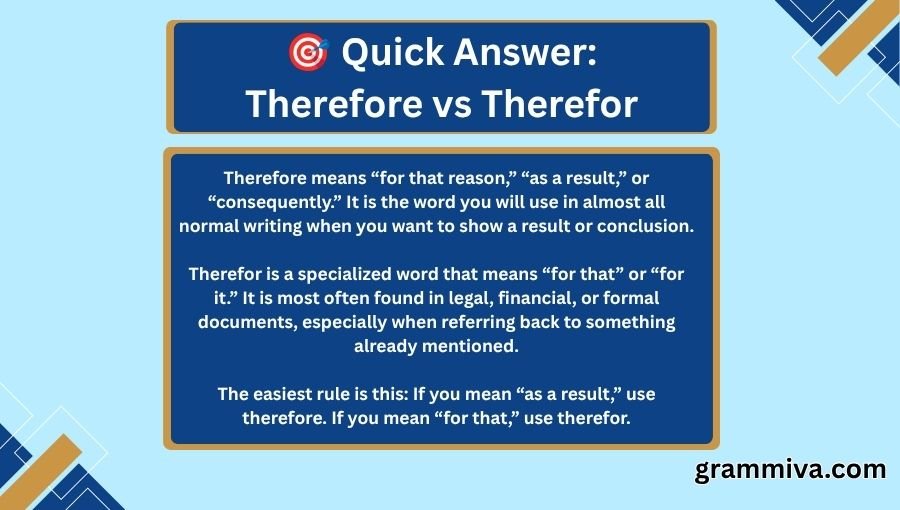
Therefore means “for that reason,” “as a result,” or “consequently.” It is the word you will use in almost all normal writing when you want to show a result or conclusion.
Therefor is a specialized word that means “for that” or “for it.” It is most often found in legal, financial, or formal documents, especially when referring back to something already mentioned.
The easiest rule is this: If you mean “as a result,” use therefore. If you mean “for that,” use therefor.
Therefore vs Therefor: Meaning and Correct Use
The core difference between these words is their meaning and grammatical role. Therefore usually connects an earlier fact with a result. Therefor points back to something and means “for that” or “for it.”
| Form | Type | Meaning | Example | Correct/Incorrect |
|---|---|---|---|---|
| therefore | Adverb | For that reason; as a result | The road was closed; therefore, we turned around. | ✅ Correct |
| therefor | Adverb | For that; for it | The buyer paid the fee and received a receipt therefor. | ✅ Correct |
| therefor | Adverb | As a result | The road was closed; therefor, we turned around. | ❌ Incorrect |
| therefore | Adverb | For that thing or document | The contract and all rights therefore were transferred. | ❌ Usually incorrect |
What Does “Therefore” Mean?
Therefore means “for that reason” or “as a result.” It tells the reader that one statement leads to another.
Consider this sentence:
The store was closed; therefore, we went home.
The first part gives the reason. The second part gives the result. The word “therefore” links the two ideas.
Here are more examples:
- The forecast predicted heavy rain; therefore, we canceled the picnic. ✅
- She studied every night; therefore, she felt ready for the exam. ✅
- The machine was damaged; therefore, production stopped. ✅
- He missed the train; therefore, he arrived late. ✅
In ordinary American English, this is the form you will encounter most often.
What Does “Therefor” Mean?
Therefor means “for that” or “for it.” It usually refers to something mentioned earlier in the sentence or document.
For example:
The company issued a payment and received a receipt therefor.
Here, “therefor” means “for that payment.”
This word is uncommon in everyday speech. It tends to appear in legal contracts, official records, and other formal writing.
The key point is that therefor does not normally mean “therefore.”
| Word | Plain-English Meaning | Common Setting |
|---|---|---|
| therefore | for that reason; as a result | Everyday, academic, business, formal |
| therefor | for that; for it | Legal, contractual, formal |
| therefore | shows a result | Very common |
| therefor | refers back to a thing | Uncommon |
Is Therefore the Same as Therefor?
No. Therefore and therefor are different words with different meanings.
The difference is only one letter, but that letter matters. Therefore describes a result or conclusion. Therefor means “for that” or “for it.”
Compare these sentences:
The deadline passed; therefore, the application was rejected. ✅
Here, “therefore” means “as a result.”
Now compare:
The customer submitted a payment and received a receipt therefor. ✅
Here, “therefor” means “for that payment.”
A useful way to think about the distinction is:
therefore = reason/result
therefor = for that thing
If you can replace the word with “as a result,” you almost certainly need therefore.
Why Do People Confuse Therefore and Therefor?
People confuse these words because they look and sound nearly the same. The difference is easy to miss when typing quickly or reading formal documents.
Another reason is that “therefor” is much less familiar. A writer may see it in a contract and assume it is simply an unusual spelling of “therefore.”
I once reviewed a short business report in which a writer had used “therefor” several times to mean “as a result.” The sentences were understandable, but the word choice made the report look less polished. Replacing each instance with “therefore” fixed the problem immediately.
The confusion often comes from three simple habits:
- Visual similarity: The two words look almost identical.
- Fast typing: Writers often type from memory without checking the meaning.
- Limited exposure: Many people rarely see “therefor,” so they do not know its special use.
| Possible Cause | What Happens | Best Fix |
|---|---|---|
| Fast typing | A writer adds or removes “e” without thinking | Stop and check the meaning |
| Autocorrect | Software may not catch a valid but wrong word | Proofread the whole sentence |
| Lack of knowledge | Both words seem interchangeable | Learn the “result vs thing” rule |
| Formal documents | “Therefor” appears in contracts | Check whether it means “for that” |
| Visual similarity | The spelling looks nearly the same | Read the sentence for meaning |
🧠 How Can You Remember the Difference?
You can remember the difference with one short test.
Ask yourself:
Does the word mean “as a result”?
If yes, choose therefore.
Does the word mean “for that” or “for it”?
If yes, choose therefor.
For example:
The flight was delayed; ___ we missed the meeting.
Try the first test. Does the blank mean “as a result”? Yes.
So the correct sentence is:
The flight was delayed; therefore, we missed the meeting. ✅
Now try:
The customer made a payment and received a receipt ___.
Does the blank mean “for that payment”? Yes.
So:
The customer made a payment and received a receipt therefor. ✅
This simple substitution test is one of the fastest ways to distinguish the two words.
💡 Test Tip: Use the “As a Result” Test
The “as a result” test works especially well for students, editors, and business writers.
Replace the word with as a result.
If the sentence still makes sense, use therefore.
Example
The roads were icy; therefore, school was canceled.
Replace “therefore”:
The roads were icy; as a result, school was canceled.
The meaning stays the same. Therefore is correct. ✅
Now try:
The tenant made the payment and received a receipt therefor.
Replace “therefor” with “as a result”:
The tenant made the payment and received a receipt as a result.
That changes the intended meaning. The sentence is talking about a receipt for the payment, not a result of the payment.
Therefore, therefor is the appropriate specialized word in that context. ✅
Correct Meanings and Uses of Therefore
Therefore has one main job in modern English: it introduces a result, conclusion, or logical consequence.
Therefore Shows a Result
Use therefore when the second idea follows from the first.
The restaurant was full; therefore, we chose another place.
The restaurant being full is the reason. Choosing another place is the result.
Therefore Shows a Logical Conclusion
You can also use therefore when drawing a conclusion.
All employees must wear badges. Maria is an employee. Therefore, Maria must wear a badge.
The final statement follows from the earlier statements.
Therefore Works in Professional Writing
Therefore is common in reports, emails, essays, instructions, and formal explanations.
The requested documents were not submitted; therefore, we cannot complete the review.
It sounds formal without being unusual.
Therefore in Academic Writing
Students often use therefore to show a clear connection between evidence and a conclusion.
The sample size was too small; therefore, the results should be interpreted with caution.
The word makes the logical relationship easy to see.
| Meaning | Word Type | Example Sentence |
|---|---|---|
| As a result | Adverb | The store closed; therefore, we left. |
| For that reason | Adverb | She was sick; therefore, she stayed home. |
| Logical conclusion | Adverb | The evidence was weak; therefore, the claim was rejected. |
| Formal result | Adverb | The payment was late; therefore, a fee was added. |
When Should You Use Therefor?
Use therefor only when it means “for that” or “for it.” It is mainly useful in formal or legal language.
For example:
The buyer submitted the required payment and received a receipt therefor.
Here, “therefor” refers to the payment.
Another example is:
The employee signed the agreement and received a copy thereof and a receipt therefor.
In this type of writing, therefor refers to something already mentioned.
This usage is not normally needed in casual communication. In plain English, you can often replace it with “for it,” “for that,” or a clearer phrase.
| Formal Use | Plain-English Version |
|---|---|
| A fee was paid, and a receipt therefor was issued. | A fee was paid, and a receipt for it was issued. |
| The payment was made, and proof therefor was provided. | The payment was made, and proof of it was provided. |
| The document was submitted, together with evidence therefor. | The document was submitted with evidence for it. |
The plain-English version is often easier for a general audience.
Case Study: A Workplace Email
Imagine that a manager sends this email:
The shipment did not arrive by Friday; therefore, the customer order will be delayed.
That sentence is clear. “Therefore” means “as a result.”
Now imagine a contract-related email:
The vendor submitted the payment and requested a receipt therefor.
This is grammatically possible in formal writing because “therefor” means “for that payment.”
I once caught myself typing “therefor” in a normal work note when I actually meant “as a result.” I reread the sentence, applied the “as a result” test, and changed it to “therefore.” That small check took only a few seconds.
The lesson is simple: do not choose the word because it looks formal. Choose it because it has the meaning you need.
| Situation | Original Idea | Best Word | Why |
|---|---|---|---|
| Project delay | The deadline passed, so work stopped | therefore | Shows a result |
| Payment record | A receipt for the payment was issued | therefor | Means “for that” |
| School essay | The evidence supports the claim | therefore | Introduces a conclusion |
| Legal document | Proof for the payment was provided | therefor | Refers to the thing |
Grammar Rules Explanation
Therefore is an adverb used to show a result, conclusion, or consequence. It connects one idea to another by signaling that the second idea follows from the first.
Therefor is also an adverb, but its function is different. It means “for that” or “for it.” It normally refers to a thing already mentioned.
The two forms should not be treated as spelling variants of the same word.
In standard English, punctuation with therefore can vary depending on how the word is used. For example:
The evidence was incomplete; therefore, the claim could not be approved.
Here, “therefore” links two independent clauses. A semicolon before it and a comma after it make the structure clear.
You can also write:
The evidence was incomplete. Therefore, the claim could not be approved.
In a shorter sentence, therefore can appear in other positions:
The claim was therefore rejected.
The main grammar lesson remains the same: therefore expresses a result, while therefor means “for that” or “for it.”
Most standard English reference sources agree on this basic distinction. The unusual nature of “therefor” is one reason writers should use it carefully.
Correct vs Incorrect at a Glance
| Sentence | Correct/Incorrect | Why |
|---|---|---|
| The weather was severe; therefore, the game was canceled. | ✅ Correct | “Therefore” means “as a result.” |
| The weather was severe; therefor, the game was canceled. | ❌ Incorrect | “Therefor” does not mean “as a result.” |
| The buyer paid the fee and received a receipt therefor. | ✅ Correct | “Therefor” means “for that fee.” |
| The buyer paid the fee; therefore, the receipt was lost. | ❌ Incorrect if the intended meaning is “for the fee” | The word would incorrectly express a result. |
| The evidence was incomplete; therefore, the decision was postponed. | ✅ Correct | The second idea is a result of the first. |
⚠️ Common Mistakes With Therefore and Therefor
Most mistakes happen because writers focus on spelling instead of meaning. The extra “e” is easy to overlook.
A second problem is autocorrect. Both words are real English words, so a spell checker may not recognize that you selected the wrong one for your sentence.
A third problem is copying language from legal documents. A writer may see “therefor” in a contract and start using it in ordinary prose. That can make simple writing sound strange.
I once edited a marketing draft that used “therefor” because the writer thought it sounded more professional. It did not. The sentences became clearer as soon as we replaced it with ordinary language.
| Similar Confusion | Correct Form | Meaning |
|---|---|---|
| it’s / its | depends on meaning | “it is” / belonging to it |
| your / you’re | depends on meaning | belonging to you / “you are” |
| they’re / their / there | depends on meaning | “they are” / belonging to them / a place |
| affect / effect | depends on use | influence / result |
| then / than | depends on meaning | time or result / comparison |
Specific Wrong Forms to Avoid
| Wrong Form or Use | What’s Wrong | Correct Form |
|---|---|---|
| therefor = as a result | Wrong meaning | therefore |
| therefore = for that payment | Wrong meaning | therefor |
| there fore | Incorrect spacing | therefore |
| there-for | Unnecessary hyphen | therefore |
| therefor, therefore used interchangeably | The two words have different meanings | Choose by meaning |
| therefore used when referring to an object | It may confuse the reader | therefor or “for it” |
Therefore vs Therefor in Everyday Writing
In everyday writing, therefore is the form you are most likely to need. Therefor is rare outside specialized contexts.
Consider a text message:
I forgot my keys; therefore, I had to wait outside.
That is perfectly understandable, although “so” would sound more natural in casual speech.
Using “therefor” would not work:
I forgot my keys; therefor, I had to wait outside. ❌
The writer means “as a result,” so “therefore” is required.
| Context | Which Term to Use | Example |
|---|---|---|
| Everyday conversation | therefore, if needed | I was tired; therefore, I went home. |
| Professional writing | therefore | The report was incomplete; therefore, we revised it. |
| Creative writing | therefore when showing a result | He knew the risk; therefore, he stayed away. |
| Social media/texting | therefore, but “so” is often more natural | The store was closed, so we left. |
Professional Writing and Formal Documents
Professional writing benefits from precise word choice. Therefore is useful when you need to show a clear result in a report, email, proposal, or business explanation.
For example:
The client did not approve the design; therefore, the launch date has been moved.
This is direct and easy to understand.
Therefor may appear in contracts or legal records:
The borrower made the payment and received a receipt therefor.
However, there is often no need to copy this formal style into a normal business email. A simpler version is usually better:
The borrower made the payment and received a receipt for it.
Clear writing is not about making every sentence sound complicated. It is about making the intended meaning easy to understand.
Creative Writing and Storytelling
Creative writers can use therefore when a character reaches a conclusion or when one event causes another.
The path was blocked; therefore, they turned toward the river.
However, writers should avoid using therefore in every possible place. Sometimes “so,” “because of that,” or “as a result” sounds more natural.
Therefor is rarely needed in creative writing unless the story deliberately includes legal or formal language.
| Writing Goal | Better Choice |
|---|---|
| Show a result | therefore |
| Sound conversational | so |
| Explain a cause | because |
| Refer to a previously named thing | therefor, if the formal style is appropriate |
| Make legal language easier to read | “for it” or “for that” |
Common Phrases and Patterns With Therefore
Therefore is not part of many fixed idioms, but it appears in several useful sentence patterns.
| Phrase or Pattern | Meaning |
|---|---|
| therefore, we conclude | introduces a conclusion |
| therefore, it follows | introduces a logical result |
| and therefore | connects a cause and result |
| therefore necessary | describes something required as a result |
| therefore unable | describes inability caused by an earlier fact |
Examples include:
- The evidence was weak; therefore, we cannot support the claim.
- The road was blocked and therefore unavailable.
- The records were missing; therefore, the review could not continue.
The word often sounds more formal than “so,” but it remains common and useful.
Alternatives to Therefore
You do not always need therefore. Depending on the sentence, several other words or phrases can express the same basic idea.
| Alternative | Works When | Does Not Work When |
|---|---|---|
| so | You want a simple, conversational result | A very formal tone is required |
| therefore | You want a clear formal result | You are referring to a thing “for it” |
| thus | You want a concise formal conclusion | Your audience may find it too formal |
| as a result | You want maximum clarity | The sentence needs to be very short |
| consequently | You want to stress a consequence | Plain, simple language is the priority |
For most readers, so and as a result are especially easy to understand.
Compare:
The train was late; therefore, I missed the meeting.
with:
The train was late, so I missed the meeting.
Both work. The second sounds more natural in casual conversation.
Why Therefore vs Therefor Matters
The distinction matters because spelling and meaning work together. A single missing letter can turn a familiar result word into a specialized word with a different function.
Clarity in Communication
Readers should not have to stop and decode your word choice. Choosing the correct form lets them understand your meaning immediately.
Professionalism
Correct word choice makes business emails, reports, resumes, and published content look carefully edited.
Accuracy in Digital Communication
Online writing moves quickly. A typo can spread through emails, websites, posts, and documents before anyone notices it.
A useful principle is:
“The best word is the one that makes the intended meaning clear.”
That principle is especially helpful when two words look almost identical.
| Situation | Why Getting It Right Matters |
|---|---|
| Resume | Shows care with written communication |
| Client email | Prevents confusion and builds trust |
| Published content | Supports clear, professional writing |
| Social post | Keeps short messages easy to understand |
How To Choose the Right Word in Seconds
When you are unsure, do not stare at the spelling. Look at the meaning.
Use this three-step method:
- Read the entire sentence.
- Replace the word with “as a result.”
- If that works, choose therefore. If not, ask whether “for that” or “for it” fits.
Example:
The file was damaged; ___ we could not open it.
“As a result” works:
The file was damaged; as a result, we could not open it.
Therefore is correct. ✅
Another example:
The customer made the payment and received documentation ___.
“For that” makes sense:
The customer made the payment and received documentation for that.
Therefor may be grammatically appropriate in a formal document. In ordinary writing, however, “for the payment” or “for it” may be clearer.
Practice Examples
Try these before looking at the answers.
Example 1
The store closed early; ___ we went home.
Answer: therefore. The word means “as a result.” ✅
Example 2
The tenant paid the fee and received a receipt ___.
Answer: therefor in formal usage, because the receipt is “for that” fee. ✅
Example 3
The evidence was incomplete; ___ the report was delayed.
Answer: therefore. The delay was a result of the incomplete evidence. ✅
❌ Common Incorrect Patterns
Here are some patterns that can cause trouble:
The meeting was canceled; therefor, everyone went home. ❌
Correct:
The meeting was canceled; therefore, everyone went home. ✅
Why? The writer means “as a result.”
Now consider:
The company paid the charge and received a receipt therefore. ❌
If the intended meaning is “a receipt for the charge,” the sentence does not use the word correctly.
A clearer version is:
The company paid the charge and received a receipt for it. ✅
In a specialized legal style, “therefor” could also be used if the sentence structure and context make the reference clear.
Quick Recap Checklist ✅
Use this checklist whenever you hesitate between the two words.
| Question | If Yes → Use |
|---|---|
| Does the word mean “as a result”? | therefore |
| Does it introduce a conclusion? | therefore |
| Does it mean “for that”? | therefor |
| Does it mean “for it”? | therefor |
| Are you writing normal everyday prose? | Usually therefore, if a result is intended |
| Are you writing a legal or formal document referring back to something? | therefor may fit |
Final Practice
- The weather was dangerous; ___, the event was canceled.
- The buyer paid the fee and received a receipt ___.
- The evidence was unclear; ___, the decision was postponed.
Answers:
- therefore ✅
- therefor ✅
- therefore ✅
FAQs About Therefore vs Therefor
What is the difference between therefore and therefor?
Therefore means “as a result” or “for that reason.” Therefor means “for that” or “for it” and is mainly used in specialized formal or legal writing.
Is therefor a correct English word?
Yes. Therefor is a real English word. It is not simply a misspelling of “therefore.” Its meaning is “for that” or “for it.”
When should I use therefore?
Use therefore when you want to show a result, conclusion, or consequence.
Example:
The roads were flooded; therefore, the school closed.
When should I use therefor?
Use therefor when it means “for that” or “for it,” especially in formal or legal writing.
Example:
The payment was received, and a receipt therefor was issued.
Can therefore mean “for that”?
No. In standard modern usage, therefore normally means “for that reason” or “as a result.” It should not be used as a replacement for therefor when you mean “for that” or “for it.”
Is therefor common in American English?
No. Therefor is uncommon in ordinary American English. Most people will encounter it mainly in legal, contractual, financial, or highly formal documents.
Is “therefor” the same as “therefore”?
No. They have different meanings. Think of therefore as a result word and therefor as a “for that” word.
Can I use “so” instead of therefore?
Often, yes. “So” is usually more conversational, while “therefore” is more formal.
For example:
The store was closed, so we left.
and
The store was closed; therefore, we left.
Both express a result.
Is “therefor” a typo?
Not always. It is a legitimate word. It is only a typo when the writer intended therefore or another expression.
Which word should I use in most situations?
In ordinary writing, therefore is the word you are much more likely to need when expressing a result. Use therefor only when you specifically mean “for that” or “for it.”
🎯 Therefore vs Therefor: The Key Rule to Remember
The simplest rule is:
Therefore = as a result.
Therefor = for that or for it.
If you are writing a school essay, email, report, blog post, or everyday message and want to show that one fact caused or supports another conclusion, therefore will usually be the correct choice.
If you are reading a contract and see therefor, do not automatically assume it is a spelling error. Check whether the word means “for that” or “for it.” If it does, the unusual-looking spelling may be intentional.
The one-letter difference becomes much easier once you stop treating these words as spelling variations and start treating them as separate words with separate jobs.
Final Conclusion
Therefore vs Therefor becomes easy once you remember what each word means. Therefore means “as a result” or “for that reason,” while therefor means “for that” or “for it.” Therefore is common in everyday, academic, business, and professional writing. Therefor is much less common and is mainly found in specialized formal or legal language.
When you are unsure, use the substitution test. Replace the word with “as a result.” If the sentence keeps its meaning, choose therefore. If you mean “for that” or “for it,” therefor may be the right choice.
I recommend focusing on meaning rather than appearance. The two words look nearly identical, but their jobs are different. Once that distinction becomes familiar, the choice takes only a few seconds. ✨
Remember: if you mean “as a result,” think therefore. If you mean “for that,” think therefor. Get the meaning right, and the spelling will follow.

I am Ryan Mitchell, a writer focused on English grammar, vocabulary, and everyday language. I work at Grammiva, creating easy-to-understand articles that help readers improve their English with confidence.

[…] when each form works, where writers make mistakes, and how to make the right choice quickly. ✨ Therefore vs Therefor | Labor vs Labour | Resume vs […]