Have you ever typed a sentence and stopped because you were not sure whether to write everyone vs every one? You are not alone.
These two forms look almost the same, but the space between the words changes how the phrase works. ✍️
The good news is that the rule is much easier than it first appears.
Everyone is normally a pronoun that means “all people.”
Every one is a phrase that means “each individual person or thing” and is often followed by of.
I teach grammar by looking at what a sentence is trying to say rather than asking students to memorize long rules.
That approach works especially well here.
Once you learn the basic meaning, you can usually choose the right form in a few seconds.
In this guide, I will show you the difference, explain the grammar behind it, give you real-world examples, and share simple tests you can use when you are writing an email, essay, report, text, or social post. 😊 Harass vs Haras | anise vs aniseed | Putting vs Puting
🎯 Quick Answer: Everyone vs Every One
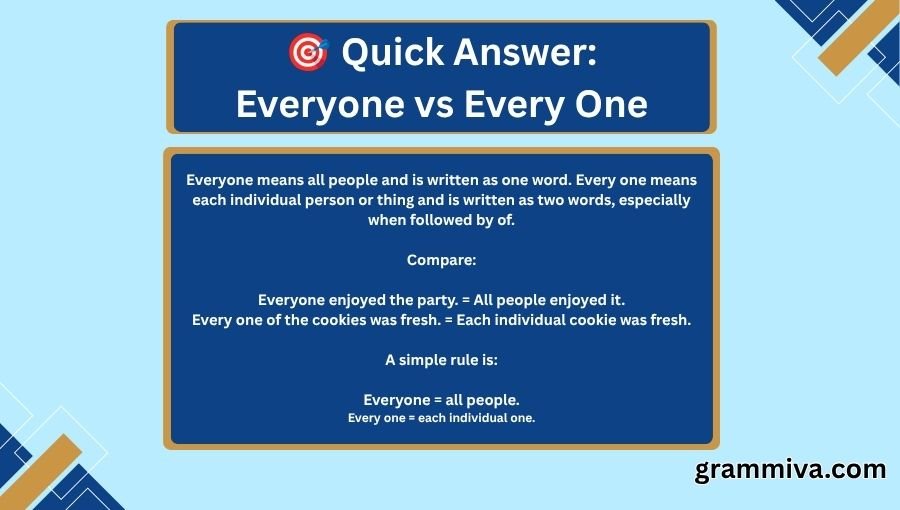
Everyone means all people and is written as one word. Every one means each individual person or thing and is written as two words, especially when followed by of.
Compare:
- Everyone enjoyed the party. = All people enjoyed it.
- Every one of the cookies was fresh. = Each individual cookie was fresh.
A simple rule is:
Everyone = all people.
Every one = each individual one.
Is Everyone the Same as Every One?
No. Everyone and every one are related, but they do not always have the same job in a sentence.
Everyone refers only to people. It works as a pronoun.
Every one focuses on individual members of a group. It can refer to people, animals, objects, or other things.
| Form | Type | Meaning | Example | Correct/Incorrect |
|---|---|---|---|---|
| Everyone | Pronoun | All people | Everyone agreed. | ✅ Correct |
| Every one | Pronoun phrase | Each individual person or thing | Every one of the books was useful. | ✅ Correct |
| Every one | Two-word phrase | Each person in a group | Every one of them received a card. | ✅ Correct |
| Everyone | Used for objects | All objects | Everyone of the boxes was open. | ❌ Incorrect |
| Every one | Used for individual objects | Each object | Every one of the boxes was open. | ✅ Correct |
The key is not simply the presence of the word every. The key is whether you mean all people as a group or each individual member of a group.
Everyone vs Every One at a Glance
Here is the fastest way to see the difference.
| Question | Use Everyone | Use Every One |
|---|---|---|
| Do you mean all people? | Yes | No |
| Do you mean each individual person? | Sometimes, but usually everyone is more natural | Yes |
| Are you talking about objects? | No | Yes |
| Does the phrase come before “of”? | Usually no | Usually yes |
| Can you replace it with “all people”? | Yes | No |
| Can you replace it with “each one”? | No | Yes |
For example:
- Everyone passed the test. = All people passed.
- Every one of the students passed the test. = Each individual student passed.
Both sentences can describe the same group, but they put attention in different places.
Why Do People Confuse Everyone and Every One?
People confuse these forms because they sound almost identical in normal speech. The difference is mainly visible in writing.
There is also a meaning overlap. If I say, “Everyone received a certificate,” I am talking about all the people in the group. If I say, “Every one of the students received a certificate,” I am focusing on each student.
I once reviewed a student essay where the writer used every one almost everywhere. The writer knew that the phrase had something to do with individual members, but the extra space made several sentences awkward. We changed most of them to everyone, and the essay became much cleaner.
Fast typing creates the same problem. A writer may know the rule but still type the wrong form because both versions sound the same.
How Can You Tell Which Form Is Correct?
Use a simple replacement test. If all people fits naturally, choose everyone. If each one fits naturally, choose every one.
Test 1: Replace It With “All People”
Sentence:
Everyone was ready for the meeting.
Try:
All people were ready for the meeting.
The replacement works in meaning, so everyone is correct.
Test 2: Replace It With “Each One”
Sentence:
Every one of the chairs was occupied.
Try:
Each one of the chairs was occupied.
The meaning stays the same, so every one is correct.
Test Tip 💡
When you are unsure, ask:
“Am I talking about all people, or am I pointing to each individual one?”
If you mean all people, write everyone.
If you mean each individual person or thing, write every one.
| Meaning | Word Type | Example Sentence |
|---|---|---|
| All people | Pronoun | Everyone laughed. |
| Each person in a group | Pronoun phrase | Every one of the guests signed the book. |
| Each object | Pronoun phrase | Every one of the doors was locked. |
| Each item in a set | Pronoun phrase | Every one of the answers was checked. |
What Does Everyone Mean?
Everyone means all the people in a particular group or situation. It is a singular pronoun, so it normally takes a singular verb.
Examples:
- Everyone is welcome.
- Everyone has a chance.
- Everyone was ready.
- Everyone knows the rule.
Notice the verbs. We say everyone is, not everyone are.
Correct and Incorrect Examples
| Sentence Pair | Correct | Incorrect |
|---|---|---|
| All people are ready. | ✅ Everyone is ready. | ❌ Everyone are ready. |
| All people have a ticket. | ✅ Everyone has a ticket. | ❌ Everyone have a ticket. |
| All people were invited. | ✅ Everyone was invited. | ❌ Everyone were invited. |
| All people knows the answer. | ❌ Everyone knows the answer. | ❌ Everyone know the answer. |
The last row needs care. The correct sentence is Everyone knows the answer. The verb is singular because everyone is grammatically singular.
What Does Every One Mean?
Every one means each individual person or thing within a group. The two-word form often appears in the structure every one of + noun or pronoun.
Examples:
- Every one of the students passed.
- Every one of the paintings was sold.
- Every one of them received an invitation.
- Every one of these answers is correct.
This form lets the writer focus on the individual members.
| Sentence | Meaning |
|---|---|
| Everyone was invited. | All people were invited. |
| Every one of the guests was invited. | Each guest was invited. |
| Everyone liked the movie. | All people liked it. |
| Every one of the children liked the movie. | Each child liked it. |
Both forms can sometimes describe the same event. The difference is the focus and grammatical structure.
When Should You Use Everyone?
Use everyone when you mean all people.
It is especially common in everyday speech and general statements.
Examples:
- Everyone wants to feel respected.
- Everyone enjoyed the meal.
- Everyone in the office received the message.
- Everyone should bring a notebook.
- Everyone knows that practice takes time.
You do not need of after everyone.
Correct:
Everyone in the class finished the assignment.
Incorrect:
Everyone of the class finished the assignment.
If you want to use of, change the structure to every one of.
Correct:
Every one of the students finished the assignment.
When Should You Use Every One?
Use every one when you mean each individual member or item.
The form is especially useful when you want to name the group afterward.
Examples:
- Every one of the players trained hard.
- Every one of the boxes was labeled.
- Every one of the questions was answered.
- Every one of the employees received a copy.
The phrase can refer to people or things.
That is one of the easiest ways to remember the difference.
Everyone → people only.
Every one → people or things.
Can Every One Refer to People?
Yes. Every one can refer to people when the sentence focuses on individual members of a group.
For example:
Every one of the volunteers arrived early.
This means each volunteer arrived early.
You could also write:
Everyone arrived early.
The second sentence is shorter and more general. The first places more emphasis on each volunteer.
Can Everyone Refer to Objects?
No. In standard English, everyone refers to people.
For objects, use every one.
Compare:
- ❌ Everyone of the computers was tested.
- ✅ Every one of the computers was tested.
- ❌ Everyone of the houses has a garage.
- ✅ Every one of the houses has a garage.
- ❌ Everyone of the files was saved.
- ✅ Every one of the files was saved.
This is one of the most useful practical rules to remember.
Case Study: A Workplace Email 📝
Imagine a manager sends this message:
Everyone on the sales team needs to submit the report by Friday.
That sentence is natural and clear. Everyone means all the people on the sales team.
Now imagine the manager wants to emphasize each report:
Every one of the reports must include the final sales figures.
Here, every one refers to individual reports, not people.
I once caught a similar issue while editing a workplace document. The writer had typed, “Everyone of the attached files has been reviewed.” The intended meaning was clear, but the form was wrong. I changed it to, “Every one of the attached files has been reviewed.” That small correction made the sentence grammatically sound without changing its meaning.
| Workplace Sentence | Correct Form | Reason |
|---|---|---|
| All team members should attend. | Everyone should attend. | Refers to people. |
| Each report needs a signature. | Every one of the reports needs a signature. | Refers to individual reports. |
| All employees received the notice. | Everyone received the notice. | Refers to people. |
| Each document was checked. | Every one of the documents was checked. | Refers to documents. |
Grammar Rules Explanation
The grammar difference comes from the role of each form.
Everyone is an indefinite pronoun. It refers to all people in a group without naming each person separately. Although it refers to many people, it is grammatically singular and therefore takes a singular verb in standard English.
Every one is a two-word construction. Here, every works with one to identify each individual member or item in a group. It can be followed by of and a noun or pronoun.
The space matters because it changes the structure.
Compare:
Everyone laughed.
Here, everyone is one pronoun meaning all people.
Every one of the guests laughed.
Here, every one identifies each guest individually.
Most standard dictionaries and grammar references make the same basic distinction: everyone means all people, while every one refers to each individual person or thing.
Correct vs Incorrect at a Glance
| Sentence | Correct/Incorrect | Why |
|---|---|---|
| Everyone is invited. | ✅ Correct | “Everyone” means all people. |
| Every one of the guests is invited. | ✅ Correct | “Every one” means each guest. |
| Everyone of the guests is invited. | ❌ Incorrect | Use “every one of” for the group of guests. |
| Every one enjoyed the concert. | ⚠️ Usually awkward | “Everyone” is the normal choice for all people. |
| Every one of the tickets was sold. | ✅ Correct | “Every one” refers to individual tickets. |
The important point is that the two forms are not simply spelling variations. They perform different grammatical jobs.
⚠️ Common Mistakes With Everyone and Every One
The most common error is adding a space before of.
Writers often type:
Everyone of the students…
But the standard form is:
Every one of the students…
Another common mistake is using everyone for objects.
For example:
Everyone of the boxes was empty.
The correct form is:
Every one of the boxes was empty.
Why do these mistakes happen?
There are several common reasons:
- Fast typing: The writer types by sound rather than by meaning.
- Autocorrect: A phone or computer may change the word automatically.
- Lack of knowledge: The writer may not know that the space changes the meaning.
- Sound: Both forms are usually pronounced similarly enough to cause confusion.
- Meaning overlap: Both can refer to a complete group in some sentences.
Similar Grammar Confusions
| Common Confusion | Correct Choice | Basic Rule |
|---|---|---|
| its / it’s | Depends on meaning | “Its” shows possession; “it’s” means “it is” or “it has.” |
| your / you’re | Depends on meaning | “Your” shows possession; “you’re” means “you are.” |
| their / they’re | Depends on meaning | “Their” shows possession; “they’re” means “they are.” |
| then / than | Depends on meaning | “Then” relates to time or sequence; “than” is used for comparison. |
| everyone / every one | Depends on meaning | “Everyone” means all people; “every one” means each individual person or thing. |
Wrong Forms and Better Choices
| Wrong Form or Use | What’s Wrong | Correct Form |
|---|---|---|
| Everyone of the books | “Everyone” cannot refer to books | Every one of the books |
| Everyone of the students | Missing space before “of” | Every one of the students |
| Every one was invited | Not always wrong, but usually less natural for “all people” | Everyone was invited |
| Everyone of these files | “Everyone” refers to people | Every one of these files |
| Everyone are ready | “Everyone” takes a singular verb | Everyone is ready |
| Everyones opinion | Missing possessive structure | Everyone’s opinion |
The last example introduces another useful form: everyone’s.
Is Everyone’s Different From Everyone?
Yes. Everyone’s is the possessive form of everyone.
It means something belongs to, relates to, or is associated with everyone.
Examples:
- Everyone’s opinion matters.
- Everyone’s phone was checked.
- Everyone’s excited about the trip.
In everyone’s, the apostrophe and s matter.
Do not write:
Everyones opinion matters.
Write:
Everyone’s opinion matters.
| Form | Meaning | Example |
|---|---|---|
| Everyone | All people | Everyone agreed. |
| Everyone’s | Belonging to or relating to everyone | Everyone’s opinion matters. |
| Every one | Each individual person or thing | Every one of the chairs was clean. |
How Is Everyone Used in Different Contexts?
The best form depends on what you mean, but everyone is much more common when talking about people as a group.
| Context | Which Term to Use | Example |
|---|---|---|
| Everyday conversation | Everyone | Everyone is coming tonight. |
| Professional writing | Everyone or every one, depending on meaning | Everyone must complete the form. |
| Creative writing | Either, depending on meaning | Everyone stared at the strange door. |
| Social media/texting | Everyone | Everyone needs to see this! |
| Reports about objects | Every one | Every one of the samples was tested. |
| Detailed group description | Every one | Every one of the paintings had a different frame. |
In casual writing, everyone often sounds more natural because speakers usually think about a group as a whole.
Every one becomes useful when the writer wants to stress individual members.
Common Phrases With Everyone
There are many everyday expressions that naturally use everyone.
| Phrase | Meaning |
|---|---|
| Everyone knows | Something is presented as widely known |
| Everyone agrees | All people in the group agree |
| Everyone is welcome | All people are invited or accepted |
| Everyone’s invited | All people are invited |
| Everyone else | All other people |
| Everyone in the room | All people in a particular place |
Examples:
Everyone is welcome at the event.
Everyone else had already left.
Everyone in the room became quiet.
These phrases are usually about people, so everyone is the natural choice.
Common Phrases With Every One
Every one is often used with of.
| Phrase | Meaning |
|---|---|
| Every one of them | Each person or thing in the group |
| Every one of us | Each member of our group |
| Every one of you | Each person being addressed |
| Every one of the books | Each book |
| Every one of the answers | Each answer |
| Every one of the students | Each student |
For example:
Every one of us has a role to play.
Here, every one emphasizes each individual member of “us.”
What Alternatives Can Replace Everyone?
Sometimes you can replace everyone with another expression. The best choice depends on the sentence.
| Alternative | Works When | Does Not Work When |
|---|---|---|
| All people | You want a direct general phrase | You need a more natural conversational style |
| Everybody | You mean all people | You are referring to objects |
| All of us | The speaker is part of the group | The group does not include the speaker |
| All of them | You are referring to a known group | The group has not been identified |
| Each person | You want to stress individual people | You want a broad, casual statement |
Everybody is especially close to everyone. In many sentences, the two can be swapped without changing the basic meaning.
For example:
Everyone was happy.
and
Everybody was happy.
Both are standard and natural.
What Alternatives Can Replace Every One?
You can often replace every one with each one when the meaning remains the same.
For example:
Every one of the boxes was checked.
can become:
Each one of the boxes was checked.
Other possible alternatives include each, each individual, or all of the individual items, depending on the sentence.
| Alternative | Works When | Does Not Work When |
|---|---|---|
| Each one | You mean every individual member | You simply mean all people as a group |
| Each | A noun follows | You need a pronoun without a following noun |
| Every individual | You want strong emphasis | The shorter “every one” is clearer |
| All of them | The group is already known | You need to stress individual members |
Why Does Getting Everyone vs Every One Right Matter?
Correct word choice makes writing easier to read. The difference may look tiny, but it can change the meaning of a sentence.
Clear grammar helps in three major ways:
Clarity in Communication
Readers should not have to stop and guess what a sentence means.
Everyone agreed.
is immediately clear.
Every one of the proposals was accepted.
is also clear because the writer identifies the individual proposals.
Professionalism
Small grammar errors can distract readers in emails, reports, applications, and business documents.
A single mistake will not usually ruin a piece of writing. However, repeated mistakes can make the writer seem less careful.
Digital Communication
Texts and social posts move quickly. That makes small word-choice errors especially common.
A useful habit is to pause before sending an important message. Read the sentence once for meaning, then once for grammar.
“Clear writing respects the reader’s time.”
That simple idea is worth remembering whenever you edit your work.
| Situation | Why Getting It Right Matters |
|---|---|
| Resume | Shows attention to detail |
| Client email | Makes the message sound polished |
| Published content | Builds reader trust |
| Social post | Prevents avoidable grammar errors |
| School assignment | Shows control of standard English |
How To Remember the Difference
You do not need a complicated grammar chart. I recommend remembering three short rules.
Rule 1: Everyone = All People
Think:
Everyone = everybody = all people
Example:
Everyone enjoyed the show.
Rule 2: Every One = Each Individual One
Think:
Every one = each one
Example:
Every one of the chairs was occupied.
Rule 3: “Of” Is a Strong Clue
When you see:
___ of the students
the correct choice is normally:
every one of the students
not:
everyone of the students
This three-part memory trick handles most cases.
Is “Every One of Them” Correct?
Yes. Every one of them is correct when you mean each individual person or thing in a known group.
Examples:
Every one of them received a prize.
Every one of them had a different answer.
I checked every one of them.
The phrase every one of them can refer to people or things. The surrounding context tells you which.
Is “Everyone of Them” Correct?
No, not when you mean each one of them.
Use:
Every one of them was invited.
Not:
Everyone of them was invited.
This is one of the most common forms people need to correct.
Is “Everyone” Singular or Plural?
Everyone is grammatically singular in standard English.
Therefore, use a singular verb:
- Everyone is ready.
- Everyone has a ticket.
- Everyone was excited.
- Everyone knows the answer.
Do not use:
- ❌ Everyone are ready.
- ❌ Everyone have a ticket.
- ❌ Everyone were excited.
- ❌ Everyone know the answer.
The fact that everyone refers to many people does not change its singular grammatical form.
Can Everyone and Every One Be Used in the Same Sentence?
Yes, when they perform different jobs.
For example:
Everyone in the class checked every one of the answers.
Here, everyone refers to all the people in the class.
Every one refers to each individual answer.
This sentence is a good reminder that the two forms can appear together without being interchangeable.
Quick Recap Checklist ✅
Use this checklist whenever you are unsure.
| Question | If Yes → Use |
|---|---|
| Do I mean all people? | Everyone |
| Do I mean each individual person? | Every one |
| Am I talking about objects? | Every one |
| Does “each one” fit? | Every one |
| Does “all people” fit? | Everyone |
| Is the phrase followed by “of + group”? | Usually every one |
| Am I showing possession? | Everyone’s |
Practice Examples
1. ___ was invited to the wedding.
Answer: Everyone
Reason: The sentence means all people were invited.
2. ___ of the invitations was printed correctly.
Answer: Every one
Reason: The sentence refers to each individual invitation.
3. ___ of us has a different job.
Answer: Every one
Reason: The phrase means each individual person in “us.”
FAQs About Everyone vs Every One
What is the difference between everyone and every one?
Everyone means all people and is written as one word. Every one means each individual person or thing and is written as two words.
Is everyone one word?
Yes. Everyone is normally written as one word when it means all people.
Example:
Everyone enjoyed the party.
Is every one two words?
Yes. Every one is written as two words when it means each individual person or thing.
Example:
Every one of the books was useful.
Which is correct: everyone of them or every one of them?
The correct form is every one of them when you mean each individual member of the group.
Correct:
Every one of them agreed.
Incorrect:
Everyone of them agreed.
Can everyone refer to things?
No. In standard English, everyone refers to people. Use every one for individual objects or things.
Correct:
Every one of the computers was tested.
Is everyone singular or plural?
Everyone is grammatically singular. Use a singular verb with it.
Correct:
Everyone is ready.
Not:
Everyone are ready.
Is every one of us correct?
Yes. Every one of us means each individual person in the group.
Example:
Every one of us has a part to play.
Can I use everybody instead of everyone?
Yes. Everybody and everyone have essentially the same basic meaning when they refer to all people.
Example:
Everyone is welcome.
Everybody is welcome.
Both are standard.
How can I quickly remember everyone vs every one?
Replace the phrase mentally. If all people fits, use everyone. If each one fits, use every one.
Is everyone’s a correct word?
Yes. Everyone’s is the possessive form of everyone.
Example:
Everyone’s opinion matters.
It can also appear as a contraction for everyone is in informal writing:
Everyone’s ready.
Final Conclusion
Everyone vs every one becomes simple once you focus on meaning instead of spelling. Use everyone when you mean all people. Use every one when you mean each individual person or thing, especially in the pattern every one of + group.
The space is small, but the grammar is different. That is why a quick replacement test works so well. Try all people. If it fits, choose everyone. Try each one. If it fits, choose every one.
Remember these three ideas:
- Everyone = all people.
- Every one = each individual one.
- Every one of the books is correct, while everyone of the books is not.
I use this rule with students, editors, and everyday writers because it is fast and reliable. You do not need to memorize a long list of exceptions. Just ask what the sentence is really saying.
Once you learn to hear the difference in meaning, choosing the right form becomes almost automatic. ✨
Small space, big difference: everyone means all people, while every one points to each individual one.

I am Adam Wilson, an English language content writer with an interest in grammar and vocabulary. I work at Grammiva and focus on creating clear explanations and practical examples for English learners.

[…] you should be able to choose the right spelling without stopping to second-guess yourself. ✍️ Everyone vs Every One | Harass vs Haras | anise vs […]
[…] you see the pattern, this tiny spelling problem becomes much easier. ✨ Labeling vs Labelling | Everyone vs Every One | Harass vs […]