Have you ever typed a word, looked at it twice, and suddenly wondered whether it looks right? 🤔 The spelling putting vs puting causes exactly that kind of doubt.
Both forms look almost the same, but only one is standard English spelling.
The correct form is putting.
It has two t letters because the base verb put keeps its spelling when we add -ing.
The form puting is a common spelling mistake.
I see this error often in student writing, quick messages, and online posts.
It can be easy to make because English has many verbs that change when -ing is added.
For example, run becomes running, while make becomes making.
So it is natural to wonder whether put follows another pattern.
In this guide, I will explain the rule in plain English.
I will also show you examples, common mistakes, memory tricks, and real-world uses.
By the end, you should be able to spot the correct spelling without stopping to think. ✍️ Repast vs Repass | Humor vs Humour | Barbecue vs Barbeque
🎯 Quick Answer: Putting vs Puting
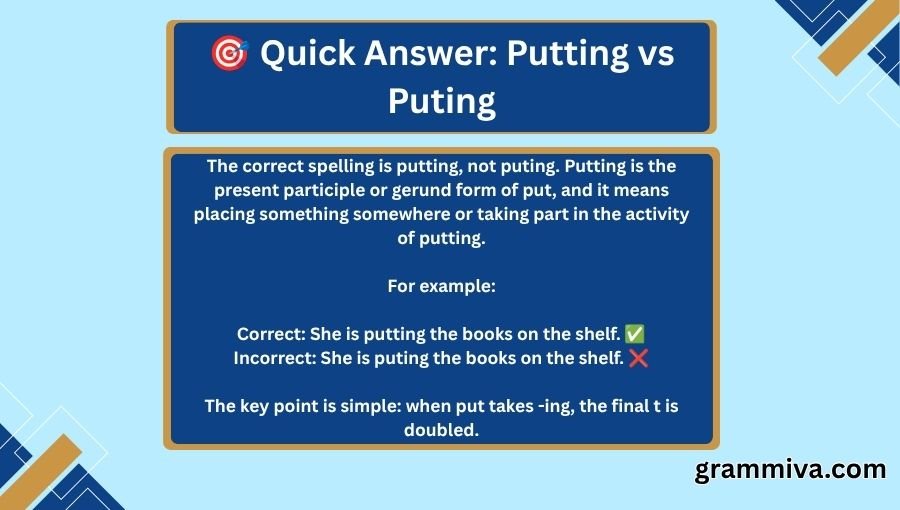
The correct spelling is putting, not puting. Putting is the present participle or gerund form of put, and it means placing something somewhere or taking part in the activity of putting.
For example:
- Correct: She is putting the books on the shelf. ✅
- Incorrect: She is puting the books on the shelf. ❌
The key point is simple: when put takes -ing, the final t is doubled.
Is Putting the Correct Spelling?
Yes. Putting is the standard spelling of the -ing form of the verb put.
The word put ends in a single t, but its spelling does not change when -ing is added. Instead, English doubles the final consonant:
put + ing = putting
The form puting leaves out one of the two required t letters.
| Form | Type | Example |
|---|---|---|
| put | Base verb | Please put the cup here. |
| putting | -ing form | He is putting the cup here. |
| puting | Incorrect spelling | ❌ He is puting the cup here. |
This is why putting vs puting is mainly a spelling question rather than a question about two different words.
🎯 Putting: Meaning and Correct Use
Putting is the -ing form of put. It can describe an action that is happening now, an activity, or an action treated as a noun.
Here are the main uses.
Putting as an Action Happening Now
We use putting with forms of be to describe an action in progress.
Examples:
- I am putting the dishes away. ✅
- She is putting her shoes on. ✅
- They are putting the chairs outside. ✅
The basic pattern is:
subject + be + putting + object
For example:
Marcus is putting the keys on the table.
Here, Marcus is the subject. Is is the helping verb. Putting shows the action. The keys are the object.
Putting as an Activity
The word can also act like a noun.
For example:
Putting things away keeps the room neat.
Here, putting names an activity. It is not simply describing something happening at that exact moment.
Another example is:
I enjoy putting together model cars.
The word still comes from put, but the whole -ing form works as part of the activity being discussed.
Putting in Sports
Putting also has a special use in golf. It refers to hitting the golf ball with a putter on the green.
For example:
Her putting improved after several weeks of practice.
This meaning is still spelled putting, with two t letters.
| Meaning | Word Type | Example Sentence |
|---|---|---|
| Placing something | Verb form | He is putting the box down. |
| An activity | Gerund | Putting things away takes time. |
| Golf action | Noun/verb form | His putting was excellent today. |
Why Do People Confuse Putting and Puting?
People confuse these forms because the difference is only one letter. 👀 When someone types quickly, the eye may not catch the missing t.
There is also a useful reason for the confusion. English uses several different spelling patterns when verbs take -ing.
Consider these examples:
- make → making
- write → writing
- run → running
- sit → sitting
- put → putting
Some verbs lose a letter. Some double a letter. Some simply add -ing.
I once reviewed a short school paragraph where a student wrote puting three times. The student knew exactly what the word meant. The problem was not vocabulary. The problem was applying the wrong spelling pattern.
That is a useful lesson: knowing a word’s meaning does not always mean knowing its correct spelling.
| Verb | + -ing | Correct Form |
|---|---|---|
| put | put + ing | putting |
| run | run + ing | running |
| sit | sit + ing | sitting |
| make | make + ing | making |
| read | read + ing | reading |
| play | play + ing | playing |
The best approach is not to guess based on how another verb behaves. Learn the spelling of putting as its own pattern.
Putting vs Puting at a Glance
The difference is straightforward: putting is correct, while puting is incorrect in standard English.
| Form | Type | Meaning | Example | Correct/Incorrect |
|---|---|---|---|---|
| put | Base verb | Place something | Put the book here. | ✅ Correct |
| putting | -ing form | Placing something | She is putting the book here. | ✅ Correct |
| puting | Misspelled form | Intended to mean putting | She is puting the book here. | ❌ Incorrect |
The spelling rule does not create a second word called puting. It is simply a misspelling of putting.
How Do You Spell Putting Correctly?
You spell it P-U-T-T-I-N-G.
A simple way to remember it is to start with put and add -ting:
put + ting = putting
Do not write:
put + ing = puting ❌
The correct spelling has tt in the middle:
putting ✅
💡 Test Tip
When you are unsure, say the base word first:
put
Then add -ing while keeping the final t strong:
put → putting
If your written word has only one t before ing, check it again.
Does Put Become Putting When Adding -ing?
Yes. The standard -ing form of put is putting.
The spelling follows the consonant-doubling pattern used with certain short verbs. In this case, the final consonant is doubled before -ing is added.
The result is:
put → putting
This same pattern appears in words such as:
- sit → sitting
- hit → hitting
- run → running
- stop → stopping
However, you should not assume that every English verb doubles its final letter. Spelling rules depend on the word and its ending.
| Base Verb | Correct -ing Form | Common Error |
|---|---|---|
| put | putting | puting ❌ |
| sit | sitting | siting ❌ when the intended word is the action of sitting |
| hit | hitting | hiting ❌ |
| run | running | runing ❌ |
| stop | stopping | stoping ❌ |
Correct Meanings and Uses of Putting
Understanding putting vs puting becomes easier when you look at how “putting” works in different sentences. The word putting can appear in several common sentence structures.
Putting Something Somewhere
This is the most basic use.
I am putting the groceries in the kitchen.
The action involves moving or placing something into a location.
More examples:
- We are putting the boxes in the garage. ✅
- She is putting her phone on the desk. ✅
- Dad is putting the tools away. ✅
Putting Something On
Putting on means placing clothing or another item on your body.
She is putting on her jacket.
Examples:
- I am putting on my shoes. ✅
- He is putting on his coat. ✅
- The children are putting on their costumes. ✅
Putting Something Away
Putting away means returning something to its proper place.
I am putting away the dishes.
This phrase is common at home, at school, and at work.
Putting Something Together
Putting together can mean assembling something or organizing parts.
We are putting together a presentation.
It can also describe creating or arranging an idea, plan, or group of things.
Putting Something Down
Putting down can mean placing something on a surface.
She is putting the bag down.
The phrase can have other meanings depending on context, so the surrounding sentence matters.
| Phrase | Basic Meaning | Example |
|---|---|---|
| putting on | Placing something on | He is putting on his hat. |
| putting away | Returning something to its place | She is putting away the books. |
| putting down | Placing something down | I am putting down the cup. |
| putting together | Assembling or organizing | We are putting together a plan. |
| putting back | Returning something | He is putting the key back. |
📝 Case Study: Putting in a Workplace Email
Imagine a worker needs to tell a manager that a report is being added to a shared folder. This example shows why knowing the difference between putting vs puting matters in real workplace writing.
A clear email might say:
I am putting the revised report in the shared folder now.
The word putting works because the action is happening at the time of writing.
A spelling error could make the sentence look careless:
I am puting the revised report in the shared folder now. ❌
The meaning is still understandable. However, the spelling is wrong.
I once caught this exact type of error while editing a short business message. The writer had used puting only once. Because the rest of the message was polished, the single spelling error stood out more than expected.
The lesson is simple: small spelling errors can be more noticeable in professional writing than they are in casual conversation.
| Situation | Example | Result |
|---|---|---|
| Correct workplace email | I am putting the file in the folder. | ✅ Clear and correct |
| Incorrect workplace email | I am puting the file in the folder. | ❌ Spelling error |
| Correct instruction | Please put the file in the folder. | ✅ Correct |
| Incorrect instruction | Please puting the file in the folder. | ❌ Wrong grammar and spelling |
Grammar Rules Explanation
The standard form is putting because put takes -ing with a doubled final t. The grammar rule for putting vs puting is straightforward.
The spelling can be shown in a simple form:
put + ing → putting
The extra t is not optional. It is part of the standard spelling.
The form puting is not a standard alternative spelling of putting. It is an error.
The grammar becomes especially clear when you compare the base verb and its -ing form:
I put the book on the desk every morning.
I am putting the book on the desk now.
The first sentence uses the base verb put. The second uses putting because the action is presented as ongoing.
Standard English reference works agree on the spelling putting. The key point for learners is to remember the complete form rather than trying to invent the spelling each time.
Correct vs Incorrect at a Glance
| Sentence | Correct/Incorrect | Why |
|---|---|---|
| She is putting the keys away. | ✅ Correct | Putting is the correct -ing form. |
| She is puting the keys away. | ❌ Incorrect | One t is missing. |
| I am putting on my coat. | ✅ Correct | The spelling is standard. |
| We are puting the chairs outside. | ❌ Incorrect | Puting is a misspelling. |
| He enjoys putting things in order. | ✅ Correct | Putting works as an activity. |
⚠️ Common Mistakes With Putting
The most common mistake is leaving out the second t. One of the most common putting vs puting mistakes is leaving out the second “t.”
Why does this happen?
Fast Typing
When people type quickly, they often leave out repeated letters. Because the missing t does not change how most readers understand the sentence, the mistake can slip past a quick review.
Autocorrect
Spell-check tools can help, but they are not perfect. A tool may miss an error if the surrounding text makes the intended word obvious.
Lack of Knowledge
Some learners simply have not learned that put becomes putting. They may apply a general rule of adding -ing directly.
For example:
put + ing = puting
That seems logical at first. But standard spelling requires the doubled t.
Similar-Looking Forms
Other words can also cause confusion.
| Confusion | Correct Forms | Main Difference |
|---|---|---|
| its / it’s | its, it’s | Possession vs. contraction |
| your / you’re | your, you’re | Possession vs. contraction |
| their / there / they’re | their, there, they’re | Different meanings |
| then / than | then, than | Time vs. comparison |
| affect / effect | affect, effect | Different grammatical uses |
These mistakes show why English spelling and grammar cannot always be solved by sound alone.
Specific Wrong Spellings and Uses
| Wrong Form | What’s Wrong | Correct Form |
|---|---|---|
| puting | Missing one t | putting |
| puttting | Has three t letters | putting |
| putingg | Has an extra g | putting |
| puttingg | Has an extra g | putting |
| puting something | Misspelled -ing form | putting something |
| puting on | Misspelled form of the phrase | putting on |
A useful editing habit is to look closely at repeated letters. They are easy to miss when reading quickly.
Is Puting Ever Correct?
In standard English, puting is not the correct spelling when you mean the -ing form of put.
That means sentences such as these should use putting:
- She is putting the dishes away. ✅
- They are putting up a tent. ✅
- I am putting the plan together. ✅
There is no normal grammar situation in which you should replace putting with puting.
This makes the choice easier than many other English spelling questions. You do not need to choose between two accepted forms. You simply need to remember the standard spelling.
Usage in Different Contexts
The correct spelling in every context is putting, not puting. Putting is correct in everyday speech, professional writing, creative writing, and digital communication. The context may change the sentence, but it does not change the spelling.
| Context | Which Term to Use | Example |
|---|---|---|
| Everyday conversation | putting | I am putting dinner on the table. |
| Professional writing | putting | We are putting the final report together. |
| Creative writing | putting | She was putting flowers in a vase. |
| Social media/texting | putting | I’m putting together a new playlist. |
In casual texting, someone might type puting by mistake. Friends may understand it anyway. But if you want correct English, use putting.
How Is Putting Used in Everyday Conversation?
In conversation, putting appears in many common phrases.
You might hear:
- “I’m putting the kids to bed.”
- “She’s putting the dishes away.”
- “We’re putting together a plan.”
- “He’s putting his shoes on.”
These phrases are natural because put is a very common English verb.
The spelling remains the same whether the sentence is formal or casual.
How Is Putting Used in Professional Writing?
Professional writing often uses putting when describing an action, process, or task.
Examples include:
We are putting the final numbers into the report.
The team is putting together a new proposal.
I am putting the requested documents in the shared folder.
A professional reader may understand puting, but it can make the writer appear less careful. Correct spelling helps a message look polished.
How Is Putting Used in Creative Writing?
Creative writing can use putting to show movement or action.
For example:
Maya was putting the old photographs into a wooden box.
Or:
He kept putting one foot in front of the other.
The spelling does not change just because the writing is more creative.
How Is Putting Used in Texting and Social Media?
Texting is more relaxed, but standard spelling is still putting.
For example:
I’m putting together a post now.
We’re putting everything in the car.
Short messages may contain typos. That does not make puting an accepted spelling.
If the message is public, such as a professional social post, correct spelling is even more useful.
Common Phrases With Putting
Putting appears in many everyday expressions and phrasal verbs.
| Phrase | Meaning |
|---|---|
| putting on | Placing something on or starting something |
| putting away | Returning something to its proper place |
| putting together | Assembling or organizing |
| putting down | Placing something on a surface |
| putting back | Returning something to its former place |
| putting off | Delaying something |
These phrases can have more than one meaning depending on context. The spelling of putting remains unchanged.
How To Remember the Difference
The easiest memory trick is to remember that putting contains put plus a doubled t before -ing.
Think:
PUT + TING = PUTTING
You can also connect it with other familiar forms:
- put → putting
- sit → sitting
- hit → hitting
- run → running
- stop → stopping
Another useful trick is visual. Look at the middle of the word:
putting
You should be able to see:
tt
If you see only one t, pause and check the spelling.
| Memory Method | What to Remember |
|---|---|
| Word building | put + ting = putting |
| Visual check | Look for tt |
| Base-word check | Start with put |
| Comparison | sit → sitting |
| Quick correction | puting → putting |
Synonyms and Alternatives
Sometimes you can avoid the spelling question by changing the sentence. This can be useful when you are editing a sentence for clarity.
However, alternatives are not always exact replacements.
| Alternative | Works When | Does Not Work When |
|---|---|---|
| placing | You mean moving something into a position | The phrase has a special meaning |
| setting | You mean placing something in a position | You specifically mean the verb put |
| moving | You mean changing location | You need to stress final placement |
| adding | You mean including something | The action is physical placement |
| arranging | You mean organizing things | You simply mean placing one object |
For example:
She is putting the books on the shelf.
could become:
She is placing the books on the shelf.
That works because placing has a similar meaning in this context.
But changing words just to avoid a spelling problem is not necessary. Once you learn putting, the original word is usually the clearest choice.
Why Does Getting Putting Right Matter?
Correct spelling matters because small details affect how readers view your writing. A single typo may not change the meaning, but repeated errors can make a message harder to trust.
Clarity in Communication
Correct spelling helps readers understand your message without distractions.
Professionalism
A resume, report, business email, or application should be carefully written. A spelling mistake can make an otherwise strong document look unfinished.
Digital Communication
Online writing spreads quickly. A typo in a public post can be copied, shared, or noticed by a large audience.
I once caught myself typing puting in a rushed note. I knew the rule, but my fingers moved faster than my editing brain. I fixed it before sending the message. That small mistake reminded me that even experienced writers benefit from a quick final check.
A useful principle is:
Clear writing shows that you cared enough to check the details.
| Situation | Why Getting It Right Matters |
|---|---|
| Resume | Shows care and attention to detail |
| Client email | Creates a polished professional impression |
| Published content | Builds reader trust |
| Social post | Keeps public writing clean and credible |
Quick Recap Checklist
Remember this simple rule when checking putting vs puting: always use “putting.” Use this checklist whenever you are unsure.
| Question | If Yes → Use |
|---|---|
| Do you mean the -ing form of put? | putting |
| Is the action happening now? | putting |
| Are you naming the activity of placing something? | putting |
| Did you write only one t before -ing? | Check it and change it to putting |
| Are you writing puting? | Change it to putting |
Practice Examples
- She is putting the plates on the table. ✅
- We are putting the books away. ✅
- He is puting his shoes by the door. ❌ → putting
Try covering the answers and correcting the sentences yourself. This simple practice can make the correct spelling easier to remember.
FAQs About Putting vs Puting
Is putting the correct spelling?
Yes. Putting is the correct standard spelling. Puting is a misspelling.
Is puting a word?
No, not when it is intended as the -ing form of put. The correct form is putting.
How do you spell putting?
The correct spelling is P-U-T-T-I-N-G: putting.
Why does put become putting?
The final t is doubled when the -ing ending is added, giving putting rather than puting.
Is it putting or puting?
It is putting. Always use the double t when writing the standard -ing form of put.
What is the difference between put and putting?
Put is the base form of the verb. Putting is its -ing form.
For example:
Please put the book here.
She is putting the book here.
Is putting a verb?
Yes. Putting is an -ing form of the verb put. Depending on how it is used in a sentence, it can also function as a gerund or part of a verb phrase.
Is putting spelled with two Ts?
Yes. Putting has two t letters together: putting.
How can I remember the spelling of putting?
Remember the visual pattern put + ting = putting. The simplest check is to look for the double t.
Can I write puting in casual texting?
You may see puting as a typo in casual messages, but it is not the standard spelling. If you want correct English, write putting.
Conclusion
Putting vs puting has a simple answer: putting is correct, and puting is a spelling mistake. ✅ The correct form contains two t letters: putting.
The word is the -ing form of put. You use it when describing an action in progress, an activity, or certain expressions such as putting on, putting away, and putting together.
The easiest way to remember it is to focus on the middle of the word:
putting = tt
Do not let the spelling patterns of other verbs make you second-guess this one. When you start with put and form its -ing version, the standard spelling is putting.
Whether you are writing a school assignment, a work email, a social post, or a quick text, this tiny spelling check takes only a second. Once putting becomes familiar, the confusion should disappear. ✨
Remember the rule, look for the double t, and write with confidence: putting, never puting.

I am Alex Morgan, an English grammar and vocabulary writer passionate about making language learning simple and useful. I work at Grammiva, where I create clear educational content and practical English examples for learners.


[…] uses, grammar, spelling, and practical examples so you can choose the right word with confidence. Putting vs Puting | Repast vs Repass | Humor vs […]
[…] be able to choose the right form without stopping to second-guess yourself. 👍 anise vs aniseed | Putting vs Puting | Repast vs […]