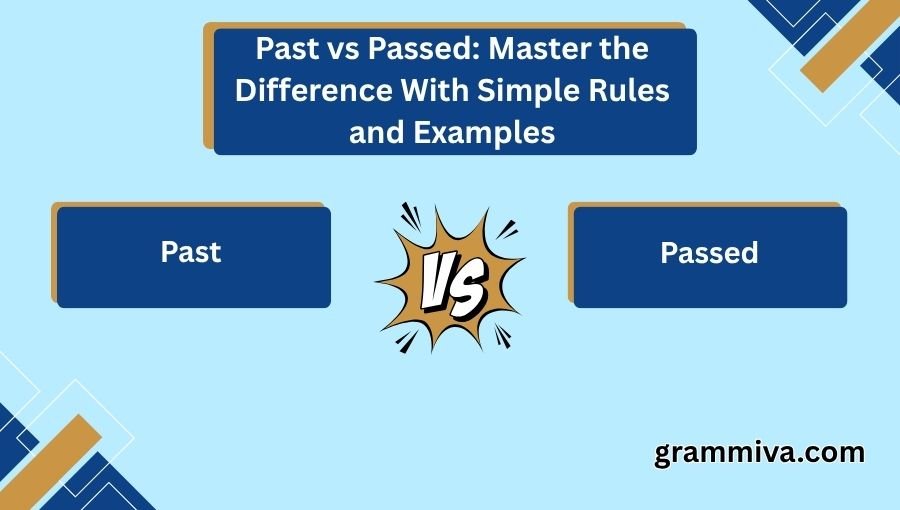
Have you ever typed a sentence, looked at it twice, and wondered whether you needed past vs passed? You are not alone.
These two words sound almost exactly the same when spoken, but they do very different jobs in a sentence.
That makes them easy to mix up, especially when you are writing quickly. ✍️
I have taught and edited English for years, and I still see this mistake in emails, school papers, work documents, and casual texts.
The good news is that the difference is much easier than it first seems.
Once you know what each word does, you can usually choose the right one in seconds.
The key is simple: past usually relates to an earlier time, while passed is usually the past tense of the verb pass.
In this guide, I will show you how to tell them apart, where each one belongs, and how to remember the rule without memorizing a long list of grammar terms. 🎯 Freshman vs Freshmen | Crummy vs Crumby | Traveled vs Travelled
🎯 Quick Answer: Past vs Passed
Past vs passed comes down to meaning and grammar. Past can refer to an earlier time, a position beyond something, or a noun, adjective, or preposition. Passed is normally a verb form that means someone or something moved by, succeeded, handed something over, or completed an action.
A quick test is this: if the word describes time or position, you often need past. If it describes an action, you often need passed.
Quick Comparison
| Word | Main Job | Basic Meaning | Example |
|---|---|---|---|
| past | Noun, adjective, preposition, adverb | Earlier time or beyond a point | We walked past the store. |
| passed | Verb | Moved by, gave, succeeded, or completed | She passed the store. |
🔎 Is Past the Same as Passed?
No. Past and passed are different words with different grammatical roles. Although they sound alike in many forms of American English, their meanings and uses are not interchangeable.
Think of past as a word that often points to time or location. Think of passed as a word that usually shows something happened.
For example:
- We drove past the school.
Here, past tells us where the car moved. - We passed the school.
Here, passed tells us what we did.
The two sentences are very close in meaning. The grammar is different.
Past as a Time Word
You can use past to talk about something that happened before now.
Examples:
- I learned a lot from my past mistakes.
- The past year has been busy.
- She does not like talking about her past.
- We should learn from the past.
Passed as an Action Word
You can use passed when someone or something performed an action related to pass.
Examples:
- The car passed our house.
- I passed the exam.
- She passed the salt.
- Time passed quickly.
Correct vs. Incorrect Examples
| Sentence Pair | Correct | Incorrect |
|---|---|---|
| We walked ___ the library. | ✅ We walked past the library. | ❌ We walked passed the library. |
| She ___ the test. | ✅ She passed the test. | ❌ She past the test. |
| He talked about his ___. | ✅ He talked about his past. | ❌ He talked about his passed. |
| The bus ___ us. | ✅ The bus passed us. | ❌ The bus past us. |
| We stayed there ___ midnight. | ✅ We stayed there past midnight. | ❌ We stayed there passed midnight. |
📚 Past vs Passed at a Glance
The easiest way to understand past vs passed is to focus on the job each word performs.
| Form | Type | Meaning | Example | Correct/Incorrect |
|---|---|---|---|---|
| past | Noun | Earlier time or events | The past teaches us lessons. | ✅ Correct |
| past | Adjective | Related to an earlier time | My past job was nearby. | ✅ Correct |
| past | Preposition | Beyond a point | We walked past the bank. | ✅ Correct |
| past | Adverb | To or beyond a point | The train went past. | ✅ Correct |
| passed | Verb | Moved beyond | The car passed us. | ✅ Correct |
| passed | Verb | Succeeded | He passed the test. | ✅ Correct |
| passed | Verb | Handed something over | She passed me the note. | ✅ Correct |
The most useful question is not “Which spelling sounds right?” Instead, ask: Am I talking about time or location, or am I describing an action?
💡 How Do You Know When to Use Past?
Use past when you are talking about an earlier time, something that happened before now, or a position beyond a person or thing.
Past for Earlier Time
This is one of the most common uses.
- We cannot change the past.
- She learned from her past.
- His past experiences helped him.
- The past few weeks have been difficult.
Here, past does not describe an action. It identifies an earlier period.
Past for a Position Beyond Something
You can also use past to show movement beyond a place or point.
- Walk past the red door.
- The runner went past the finish line.
- We drove past the museum.
- She looked past me.
Notice the difference between these sentences and sentences using passed. With past, the word can act as a preposition or adverb.
Past for Time Expressions
You will often see past in expressions involving a clock.
- It is five minutes past noon.
- We arrived past midnight.
- She stayed awake past her bedtime.
- The meeting continued past 6 p.m.
A useful shortcut is to remember that past + time often means “later than” that time.
Past as a Noun
Sometimes past is a thing or period we can talk about.
- His past is private.
- We should respect the past.
- The past cannot be changed.
- She has moved on from her past.
Meaning Summary
| Meaning | Word Type | Example Sentence |
|---|---|---|
| Earlier time | Noun | We cannot change the past. |
| Earlier period | Adjective | The past month was busy. |
| Beyond a place | Preposition | Walk past the gate. |
| Beyond a point | Adverb | The train moved past. |
| Later than a time | Preposition | It is past midnight. |
💡 Test Tip
Try replacing past with earlier or beyond.
If the sentence still makes sense, past may be the right choice.
- My past mistakes → my earlier mistakes. ✅
- Walk past the house → walk beyond the house. ✅
Do not use this test blindly, but it is a useful quick check.
🚶 When Should You Use Passed?
Use passed when you need the past-tense form of the verb pass. It normally describes an action that already happened.
Passed Means Moved By
- The runner passed me.
- We passed three gas stations.
- The car passed the truck.
- She passed through the doorway.
In each case, someone or something moved beyond another point.
Passed Means Succeeded
This is another very common use.
- I passed my driving test.
- She passed the final exam.
- He passed the interview.
- They passed the inspection.
Here, passed clearly describes an action or result.
Passed Means Handed Something Over
You can also use passed when someone gives something to another person.
- Please passed the paper to me. ❌
- Please pass the paper to me. ✅
But when describing an action that already happened:
- She passed the paper to me. ✅
The tense matters.
Passed Means Time Went By
You may also use passed to describe time moving forward.
- Three hours passed.
- The weeks passed quickly.
- As time passed, we became closer.
This is a common place where learners get confused. Although the sentence is about time, passed is correct because it describes an action: time moved forward.
Action Summary
| Meaning | Word Type | Example |
|---|---|---|
| Moved beyond | Verb | The car passed us. |
| Succeeded | Verb | She passed the exam. |
| Handed over | Verb | He passed me the book. |
| Went by | Verb | Two hours passed. |
| Completed or got through | Verb | We passed the inspection. |
🧠 Why Do People Confuse Past and Passed?
People confuse these words mainly because they sound alike. They also appear in sentences about similar ideas, especially time and movement.
For example, compare:
- We walked past the store.
- We passed the store.
Both sentences describe movement. That makes the spelling choice feel less obvious.
I once edited a short business report in which the writer used passed every time the word followed a place. The meaning was clear, but the repeated error stood out immediately. When I asked the writer to replace passed with past, the rule clicked: one word described the location, while the other described the action.
Sound Is Not Enough
When two words sound alike, listening cannot tell you which spelling to use. You have to look at the sentence.
Compare:
- The dog ran past me.
- The dog passed me.
In the first sentence, past describes the direction or position. In the second, passed is the action performed by the dog.
Similar Confusions
| Confusing Pair | Main Difference | Example |
|---|---|---|
| past / passed | Time or position vs. action | We walked past it. / We passed it. |
| its / it’s | Possession vs. “it is” | Its color is bright. / It’s bright. |
| your / you’re | Possession vs. “you are” | Your coat is here. / You’re early. |
| their / there / they’re | Possession, place, “they are” | Their car is there. / They’re late. |
| then / than | Time or result vs. comparison | First this, then that. / Taller than me. |
📝 Case Study: Past vs Passed in a Work Email
Imagine a manager writing this email:
“I walked passed the new office yesterday and noticed the lights were still on.”
The correct version is:
“I walked past the new office yesterday and noticed the lights were still on.”
Why? Past tells us where the manager walked. It comes after the verb walked and points to a location beyond the office.
Now consider:
“I passed the new office yesterday.”
Here, passed is correct because it is the main verb. The sentence says the manager moved beyond the office.
The difference becomes clear when you change the structure:
| Sentence | Correct Word | Reason |
|---|---|---|
| I walked ___ the office. | past | Shows position or direction |
| I ___ the office. | passed | Shows an action |
| We drove ___ the hospital. | past | Shows location |
| We ___ the hospital. | passed | Shows movement |
| She ___ her exam. | passed | Shows success |
This is why grammar should be judged by the whole sentence, not by sound alone.
📖 Grammar Rules Explanation
Past and passed are not interchangeable because they have different grammatical functions.
Past can function as a noun, adjective, preposition, or adverb. Its meanings commonly relate to an earlier time or a position beyond something.
Passed is generally the simple past form and past participle of the verb pass. It describes an action such as moving beyond something, succeeding, handing something over, or allowing something to go by.
Consider the sentence:
We walked past the restaurant.
The verb is walked. The word past tells us where we walked.
Now consider:
We passed the restaurant.
The verb is passed. It tells us what we did.
Both sentences are grammatical, but their structures are different.
A helpful grammar test is to look for another verb. If the sentence already has an action verb and you need a word showing position, past may fit.
If you need the action itself, passed may be the correct verb.
Standard English reference works and major dictionaries agree on the basic distinction: past and passed are separate words, even though their sounds can overlap.
Correct vs. Incorrect at a Glance
| Sentence | Correct/Incorrect | Why |
|---|---|---|
| We drove past the school. | ✅ Correct | Past shows location. |
| We drove passed the school. | ❌ Incorrect | Passed is not needed after drove. |
| She passed the test. | ✅ Correct | Passed is the action verb. |
| She past the test. | ❌ Incorrect | Past cannot serve as the main verb here. |
| Two hours passed quickly. | ✅ Correct | Passed means time went by. |
⚠️ Common Mistakes With Past and Passed
Most mistakes happen because the words sound alike. Fast typing, autocorrect, and limited knowledge of the difference can all make the problem worse.
Fast Typing
When people write quickly, they often choose the word that feels familiar. Because past and passed sound so similar, the wrong one can slip through.
I once caught myself typing “passed midnight” in a draft email. I was writing quickly and thinking about the meaning, not the grammar. A quick reread caught it: “past midnight” was what I needed.
Autocorrect
Spell-check tools are helpful, but they cannot always understand your intended meaning. Both past and passed are correctly spelled words. A spelling checker may not flag the wrong choice.
Lack of Knowledge
If someone has never learned the difference, both words can seem interchangeable. The best solution is to learn the role of each word rather than memorize isolated sentences.
Common Grammar Mix-Ups
| Confusion | Common Reason | Quick Check |
|---|---|---|
| past / passed | Same or similar sound | Time/location or action? |
| its / it’s | Similar spelling | “It is” or possession? |
| your / you’re | Similar sound | “You are” or possession? |
| then / than | Similar sound | Time/result or comparison? |
| affect / effect | Related meanings | Verb or noun in context? |
Specific Wrong Forms to Avoid
| Wrong Form | What’s Wrong | Correct Form |
|---|---|---|
| walked passed the store | Uses a verb where a position word is needed | walked past the store |
| past the exam | Uses a position/time word instead of the action verb | passed the exam |
| passed midnight | Usually uses the action form where a time expression needs past | past midnight |
| past me on the road | Wrong if the sentence needs the action pass | passed me |
| the passed year | Usually incorrect for an earlier year or period | the past year |
🕰️ The History of Past and Passed
The two words have long histories in English, but you do not need detailed language history to use them correctly today.
Their forms developed separately even though modern speakers may pronounce them alike. Over time, past became strongly associated with earlier time and being beyond a point. Passed remained closely tied to the verb pass and its forms.
The modern distinction is the important part for everyday writing.
| Period | Form | General Note |
|---|---|---|
| Earlier English | Forms related to pass | Words developed around movement and going beyond. |
| Middle English | Forms resembling past and passed | Different grammatical uses became clearer. |
| Later English | Past / passed | The two spellings became established in different roles. |
| Modern English | past / passed | The distinction remains important in standard writing. |
The history explains why the words look related, but the grammar tells you which one to choose today.
🌎 Past vs Passed in Different Contexts
The correct choice does not change just because you are writing an email, a text, or a story. The same grammar rule applies in every setting.
Everyday Conversation
In casual speech, the words may sound identical.
- “I walked past your house.”
- “I passed your house on the way home.”
Both can be correct.
Professional Writing
Accuracy matters more in work documents.
- “The proposal passed the review.”
- “The deadline is past.”
Using the wrong form can make polished writing look careless.
Creative Writing
Writers often use both words to create clear descriptions.
- “She stared into the past.”
- “He passed the old house without stopping.”
Social Media and Texting
Casual writing often contains mistakes, but the distinction is still useful.
- “Can you believe two years passed already?”
- “I just drove past that place!”
Context Table
| Context | Which Term to Use | Example |
|---|---|---|
| Everyday conversation | Either, depending on meaning | I walked past the park. |
| Professional writing | Either, depending on grammar | The proposal passed review. |
| Creative writing | Either, depending on meaning | He passed the old house. |
| Social media/texting | Either, depending on meaning | Time passed so fast! |
💬 Common Phrases With Past
Several common expressions use past, especially when talking about time or something beyond a point.
| Phrase | Meaning |
|---|---|
| in the past | At an earlier time |
| the past few days | The days immediately before now |
| past midnight | Later than midnight |
| past due | Later than the required date |
| past experience | Experience from an earlier time |
| move past something | Go beyond an issue or event |
Common Phrases With Passed
Passed appears naturally in phrases built around the verb pass.
| Phrase | Meaning |
|---|---|
| passed the test | Succeeded on a test |
| passed the exam | Succeeded on an exam |
| passed away | A gentle expression meaning died |
| passed by | Went by or moved beyond |
| passed through | Went from one side or place to another |
| passed the message | Gave or communicated information |
Remember that these phrases are not interchangeable. You cannot replace passed with past simply because the words sound alike.
🎯 How to Remember the Difference
I recommend using three simple questions.
Question 1: Is the sentence about an earlier time?
If yes, try past.
- the past
- past mistakes
- past years
Question 2: Does the word show a position beyond something?
If yes, try past.
- walk past the door
- drive past the store
- run past the finish line
Question 3: Is the word describing an action that already happened?
If yes, try passed.
- She passed me.
- He passed the test.
- Time passed quickly.
The Three-Question Test
| Question | If Yes | Example |
|---|---|---|
| Is it about earlier time? | Use past | the past year |
| Does it show a position beyond something? | Use past | walk past me |
| Is it an action that already happened? | Use passed | she passed me |
✏️ Past vs Passed in Real Sentences
Seeing the words in different sentence patterns can make the rule easier to remember.
Time
- The past year has taught me a lot. ✅
- The passed year has taught me a lot. ❌
Here, past means the year before now or the recent period leading up to the present.
Movement
- The dog ran past the gate. ✅
- The dog ran passed the gate. ❌
The verb ran already describes the action. Past tells us where the dog ran.
Action
- The dog passed the gate. ✅
- The dog past the gate. ❌
Now passed is the verb.
Time Going By
- Three days passed quickly. ✅
- Three days past quickly. ❌
Here, passed is the verb meaning “went by.”
Clock Time
- We stayed past 10 p.m. ✅
- We stayed passed 10 p.m. ❌
Here, past means later than 10 p.m.
🔄 Can Past and Passed Ever Appear in Similar Sentences?
Yes. They can appear in sentences with nearly the same meaning, but they do not perform the same grammatical job.
Compare:
We walked past the theater.
The main verb is walked. The word past gives information about location.
We passed the theater.
The main verb is passed. It tells us that we moved beyond the theater.
This is one of the best examples of why the past vs passed question cannot be answered by sound alone.
| Sentence | Main Verb | Role of Past/Passed |
|---|---|---|
| We walked past the theater. | walked | Location |
| We passed the theater. | passed | Action |
| We drove past the hotel. | drove | Location |
| We passed the hotel. | passed | Action |
💼 Why Past vs Passed Matters
Using the right word improves clarity, professionalism, and trust.
A small spelling mistake may not change the meaning of a sentence, but repeated errors can distract readers. In professional writing, readers often notice word choice even when they do not consciously identify the grammar rule.
A simple principle I use when editing is:
“Clear writing makes the reader work less.”
That applies to emails, resumes, articles, reports, and social posts.
| Situation | Why Getting It Right Matters |
|---|---|
| Resume | Shows attention to detail |
| Client email | Builds a professional impression |
| Published content | Protects writing quality |
| Social post | Makes your message easier to read |
Clarity in Communication
Compare:
We walked passed the office.
A reader can probably understand the sentence. But the incorrect word creates a small distraction.
The correct version is:
We walked past the office.
Professionalism
Grammar errors can make otherwise strong work appear rushed. This is especially true when the mistake occurs in a formal email, proposal, or report.
Digital Communication
Text messages and posts are often written quickly. That makes sound-alike words especially easy to mix up. A five-second reread can prevent many of these errors.
🧩 Synonyms and Alternatives
Sometimes you can replace past or passed with another word or phrase. This can help when you want to avoid repetition, but the replacement must match the meaning.
| Alternative | Works When | Does Not Work When |
|---|---|---|
| beyond | You mean farther than a point | You mean an earlier period |
| earlier | You mean a previous time | You mean physical movement |
| went by | You mean time moved forward | You mean success on a test |
| moved beyond | You mean physical movement | You mean the past as history |
| succeeded | You mean passed a test or requirement | You mean walking beyond a place |
For example, “The car went beyond the house” may replace “The car went past the house.” But “She went beyond the exam” does not mean “She passed the exam.”
The meaning must stay the same.
⚠️ Special Cases and Tricky Examples
Some sentences require extra attention because both words may seem possible at first glance.
“Passed by” vs. “Past”
Both forms can occur, but they have different structures.
- We walked past the store.
- We passed by the store.
In the first sentence, past is a preposition. In the second, passed is part of the verb phrase.
“Past Due”
Use past in the common phrase past due.
- The bill is past due. ✅
- The bill is passed due. ❌
Here, past means beyond the required date.
“Passed Away”
Use passed in the expression passed away.
- Her grandfather passed away peacefully. ✅
- Her grandfather past away peacefully. ❌
This is a fixed expression using the verb pass.
📝 Practice: Choose Past or Passed
Try each sentence before checking the answers.
- We walked ___ the bakery.
- She ___ her final exam.
- The last two hours ___ quickly.
- I have learned from my ___ mistakes.
- The train ___ our station.
- We stayed ___ midnight.
- He ___ me the remote.
- They drove ___ the old school.
Answers
| Sentence | Answer | Reason |
|---|---|---|
| We walked ___ the bakery. | past | Shows location |
| She ___ her final exam. | passed | Action of succeeding |
| The last two hours ___ quickly. | passed | Time went by |
| My ___ mistakes | past | Earlier time |
| The train ___ our station. | passed | Action |
| We stayed ___ midnight. | past | Later than a time |
| He ___ me the remote. | passed | Handed something over |
| They drove ___ the old school. | past | Shows location |
✅ Quick Recap Checklist
Use this checklist whenever you are unsure about past vs passed.
| Question | If Yes → Use |
|---|---|
| Does it mean an earlier time? | past |
| Does it describe something beyond a point? | past |
| Does it mean later than a certain time? | past |
| Is it the action of moving beyond something? | passed |
| Does it mean succeeded? | passed |
| Does it mean handed something over? | passed |
| Does it mean time went by? | passed |
Three Final Practice Examples
- We walked past the store.
- We passed the store.
- Two hours passed while we waited.
If you can explain why each word works, you understand the core rule.
❓ FAQs About Past vs Passed
What is the main difference between past and passed?
Past usually refers to an earlier time or a position beyond something. Passed is usually a verb that describes an action, such as moving beyond something, succeeding, handing something over, or going by.
Is it “walk past” or “walk passed”?
It is “walk past.” The verb walk already provides the action, so past shows the position or direction.
Correct: We walked past the house.
Incorrect: We walked passed the house.
Is it “I passed the store” or “I past the store”?
It is “I passed the store.” Here, passed is the main verb. It means you moved beyond the store.
Is it “past the test” or “passed the test”?
It is “passed the test.” Passing a test means succeeding on it, so the verb form passed is required.
Is it “past midnight” or “passed midnight”?
The standard expression is “past midnight.” It means later than midnight.
Example: “We stayed up past midnight.”
Is “time passed” correct?
Yes. “Time passed” is correct because passed is the verb. It means that time went by.
Example: “As time passed, things became easier.”
Is “the past year” correct?
Yes. “The past year” is correct when you mean the previous or recently completed period of one year.
Example: “I have learned a lot over the past year.”
Is “passed away” correct?
Yes. “Passed away” is a common polite expression for death. The word passed is the past form of the verb pass.
Can past be a verb?
In standard modern English, past is not normally used as the ordinary past-tense verb form of pass. For actions such as moving beyond something or succeeding on a test, use passed.
How can I remember past vs passed?
Use this simple rule: past is often about time or position, while passed is about an action. If you can replace the word with “earlier” or “beyond,” past may fit. If you need a verb meaning “went by,” “succeeded,” or “moved beyond,” use passed.
🎯 Conclusion: Past vs Passed Made Simple
Past vs passed becomes much easier when you stop relying on sound and start looking at the word’s job in the sentence.
Past usually points to an earlier time, a previous period, or a place beyond something.
Passed is generally a verb that describes an action, such as moving by, succeeding, handing something over, or going by.
My best advice is to pause for one second and ask: Am I describing time or position, or am I describing an action? If it is time or position, check past. If it is an action that already happened, check passed.
Remember these three examples:
- We walked past the store.
- We passed the store.
- Two hours passed.
Once this pattern becomes familiar, the choice starts to feel automatic.
You will catch the error while writing instead of after someone else points it out.
And that small improvement can make every email, essay, report, and post a little clearer. 😊
When in doubt, check the job of the word—not the sound. That one habit will keep past and passed in their proper places.

I am Adam Wilson, an English language content writer with an interest in grammar and vocabulary. I work at Grammiva and focus on creating clear explanations and practical examples for English learners.