Have you ever typed a sentence, looked at breath vs breathe, and suddenly wondered which word belongs there? You are not alone.
These two words look almost identical, sound closely related, and both connect to the act of taking air into and out of your lungs. 😅
The good news is that the difference is much easier to understand than it first seems. Breath and breathe are not interchangeable. One is mainly a noun.
The other is a verb. Once you learn that basic rule, most sentences become easy to check.
I have taught and edited English for years, and I often see this mistake in emails, school assignments, social posts, and even polished business writing.
The problem usually is not a lack of English skill. The words are simply easy to mix up.
In this guide, I will show you exactly when to use each word, how to remember the difference, which common phrases use them, and how to avoid the most common mistakes.
By the end, you should be able to choose the right word without stopping to think twice. 🌬️ Swiftie vs Swifty | Never Mind vs Nevermind | Sneaked vs Snuck
🎯 Quick Answer: Breath vs Breathe
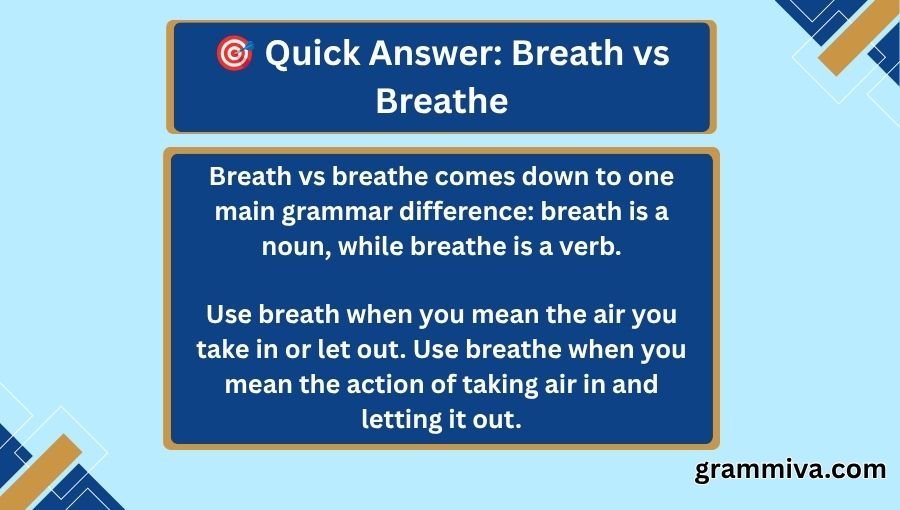
Breath vs breathe comes down to one main grammar difference: breath is a noun, while breathe is a verb.
Use breath when you mean the air you take in or let out. Use breathe when you mean the action of taking air in and letting it out.
- Breath = a thing or amount of air.
- Breathe = the action of taking air in and letting it out.
A simple memory trick is this: breath is the thing; breathe is the action.
Related Word Forms
The two words have several related forms that can cause confusion. Knowing these forms makes the basic rule even easier to apply.
| Form | Type | Example |
|---|---|---|
| breath | noun | Take a deep breath. |
| breathe | verb | Try to breathe slowly. |
| breaths | plural noun | She took three deep breaths. |
| breathed | past-tense verb | He breathed deeply after the race. |
| breathing | present participle/gerund | Slow breathing can help you relax. |
| breathless | adjective | The long run left me breathless. |
Notice that breaths stays a noun, while breathed and breathing come from the verb breathe.
🧭 Understanding the Basics of Breath vs Breathe
The core difference between breath vs breathe is grammatical.
Breath names the air that enters or leaves your lungs. It can also refer to one act or amount of air.
Breathe describes what a person, animal, or living thing does with air.
Here is the difference at a glance:
| Form | Type | Meaning | Example | Correct/Incorrect |
|---|---|---|---|---|
| breath | Noun | Air taken into or released from the lungs | Take a deep breath. | ✅ Correct |
| breathe | Verb | To take air into and release it from the lungs | Remember to breathe slowly. | ✅ Correct |
| breath | Noun | Used as a verb | Remember to breath slowly. | ❌ Incorrect |
| breathe | Verb | Used as a noun | Take a deep breathe. | ❌ Incorrect |
What Does Breath Mean?
Breath is a noun. It refers to the air you take into your lungs, the air you release, or one act of taking in and releasing air.
Examples include:
- Take a deep breath.
- I could see my breath in the cold air.
- She held her breath underwater.
- He was out of breath after running.
- Take another breath before you speak.
The word often appears after words such as a, one, deep, short, last, or fresh.
What Does Breathe Mean?
Breathe is a verb. It describes the action of moving air into and out of your lungs.
Examples include:
- Try to breathe slowly.
- It is hard to breathe in this room.
- Plants and animals breathe in different ways.
- She stopped to breathe after climbing the stairs.
- Remember to breathe before you begin.
Because breathe is a verb, it often follows words such as to, can, will, should, or must.
Breath and Breathe in Sentence Patterns
The sentence pattern can give you a fast clue.
| Pattern | Correct Word | Example |
|---|---|---|
| Take a ___ | breath | Take a deep breath. |
| Need to ___ | breathe | I need to breathe. |
| Hold your ___ | breath | Hold your breath. |
| Can ___ | breathe | Can you breathe normally? |
| Out of ___ | breath | I am out of breath. |
| ___ deeply | breathe | Breathe deeply. |
💡 How Can You Tell Breath and Breathe Apart?
Ask yourself one question: Am I naming the air, or am I describing the action?
If you are naming the air or one intake of air, choose breath.
If you are describing the action, choose breathe.
The Noun Test
Try placing a before the word.
If the sentence makes sense with a, you probably need breath.
- Take a breath. ✅
- Take a breathe. ❌
You can also use plural forms:
- Take two breaths. ✅
- Take two breathes. ❌
The Verb Test
Try placing to before the word.
If the sentence needs an action, breathe is usually the right choice.
- I need to breathe. ✅
- I need to breath. ❌
The same idea works with helping verbs:
- I can breathe.
- She will breathe.
- We should breathe.
- They must breathe.
💡 Test Tip
When I check these words while editing, I mentally replace the word with air or take air in.
If air works, think breath.
If take air in and let it out works, think breathe.
That quick test catches most errors.
Correct Meanings and Uses of Breath
Breath has several common uses in everyday English. The meaning changes slightly with the phrase, but it remains a noun.
A Single Act of Breathing
You can use breath to describe one intake or release of air.
- She took a deep breath.
- He let out a long breath.
- I could hear her breath from across the room.
Here, breath is the thing being taken, held, or released.
Breath as Air
The word can also refer to the air coming from someone’s lungs.
- His breath smelled like coffee.
- Her warm breath fogged the window.
- I could see my breath on the cold morning.
Common Expressions With Breath
English has many fixed expressions containing breath.
- Hold your breath.
- Catch your breath.
- Take a breath.
- Out of breath.
- A breath of fresh air.
- Save your breath.
These phrases are worth learning as complete units.
| Meaning | Word Type | Example Sentence |
|---|---|---|
| One intake of air | Noun | She took a deep breath. |
| Air released from the lungs | Noun | His breath was warm. |
| Ability to speak or continue after exertion | Noun | I was out of breath. |
| A short pause | Noun | Take a breath before answering. |
| Fresh or new feeling | Noun in fixed phrase | The new idea was a breath of fresh air. |
Correct Meanings and Uses of Breathe
Breathe is a verb used for the physical act of moving air in and out of the lungs. It can also be used in broader expressions.
Physical Breathing
This is the most basic use.
- We breathe automatically.
- The baby is breathing normally.
- Try to breathe through your nose.
- He breathed deeply after the race.
Breathe in and Breathe out
The word often appears with in and out.
- Breathe in slowly.
- Breathe out through your mouth.
- Breathe in and count to four.
- Then breathe out slowly.
Breathe in a Broader Sense
In some writing, breathe can describe giving life, energy, or movement to something.
For example:
The new design breathed life into the old building.
Here, breathed does not mean literal physical breathing. It means the design made the building feel alive or fresh.
🔍 Breath vs Breathe: Key Differences
The easiest way to understand breath vs breathe is to focus on their jobs in a sentence.
| Feature | Breath | Breathe |
|---|---|---|
| Part of speech | Noun | Verb |
| Main idea | Air or one act of breathing | The action of taking in and releasing air |
| Can follow “a”? | Yes | No |
| Can follow “to”? | No | Yes |
| Plural form | breaths | — |
| Past form | — | breathed |
| Example | Take a breath. | Breathe slowly. |
Is Breath a Noun?
Yes. Breath is a noun.
It can be the subject or object of a sentence:
- Her breath was visible.
- Take a breath.
- My breath caught when I heard the news.
Is Breathe a Verb?
Yes. Breathe is a verb.
It describes an action:
- I breathe slowly.
- She breathed deeply.
- They are breathing normally.
This noun-versus-verb distinction is the most useful rule to remember.
📝 Case Study: A Workplace Email
Imagine that a coworker has just finished a difficult presentation. They send you this message:
“I finally finished the presentation. I need to take a deep breathe!”
The sentence is understandable, but the word choice is wrong.
The corrected version is:
“I finally finished the presentation. I need to take a deep breath!”
Why? Take needs a noun in this expression. You take a breath. You do not take a breathe.
Now consider a different sentence:
“I was so nervous that I forgot to breath before I started.”
That should be:
“I was so nervous that I forgot to breathe before I started.”
After to, the sentence needs the verb breathe.
I once edited a short workplace note where the writer had used breathe in three places where breath was needed. The writer knew the words were related but had never learned the noun-versus-verb rule. Once we changed the sentence pattern, every correction became obvious.
📚 Grammar Rules Explanation
The grammatical reason for the difference is simple. Breath functions as a noun, while breathe functions as a verb.
A noun can name a person, place, thing, or idea. In this case, breath names the air taken into or released from the lungs, or one act of doing so.
A verb expresses an action or state. Breathe expresses the action of taking air into the lungs and releasing it.
This is why the following patterns work:
- a breath
- one breath
- two breaths
- take a breath
- hold your breath
And these patterns work:
- to breathe
- can breathe
- should breathe
- will breathe
- breathe slowly
Most standard English dictionaries and grammar references make the same basic noun-versus-verb distinction.
Correct vs Incorrect at a Glance
| Sentence | Correct/Incorrect | Why |
|---|---|---|
| Take a deep breath. | ✅ Correct | “Breath” is a noun after “a.” |
| Remember to breathe slowly. | ✅ Correct | “Breathe” is a verb after “to.” |
| I need to breath slowly. | ❌ Incorrect | The verb form is “breathe.” |
| She took a deep breathe. | ❌ Incorrect | The noun form is “breath.” |
| He held his breath. | ✅ Correct | “Breath” is the noun being held. |
⚠️ Common Mistakes With Breath and Breathe
People confuse these words because they look nearly the same and come from the same basic idea. The extra e in breathe is easy to overlook.
There are also several practical reasons mistakes happen:
- Fast typing: When people type quickly, they may choose the first spelling that looks right.
- Autocorrect: Spell-check tools may not catch the error because both words are real English words.
- Lack of knowledge: A writer may know the meaning but not know which grammatical form belongs in the sentence.
- Sound confusion: The words are closely related in meaning and pronunciation, which makes them easy to mix up.
- Habit: Seeing the wrong form repeatedly online can make it look normal.
I once caught myself typing “take a deep breathe” in a casual message. I knew the rule, but I was typing quickly and focused on the meaning rather than the grammar. That was a useful reminder: even experienced writers can make this mistake when they rush.
Similar Grammar Confusions
This problem is not unique. English contains many word pairs that look or sound similar.
| Confusing Pair | Correct Use | Common Error |
|---|---|---|
| its / it’s | “The dog wagged its tail.” | Confusing possession with “it is” |
| your / you’re | “You’re doing well.” | Mixing possession with “you are” |
| their / there / they’re | “They’re over there.” | Mixing three different forms |
| then / than | “She is taller than me.” | Using “then” for comparison |
| affect / effect | “The change affected sales.” | Switching verb and noun roles |
The lesson is useful beyond breath vs breathe: when two words look similar, first ask what job the word has in the sentence.
Common Wrong Spellings and Uses
| Wrong Form | What’s Wrong | Correct Form |
|---|---|---|
| take a breathe | Uses the verb as a noun | take a breath |
| to breath | Uses the noun instead of the verb | to breathe |
| deep breathe | Uses the verb where a noun is needed | deep breath |
| hold your breathe | Uses the verb as a noun | hold your breath |
| need to breath | Uses the noun as a verb | need to breathe |
| several breathes | Incorrect plural for the noun | several breaths |
🕰️ Word History and Spelling
The words breath and breathe have a long shared history in English and developed as related forms of the same basic idea. Over time, English spelling kept different forms for the noun and verb.
The important point for modern writers is not the full history. It is the spelling pattern that exists today: breath is the noun, and breathe is the verb.
| Period | Form | Note |
|---|---|---|
| Early English | Related forms of the breathing word family | The basic idea of breathing was already present. |
| Middle English | Forms developed and changed in spelling | English spelling was not yet fully standardized. |
| Later English | Separate noun and verb forms became established | The distinction between forms became clearer. |
| Modern English | breath / breathe | Both forms remain common and distinct. |
You do not need to memorize this history to use the words correctly. The modern grammar rule is what matters most.
🌎 Usage in Different Contexts
The same basic rule applies whether you are speaking with a friend, writing a report, posting online, or creating a story.
| Context | Which Term to Use | Example |
|---|---|---|
| Everyday conversation | Both, depending on sentence | Take a breath and breathe slowly. |
| Professional writing | Both, depending on grammar | Please breathe slowly before the test. |
| Creative writing | Both, depending on meaning | She held her breath as the door opened. |
| Social media/texting | Both, depending on sentence | I need a minute to breathe! |
Everyday Conversation
You will hear both words often in ordinary speech.
- “Give me a breath.”
- “I need to breathe.”
- “I’m out of breath.”
- “Just breathe.”
Professional Writing
In professional writing, accuracy matters because a small spelling error can distract readers.
For example:
“Please take a deep breath before beginning.”
is correct.
So is:
“Please breathe slowly before beginning.”
But:
“Please take a deep breathe before beginning.”
is not correct.
Creative Writing
Writers often use these words to show fear, excitement, relief, or suspense.
She held her breath as she opened the envelope.
He tried to breathe calmly, but his heart was racing.
Social Media and Texting
Informal writing is more forgiving, but the grammar rule does not change.
A short post might say:
“Pause. Take a breath. You’ve got this.”
Or:
“Just breathe. Everything will be okay.”
💬 Common Phrases With Breath
Many everyday expressions use breath. Learning these as chunks can help you remember the noun form.
| Phrase | Meaning |
|---|---|
| take a breath | Pause and inhale |
| hold your breath | Stop breathing temporarily or wait expectantly |
| catch your breath | Recover after effort or surprise |
| out of breath | Breathing hard after activity |
| a breath of fresh air | Something refreshing or new |
| save your breath | Do not waste time speaking |
Some expressions can be especially useful as memory clues.
If you can say “take a breath,” you know the noun is needed.
If you can say “breathe slowly,” you know the verb is needed.
🧠 How To Remember the Difference
The best memory trick is to connect each word to its grammar role.
Breath = noun.
Think:
“Take a breath.”
Breathe = verb.
Think:
“Breathe slowly.”
You can also remember that breathe has an extra e, just like the verb form needs an extra sound and letter compared with the noun.
Another useful pair is:
- Take a breath.
- Breathe deeply.
Memorize those two sentences. They can act as your mental model whenever you are unsure.
A One-Second Memory Trick
Ask:
Can I put “a” before it?
- a breath → yes
- a breathe → no
Ask:
Can I put “to” before it?
- to breathe → yes
- to breath → no
That is often enough.
🔄 Synonyms and Alternatives
Sometimes you can replace one of these words with another phrase. However, a synonym may change the meaning or sound less natural.
| Alternative | Works When | Does Not Work When |
|---|---|---|
| inhale | You mean taking air in | You mean the complete breathing process |
| exhale | You mean releasing air | You mean taking air in |
| respiration | You need a formal or technical term | You want casual everyday language |
| pause | You mean stopping briefly | You specifically mean breathing |
| take a moment | You mean stopping to recover or think | You need the exact physical meaning of breath |
For example, inhale can replace breathe in, but it cannot always replace breathe.
Breathe slowly. ✅
Inhale slowly. ✅
Both can work, but they do not always carry exactly the same meaning.
❤️ Why Getting Breath and Breathe Right Matters
Correct word choice helps readers understand you without stopping to decode your sentence.
Clarity in Communication
A sentence such as “Take a deep breathe” is understandable, but it contains a grammar error. Readers may notice it immediately.
Professionalism
A resume, report, client email, or formal document should show careful word choice. Small errors can make otherwise strong writing look rushed.
Digital Communication
Social posts and messages are informal, but correct spelling still makes your meaning clear. Because spell-check may accept both words, you cannot always rely on software to catch this mistake.
“Clear writing lets the reader focus on your message instead of your mistakes.”
| Situation | Why Getting It Right Matters |
|---|---|
| Resume | Shows attention to detail |
| Client email | Builds trust and professionalism |
| Published content | Protects writing quality |
| Social post | Makes your message easier to read |
🧩 Breath vs Breathe in Common Sentence Patterns
Looking at complete patterns is often more useful than memorizing isolated definitions.
| Sentence Pattern | Example | Correct Word |
|---|---|---|
| take a ___ | Take a deep breath. | breath |
| hold your ___ | Hold your breath. | breath |
| out of ___ | She was out of breath. | breath |
| need to ___ | I need to breathe. | breathe |
| try to ___ | Try to breathe slowly. | breathe |
| can ___ | He can breathe normally now. | breathe |
| ___ deeply | Breathe deeply. | breathe |
| ___ in | Breathe in slowly. | breathe |
❓ Why Do People Confuse Breath and Breathe?
People confuse them because they have nearly identical spellings, closely related meanings, and the same basic word family.
The biggest visual clue is the final e in breathe. The noun breath does not have that final e.
The grammar clue is even stronger:
- breath → noun
- breathe → verb
If you focus only on how the words look, the difference can feel tiny. If you focus on their jobs in a sentence, the difference becomes much clearer.
❓ Is Breath the Same as Breathe?
No. Breath and breathe are related, but they are different parts of speech.
Breath is a noun. Breathe is a verb.
For example:
Take a breath.
Breathe slowly.
The first sentence names the thing. The second describes the action.
❓ Which Is Correct: Take a Breath or Take a Breathe?
“Take a breath” is correct.
The word after a needs to be a noun. Breath is the noun.
Correct:
Take a deep breath. ✅
Incorrect:
Take a deep breathe. ❌
❓ Which Is Correct: Breathe Deeply or Breath Deeply?
“Breathe deeply” is correct.
The sentence describes an action, so it needs the verb breathe.
Correct:
Breathe deeply. ✅
Incorrect:
Breath deeply. ❌
❓ How Do You Remember Breath vs Breathe?
Remember two simple phrases:
Take a breath.
Breathe slowly.
The first uses the noun. The second uses the verb.
You can also use the a/to test:
- a breath → correct
- to breathe → correct
❓ What Is the Plural of Breath?
The plural of breath is breaths.
Examples:
- She took several breaths.
- Take three deep breaths.
- His final breaths were very slow.
Do not use breathes as the plural noun.
❓ What Is the Past Tense of Breathe?
The past tense of breathe is breathed.
Examples:
- She breathed slowly.
- He breathed a sigh of relief.
- They breathed deeply after the exercise.
The spelling changes from breathe to breathed, but it remains a verb.
❓ Is “Out of Breath” Correct?
Yes. “Out of breath” is a standard expression.
It usually means that someone is breathing hard after exercise or another physical effort.
Example:
I was out of breath after running up the stairs.
The phrase uses breath, not breathe.
❓ Is “Take a Deep Breath” Correct?
Yes. “Take a deep breath” is correct.
Here, breath is a noun. The word deep describes the noun.
Example:
Before the interview, I took a deep breath and relaxed.
❓ Is “Breathe In and Breathe Out” Correct?
Yes. “Breathe in and breathe out” is correct.
Both instances use breathe because they describe actions.
Example:
Breathe in slowly, then breathe out.
❓ Can Breath Be Used as a Verb?
In standard modern English, the normal verb is breathe, not breath.
For ordinary writing, use breathe when you need the verb.
- I need to breathe. ✅
- I need to breath. ❌
❓ What Is the Fastest Way to Check the Right Word?
Look at the word’s role in the sentence.
If it names air or one act of breathing, use breath.
If it describes the action, use breathe.
Then test the sentence:
- a breath → noun
- to breathe → verb
That simple check works in most situations.
❓ Can You Use Both Words in One Sentence?
Yes. In fact, using both together can make the difference easy to see.
Take a breath and breathe slowly.
Here, breath is the noun and breathe is the verb.
Another example:
After taking a deep breath, she began to breathe more calmly.
The two words work together because they have different grammatical jobs.
❓ What Are the Most Common Breath and Breathe Mistakes?
The most common mistakes are switching the noun and verb forms.
| Incorrect | Correct |
|---|---|
| Take a deep breathe. | Take a deep breath. |
| I need to breath. | I need to breathe. |
| Hold your breathe. | Hold your breath. |
| Breathe deeply after taking a breath. | Breathe deeply after taking a breath. |
| She was out of breathe. | She was out of breath. |
The key is not to memorize every wrong sentence. Learn the noun-versus-verb rule and apply it.
❓ How Can I Practice Breath and Breathe?
Start with short sentence pairs. Say them aloud and identify the word’s job.
- Take a deep breath.
- Breathe slowly.
- Hold your breath.
- Try to breathe normally.
- I was out of breath.
- I need to breathe.
Then create your own sentences. Use breath in three noun sentences and breathe in three verb sentences.
❓ Does the Difference Matter in Formal Writing?
Yes. The difference matters whenever you want your writing to be grammatically correct.
A typo between two real words may not trigger spell-check. That makes this kind of mistake especially easy to miss.
Before submitting important writing, search for both breath and breathe. Read each sentence and ask whether the word is functioning as a noun or a verb.
❓ Can the Words Be Used Figuratively?
Yes. Both can appear in figurative writing.
For example:
The quiet room seemed to hold its breath.
This does not mean the room literally has lungs. It creates an image of complete silence.
Similarly:
The new program breathed life into the old community center.
Here, breathed is used figuratively to mean that something brought new energy or life.
❓ What Is the Best Rule for Breath vs Breathe?
The best rule is simple:
Use breath for the noun and breathe for the verb.
If you can say “a breath,” choose breath.
If you can say “to breathe,” choose breathe.
That rule handles the vast majority of everyday cases.
✅ Quick Recap Checklist
Use this checklist whenever you are unsure.
| Question | If Yes → Use |
|---|---|
| Am I naming air or one act of breathing? | breath |
| Can I put “a” before the word? | breath |
| Can I make it plural as “breaths”? | breath |
| Am I describing the action? | breathe |
| Can I put “to” before the word? | breathe |
| Does the sentence use “can,” “will,” or “should” before it? | breathe |
Practice Examples
Try choosing the correct word before checking the answers:
- Please take a deep ___.
- Remember to ___ slowly.
- She was out of ___ after the race.
Answers:
- breath ✅
- breathe ✅
- breath ✅
Here is one final challenge:
“Take a ___, then ___ slowly.”
The answer is:
“Take a breath, then breathe slowly.” ✅
That single sentence captures the entire rule.
🔑 Final Takeaway
Breath vs breathe becomes easy once you stop treating the words as interchangeable spellings. Breath is a noun. It names air or one act of breathing. Breathe is a verb. It describes the action of taking air in and letting it out.
When I am proofreading, I use a very simple check: “a breath” and “to breathe.” If the sentence needs a noun, choose breath. If it needs an action, choose breathe.
Remember these two examples:
Take a deep breath.
Breathe slowly.
You do not need a complicated grammar rule. You only need to recognize the job the word is doing in the sentence. Once that habit becomes automatic, this common spelling problem almost disappears.
So the next time you hesitate between these two words, pause for one second. Ask whether you need the thing or the action.
Breath is the thing. Breathe is the action. Master that, and you will never need to guess again. 🌬️✨

I am Alex Morgan, an English grammar and vocabulary writer passionate about making language learning simple and useful. I work at Grammiva, where I create clear educational content and practical English examples for learners.

[…] end, you should be able to choose the right form without stopping to second-guess yourself. ✍️ Breath vs Breathe | Swiftie vs Swifty | Never Mind vs […]