Have you ever typed a sentence and stopped because you were not sure whether to write die vs dye? You are not alone. These two words look and sound almost the same, but they have completely different meanings. One is connected with death, while the other is connected with changing the color of something. 🎨
The confusion often appears in sentences such as “I want to dye my hair” or “The flowers will die without water.” The spelling matters because using the wrong word can change the entire meaning of your sentence.
As an editor and grammar teacher, I see this mix-up most often when people type quickly. The good news is that the rule is simple. Once you connect each spelling with its meaning, the difference becomes easy to remember.
This guide explains die vs dye in plain US English. You will learn what each word means, how each one works in a sentence, common mistakes to avoid, memory tricks, examples from real-life situations, and answers to the questions writers ask most often. ✍️ Bougie vs Boujee | onto vs on to | dreamed vs dreamt
🎯 Quick Answer: Die vs Dye
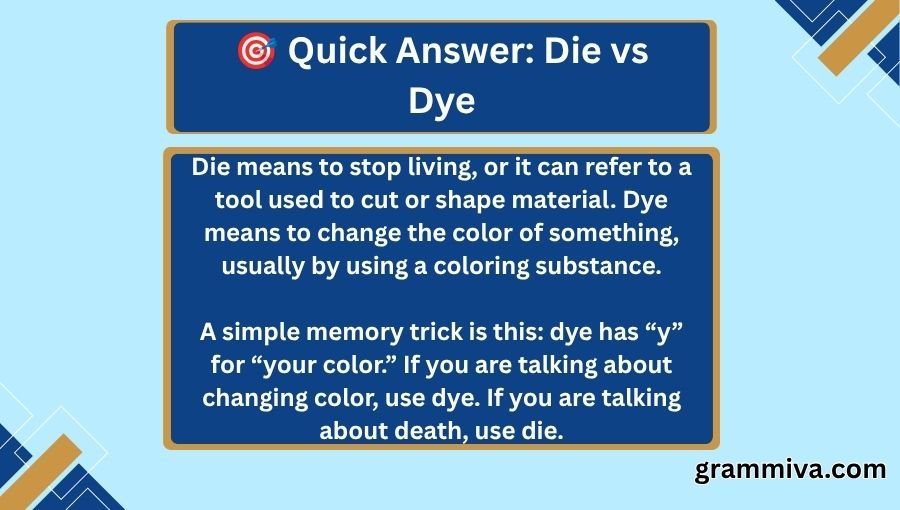
Die means to stop living, or it can refer to a tool used to cut or shape material. Dye means to change the color of something, usually by using a coloring substance.
A simple memory trick is this: dye has “y” for “your color.” If you are talking about changing color, use dye. If you are talking about death, use die.
| Word | Main Meaning | Example |
|---|---|---|
| die | To stop living | Plants may die without water. |
| dye | To change color | I want to dye my shirt blue. |
🔤 Related Word Forms of Die and Dye
The two words have several related forms, so it helps to learn their common versions together. The forms of die include dies, died, dying, and death-related uses. The forms of dye include dyes, dyed, dyeing, and dyeable in less common contexts.
| Form | Type | Example |
|---|---|---|
| die | Base verb | Some plants die in extreme heat. |
| dies | Present-tense verb | A flower dies without enough water. |
| died | Past-tense verb | The old tree died last winter. |
| dying | Present participle | The plant is dying. |
| dye | Base verb / noun | I want to dye this shirt. |
| dyes | Verb / plural noun | She dyes fabric at home. |
| dyed | Past-tense verb | He dyed his hair brown. |
| dyeing | Present participle | She is dyeing the fabric today. |
A useful spelling point is that dyeing is the form of dye. It should not be confused with dying, which comes from die.
📚 Understanding Die vs Dye
The core difference between die vs dye is meaning. Die is mainly about life ending, while dye is about changing color.
The words can sound very similar in normal speech. That is why spelling becomes especially important in writing.
| Form | Type | Meaning | Example | Correct/Incorrect |
|---|---|---|---|---|
| die | Verb | Stop living | The plant may die. | ✅ Correct |
| dye | Verb | Change color | I will dye the fabric. | ✅ Correct |
| die | Verb | Change color | I will die the fabric. | ❌ Incorrect |
| dye | Verb | Stop living | The plant will dye. | ❌ Incorrect |
| die | Noun | A tool used for shaping or cutting | The machine uses a metal die. | ✅ Correct |
What Does Die Mean?
Die is a verb that usually means to stop living. It can apply to people, animals, plants, and other living things.
For example:
The flowers will die without water.
Here, die is the verb. It tells us what may happen to the flowers.
Other examples include:
- The fish died overnight.
- Some trees die during long periods of drought.
- The bird was very sick and died.
- My houseplant almost died last summer.
Die can also have meanings outside ordinary life and death. For example, a machine may use a die, which is a tool used to cut, shape, or form material. The plural of this noun is often dies.
What Does Dye Mean?
Dye means to change the color of something by applying a coloring substance.
For example:
She wants to dye her hair red.
The word tells us that the person’s hair will have its color changed.
You can dye many things:
- hair
- fabric
- clothing
- yarn
- leather
- paper
- Easter eggs
- other materials
For example:
We dyed the white shirt blue.
The shirt did not stop living. Its color changed. Therefore, dye is the correct word.
Die vs Dye at a Glance
When you compare die vs dye, ask what action the sentence describes. If something stops living, choose die. If something changes color, choose dye.
| Word | Basic Idea | Common Example |
|---|---|---|
| die | Life ends | The plant may die. |
| dye | Color changes | We can dye the fabric. |
| dying | In the process of dying | The plant is dying. |
| dyeing | In the process of changing color | She is dyeing her shirt. |
🎯 How Can You Remember the Difference Between Die and Dye?
The easiest memory trick is to connect the Y in dye with your color.
Think:
DYE = change your color.
For example:
I want to dye my hair.
If the sentence has nothing to do with color, dye probably does not belong there.
Another trick is to remember:
DIE = life ends.
The plant will die without water.
DYE = color changes.
The artist will dye the fabric.
This quick test works well because it focuses on meaning instead of spelling.
💡 Test Tip
Replace the word mentally with one of these phrases:
- “stop living” → die
- “change the color” → dye
Try it with this sentence:
The leaves will ___ in the winter.
“The leaves will stop living in the winter.” The sentence makes sense, so die is correct.
Now try:
I want to ___ my jacket black.
“I want to change the color of my jacket black.” The intended meaning is clear, so dye is correct.
✍️ Correct Meanings and Uses of Die
The most common use of die is as a verb meaning to stop living.
Die as a Verb
Use die when the subject is no longer alive or is expected to stop living.
Examples:
Sadly, the old dog died last year.
Some flowers die quickly in extreme heat.
The fish may die if the water becomes too warm.
The form changes with tense:
- Present: die
- Third-person singular: dies
- Past: died
- Continuous: dying
Notice the spelling of dying. It has no extra “e.”
Die as a Noun
Die can also be a noun. In manufacturing, printing, metalwork, and other technical settings, a die is a tool used to cut, shape, press, or form material.
For example:
The factory replaced the damaged die.
This meaning is less common in everyday conversation, but it is completely correct.
There is also a traditional board-game meaning. A single cube used in games such as dice games can be called a die.
| Meaning | Word Type | Example Sentence |
|---|---|---|
| Stop living | Verb | The plant may die. |
| Stop functioning, in some uses | Verb | The battery may die soon. |
| Cutting or shaping tool | Noun | The machine needs a new die. |
| Single game cube | Noun | He rolled one die. |
🎨 Correct Meanings and Uses of Dye
Use dye when something is given a new color.
Dye as a Verb
The most common use is as a verb.
I plan to dye my hair.
They dyed the fabric green.
She is dyeing the yarn today.
The object receives the new color.
A helpful sentence pattern is:
Subject + dye + object + color
For example:
Maria dyed her dress purple.
Maria is the subject. Dyed is the verb. Her dress is the object. Purple describes the new color.
Dye as a Noun
Dye can also mean the substance used to give something color.
The artist mixed the dye carefully.
Here, dye is not an action. It is the coloring substance itself.
| Meaning | Word Type | Example Sentence |
|---|---|---|
| Change the color | Verb | They will dye the cloth. |
| Coloring substance | Noun | The dye turned the cloth red. |
| Change hair color | Verb | She dyed her hair blonde. |
📝 Case Study: A Workplace Email
I once edited a short workplace email in which an employee wrote, “We will die the fabric before shipping.” The writer clearly meant that the factory would change the fabric’s color. The sentence sounded alarming because die suggested that the fabric was going to stop living.
The corrected sentence was:
“We will dye the fabric before shipping.” ✅
That tiny spelling change made the message clear and professional.
This is a good example of why die vs dye is more than a spelling issue. A single letter can change the meaning of an entire sentence.
Imagine a clothing company sending this message to a customer:
“We can die your shirt blue.”
That looks like a serious mistake.
The correct version is:
“We can dye your shirt blue.” ✅
Grammar Rules Explanation
The grammar rule is based on meaning and word function.
Use die when you mean that a living thing stops living. Use dye when you mean that something receives a different color.
Both words can function as verbs, but they describe different actions.
The form dying means that someone or something is in the process of dying:
The plant is dying.
The form dyeing means that someone is in the process of changing an object’s color:
She is dyeing the fabric.
Most standard English reference sources and dictionaries make this same basic distinction.
Correct vs Incorrect at a Glance
| Sentence | Correct/Incorrect | Why |
|---|---|---|
| The flowers will die without water. | ✅ Correct | The flowers may stop living. |
| She wants to dye her hair. | ✅ Correct | She wants to change its color. |
| I will die my shirt red. | ❌ Incorrect | The intended word is dye. |
| The plant will dye without water. | ❌ Incorrect | The intended word is die. |
| They dyed the fabric blue. | ✅ Correct | The fabric received a new color. |
The important point is that neither spelling is simply “the correct one.” The correct choice depends on what you mean.
⚠️ Common Mistakes With Die and Dye
People confuse die vs dye because the words look and sound similar. Fast typing is one major reason. Autocorrect can also make the problem worse if a writer does not notice the suggested spelling.
I once caught myself typing “dying” when I meant “dyeing” in a note about a fabric project. I noticed it because the sentence suddenly sounded as if the fabric were in trouble. That small mistake reminded me how useful the meaning test can be.
Other common reasons include:
- fast typing
- autocorrect
- weak spelling habits
- lack of knowledge
- confusing similar-sounding words
- writing without proofreading
- relying too heavily on spell-check
Similar Grammar Confusions
The problem is not unique to die vs dye. English has many word pairs that look or sound alike but have different meanings.
| Confusion | Correct Difference | Example |
|---|---|---|
| its / it’s | Possession vs. “it is” | The dog hurt its paw. |
| your / you’re | Possession vs. “you are” | You’re holding your bag. |
| their / they’re | Possession vs. “they are” | They’re in their car. |
| to / too | Direction/infinitive vs. also/excess | I want to go too. |
| there / their | Place vs. possession | Their house is over there. |
| then / than | Time/order vs. comparison | She is taller than me. |
The solution is the same: focus on meaning instead of relying only on how a word sounds.
Common Wrong Forms for Die and Dye
| Wrong Form | What’s Wrong | Correct Form |
|---|---|---|
| die your hair | Uses the death-related verb for color | dye your hair |
| dye without water | Uses the color word for death | die without water |
| dieing | Incorrect spelling of the continuous form of die | dying |
| dyeing for death | Means changing color, not dying | dying |
| died my shirt | Past form of die has the wrong meaning | dyed my shirt |
| dyed last year for a person | Suggests color change instead of death | died last year |
Is Die the Same as Dye?
No. Die and dye are different words with different meanings.
Die generally means to stop living. Dye means to change the color of something or refers to the coloring substance used for that purpose.
| Word | Meaning | Example |
|---|---|---|
| die | Stop living | The plant died. |
| dye | Change color | She dyed the fabric. |
Why Do People Confuse Die and Dye?
People confuse these words mainly because they are pronounced similarly and differ by only one letter. The meanings are completely different, but quick speech does not always make that difference obvious.
A student once wrote, “My grandmother will dye next week” in a class exercise. He meant die, but he had focused on the sound rather than the meaning. We changed the sentence to “My grandmother will die someday” and then practiced a few color examples with dye.
The lesson was simple: when two words sound alike, ask what the sentence means.
Die vs Dye in Everyday Conversation
In casual speech, listeners can often understand the intended word from context. In writing, however, the spelling must show the meaning clearly.
| Context | Which Term to Use | Example |
|---|---|---|
| Everyday conversation | die | Plants can die without water. |
| Everyday conversation | dye | I want to dye my hair. |
| Professional writing | die | The company reported that several plants died. |
| Professional writing | dye | The company will dye the material before delivery. |
| Creative writing | die | The leaves slowly began to die. |
| Creative writing | dye | She used red dye on the cloth. |
| Social media/texting | die | My flowers are dying! |
| Social media/texting | dye | Should I dye my hair pink? |
How Do Die and Dye Work in Professional Writing?
In professional writing, the correct spelling matters because readers may not have enough context to guess what you mean.
Consider these examples:
“The company will die the material before delivery.” ❌
A reader may pause because the sentence is nonsensical.
The better version is:
“The company will dye the material before delivery.” ✅
A professional document should not make readers stop to decode an obvious spelling error.
This matters in:
- business emails
- product descriptions
- manufacturing instructions
- resumes
- reports
- school assignments
- websites
- marketing copy
Common Phrases With Die
Die appears in many common expressions and phrases.
| Phrase | Meaning |
|---|---|
| die laughing | Laugh extremely hard |
| die of laughter | Laugh very hard |
| die young | Stop living at a young age |
| die out | Gradually disappear |
| die down | Become weaker or quieter |
| die hard | Be difficult to stop or eliminate |
Some of these phrases are figurative. For example, if someone says, “I nearly died laughing,” they usually mean they laughed extremely hard, not that they literally stopped living.
Common Phrases With Dye
Dye is most often used in phrases related to changing color.
| Phrase | Meaning |
|---|---|
| dye your hair | Change your hair color |
| fabric dye | Coloring material for fabric |
| hair dye | Product used to change hair color |
| food dye | Coloring used in food |
| natural dye | Coloring made from natural sources |
| dye the fabric | Add color to fabric |
These phrases all involve color, which makes them easy to connect with dye.
What Is the Difference Between Dying and Dyeing?
Dying means being in the process of dying. Dyeing means being in the process of changing color.
This is one of the most important spelling differences to learn.
Compare:
The plant is dying. ✅
The plant is losing its life.
She is dyeing the fabric. ✅
She is changing the fabric’s color.
| Word | Base Word | Meaning | Example |
|---|---|---|---|
| dying | die | In the process of dying | The tree is dying. |
| dyeing | dye | In the process of changing color | He is dyeing the shirt. |
A quick visual clue is the extra e in dyeing. The word keeps the “e” from dye.
Synonyms and Alternatives
Sometimes you can replace die or dye with another word. The best alternative depends on the exact meaning.
| Alternative | Works When | Does Not Work When |
|---|---|---|
| pass away | Referring politely to a person’s death | Talking about color |
| perish | Referring to death in formal or literary writing | Referring to hair or fabric color |
| expire | Referring to a person’s death in certain formal contexts | Referring to changing color |
| color | Referring to adding or changing color | Referring to death |
| tint | Referring to giving something a slight color | Referring to death or a strong color change |
For example, color can sometimes replace dye:
We will color the fabric blue.
That sentence can work, although dye may be more precise when the process involves dye.
Why Does Getting Die and Dye Right Matter?
Correct spelling improves clarity. It also helps your writing look careful and professional.
Imagine reading this in a client email:
“We can dye the damaged product.”
That sentence suggests the product will receive a new color.
Now imagine:
“We can die the damaged product.”
The meaning becomes confusing because die does not describe the intended color process.
As a writer, I use a simple rule: if one letter can change the meaning, I slow down and check the word.
“Clear words make clear messages.”
| Situation | Why Getting It Right Matters |
|---|---|
| Resume | Shows careful writing skills |
| Client email | Prevents confusion |
| Published content | Protects credibility |
| Social post | Makes the message easier to understand |
Correct spelling is not just about following rules. It helps readers understand your exact meaning.
How Can You Avoid Confusing Die and Dye?
The best approach is to build a quick mental connection.
Remember:
Die → life ends.
Dye → color changes.
Then check the sentence.
Ask:
- Is something stopping living?
- Is something changing color?
- Am I describing the process or the result?
- Am I using dying or dyeing?
For example:
The leaves are ___.
If the leaves are losing life, choose dying.
She is ___ the curtains.
If she is changing their color, choose dyeing.
This method is faster and more reliable than trying to remember the spelling alone.
Die vs Dye Examples for Practice
Try to choose the correct word before checking the answers.
- The flowers may ___ without sunlight.
- She wants to ___ her dress green.
- The old tree ___ during the storm.
- He is ___ his hair black.
- The plant is ___ from lack of water.
- They ___ the fabric yesterday.
Answers
- die — The flowers may die without sunlight. ✅
- dye — She wants to dye her dress green. ✅
- died — The old tree died during the storm. ✅
- dyeing — He is dyeing his hair black. ✅
- dying — The plant is dying from lack of water. ✅
- dyed — They dyed the fabric yesterday. ✅
⚠️ Die vs Dye Mistakes to Watch For
Here are some especially common mistakes:
“Die My Hair”
I want to die my hair blue. ❌
The sentence is wrong because die refers to stopping life.
Correct:
I want to dye my hair blue. ✅
“Dye Without Water”
The plant will dye without water. ❌
Plants do not change color in the intended meaning. They may stop living.
Correct:
The plant will die without water. ✅
“Dieing”
The plant is dieing. ❌
The correct spelling is:
The plant is dying. ✅
“Dying Fabric”
She is dying the fabric red. ❌
If the intended meaning is changing the fabric’s color, use:
She is dyeing the fabric red. ✅
The distinction between dying and dyeing deserves special attention because both are common words.
Are Die and Dye Homophones?
They are commonly treated as homophones because they are pronounced alike in standard English speech, even though their spellings and meanings differ.
This is why you may hear the correct word but still choose the wrong spelling when writing.
Other familiar English pairs work in a similar way:
- right / write
- sea / see
- flower / flour
- hear / here
The key skill is recognizing the meaning before choosing the spelling.
Special Exceptions and Edge Cases
There is one useful edge case worth knowing: die has meanings that do not involve literal death.
For example, a battery can die:
My phone battery died.
The battery did not become a living thing and then stop living. Instead, die is being used to describe something stopping its useful function.
Likewise, die can appear in technical contexts as a noun:
The factory needs a new metal die.
This does not involve death or color. It refers to a tool used to shape or cut material.
These meanings do not change the basic rule for distinguishing die from dye.
Quick Recap Checklist ✅
Use this checklist whenever you hesitate between the two spellings.
| Question | If Yes → Use |
|---|---|
| Does something stop living? | die |
| Does something change color? | dye |
| Is someone in the process of losing life? | dying |
| Is someone changing the color of something? | dyeing |
| Is a coloring substance being discussed? | dye |
| Is a shaping or cutting tool being discussed? | die |
Three More Practice Examples
1. The grass may ___ during the drought.
Answer: die ✅
2. We want to ___ the curtains yellow.
Answer: dye ✅
3. She is ___ the yarn blue.
Answer: dyeing ✅
If you remember only one thing, remember this:
Life ends → die. Color changes → dye.
FAQs About Die vs Dye
Is die the correct word for changing hair color?
No. Use dye when you mean changing hair color.
I want to dye my hair brown. ✅
Die refers primarily to stopping life, so it is not the correct word for hair color.
Is dye the correct word for something that stops living?
No. Use die.
The plant will die without water. ✅
Dye relates to changing color.
What is the difference between dying and dyeing?
Dying means being in the process of dying. Dyeing means being in the process of changing color.
The flower is dying. ✅
She is dyeing the fabric. ✅
The extra e in dyeing helps preserve the spelling of the base word dye.
How do I remember die vs dye?
Use the memory phrase “Dye changes your color.” The y can remind you of your color.
For death, use die.
Is “I want to die my hair” correct?
No. The correct sentence is:
I want to dye my hair. ✅
The verb dye means to change the color of something.
Is “My plant is dyeing” correct?
No, not if you mean that the plant is losing its life.
The correct sentence is:
My plant is dying. ✅
Dyeing means changing color.
Is “dyed” the past tense of die?
No. Died is the past tense of die.
Dyed is the past tense of dye.
Compare:
The plant died yesterday. ✅
She dyed the fabric yesterday. ✅
Can die have meanings other than death?
Yes. Die can be used figuratively or technically. For example, a battery can “die” when it stops working, and a die can be a tool used to shape or cut material.
The intended meaning comes from context.
Is dye a noun or a verb?
It can be both.
As a verb:
They will dye the fabric.
As a noun:
The dye changed the fabric’s color.
Why are die and dye so easy to confuse?
They have similar pronunciation and nearly identical spelling. Their meanings are different, so writers must use context to choose the correct form.
The easiest test is:
Stop living = die.
Change color = dye.
Die vs Dye: Final Takeaway
Die vs dye becomes easy once you connect each word to its meaning. Die means to stop living, and it can also have a few related figurative or technical meanings. Dye means to change the color of something or refers to a coloring substance.
When you are unsure, do not focus only on how the word sounds. Ask what the sentence is trying to say. If the idea is about life ending, choose die. If the idea is about changing color, choose dye.
Also remember the two tricky forms: dying means approaching or experiencing death, while dyeing means changing color.
With a little practice, this spelling pair becomes almost automatic. The next time you hesitate, stop for one second and ask: “Is something losing life, or is something getting a new color?” 🎯
Life ends: die. Color changes: dye. Remember that simple rule, and you will almost never mix them up again. 🌟

I am Ethan Brooks, an English grammar and vocabulary writer. I work at Grammiva, where I create simple and helpful content to make English learning easier for students and everyday learners.

[…] patterns, quick tests, real examples, common mistakes, and easy ways to remember the difference. Die vs Dye | Bougie vs Boujee | onto vs on […]
[…] form does and which spelling is the safest choice, the decision becomes easy. Awhile vs a While | Die vs Dye | Bougie vs […]